Lumber Stacker
ProductOverview
A lumber stacker automates the labor-intensive task of hand-stacking lumber for air-drying or kiln-drying. Boards arrive from upstream (typically a kiln discharge or planer output) in single-file or in groups. The Board Layer picks up one board at a time and positions it on a growing stack. After each board is placed, the Sticker Placer inserts a perpendicular wooden spacer stick. Once the stack reaches a preset height, the Compression System applies pressure to compress it, and the Hoist System raises the completed stack onto a deck or conveyor for transport to storage or a kiln.
The machine is driven by a Drive Motor that powers a Hydraulic Pump, which supplies all the hydraulic actuators. A Control Panel with a PLC orchestrates the sequence: layer board, insert sticker, lift layer, repeat.
How it works
Boards arrive on a conveyor or roller system and stop at the Board Layer. The PLC in the Control Panel detects the board presence via the Layer Sensor. The Layer Cylinder (a hydraulic actuator) extends, raising the Layer Forks, which lift the board up against the Roller Guides (side positioning rollers).
Once the board is at stack height, the Layer Forks lower it slowly onto the previous layer. The Compression System is released during this lowering to allow gentle seating.
Next, the Sticker Placer is activated. The Sticker Pusher (a linear actuator) advances a sticker from the magazine horizontally across the top of the board, typically positioning it perpendicular to the board length at two or more locations across the board width. The Sticker Sensor confirms the sticker is in place.
The Layer Forks then lower and retract, ready for the next board.
Once the stack reaches a preset height (typically 20–30 boards, or 24–60 inches of total height), the Compression System is activated. Two Compression Cylinders extend, driving the Compression Plate down onto the top of the stack, applying 1,000–3,000 pounds of force. This compresses the stack and improves drying uniformity (moisture flows more evenly through compressed material).
The Hoist System then engages. The Hoist Motor drives the Lift Screw, which lifts the entire stack carriage up out of the stacking frame. Once clear, a downstream conveyor or worker removes the stack, and the hoist lowers the carriage back into stacking position, ready for a new cycle.
Typical cycle time: 30–90 seconds per stack, depending on stack height and compression dwell time.
Board layer mechanism
The Board Layer is the primary working element. It consists of two or more Layer Forks (typically forklift-style tines, 1–2 inches thick and 30–50 inches long) mounted on a carriage. The carriage rises and falls on the frame columns, driven by the Layer Cylinder (a large hydraulic cylinder).
The Roller Guides run along the outside of the columns, preventing sideways motion and keeping the board centered. As the forks rise, they lift the board from the incoming conveyor, elevating it to stack height. The forks are typically wide enough to support a board at one or two points, distributing load evenly.
Some stackers use friction rollers instead of forks; these rollers push the board horizontally onto the stack. This is common for narrow boards or when a more gentle layering action is needed.
Sticker placement
The Sticker Placer is a horizontal arm that carries spacer sticks (typically 1.5 × 1.5 inches in cross-section, as long as the board width) from a hopper. The Sticker Pusher, a linear pneumatic or hydraulic cylinder, advances the arm, sliding the sticker horizontally across the board. Typically, two or three stickers are placed per layer, evenly spaced along the board length (e.g., at 25%, 50%, and 75% of the board length for a 16-foot board).
Correct sticker positioning is critical: stickers must align vertically through all layers so that load is supported throughout the stack. Misaligned stickers can cause boards to sag and defects (warp, checking) to develop during drying.
The Sticker Sensor monitors sticker position, triggering a re-feed or alert if a sticker is misplaced.
Compression and stacking strategy
Once a stack is complete (typically 20–30 boards high, 24–60 inches tall), the Compression System applies a preset force (often 1,000–3,000 lbf) via the Compression Cylinders. This compression:
- Squeezes the stack into a compact unit for transport.
- Improves drying uniformity by forcing moisture to flow more uniformly through the stack.
- Prevents air gaps (which would allow preferential moisture loss at edges).
- Partially compresses the wood, improving final dimensional stability.
Compression is typically held for 5–30 seconds, then released. The Pressure Sensor or regulator ensures the force doesn't exceed a preset limit, which could crush the wood or damage the boards.
Hoist and ejection
Once the stack is compressed and ready, the Hoist System raises it. The Lift Screw (a large ball screw or lead screw) is driven by the Hoist Motor, lifting the Hoist Carriage (the platform holding the stack) vertically out of the stacking frame. The Hoist Brake (a spring-set brake) is typically engaged once the stack reaches the top position, preventing drift or collapse if hydraulic pressure is lost.
At the top, the stack is either manually removed by a forklift or conveyed away by a discharge conveyor. Once cleared, the hoist lowers, and the sequence begins again.
Control and automation
The Control Panel is the sequencer. The PLC monitors inputs from all sensors (board presence, sticker in place, pressure achieved, hoist position) and controls outputs (layer cylinder, sticker pusher, compression, hoist). Modern controls allow adjustment of:
- Stack height (in inches or number of boards)
- Compression force and dwell time
- Layer speed (fast vs. gentle)
- Sticker position and spacing
Fault tolerance is built in: if a sticker fails to place, an alarm sounds and the cycle halts until the issue is resolved.
Integration and workflow
In a typical mill: Log → debarker → headrig → edger/resaw → kiln discharge → Lumber Stacker → Dry storage or conditioning kiln → planer → grading/sorting → Ship.
Stackers are essential in mills processing 1,000+ board feet per day. They eliminate hand-stacking labor (which is backbreaking and slow, 20–40 boards per hour manually) and improve consistency. A typical automatic stacker processes 60–120 boards per hour, producing uniform stacks suitable for kiln loading.
Sticker quality matters: stickers must be knot-free, straight, and dimensionally uniform, or drying will be uneven. Many mills re-saw and dry their own stickers or source them from specialists.
Lumber Stacker parts and their functions
7 top-level parts · 43 parts in total · full bill of materials below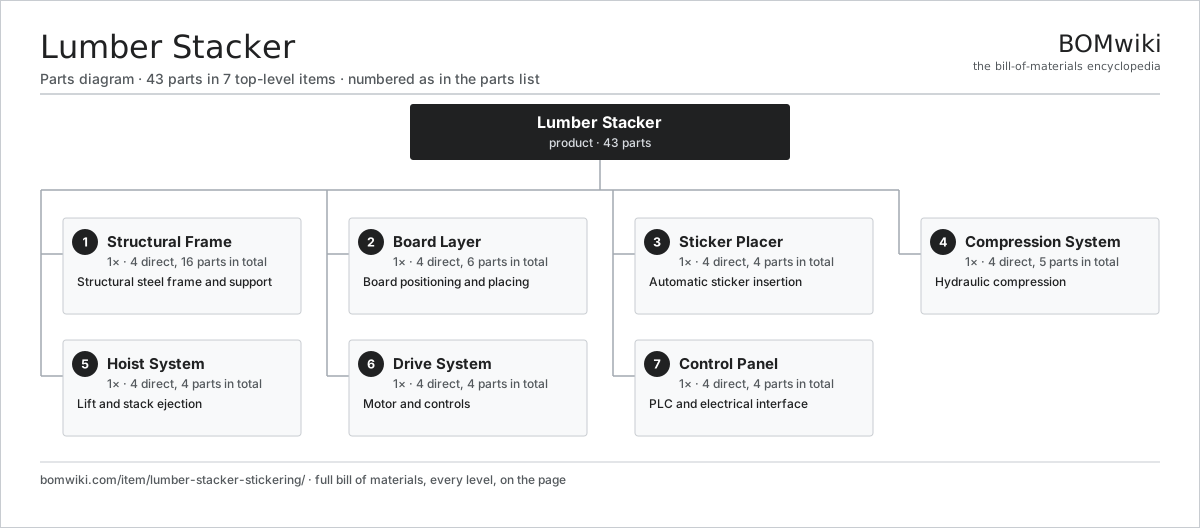
| # | Part | Qty | What it does |
|---|---|---|---|
| 1 | Structural Frame 4 parts | 1× | Structural steel frame and support |
| 2 | Board Layer 4 parts | 1× | Board positioning and placing |
| 3 | Sticker Placer 4 parts | 1× | Automatic sticker insertion |
| 4 | Compression System 4 parts | 1× | Hydraulic compression |
| 5 | Hoist System 4 parts | 1× | Lift and stack ejection |
| 6 | Drive System 4 parts | 1× | Motor and controls |
| 7 | Control Panel 4 parts | 1× | PLC and electrical interface |
3D model
No 3D model yet. Have a CAD file of this? Add a 3D model. STL renders right on this page; STEP, FreeCAD, and OpenSCAD sources are welcome too (openly licensed, like all 3D models on BOMwiki).
Build & assembly graph
expand / collapse · shared sub-assemblies converge · links to related products · est. labourTap an assembly to expand/collapse · tap a part to open it · use “Open page” for any node · drag to pan, scroll to zoom.
Bill of materials for Lumber Stacker
7 top-level lines · 35 rows shown · 43 parts total · indented to 3 levels| # | Item / sub-assembly | Part no. | Qty/assy | Ext. qty | Parts | Type |
|---|---|---|---|---|---|---|
| 1 | Structural Frame 4 parts | lumber-stacker-frame | 1× | 1 | 16 | assembly |
| 1.1 | Support Column | lumber-stacker-frame-column | 4× | 4 | · | part |
| 1.2 | Cross Beam | lumber-stacker-frame-cross-beam | 4× | 4 | · | part |
| 1.3 | Gusset Plate | lumber-stacker-frame-gusset | 6× | 6 | · | part |
| 1.4 | Fastener Set | fastener-set | 2× | 2 | · | part |
| 2 | Board Layer 4 parts | lumber-stacker-board-layer | 1× | 1 | 6 | assembly |
| 2.1 | Layer Fork | lumber-stacker-layer-fork | 2× | 2 | · | part |
| 2.2 | Layer Cylinder | lumber-stacker-layer-cylinder | 1× | 1 | · | part |
| 2.3 | Layer Sensor | lumber-stacker-layer-sensor | 1× | 1 | · | part |
| 2.4 | Roller Guide | lumber-stacker-roller-guide | 2× | 2 | · | part |
| 3 | Sticker Placer 4 parts | lumber-stacker-sticker-placer | 1× | 1 | 4 | assembly |
| 3.1 | Sticker Hopper | lumber-stacker-sticker-hopper | 1× | 1 | · | part |
| 3.2 | Sticker Arm | lumber-stacker-sticker-arm | 1× | 1 | · | part |
| 3.3 | Sticker Pusher | lumber-stacker-sticker-pusher | 1× | 1 | · | part |
| 3.4 | Sticker Sensor | lumber-stacker-sticker-sensor | 1× | 1 | · | part |
| 4 | Compression System 4 parts | lumber-stacker-compression-system | 1× | 1 | 5 | assembly |
| 4.1 | Compression Plate | lumber-stacker-compression-plate | 1× | 1 | · | part |
| 4.2 | Compression Cylinder | lumber-stacker-compression-cylinder | 2× | 2 | · | part |
| 4.3 | Pressure Regulator | lumber-stacker-pressure-control | 1× | 1 | · | part |
| 4.4 | Pressure Sensor | pressure-sensor | 1× | 1 | · | part |
| 5 | Hoist System 4 parts | lumber-stacker-hoist-system | 1× | 1 | 4 | assembly |
| 5.1 | Hoist Carriage | lumber-stacker-hoist-carriage | 1× | 1 | · | part |
| 5.2 | Lift Screw | lumber-stacker-hoist-screw | 1× | 1 | · | part |
| 5.3 | Hoist Motor | lumber-stacker-hoist-motor | 1× | 1 | · | part |
| 5.4 | Hoist Brake | lumber-stacker-hoist-brake | 1× | 1 | · | part |
| 6 | Drive System 4 parts | lumber-stacker-drive-system | 1× | 1 | 4 | assembly |
| 6.1 | Drive Motor | lumber-stacker-main-motor | 1× | 1 | · | part |
| 6.2 | Hydraulic Pump | lumber-stacker-hydraulic-pump | 1× | 1 | · | part |
| 6.3 | Hydraulic Tank | lumber-stacker-hydraulic-tank | 1× | 1 | · | part |
| 6.4 | Hydraulic Filter | lumber-stacker-filter | 1× | 1 | · | part |
| 7 | Control Panel 4 parts | lumber-stacker-control-panel | 1× | 1 | 4 | assembly |
| 7.1 | Microcontroller | mcu | 1× | 1 | · | part |
| 7.2 | Bare PCB | pcb-bare | 1× | 1 | · | part |
| 7.3 | Input Module | lumber-stacker-input-module | 1× | 1 | · | part |
| 7.4 | Output Module | lumber-stacker-output-module | 1× | 1 | · | part |
Something wrong in this list? Report a problem with this BOM.
Sourcing: possible vendors
Browse the supplier directory → Prices, MOQ, and lead times are algorithmic estimates, not quotes, and not claims about these companies. Company mappings are curated by keyword; est. price band $5k–$2M. How estimates work| Vendor | HQ | Specialty | MOQ | Lead time |
|---|---|---|---|---|
| atlascopco.com ↗ | Stockholm, SE | Compressors & industrial | 10 units | 12–20 wks |
|
🇦🇹Andritz
andritz.com ↗
|
Graz, AT | Process plants & machinery | 10 units | 12–20 wks |
| buhlergroup.com ↗ | Uzwil, CH | Food & materials processing | 10 units | 12–20 wks |
| gea.com ↗ | Düsseldorf, DE | Process technology | 10 units | 12–20 wks |
| mhi.com ↗ | Tokyo, JP | Heavy machinery | 10 units | 12–20 wks |
1,231-word article