Marine Radar
ProductOverview
Marine radar is the primary collision-avoidance and pilotage sensor on vessels from sport-fishing boats to ULCCs. It measures the range and bearing of targets, ships, buoys, coastline, rain, by timing microwave echoes and noting where the antenna pointed when each echo returned. Small-craft units operate in X band around 9.4 GHz, where a compact antenna still achieves a narrow beam and small targets reflect well; large ships add an S-band (3 GHz) set for better rain penetration.
This unit is the modern solid-state type. Instead of a magnetron firing kilowatt pulses, a GaN Power Amplifier built on gallium nitride transmits long, frequency-swept chirps of only 25 W peak. Pulse compression in the receiver recovers the range resolution of a short pulse with the energy of a long one, so detection performance matches a 4 kW magnetron set while eliminating warm-up time, magnetron ageing, and most of the radiation hazard near the antenna.
How it works
Each trigger, the Chirp Exciter synthesizes a linear-FM chirp, 80 ns for close ranges up to 18 µs offshore, which the GaN amplifier raises to 25 W. The Ferrite Circulator steers this pulse through the RF Rotary Joint into the rotating Slotted Waveguide. The array's milled slots form a fan beam 1.8° wide in azimuth and 22° tall; the width sets how well two adjacent targets are separated in bearing, while the generous height keeps the beam on the horizon as the vessel rolls.
Returning echoes re-enter the same waveguide and the circulator routes them to the receiver, where the Receiver Protector / Limiter protects the Low-Noise Amplifier from transmit leakage. After the Receive Downconverter shifts the signal to IF, the High-Speed ADC digitises it and the Radar FPGA applies the matched filter: correlating the received chirp against the transmitted one compresses an 18 µs pulse to an effective ~30 ns, giving roughly 5 m range resolution. The FPGA also runs constant-false-alarm-rate thresholds and the sea and rain clutter filters, and because the chirped waveform preserves phase, it extracts Doppler: echoes from closing targets are colour-coded differently from opening ones, an immediate visual collision cue.
Bearing comes from the Pedestal & Rotation Drive. The Scanner Drive Motor spins the Antenna Turntable at 24 rpm (48 rpm on short ranges for faster updates) through a final Helical Gear Pair, while the Encoder reports azimuth continuously and the Heading-Line Sensor pulses as the beam sweeps past the bow, anchoring the picture to the vessel's heading.
Display and tracking
The Signal Processor Board's Compute SoC Module assembles compressed, filtered echoes into the familiar PPI picture and streams it as Ethernet packets down the Scanner Interconnect Cable to the Display Unit. The 12-inch LCD Panel runs about 1200 nits for sunlight viewing, with a Touch Digitizer for chart work and the Keypad & Rotary Control rotary knob for gain and range when spray makes touch unreliable. The tracker maintains up to 50 ARPA targets, computing each one's course, speed, closest point of approach (CPA), and time to CPA from successive plots; CPA violations and guard-zone intrusions sound through the Speaker. Radar video can be overlaid on the electronic chart, with heading input from the vessel's compass aligning the two.
Installation
The pedestal mounts on the Mast Mounting Platform high enough to clear crew sightlines and extend the radar horizon, which scales with the square root of antenna height, at 5 m the horizon for a surface target is roughly 8 nm. The Pedestal Casting seals the drive and Transceiver Module to IPX6 against green water and driving spray, and the Scanner Power Module with its EMI Input Filter keeps switching hash off the vessel's DC bus, where it would otherwise leak into VHF and AIS receivers. Total draw while transmitting is near 35 W, modest enough for sailing yachts to run radar continuously at night.
Operating considerations
Solid-state sets transmit on the instant, no three-minute magnetron warm-up, and their low peak power makes the mandated safe-distance circle around the open array a matter of centimetres rather than metres, though crew are still kept clear of the rotating antenna. Routine maintenance is limited to washing salt off the Array Fairing, checking the RF Rotary Joint and azimuth bearings at refit, and confirming heading-line alignment, since a misaligned heading pulse skews every bearing the radar reports.
Marine Radar parts and their functions
7 top-level parts · 54 parts in total · full bill of materials below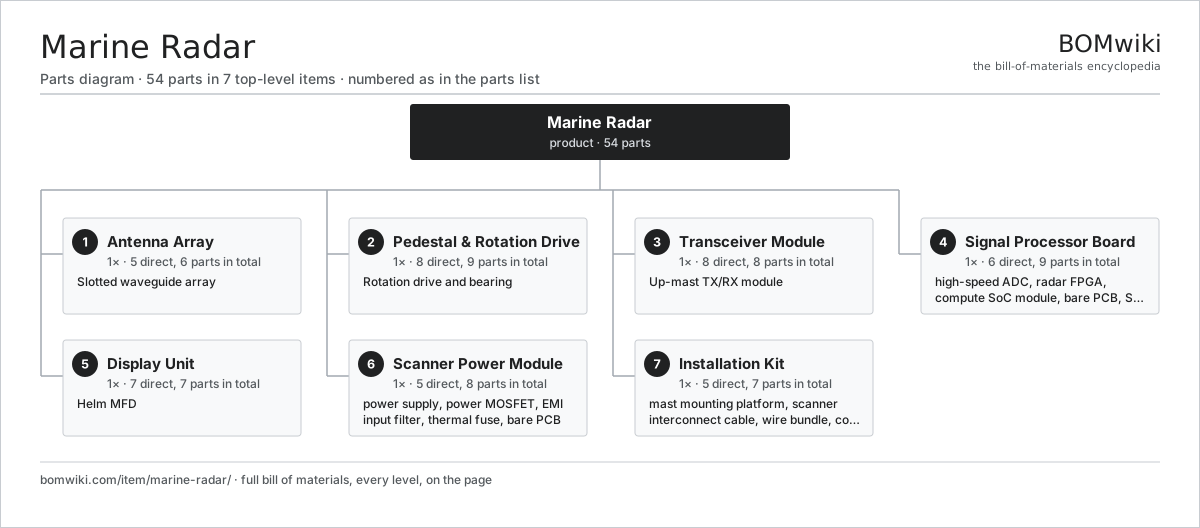
| # | Part | Qty | What it does |
|---|---|---|---|
| 1 | Antenna Array 5 parts | 1× | Slotted waveguide array |
| 2 | Pedestal & Rotation Drive 8 parts | 1× | Rotation drive and bearing |
| 3 | Transceiver Module 8 parts | 1× | Up-mast TX/RX module |
| 4 | Signal Processor Board 6 parts | 1× | Digital board that pulse-compresses echoes, applies Doppler and clutter processing, and tracks targets. |
| 5 | Display Unit 7 parts | 1× | Helm MFD |
| 6 | Scanner Power Module 5 parts | 1× | Up-mast supply that converts vessel 12/24 V DC into the rails for the transmitter, drive motor, and processor. |
| 7 | Installation Kit 5 parts | 1× | Mast mount, interconnect cable, and hardware connecting the scanner to the helm. |
3D model
No 3D model yet. Have a CAD file of this? Add a 3D model. STL renders right on this page; STEP, FreeCAD, and OpenSCAD sources are welcome too (openly licensed, like all 3D models on BOMwiki).
Build & assembly graph
expand / collapse · shared sub-assemblies converge · links to related products · est. labourTap an assembly to expand/collapse · tap a part to open it · use “Open page” for any node · drag to pan, scroll to zoom.
Bill of materials for Marine Radar
7 top-level lines · 51 rows shown · 54 parts total · indented to 3 levels| # | Item / sub-assembly | Part no. | Qty/assy | Ext. qty | Parts | Type |
|---|---|---|---|---|---|---|
| 1 | Antenna Array 5 parts | marine-radar-antenna-array | 1× | 1 | 6 | assembly |
| 1.1 | Slotted Waveguide | marine-radar-slotted-waveguide | 1× | 1 | · | part |
| 1.2 | Array Fairing | marine-radar-array-fairing | 1× | 1 | · | part |
| 1.3 | Array End Cap | marine-radar-end-cap | 2× | 2 | · | part |
| 1.4 | RF Rotary Joint | marine-radar-rotary-joint | 1× | 1 | · | part |
| 1.5 | Fastener Set | fastener-set | 1× | 1 | · | part |
| 2 | Pedestal & Rotation Drive 8 parts | marine-radar-pedestal | 1× | 1 | 9 | assembly |
| 2.1 | Scanner Drive Motor | marine-radar-scanner-motor | 1× | 1 | · | part |
| 2.2 | Helical Gear Pair | gear-pair | 1× | 1 | · | part |
| 2.3 | Antenna Turntable | marine-radar-turntable | 1× | 1 | · | part |
| 2.4 | Ball Bearing | ball-bearing | 2× | 2 | · | part |
| 2.5 | Encoder | encoder | 1× | 1 | · | part |
| 2.6 | Heading-Line Sensor | marine-radar-heading-sensor | 1× | 1 | · | part |
| 2.7 | Oil Seal | oil-seal | 1× | 1 | · | part |
| 2.8 | Pedestal Casting | marine-radar-pedestal-casting | 1× | 1 | · | part |
| 3 | Transceiver Module 8 parts | marine-radar-transceiver | 1× | 1 | 8 | assembly |
| 3.1 | GaN Power Amplifier | marine-radar-power-amplifier | 1× | 1 | · | part |
| 3.2 | Chirp Exciter | marine-radar-exciter | 1× | 1 | · | part |
| 3.3 | Ferrite Circulator | marine-radar-circulator | 1× | 1 | · | part |
| 3.4 | Receiver Protector / Limiter | marine-radar-limiter | 1× | 1 | · | part |
| 3.5 | Low-Noise Amplifier | marine-radar-lna | 1× | 1 | · | part |
| 3.6 | Receive Downconverter | marine-radar-rx-downconverter | 1× | 1 | · | part |
| 3.7 | Bare PCB | pcb-bare | 1× | 1 | · | part |
| 3.8 | SMD Passive (R/C/L) | smd-passives | 1× | 1 | · | part |
| 4 | Signal Processor Board 6 parts | marine-radar-processor-board | 1× | 1 | 9 | assembly |
| 4.1 | High-Speed ADC | marine-radar-adc | 1× | 1 | · | part |
| 4.2 | Radar FPGA | marine-radar-fpga | 1× | 1 | · | part |
| 4.3 | Compute SoC Module | soc-module | 1× | 1 | · | part |
| 4.4 | Bare PCB | pcb-bare | 1× | 1 | · | part |
| 4.5 | SMD Passive (R/C/L) | smd-passives | 1× | 1 | · | part |
| 4.6 | Connector | connector | 4× | 4 | · | part |
| 5 | Display Unit 7 parts | marine-radar-display-unit | 1× | 1 | 7 | assembly |
| 5.1 | LCD Panel | lcd-panel | 1× | 1 | · | part |
| 5.2 | Touch Digitizer | touch-digitizer | 1× | 1 | · | part |
| 5.3 | Compute SoC Module | soc-module | 1× | 1 | · | part |
| 5.4 | Display Housing | marine-radar-display-housing | 1× | 1 | · | part |
| 5.5 | Keypad & Rotary Control | marine-radar-keypad | 1× | 1 | · | part |
| 5.6 | Speaker | speaker | 1× | 1 | · | part |
| 5.7 | Power Supply | power-supply | 1× | 1 | · | part |
| 6 | Scanner Power Module 5 parts | marine-radar-power-module | 1× | 1 | 8 | assembly |
| 6.1 | Power Supply | power-supply | 1× | 1 | · | part |
| 6.2 | Power MOSFET | mosfet | 4× | 4 | · | part |
| 6.3 | EMI Input Filter | marine-radar-emi-filter | 1× | 1 | · | part |
| 6.4 | Thermal Fuse | thermal-fuse | 1× | 1 | · | part |
| 6.5 | Bare PCB | pcb-bare | 1× | 1 | · | part |
| 7 | Installation Kit 5 parts | marine-radar-installation-kit | 1× | 1 | 7 | assembly |
| 7.1 | Mast Mounting Platform | marine-radar-mast-mount | 1× | 1 | · | part |
| 7.2 | Scanner Interconnect Cable | marine-radar-scanner-cable | 1× | 1 | · | part |
| 7.3 | Wire Bundle | wire-bundle | 1× | 1 | · | part |
| 7.4 | Connector | connector | 3× | 3 | · | part |
| 7.5 | Fastener Set | fastener-set | 1× | 1 | · | part |
Something wrong in this list? Report a problem with this BOM.
Related products
same domain, ranked by shared parts Marine VHF Radio
46 parts · shares 4 with this page
Marine VHF Radio
46 parts · shares 4 with this page
 Cruise Ship
2,306,635 parts · shares 6 with this page
Cruise Ship
2,306,635 parts · shares 6 with this page
 Work-Class ROV
155 parts · shares 6 with this page
Marine Capstan
46 parts · shares 4 with this page
Work-Class ROV
155 parts · shares 6 with this page
Marine Capstan
46 parts · shares 4 with this page
 Crewed Submersible
2,830 parts · shares 9 with this page
Crewed Submersible
2,830 parts · shares 9 with this page
Sourcing: possible vendors
Browse the supplier directory → Prices, MOQ, and lead times are algorithmic estimates, not quotes, and not claims about these companies. Company mappings are curated by keyword; est. price band $2k–$500M. How estimates work| Vendor | HQ | Specialty | MOQ | Lead time |
|---|---|---|---|---|
| hd.com ↗ | Ulsan, KR | Shipbuilder | made to order | 52–104 wks |
| fincantieri.com ↗ | Trieste, IT | Shipbuilder | made to order | 52–104 wks |
| damen.com ↗ | Gorinchem, NL | Shipbuilder | made to order | 52–104 wks |
| brunswick.com ↗ | Mettawa, US | Marine & boats | made to order | 52–104 wks |
|
🇨🇳CSSC
cssc.net.cn ↗
|
Shanghai, CN | Shipbuilding conglomerate | made to order | 52–104 wks |
767-word article