Marine VHF Radio
ProductOverview
A marine VHF radio is the primary communication device on any ocean-going vessel, transmitting and receiving voice over the VHF marine band (156–162 MHz) and handling emergency distress notifications through Digital Selective Calling (DSC). Vessels are required by international law (SOLAS) to maintain continuous watch on Channel 16 (156.8 MHz), the international maritime distress and calling frequency. When a ship is in danger and cannot reach rescue by radio alone, the captain uses the DSC function to broadcast an automated digital distress alert containing the vessel's position, vessel identification (MMSI), and nature of the emergency to all ships within radio range and to the nearest maritime rescue coordination center. Unlike voice distress calls, DSC operates in just 1–2 seconds and does not require the shore station to be monitoring voice, it arrives as a structured data packet that prints on the emergency console.
The radio is typically mounted on the bridge near the helm and consists of several parts: a transceiver module with a 25 W power amplifier and high-sensitivity receiver, a DSC processor running distress protocols, a handheld microphone with integrated speaker for crew communication, an external antenna above deck for line-of-sight range, and a GPS receiver that provides the vessel's position to include in distress transmissions. The control panel on the radio front face allows the operator to select channels, adjust volume, initiate DSC calls, and monitor signal strength.
How it works
The VHF Transceiver Module is a direct-conversion or superheterodyne receiver/transmitter covering the 156–162 MHz marine band. On receive, the low-noise preamplifier captures the weak RF signal from the antenna (often −110 dBm or weaker), amplifies it by 20–30 dB, and passes it to a mixer. The frequency synthesizer is a phase-locked loop tuned to the selected channel; its output is mixed with the RF input to produce an intermediate frequency. The IF is filtered, amplified, and demodulated to recover the audio and any data signals (like DSC packets at 1200 baud). Audio is sent to the speaker amplifier, which drives 1–2 W into the integrated speaker in the handset.
On transmit, the crew speaks into the microphone, and the analog audio is passed through a preamp and limiter to protect the transmitter from overdrive. This audio is frequency-modulated onto the carrier (from the synthesizer) with ±5 kHz deviation, meeting the narrow-band FM standard. The modulated signal is sent to the RF power amplifier, which stages the signal from low power (milliwatts) to 1 W or 25 W depending on the power setting selected on the control panel. The amplified RF is passed through the transmit/receive duplexer (a circulator that isolates the transmitter from the sensitive receiver) and into the antenna, where the RF is radiated.
The DSC processor runs in parallel with the transceiver and handles the Digital Selective Calling protocol defined by ITU-R M.493. When the captain activates the Distress button on the control panel, the DSC processor triggers an automatic sequence: it queries the integrated GPS receiver for the vessel's current latitude and longitude, reads the pre-programmed MMSI (Maritime Mobile Service Identity) number from memory, and assembles a digital distress message packet. The 1200 baud FSK modem encodes this packet as audio tones (800 Hz and 1600 Hz) that sound like chirping, this audio is patched to the transceiver and transmitted on VHF Channel 70 (156.525 MHz), which is the international DSC calling frequency monitored by all modern radios and coast guard stations.
The DSC alert is a 120-bit packet containing the vessel's MMSI, position (latitude/longitude), time of distress, and type of emergency (sinking, fire, medical, engine failure, etc.). Within 2–3 seconds, the alert is received by all ships within VHF radio range (typically 20–40 nm depending on antenna height) and by shore stations via their DSC receivers. When a rescue vessel receives the DSC distress alert, its radio automatically triggers an alarm, prints the distress details on the screen, and switches to the corresponding voice channel so the crews can begin verbal coordination of the rescue.
Distance and coverage in VHF are governed by line-of-sight propagation. The range formula is roughly √(height in feet of antenna) × 1.2 nautical miles per side. A ship with a 30 m (100 ft) antenna above the water can transmit and receive about 12 nm away from a shore station with the same antenna height. Coastal merchant vessels carry VHF, but ships operating thousands of miles offshore also require HF (high frequency) radio and INMARSAT satellite communication for long-range distress calling, since VHF only works within horizon range.
Marine band and channel structure
The marine VHF band is divided into 74 channels, each 25 kHz wide, covering 156.000–162.025 MHz. Channel 16 (156.800 MHz) is the international distress and calling frequency; vessels maintain continuous watch there and only move to a working channel after establishing contact. Channels 70–72 are dedicated to DSC distress and radio-telephone calls. Working channels include duplex pairs where a vessel transmits on one frequency and receives on another (with a 5-channel separation to allow simultaneous operation), and simplex channels where transmission and reception use the same frequency. Common working channels include Channel 06 (inter-ship navigation), Channel 12 (port operations), and Channel 09 (bridge-to-bridge). Modern AIS (Automatic Identification System) transponders also operate in the VHF band, transmitting position and identity on channels 87A and 87B (each carries ~2250 baud GMSK data), separate from the voice channels.
The control panel allows the operator to select channels, scan for activity, and manually override to a distress frequency. A rotary channel knob or numeric keypad is used to dial channels. The display shows the current channel number, transmitted power level (high/low), and any incoming DSC alerts. A dedicated red Distress button with a flip-cover guard on most modern radios initiates the DSC distress sequence, and a separate Scan button allows the operator to automatically step through channels to find a clear frequency for inter-ship communication.
Integration and safety
Ship radios are certified under IMO SOLAS Chapter III (Life-Saving Appliances) and must meet ITU-R M.493 (DSC) and IMO Performance Standard MSC.74(69) (Bridge Navigation Watch Alarm System, BNWAS) integration requirements. The radio must remain powered and operational from the ship's main electrical system and a battery backup system during an emergency. Redundancy is achieved by installing two independent radios on large vessels (one primary, one backup) fed from separate battery banks. The power supply module receives 24 V or 230 V AC ship power and converts it to a regulated 13.8 V DC bus; a fuse protects against short circuits, and a noise filter suppresses alternator ripple.
Marine VHF Radio parts and their functions
8 top-level parts · 46 parts in total · full bill of materials below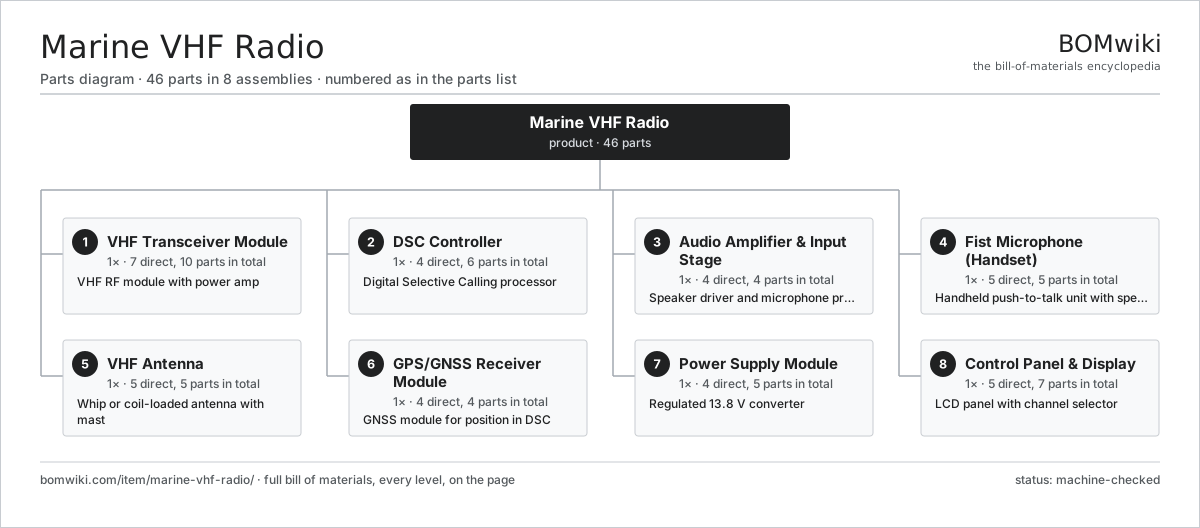
| # | Part | Qty | What it does |
|---|---|---|---|
| 1 | VHF Transceiver Module 7 parts | 1× | VHF RF module with power amp |
| 2 | DSC Controller 4 parts | 1× | Digital Selective Calling processor |
| 3 | Audio Amplifier & Input Stage 4 parts | 1× | Speaker driver and microphone preamp |
| 4 | Fist Microphone (Handset) 5 parts | 1× | Handheld push-to-talk unit with speaker |
| 5 | VHF Antenna 5 parts | 1× | Whip or coil-loaded antenna with mast |
| 6 | GPS/GNSS Receiver Module 4 parts | 1× | GNSS module for position in DSC |
| 7 | Power Supply Module 4 parts | 1× | Regulated 13.8 V converter |
| 8 | Control Panel & Display 5 parts | 1× | LCD panel with channel selector |
3D model
No 3D model yet. Have a CAD file of this? Add a 3D model — STL renders right on this page; STEP, FreeCAD, and OpenSCAD sources are welcome too (openly licensed, like all 3D models on BOMwiki).
Build & assembly graph
expand / collapse · shared sub-assemblies converge · links to related products · est. labourTap an assembly to expand/collapse · tap a part to open it · use “Open page” for any node · drag to pan, scroll to zoom.
Bill of materials for Marine VHF Radio
8 top-level lines · 46 rows shown · 46 parts total · indented to 3 levels| # | Item / sub-assembly | Part no. | Qty/assy | Ext. qty | Parts | Type |
|---|---|---|---|---|---|---|
| 1 | VHF Transceiver Module 7 parts | marine-vhf-radio-transceiver | 1× | 1 | 10 | assembly |
| 1.1 | Receiver Front End | marine-vhf-radio-receiver-frontend | 1× | 1 | · | part |
| 1.2 | Transmitter Driver | marine-vhf-radio-transmitter-driver | 1× | 1 | · | part |
| 1.3 | Frequency Synthesizer | marine-vhf-radio-oscillator | 1× | 1 | · | part |
| 1.4 | Filter Bank | marine-vhf-radio-filter-bank | 1× | 1 | · | part |
| 1.5 | Duplexer | marine-vhf-radio-duplexer | 1× | 1 | · | part |
| 1.6 | Power MOSFET | mosfet | 4× | 4 | · | part |
| 1.7 | Bare PCB | pcb-bare | 1× | 1 | · | part |
| 2 | DSC Controller 4 parts | marine-vhf-radio-dsc-controller | 1× | 1 | 6 | assembly |
| 2.1 | DSC Processor | marine-vhf-radio-dsc-processor | 1× | 1 | · | part |
| 2.2 | DSC Modem | marine-vhf-radio-dsc-modem | 1× | 1 | · | part |
| 2.3 | DSC Memory | marine-vhf-radio-memory-dsc | 1× | 1 | · | part |
| 2.4 | Connector | connector | 3× | 3 | · | part |
| 3 | Audio Amplifier & Input Stage 4 parts | marine-vhf-radio-audio-amplifier | 1× | 1 | 4 | assembly |
| 3.1 | Speaker Amplifier IC | marine-vhf-radio-audio-amp-ic | 1× | 1 | · | part |
| 3.2 | Microphone Preamp | marine-vhf-radio-mic-preamp | 1× | 1 | · | part |
| 3.3 | Volume Potentiometer | marine-vhf-radio-volume-pot | 1× | 1 | · | part |
| 3.4 | Speaker | speaker | 1× | 1 | · | part |
| 4 | Fist Microphone (Handset) 5 parts | marine-vhf-radio-fist-microphone | 1× | 1 | 5 | assembly |
| 4.1 | Microphone Element | marine-vhf-radio-mic-element | 1× | 1 | · | part |
| 4.2 | Push-to-Talk Switch | marine-vhf-radio-ptt-switch | 1× | 1 | · | part |
| 4.3 | Microphone Speaker | marine-vhf-radio-mic-speaker | 1× | 1 | · | part |
| 4.4 | Coiled Cable | marine-vhf-radio-coiled-cable | 1× | 1 | · | part |
| 4.5 | Connector | connector | 1× | 1 | · | part |
| 5 | VHF Antenna 5 parts | marine-vhf-radio-antenna | 1× | 1 | 5 | assembly |
| 5.1 | Antenna Element | marine-vhf-radio-antenna-element | 1× | 1 | · | part |
| 5.2 | Antenna Mast | marine-vhf-radio-antenna-mast | 1× | 1 | · | part |
| 5.3 | Antenna Mount | marine-vhf-radio-antenna-mount | 1× | 1 | · | part |
| 5.4 | Antenna Cable | marine-vhf-radio-antenna-cable | 1× | 1 | · | part |
| 5.5 | Fastener Set | fastener-set | 1× | 1 | · | part |
| 6 | GPS/GNSS Receiver Module 4 parts | marine-vhf-radio-gps-receiver | 1× | 1 | 4 | assembly |
| 6.1 | GNSS SoC | marine-vhf-radio-gps-chip | 1× | 1 | · | part |
| 6.2 | GPS Antenna | marine-vhf-radio-gps-antenna | 1× | 1 | · | part |
| 6.3 | Reference Oscillator | marine-vhf-radio-gps-oscillator | 1× | 1 | · | part |
| 6.4 | Connector | connector | 1× | 1 | · | part |
| 7 | Power Supply Module 4 parts | marine-vhf-radio-power-supply | 1× | 1 | 5 | assembly |
| 7.1 | DC Converter | marine-vhf-radio-converter | 1× | 1 | · | part |
| 7.2 | Fuse Holder | marine-vhf-radio-fuse-holder | 1× | 1 | · | part |
| 7.3 | Noise Filter | marine-vhf-radio-noise-filter | 1× | 1 | · | part |
| 7.4 | Connector | connector | 2× | 2 | · | part |
| 8 | Control Panel & Display 5 parts | marine-vhf-radio-control-panel | 1× | 1 | 7 | assembly |
| 8.1 | Panel Frame | marine-vhf-radio-panel-frame | 1× | 1 | · | part |
| 8.2 | LCD Panel | lcd-panel | 1× | 1 | · | part |
| 8.3 | Channel Knob | marine-vhf-radio-channel-knob | 1× | 1 | · | part |
| 8.4 | Function Buttons | marine-vhf-radio-function-buttons | 1× | 1 | · | part |
| 8.5 | Connector | connector | 3× | 3 | · | part |
Related products
same domain, ranked by shared parts Marine Radar
54 parts · shares 4 with this page
Marine Radar
54 parts · shares 4 with this page
 Cruise Ship
2,306,635 parts · shares 3 with this page
Cruise Ship
2,306,635 parts · shares 3 with this page
 Canal Narrowboat
144 parts · shares 3 with this page
Canal Narrowboat
144 parts · shares 3 with this page
 Crewed Submersible
2,830 parts · shares 3 with this page
Crewed Submersible
2,830 parts · shares 3 with this page
 Houseboat
444 parts · shares 3 with this page
Houseboat
444 parts · shares 3 with this page
Sourcing: possible vendors
Prices, MOQ, and lead times are algorithmic estimates, not quotes, and not claims about these companies. Company mappings are curated by keyword; est. price band $2k–$500M. How estimates work| Vendor | HQ | Specialty | MOQ | Lead time |
|---|---|---|---|---|
| hd.com ↗ | Ulsan, KR | Shipbuilder | made to order | 52–104 wks |
| fincantieri.com ↗ | Trieste, IT | Shipbuilder | made to order | 52–104 wks |
| damen.com ↗ | Gorinchem, NL | Shipbuilder | made to order | 52–104 wks |
| brunswick.com ↗ | Mettawa, US | Marine & boats | made to order | 52–104 wks |
|
🇨🇳CSSC
cssc.net.cn ↗
|
Shanghai, CN | Shipbuilding conglomerate | made to order | 52–104 wks |
1,258-word article