Marker Filling Machine
ProductOverview
Marker filling machines automate the assembly of liquid-based markers by coordinating the loading of plastic barrels, metered ink dispensing via positive-displacement pumps, nib insertion, spring cartridge loading, cap placement, and optional sealing and curing. These machines achieve 100–250 markers per minute using carousel indexing and tightly synchronized pneumatic and pump operations. The critical process control points are ink volume accuracy (±5% tolerance required for consistent color saturation and marker lifespan), nib insertion force (to avoid crushing absorbent material or creating poor ink flow), and cap sealing (to prevent ink evaporation and leakage).
How It Works
Barrel Loading and Positioning
The Barrel Loading System system begins with a magazine or roll of plastic marker barrel tubes. A Barrel Lift Arm (vacuum gripper or mechanical arm) retrieves one barrel per cycle and places it onto the first position of the main Control and Synchronization carousel. A Barrel Alignment Sleeve precision sleeve aligns the barrel vertically with ±0.1 mm concentricity. An Encoder confirms barrel presence before proceeding.
Ink Metering and Dispensing
At the Ink Metering and Pump Station station, a Fill Nozzle and Solenoid nozzle lowers into the barrel opening. A Ink Metering Pump (peristaltic or gear pump) draws ink from the Ink Storage Tank and meters a precise volume (typically 5–15 mL per marker) into the barrel via solenoid-controlled valve actuation. The Encoder counts pump strokes; a Temperature Sensor monitors ink temperature, as viscosity is temperature-dependent, warm ink (25–35 °C) flows freely, while cold ink becomes too viscous for proper fill.
Pump accuracy of ±5% is critical; under-fill creates pale markers with short lifespan, while over-fill causes ink leakage around the nib and cap seams. A Pressure Sensor in the fill circuit detects blockages or pump failures.
Nib Insertion
The carousel advances to the Nib Insertion Assembly station. A Nib Magazine Cartridge holds pre-assembled marker nib units, felt or synthetic absorbent tip crimped into a plastic collar. A Nib Pick-and-Place Gripper vacuum gripper retrieves one nib and positions it above the filled barrel. A Nib Insertion Press (pneumatic, 5–20 bar) then descends, pressing the nib into the barrel opening with controlled force (typically 300–800 N). A Nib Alignment Bushing precision bushing ensures the nib seats straight and doesn't deform the barrel opening.
The Pressure Sensor monitors insertion force; excessive force can compress the absorbent material and restrict ink flow, while insufficient force leaves the nib loose and prone to ink leakage.
Spring Cartridge Loading
In multi-chambered markers (with separate ink reservoir and pressure-regulation spring), a Spring Magazine Cartridge holds pre-assembled spring cartridges. A Spring Feed Mechanism (mechanical vibration feeder or pneumatic pusher) places the spring into the barrel at the correct depth, determined by a Spring Depth stop. The spring provides back-pressure, regulating ink flow as the marker is drawn across paper.
Cap Placement and Sealing
The carousel continues to the Cap Applicator and Press station. A Cap Magazine Roll (roll or stack) holds plastic caps. A Cap Retrieval Arm retrieves one cap and positions it above the barrel. A Cap Press Head (pneumatic or hydraulic, 10–30 bar) presses the cap onto the barrel with controlled force, seating it firmly without over-deformation. A Cap Insertion Guide bushing ensures straight insertion.
For markers requiring additional sealing, the Sealing and Torque Control station applies a secondary seal. A Adhesive Nozzle or Torque Probe dispenses a hot-melt adhesive bead around the cap-barrel interface (if used) or verifies cap torque (0.5–2 N·m) via mechanical probe. Temperature Sensor feedback monitors adhesive temperature if hot-melt is deployed.
Optional Curing
For marker designs using adhesive sealant or requiring ink stabilization before shipping, an optional Optional Cure Station station houses UV lamps (365 nm) or a heating element (40–80 °C). A Cure Conveyor Belt slow-speed belt transports completed markers through the cure chamber at 0.5–2 m/min, allowing 30–60 seconds dwell for adhesive curing or ink settling. Temperature Sensor and UV intensity feedback ensure consistent cure conditions.
Synchronization and Control
All operations are orchestrated by the Control and Synchronization PLC. A Microcontroller receives position feedback from the main carousel Encoder and triggers all sub-operations in sequence:
- Barrel present and positioned (encoder confirmation)
- Ink pump activated for metered duration (pump stroke counter)
- Nib press solenoid engaged after fill completes (time interlock)
- Spring feeder mechanism activated (position feedback)
- Cap press solenoid triggered
- Optional seal applicator or torque verifier engaged
- Carousel advance to next position
If any step takes too long (e.g., ink fill blocked, nib press overload), the carousel halts and an alarm is triggered. Relay outputs energize motor contactors and solenoid valves; VFD speed control manages carousel and optional cure-conveyor speed.
Engineering Considerations
Ink Viscosity and Temperature Control: Marker ink viscosity varies 2–3× across a 20 °C range. Pump metering accuracy depends on stable viscosity; a 5 °C ambient drop can cause 10–20% fill variance. Tank heating or cooling and sensored feedback are essential for tight tolerances.
Nib Material Resilience: Felt and synthetic absorbent tips compress under press force. Over-pressing (>1000 N) damages the material structure and impairs ink capillary flow; under-pressing (<300 N) leaves the nib loose, risking ink leakage and poor connection. Force feedback and calibration per nib material are required.
Pump Wear and Consistency: Peristaltic pumps are gentle on inks but exhibit wear in the tube (every 500,000–1,000,000 cycles). Gear pumps are more consistent but can damage delicate particles in ink if speed is excessive. Regular pump replacement and viscosity monitoring are needed.
Cap Seal Integrity: Cap-to-barrel fit must be tight enough to prevent evaporation (critical for water-based marker inks, which can lose 10–20% water per month if loosely capped) but not so tight that over-stress deforms the barrel permanently. Press force is typically calibrated per cap geometry.
Adhesive Curing: Hot-melt adhesive seals must cool sufficiently before markers are stacked or packaged; insufficient cure time allows adhesive to re-soften under stacking load. UV-cured adhesives are faster but require intensity feedback to ensure photopolymerization.
Production Metrics
A 10-position carousel with 4-second dwell per station (1 second per operation) produces 150 markers per minute. Optimized machines with faster actuators reach 200–250/minute. Power consumption is 3–8 kW depending on ink tank heating and heater/UV provision. Ink tank changeover (drain, flush, refill) requires 15–30 minutes per color change. Pump maintenance (tube replacement or gear inspection) is typically done every 2–4 weeks on 24/7 operation.
Marker Filling Machine parts and their functions
8 top-level parts · 45 parts in total · full bill of materials below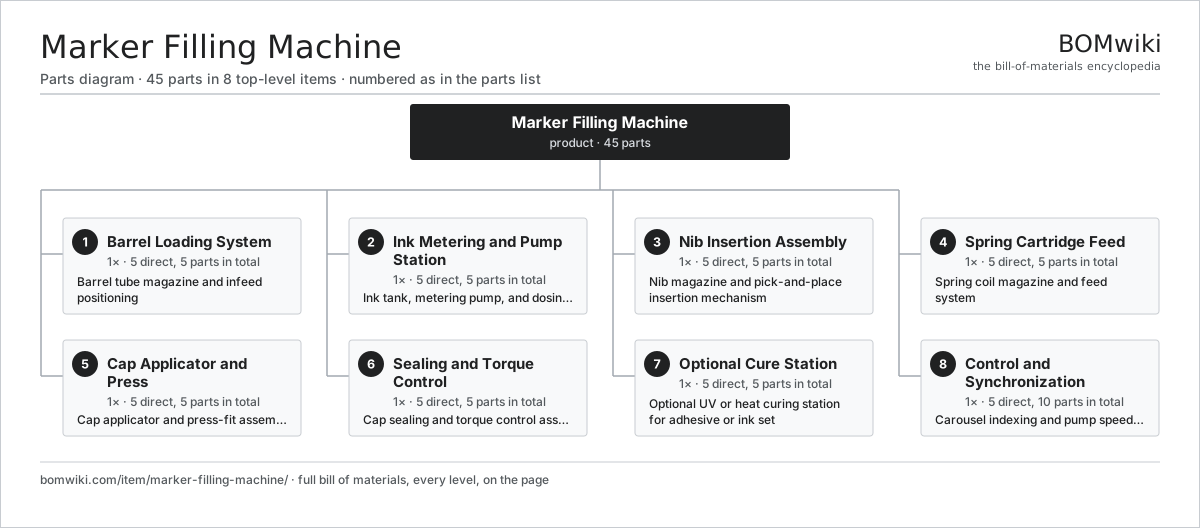
| # | Part | Qty | What it does |
|---|---|---|---|
| 1 | Barrel Loading System 5 parts | 1× | Barrel tube magazine and infeed positioning |
| 2 | Ink Metering and Pump Station 5 parts | 1× | Ink tank, metering pump, and dosing control |
| 3 | Nib Insertion Assembly 5 parts | 1× | Nib magazine and pick-and-place insertion mechanism |
| 4 | Spring Cartridge Feed 5 parts | 1× | Spring coil magazine and feed system |
| 5 | Cap Applicator and Press 5 parts | 1× | Cap applicator and press-fit assembly mechanism |
| 6 | Sealing and Torque Control 5 parts | 1× | Cap sealing and torque control assembly |
| 7 | Optional Cure Station 5 parts | 1× | Optional UV or heat curing station for adhesive or ink set |
| 8 | Control and Synchronization 5 parts | 1× | Carousel indexing and pump speed synchronization |
3D model
No 3D model yet. Have a CAD file of this? Add a 3D model. STL renders right on this page; STEP, FreeCAD, and OpenSCAD sources are welcome too (openly licensed, like all 3D models on BOMwiki).
Build & assembly graph
expand / collapse · shared sub-assemblies converge · links to related products · est. labourTap an assembly to expand/collapse · tap a part to open it · use “Open page” for any node · drag to pan, scroll to zoom.
Bill of materials for Marker Filling Machine
8 top-level lines · 48 rows shown · 45 parts total · indented to 3 levels| # | Item / sub-assembly | Part no. | Qty/assy | Ext. qty | Parts | Type |
|---|---|---|---|---|---|---|
| 1 | Barrel Loading System 5 parts | marker-filling-machine-barrel | 1× | 1 | 5 | assembly |
| 1.1 | Barrel Magazine Stack | marker-filling-machine-barrel-magazine | 1× | 1 | · | part |
| 1.2 | Barrel Lift Arm | marker-filling-machine-barrel-lifter | 1× | 1 | · | part |
| 1.3 | Barrel Alignment Sleeve | marker-filling-machine-barrel-guide | 1× | 1 | · | part |
| 1.4 | Encoder | encoder | 1× | 1 | · | part |
| 1.5 | Connector | connector | 1× | 1 | · | part |
| 2 | Ink Metering and Pump Station 5 parts | marker-filling-machine-ink | 1× | 1 | 5 | assembly |
| 2.1 | Ink Storage Tank | marker-filling-machine-ink-tank | 1× | 1 | · | part |
| 2.2 | Ink Metering Pump | marker-filling-machine-pump | 1× | 1 | · | part |
| 2.3 | Fill Nozzle and Solenoid | marker-filling-machine-dispenser | 1× | 1 | · | part |
| 2.4 | Encoder | encoder | 1× | 1 | · | part |
| 2.5 | Temperature Sensor | temperature-sensor | 1× | 1 | · | part |
| 3 | Nib Insertion Assembly 5 parts | marker-filling-machine-nib | 1× | 1 | 5 | assembly |
| 3.1 | Nib Magazine Cartridge | marker-filling-machine-nib-magazine | 1× | 1 | · | part |
| 3.2 | Nib Pick-and-Place Gripper | marker-filling-machine-nib-picker | 1× | 1 | · | part |
| 3.3 | Nib Insertion Press | marker-filling-machine-nib-press | 1× | 1 | · | part |
| 3.4 | Nib Alignment Bushing | marker-filling-machine-nib-guide | 1× | 1 | · | part |
| 3.5 | Pressure Sensor | pressure-sensor | 1× | 1 | · | part |
| 4 | Spring Cartridge Feed 5 parts | marker-filling-machine-spring | 1× | 1 | 5 | assembly |
| 4.1 | Spring Magazine Cartridge | marker-filling-machine-spring-magazine | 1× | 1 | · | part |
| 4.2 | Spring Feed Mechanism | marker-filling-machine-spring-picker | 1× | 1 | · | part |
| 4.3 | Spring Depth | marker-filling-machine-spring-depth | 1× | 1 | · | part |
| 4.4 | Encoder | encoder | 1× | 1 | · | part |
| 4.5 | Fastener Set | fastener-set | 1× | 1 | · | part |
| 5 | Cap Applicator and Press 5 parts | marker-filling-machine-cap | 1× | 1 | 5 | assembly |
| 5.1 | Cap Magazine Roll | marker-filling-machine-cap-magazine | 1× | 1 | · | part |
| 5.2 | Cap Retrieval Arm | marker-filling-machine-cap-picker | 1× | 1 | · | part |
| 5.3 | Cap Press Head | marker-filling-machine-cap-press | 1× | 1 | · | part |
| 5.4 | Cap Insertion Guide | marker-filling-machine-cap-guide | 1× | 1 | · | part |
| 5.5 | Pressure Sensor | pressure-sensor | 1× | 1 | · | part |
| 6 | Sealing and Torque Control 5 parts | marker-filling-machine-seal | 1× | 1 | 5 | assembly |
| 6.1 | Seal or Torque Applicator | marker-filling-machine-seal-head | 1× | 1 | · | part |
| 6.2 | Adhesive Nozzle or Torque Probe | marker-filling-machine-seal-nozzle | 1× | 1 | · | part |
| 6.3 | Temperature Sensor | temperature-sensor | 1× | 1 | · | part |
| 6.4 | Encoder | encoder | 1× | 1 | · | part |
| 6.5 | Connector | connector | 1× | 1 | · | part |
| 7 | Optional Cure Station 5 parts | marker-filling-machine-cure | 1× | 1 | 5 | assembly |
| 7.1 | Cure Oven or UV Chamber | marker-filling-machine-cure-chamber | 1× | 1 | · | part |
| 7.2 | Cure Conveyor Belt | marker-filling-machine-conveyor | 1× | 1 | · | part |
| 7.3 | Temperature Sensor | temperature-sensor | 1× | 1 | · | part |
| 7.4 | Heating Element | heating-element | 1× | 1 | · | part |
| 7.5 | Blower Motor | blower-motor | 1× | 1 | · | part |
| 8 | Control and Synchronization 5 parts | marker-filling-machine-control | 1× | 1 | 10 | assembly |
| 8.1 | Microcontroller | mcu | 1× | 1 | · | part |
| 8.2 | Bare PCB | pcb-bare | 1× | 1 | · | part |
| 8.3 | Relay | relay | 5× | 5 | · | part |
| 8.4 | Power Supply | power-supply | 1× | 1 | · | part |
| 8.5 | Encoder | encoder | 2× | 2 | · | part |
Something wrong in this list? Report a problem with this BOM.
Related products
same domain, ranked by shared parts Chalk Extrusion Machine
47 parts · shares 8 with this page
Crayon Molding Machine
56 parts · shares 8 with this page
Match Making Machine
47 parts · shares 8 with this page
Chalk Extrusion Machine
47 parts · shares 8 with this page
Crayon Molding Machine
56 parts · shares 8 with this page
Match Making Machine
47 parts · shares 8 with this page
 Exercise Book Machine
53 parts · shares 7 with this page
Lipstick Molding Machine
131 parts · shares 6 with this page
Exercise Book Machine
53 parts · shares 7 with this page
Lipstick Molding Machine
131 parts · shares 6 with this page
 Vacuum Casting Machine
39 parts · shares 5 with this page
Vacuum Casting Machine
39 parts · shares 5 with this page
Sourcing: possible vendors
Browse the supplier directory → Prices, MOQ, and lead times are algorithmic estimates, not quotes, and not claims about these companies. Company mappings are curated by keyword; est. price band $5k–$2M. How estimates work| Vendor | HQ | Specialty | MOQ | Lead time |
|---|---|---|---|---|
| atlascopco.com ↗ | Stockholm, SE | Compressors & industrial | 10 units | 12–20 wks |
|
🇦🇹Andritz
andritz.com ↗
|
Graz, AT | Process plants & machinery | 10 units | 12–20 wks |
| buhlergroup.com ↗ | Uzwil, CH | Food & materials processing | 10 units | 12–20 wks |
| gea.com ↗ | Düsseldorf, DE | Process technology | 10 units | 12–20 wks |
| mhi.com ↗ | Tokyo, JP | Heavy machinery | 10 units | 12–20 wks |
1,144-word article