Match Making Machine
ProductOverview
Match making machines are industrial-scale production lines that transform raw wooden splints into finished matches ready for sale. The process integrates splint feeding, paraffin wax coating, chemical match-head dipping, controlled drying, cooling, and automated boxing into a single synchronized system. Modern machines achieve 600–1200 matches per minute (equivalent to 3000–6000 boxes per hour) using continuous conveyor transport, precision dipping baths, and tightly controlled temperature profiles. The machines combine chemical engineering (match-head composition), thermal management (drying and cooling), and mechanical automation to produce consistent, reliable matches at high volume.
How It Works
Splint Feeding and Preparation
The Splint Feed System system begins with a gravity-fed Splint Hopper holding 10,000–50,000 wooden splints. A vibration deck meters splints onto a Spacing Rail that positions them at regular intervals (typically 2–3 cm apart) on the main conveyor chain. A Splint Guide Block aligns each splint horizontally to ensure proper presentation at the dipping stations. An Encoder counts passing splints and signals the system if spacing becomes irregular.
Paraffin Coating
At the first dipping station, splints pass through the Paraffin Coating Station tank containing melted paraffin wax at 75–85 °C. The Heating Element and Temperature Sensor maintain precise melt temperature; paraffin that is too cold results in thick, uneven coating, while paraffin that is too hot creates thin spots. As splints exit the tank, Squeegee Roller Assembly rollers remove excess paraffin, controlling the coating thickness to 0.1–0.3 mm. A Blower Motor immediately applies hot air to prevent pooling of paraffin at the match head end and to begin solidification.
Match Head Application
Immediately following paraffin coating, splints are dipped into the Match Head Dipping station. The dip vat contains a paste-like chemical mixture of phosphorus sesquisulfide (4–5%), potassium chlorate (50–55%), sulfur (35–40%), and glue binders. The {{match-making-machine-agitator}} (slow-speed paddle) continuously stirrs the mixture to prevent settling of heavier components, while the Circulation Filter Pump circulates the chemical through a 50-mesh filter to remove agglomerations. The Temperature Sensor monitors vat temperature; although the reaction is exothermic, ambient cooling and circulation help maintain 25–35 °C to prevent decomposition.
As splints are dipped, a thin layer of match-head paste coats the exposed end, creating the strike-ready head. The dip depth and duration control head size (typically 3–4 mm diameter × 2–3 mm length).
Drying and Curing
The Conveyor Drying Tunnel conveyor tunnel is the critical process step. Newly dipped matches are transported on a Mesh or Chain Conveyor (stainless steel mesh or coated chain) through a heated enclosure for 30–60 seconds at 50–60 °C. The Heating Element (electric or steam-jacketed) provides uniform heat; the Blower Motor circulates air to accelerate moisture evaporation and chemical curing. The Temperature Sensor feeds back to a PID controller, adjusting heater output to maintain setpoint. Under-drying leaves matches sticky and prone to clumping; over-drying makes heads brittle and prone to crumbling.
Cooling and Inspection
Following the drying tunnel, matches pass through the Cooling and Settlement Station station, a Cooling and Vibration Table with gentle vibration. Matches cool to ambient temperature (15–25 °C) and loose chemical particles and paraffin flakes settle out or are removed by low-speed Blower Motor air. An Match Inspection Sensor (optical or capacitive) examines each match, detecting bent splints, missing or malformed heads, or other defects. Rejected matches are diverted to a scrap chute; good matches proceed to boxing.
Automated Boxing
The Boxing and Collating assembly handles final packaging. A Box Magazine gravity magazine feeds prefolded flat matchbox sleeves sequentially to the boxing station. A Match Drop Chute (metered vibratory chute) dispenses exactly 40–50 matches into the open box below. A Box Closure Mechanism pneumatic gate or mechanical cam closes the box around the matches, folding the cardboard sleeve into its final form. A Wrapper Application Head applies a printed label or cellophane wrapper with adhesive, completing the finished product. Boxed matches are discharged onto a collection conveyor for case-packing.
Main Transport and Synchronization
All stations are connected by the Main Transport System system, a chain, belt, or bucket conveyor powered by a Main Drive Motor and Gearbox VFD-controlled motor with gearbox. The Encoder senses conveyor speed and provides feedback to the Control System PLC. All operations are timed relative to conveyor position: splint feed rate, dip tank indexing (if using rotary dips), heater cycling, and boxing gate timing are all synchronized to conveyor speed.
Control and Monitoring
The Control System unit is a programmable controller managing:
- Conveyor motor speed via VFD (50–200 m/min typical)
- Paraffin and drying-tunnel heater output via PID loops
- Match-head vat agitator motor on/off timing
- Pneumatic boxing-gate solenoid activation
- Safety interlocks to stop the machine if vat temperature drifts >5 °C or conveyor speed becomes irregular
- Production counters and quality metrics
Relay outputs energize high-power motors; Encoder feedback ensures that all mechanical operations occur at the correct carousel or conveyor position.
Engineering Considerations
Chemical Stability: Phosphorus sesquisulfide is moisture-sensitive and slightly spontaneously combustible at concentrations >10% in organic solvents. The match-head vat must be kept tightly sealed when not active, and circulation/agitation prevents stagnant zones where exothermic runaway is possible.
Paraffin Temperature Control: Paraffin viscosity doubles from 75 °C to 85 °C. Coating thickness is extremely sensitive to melt temperature; ±5 °C drift causes ±30% variation in coat weight, affecting match burn rate and storage life.
Drying Kinetics: Under-drying (moisture >5%) causes matches to stick together and enables mold growth. Over-drying (moisture <1%) makes heads brittle and prone to premature ignition. Optimal moisture is 2–3%.
Splint Quality: Splint diameter uniformity (±0.1 mm) is critical; oversized splints jam the spacing rail, while undersized splints may be missed by the dipping bath.
Head Consistency: The phosphorus/chlorate ratio, glue binder percentage, and particle size all affect ignition temperature and burn rate. Regular vat analysis (titration, particle size) is required for quality assurance.
Production Metrics
A typical machine producing 800 matches/minute yields 48,000 per hour or approximately 10,000 boxes/hour (at 40 matches per box). Power consumption is 5–12 kW depending on heater duty and conveyor speed. Vat changeover (emptying head tank, refreshing chemicals) typically requires 4–8 hours of shutdown; splint quality issues usually necessitate machine shutdown within 24 hours to allow vat analysis and rebalancing.
Match Making Machine parts and their functions
8 top-level parts · 47 parts in total · full bill of materials below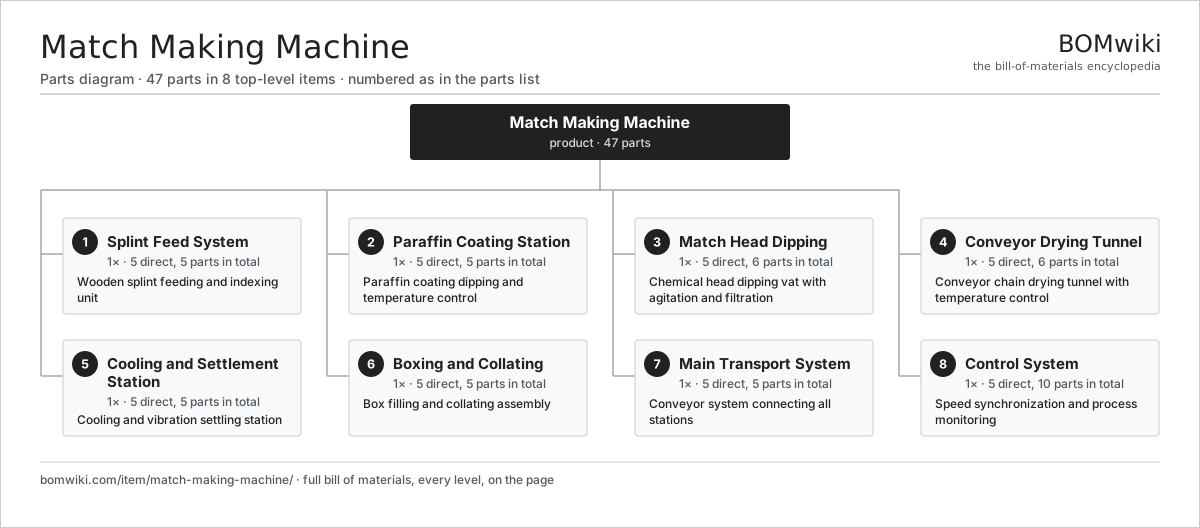
| # | Part | Qty | What it does |
|---|---|---|---|
| 1 | Splint Feed System 5 parts | 1× | Wooden splint feeding and indexing unit |
| 2 | Paraffin Coating Station 5 parts | 1× | Paraffin coating dipping and temperature control |
| 3 | Match Head Dipping 5 parts | 1× | Chemical head dipping vat with agitation and filtration |
| 4 | Conveyor Drying Tunnel 5 parts | 1× | Conveyor chain drying tunnel with temperature control |
| 5 | Cooling and Settlement Station 5 parts | 1× | Cooling and vibration settling station |
| 6 | Boxing and Collating 5 parts | 1× | Box filling and collating assembly |
| 7 | Main Transport System 5 parts | 1× | Conveyor system connecting all stations |
| 8 | Control System 5 parts | 1× | Speed synchronization and process monitoring |
3D model
No 3D model yet. Have a CAD file of this? Add a 3D model. STL renders right on this page; STEP, FreeCAD, and OpenSCAD sources are welcome too (openly licensed, like all 3D models on BOMwiki).
Build & assembly graph
expand / collapse · shared sub-assemblies converge · links to related products · est. labourTap an assembly to expand/collapse · tap a part to open it · use “Open page” for any node · drag to pan, scroll to zoom.
Bill of materials for Match Making Machine
8 top-level lines · 48 rows shown · 47 parts total · indented to 3 levels| # | Item / sub-assembly | Part no. | Qty/assy | Ext. qty | Parts | Type |
|---|---|---|---|---|---|---|
| 1 | Splint Feed System 5 parts | match-making-machine-splint | 1× | 1 | 5 | assembly |
| 1.1 | Splint Hopper | match-making-machine-hopper | 1× | 1 | · | part |
| 1.2 | Spacing Rail | match-making-machine-spacer-rail | 1× | 1 | · | part |
| 1.3 | Splint Guide Block | match-making-machine-guide-block | 1× | 1 | · | part |
| 1.4 | Encoder | encoder | 1× | 1 | · | part |
| 1.5 | Fastener Set | fastener-set | 1× | 1 | · | part |
| 2 | Paraffin Coating Station 5 parts | match-making-machine-paraffin | 1× | 1 | 5 | assembly |
| 2.1 | Paraffin Dip Tank | match-making-machine-paraffin-tank | 1× | 1 | · | part |
| 2.2 | Heating Element | heating-element | 1× | 1 | · | part |
| 2.3 | Temperature Sensor | temperature-sensor | 1× | 1 | · | part |
| 2.4 | Squeegee Roller Assembly | match-making-machine-squeegee | 1× | 1 | · | part |
| 2.5 | Blower Motor | blower-motor | 1× | 1 | · | part |
| 3 | Match Head Dipping 5 parts | match-making-machine-head | 1× | 1 | 6 | assembly |
| 3.1 | Match Head Dip Vat | match-making-machine-head-vat | 1× | 1 | · | part |
| 3.2 | Paddle Stirrer | match-making-machine-agitator | 1× | 1 | · | part |
| 3.3 | Circulation Filter Pump | match-making-machine-filter-pump | 1× | 1 | · | part |
| 3.4 | Temperature Sensor | temperature-sensor | 1× | 1 | · | part |
| 3.5 | Connector | connector | 2× | 2 | · | part |
| 4 | Conveyor Drying Tunnel 5 parts | match-making-machine-drying | 1× | 1 | 6 | assembly |
| 4.1 | Mesh or Chain Conveyor | match-making-machine-conveyor-chain | 1× | 1 | · | part |
| 4.2 | Drive Belt | drive-belt | 1× | 1 | · | part |
| 4.3 | Heating Element | heating-element | 2× | 2 | · | part |
| 4.4 | Temperature Sensor | temperature-sensor | 1× | 1 | · | part |
| 4.5 | Blower Motor | blower-motor | 1× | 1 | · | part |
| 5 | Cooling and Settlement Station 5 parts | match-making-machine-cooling | 1× | 1 | 5 | assembly |
| 5.1 | Cooling and Vibration Table | match-making-machine-cooling-table | 1× | 1 | · | part |
| 5.2 | Blower Motor | blower-motor | 1× | 1 | · | part |
| 5.3 | Match Inspection Sensor | match-making-machine-inspection-sensor | 1× | 1 | · | part |
| 5.4 | Encoder | encoder | 1× | 1 | · | part |
| 5.5 | Fastener Set | fastener-set | 1× | 1 | · | part |
| 6 | Boxing and Collating 5 parts | match-making-machine-boxing | 1× | 1 | 5 | assembly |
| 6.1 | Box Magazine | match-making-machine-box-hopper | 1× | 1 | · | part |
| 6.2 | Match Drop Chute | match-making-machine-drop-chute | 1× | 1 | · | part |
| 6.3 | Box Closure Mechanism | match-making-machine-box-former | 1× | 1 | · | part |
| 6.4 | Wrapper Application Head | match-making-machine-wrapper-roller | 1× | 1 | · | part |
| 6.5 | Blower Motor | blower-motor | 1× | 1 | · | part |
| 7 | Main Transport System 5 parts | match-making-machine-transport | 1× | 1 | 5 | assembly |
| 7.1 | Main Drive Motor and Gearbox | match-making-machine-main-drive | 1× | 1 | · | part |
| 7.2 | Drive Belt | drive-belt | 1× | 1 | · | part |
| 7.3 | Encoder | encoder | 1× | 1 | · | part |
| 7.4 | Pressure Sensor | pressure-sensor | 1× | 1 | · | part |
| 7.5 | Fastener Set | fastener-set | 1× | 1 | · | part |
| 8 | Control System 5 parts | match-making-machine-control | 1× | 1 | 10 | assembly |
| 8.1 | Microcontroller | mcu | 1× | 1 | · | part |
| 8.2 | Bare PCB | pcb-bare | 1× | 1 | · | part |
| 8.3 | Relay | relay | 5× | 5 | · | part |
| 8.4 | Power Supply | power-supply | 1× | 1 | · | part |
| 8.5 | Temperature Sensor | temperature-sensor | 2× | 2 | · | part |
Something wrong in this list? Report a problem with this BOM.
Related products
same domain, ranked by shared parts Chalk Extrusion Machine
47 parts · shares 9 with this page
Crayon Molding Machine
56 parts · shares 8 with this page
Marker Filling Machine
45 parts · shares 8 with this page
Chalk Extrusion Machine
47 parts · shares 9 with this page
Crayon Molding Machine
56 parts · shares 8 with this page
Marker Filling Machine
45 parts · shares 8 with this page
 Exercise Book Machine
53 parts · shares 7 with this page
Exercise Book Machine
53 parts · shares 7 with this page
 Vacuum Casting Machine
39 parts · shares 6 with this page
Lipstick Molding Machine
131 parts · shares 6 with this page
Vacuum Casting Machine
39 parts · shares 6 with this page
Lipstick Molding Machine
131 parts · shares 6 with this page
Sourcing: possible vendors
Browse the supplier directory → Prices, MOQ, and lead times are algorithmic estimates, not quotes, and not claims about these companies. Company mappings are curated by keyword; est. price band $5k–$2M. How estimates work| Vendor | HQ | Specialty | MOQ | Lead time |
|---|---|---|---|---|
| atlascopco.com ↗ | Stockholm, SE | Compressors & industrial | 10 units | 12–20 wks |
|
🇦🇹Andritz
andritz.com ↗
|
Graz, AT | Process plants & machinery | 10 units | 12–20 wks |
| buhlergroup.com ↗ | Uzwil, CH | Food & materials processing | 10 units | 12–20 wks |
| gea.com ↗ | Düsseldorf, DE | Process technology | 10 units | 12–20 wks |
| mhi.com ↗ | Tokyo, JP | Heavy machinery | 10 units | 12–20 wks |
1,107-word article