Megaphone
ProductOverview
A megaphone or loudhailer is a portable voice amplifier built for maximum acoustic output per watt of battery power. Everything in its design serves efficiency: a Compression Driver working into a folded Reentrant Horn converts 10–45 electrical watts into 100–130 dB SPL of directed speech, intelligible at hundreds of meters in open air. The speech band is all it attempts, response from roughly 400 Hz to 5 kHz covers the frequencies that carry consonant intelligibility, and nothing below or above is worth the battery cost.
How it works
The operator squeezes the Trigger Switch in the Trigger Grip, which powers the Amplifier Board only while held. Speech enters the Microphone Capsule behind the rear opening, gets amplified by the Amplifier IC, a Class-AB or Class-D chip running directly off the battery rail, and drives the compression driver. An AGC Limiter compresses sudden shouts so the amplifier stays out of hard clipping, which on a horn sounds harsh and actually reduces intelligibility. The Volume Potentiometer sets level, and a Siren Circuit sweeps a 500 Hz – 2 kHz alert tone when its button is pressed; many models add a whistle tone and a record-and-loop message function via the Mode Buttons.
The compression driver
An ordinary cone speaker couples poorly to air: the diaphragm is heavy and the air is compliant, so most amplifier power becomes heat. The compression driver fixes the mismatch. Its Driver Diaphragm, a phenolic or mylar dome driven by a Copper Winding voice coil in the field of a Ferrite Magnet, radiates into a chamber whose exit area is roughly a tenth of the diaphragm area. The Phase Plug channels this compression chamber to the throat through slots of equal path length, so pressure waves from different parts of the dome arrive in phase. Loading the diaphragm against this stiff, small air volume raises the radiation resistance and lifts electroacoustic efficiency to 10–25 %, against roughly 1 % for a direct-radiating cone.
The horn
The horn is an acoustic transformer. Starting from the small throat behind the Throat Adapter, its cross-section expands exponentially to the mouth of the Horn Bell, stepping the acoustic impedance down gradually from the dense throat to open air. A straight horn long enough to cut off at 400 Hz would be unwieldy, so megaphones fold it: the Reentrant Core routes the sound forward, back, and forward again through concentric ducts, packing the required path length into a body a fraction as deep. The mouth diameter, 150–300 mm, sets the low-frequency limit and the beamwidth, the horn concentrates output into a forward lobe of roughly 30–60 degrees, which is where the range advantage over an omnidirectional speaker comes from.
Microphone and feedback
The microphone sits at the acoustic rear null of the horn, but a megaphone is still an amplifier with its input near its output, so feedback management matters. The Microphone Capsule is noise-cancelling: ports on both faces of the element cancel far-field sound (including horn spill) while close-talking speech, which reaches the front face much louder than the rear, passes through. A Microphone Windscreen suppresses breath pops, and the rubber Microphone Mount keeps body vibration out of the capsule. Handheld-mic variants put the capsule on a coiled cord so police and event users can aim the horn independently of their head.
Power
The Battery Pack is sized for hours of intermittent use, the trigger duty cycle, not continuous draw, dominates. Rechargeable models carry four Li-ion Cell, 18650 cells with a BMS Board for protection and a Charging Jack for the wall adapter; the Battery Holder in cheaper units takes four to eight C or D alkaline cells instead, accessed through the Battery Door. At a typical 10 W average draw a fresh pack sustains four to eight hours of normal use.
Construction
The Body Shell is injection-molded ABS throughout, the Body Molding clamps the horn bell, encloses the electronics, and carries Strap Lugs for the Shoulder Strap. Weather resistance matters more than appearance in this product class: gasketed seams and a sealed driver let the unit work in rain at outdoor events, marine use, and emergency response, where the megaphone remains standard equipment precisely because it has no infrastructure dependencies.
Megaphone parts and their functions
7 top-level parts · 36 parts in total · full bill of materials below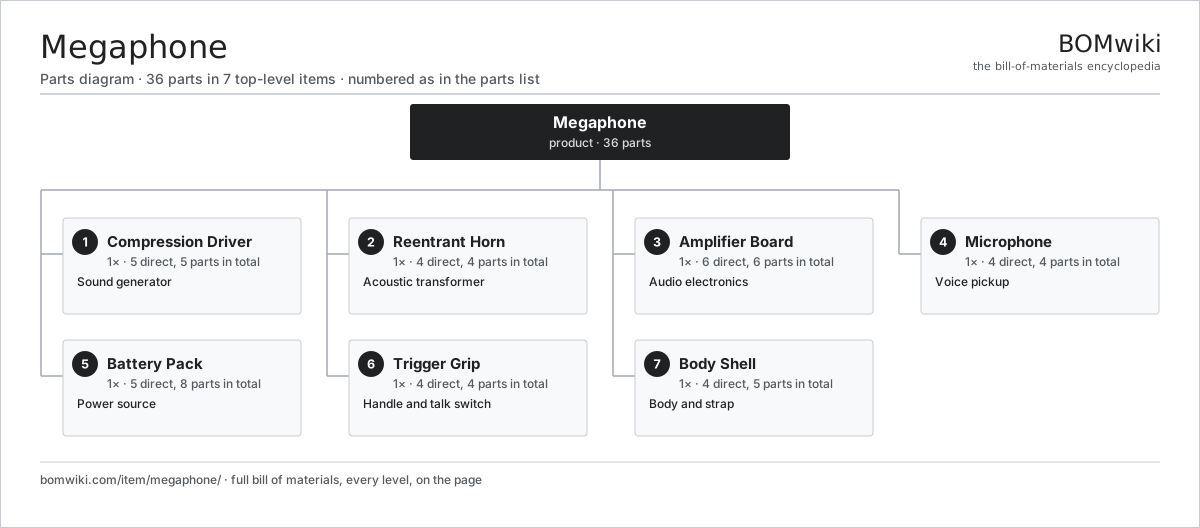
| # | Part | Qty | What it does |
|---|---|---|---|
| 1 | Compression Driver 5 parts | 1× | Sound generator |
| 2 | Reentrant Horn 4 parts | 1× | Acoustic transformer |
| 3 | Amplifier Board 6 parts | 1× | Audio electronics |
| 4 | Microphone 4 parts | 1× | Voice pickup |
| 5 | Battery Pack 5 parts | 1× | Power source |
| 6 | Trigger Grip 4 parts | 1× | Handle and talk switch |
| 7 | Body Shell 4 parts | 1× | Body and strap |
3D model
No 3D model yet. Have a CAD file of this? Add a 3D model. STL renders right on this page; STEP, FreeCAD, and OpenSCAD sources are welcome too (openly licensed, like all 3D models on BOMwiki).
Build & assembly graph
expand / collapse · shared sub-assemblies converge · links to related products · est. labourTap an assembly to expand/collapse · tap a part to open it · use “Open page” for any node · drag to pan, scroll to zoom.
Bill of materials for Megaphone
7 top-level lines · 39 rows shown · 36 parts total · indented to 3 levels| # | Item / sub-assembly | Part no. | Qty/assy | Ext. qty | Parts | Type |
|---|---|---|---|---|---|---|
| 1 | Compression Driver 5 parts | megaphone-compression-driver | 1× | 1 | 5 | assembly |
| 1.1 | Driver Diaphragm | megaphone-diaphragm | 1× | 1 | · | part |
| 1.2 | Copper Winding | copper-winding | 1× | 1 | · | part |
| 1.3 | Ferrite Magnet | megaphone-ferrite-magnet | 1× | 1 | · | part |
| 1.4 | Phase Plug | megaphone-phase-plug | 1× | 1 | · | part |
| 1.5 | Driver Housing | megaphone-driver-housing | 1× | 1 | · | part |
| 2 | Reentrant Horn 4 parts | megaphone-horn | 1× | 1 | 4 | assembly |
| 2.1 | Horn Bell | megaphone-horn-bell | 1× | 1 | · | part |
| 2.2 | Reentrant Core | megaphone-reentrant-core | 1× | 1 | · | part |
| 2.3 | Throat Adapter | megaphone-throat-adapter | 1× | 1 | · | part |
| 2.4 | Fastener Set | fastener-set | 1× | 1 | · | part |
| 3 | Amplifier Board 6 parts | megaphone-amplifier-board | 1× | 1 | 6 | assembly |
| 3.1 | Amplifier IC | megaphone-amp-ic | 1× | 1 | · | part |
| 3.2 | Volume Potentiometer | megaphone-volume-pot | 1× | 1 | · | part |
| 3.3 | Siren Circuit | megaphone-siren-circuit | 1× | 1 | · | part |
| 3.4 | AGC Limiter | megaphone-agc-limiter | 1× | 1 | · | part |
| 3.5 | Bare PCB | pcb-bare | 1× | 1 | · | part |
| 3.6 | SMD Passive (R/C/L) | smd-passives | 1× | 1 | · | part |
| 4 | Microphone 4 parts | megaphone-microphone | 1× | 1 | 4 | assembly |
| 4.1 | Microphone Capsule | megaphone-mic-capsule | 1× | 1 | · | part |
| 4.2 | Microphone Windscreen | megaphone-mic-windscreen | 1× | 1 | · | part |
| 4.3 | Microphone Mount | megaphone-mic-mount | 1× | 1 | · | part |
| 4.4 | Wire Bundle | wire-bundle | 1× | 1 | · | part |
| 5 | Battery Pack 5 parts | megaphone-battery-pack | 1× | 1 | 8 | assembly |
| 5.1 | Li-ion Cell, 18650 | li-cell-18650 | 4× | 4 | · | part |
| 5.2 | BMS Board | bms-board | 1× | 1 | · | part |
| 5.3 | Battery Holder | megaphone-battery-holder | 1× | 1 | · | part |
| 5.4 | Battery Door | megaphone-battery-door | 1× | 1 | · | part |
| 5.5 | Charging Jack | megaphone-charge-jack | 1× | 1 | · | part |
| 6 | Trigger Grip 4 parts | megaphone-trigger-grip | 1× | 1 | 4 | assembly |
| 6.1 | Trigger Switch | megaphone-trigger-switch | 1× | 1 | · | part |
| 6.2 | Grip Shell | megaphone-grip-shell | 1× | 1 | · | part |
| 6.3 | Mode Buttons | megaphone-mode-buttons | 1× | 1 | · | part |
| 6.4 | Wire Bundle | wire-bundle | 1× | 1 | · | part |
| 7 | Body Shell 4 parts | megaphone-shell | 1× | 1 | 5 | assembly |
| 7.1 | Body Molding | megaphone-body-molding | 1× | 1 | · | part |
| 7.2 | Shoulder Strap | megaphone-shoulder-strap | 1× | 1 | · | part |
| 7.3 | Strap Lugs | megaphone-strap-lugs | 2× | 2 | · | part |
| 7.4 | Fastener Set | fastener-set | 1× | 1 | · | part |
Something wrong in this list? Report a problem with this BOM.
Related products
same domain, ranked by shared parts Karaoke Machine
59 parts · shares 3 with this page
UHF Wireless Microphone System
291 parts · shares 3 with this page
Wireless Video TX/RX Kit
448 parts · shares 3 with this page
Karaoke Machine
59 parts · shares 3 with this page
UHF Wireless Microphone System
291 parts · shares 3 with this page
Wireless Video TX/RX Kit
448 parts · shares 3 with this page
 Portable Boombox
47 parts · shares 2 with this page
Portable Boombox
47 parts · shares 2 with this page
 Portable PA System
86 parts · shares 2 with this page
Portable PA System
86 parts · shares 2 with this page
Sourcing: possible vendors
Browse the supplier directory → Prices, MOQ, and lead times are algorithmic estimates, not quotes, and not claims about these companies. Company mappings are curated by keyword; est. price band $50–$3k. How estimates work| Vendor | HQ | Specialty | MOQ | Lead time |
|---|---|---|---|---|
|
🇯🇵Sony
sony.com ↗
|
Tokyo, JP | Consumer electronics | 1,000 units | 8–12 wks |
| samsung.com ↗ | Suwon, KR | Electronics & displays | 1,000 units | 8–12 wks |
|
🇺🇸Harman
harman.com ↗
|
Stamford, US | Audio (JBL, AKG) | 1,000 units | 8–12 wks |
|
🇺🇸Bose
bose.com ↗
|
Framingham, US | Audio | 1,000 units | 8–12 wks |
| yamaha.com ↗ | Hamamatsu, JP | Audio & instruments | 1,000 units | 8–12 wks |
738-word article