Electric Metal Shears
ProductOverview
An electric metal shears is a handheld power tool designed for straight-line cutting of sheet metal, plate, and rolled stock. Unlike traditional metal-cutting saws that produce heat and kerf loss, the oscillating blade shears the material cleanly without generating chips or burrs that require deburring. The tool is essential in HVAC installation, sheet metal fabrication, gutter and flashing work, and automotive bodywork.
The cordless electric variant offers superior mobility compared to corded alternatives and eliminates the need for hydraulic systems or manual lever action. Modern designs deliver cutting speeds of 3–5 meters per minute on aluminum and 1–2 meters per minute on steel, making complex cut-outs and curves practical in field conditions.
How it Works
The Brushless Motor Assembly brushless motor runs at 3500 RPM, drawing power from the Lithium-Ion Battery Pack 20V lithium-ion pack. The motor output couples to the Drive Gearbox, a planetary gear reducer that steps the speed down to approximately 800–1000 strokes per minute while multiplying torque.
The gearbox output shaft is the Output Crankshaft, an eccentric lobe mechanism. As the crankshaft rotates, the eccentric lobe drives the Blade Drive Connector link, which oscillates the Reciprocating Lower Blade (lower blade) in a rapid up-and-down motion. The Fixed Upper Blade (upper blade) remains stationary.
The two blades are ground to precise angles that allow them to overlap slightly at each stroke, creating a cutting action analogous to scissors but at 800+ cycles per minute. As the operator pushes the tool forward along a cutting line, the oscillating blades shear the material between them. The shearing action produces minimal heat and no chips, leaving edges clean and relatively burr-free.
The Variable-Speed Control Electronics board modulates motor speed via PWM. At 50% trigger, the motor delivers 50% RPM, reducing blade frequency to approximately 400 strokes per minute, useful for precise corner work. At full trigger, maximum cutting speed is achieved.
Blade Design and Sharpening
The Fixed Upper Blade and Reciprocating Lower Blade are precision-ground from tool steel and hardened to approximately 50–55 HRC (Rockwell hardness). The blade angle is typically 6–8 degrees, optimized for shearing mild steel without excessive force.
Over weeks of continuous use, blade edges dull and cutting requires higher motor load. Most professional operators replace blades every 40–80 hours of cutting, depending on material hardness. Individual blades cost $10–20 and swap in under 5 minutes. Re-sharpening is possible but typically slower than replacement.
Material Cutting Capability
The maximum material thickness is determined by motor torque and blade shear area. This model cuts mild steel up to 3.2 mm and aluminum up to 4 mm without stalling. Stainless steel is 20–30% harder and requires slower feed rates or thinner stock (typically 2.4 mm maximum).
Cut quality, the ratio of cut edge flatness to burr height, is excellent: straight cuts typically show 0.1–0.2 mm burr, acceptable for fabrication without post-cut deburring. Curved cuts (radius > 10 mm) require gradual feed and result in similarly high edge quality.
Chip Management
Unlike saws, the shears produce metal chips rather than a kerf dust. The Chip Collection Shroud and Chip Deflector Plate are designed to eject hot chips away from the operator and down the Chip Collection Chute. Connecting a collection bin or vacuum system to the chute keeps the work area clean.
Steel chips are sharp and extremely hot (up to 200°C immediately after cutting), so operators must never reach for chips or attempt to clear jams by hand. Allowing chips to cool naturally in the collection bin is the safe practice.
Guide Rails and Straight-Cut Control
The Material Guide and Chip Deflector and Workpiece Guide Rail rails keep the workpiece positioned uniformly relative to the blades. For straight cuts, the operator aligns the edge of the material with the guide rail and feeds the tool forward at a steady pace. Straight-line accuracy is typically ±0.5 mm over 1-meter cuts.
For curved cuts, the operator freehand the tool, following a scribed line or template. This requires skill to maintain consistent blade engagement and feed rate.
Oscillating vs. Rotary Blade Design
This specification covers oscillating designs (most common in cordless). Rotary-blade shears exist and are superior for extremely thick material (6–10 mm), but are heavier and more vibration-prone. Oscillating designs are lighter, quieter, and adequate for the typical sheet metal and ductwork applications served by cordless tools.
Speed Control and Feed Rate
The Variable-Speed Control Electronics proportional speed allows fine control of cutting rate. Soft materials (aluminum, copper) accept faster feed and higher blade speed. Hard materials (stainless, tool steel) require slower feed and lower blade speed. Experienced operators judge the right combination by ear and feel: a smooth whir and steady feed is the target; chattering or motor load indicates the feed is too fast.
Vibration and Operator Fatigue
The rapid reciprocating blade motion generates significant vibration, transmitted through the handle to the operator. The Rubberized Grip Sleeve elastomer dampens high-frequency vibration, reducing hand fatigue. On long cutting days (6+ hours), operator wrist fatigue is the limiting factor in productivity.
Professional operators rotate hands every 30–45 minutes to distribute load evenly and allow muscles to recover, extending the workday before fatigue becomes problematic.
Battery Runtime and Charging
A 2.0 Ah battery delivers approximately 30–50 linear meters of straight cutting on aluminum and 15–30 meters on steel before depletion, depending on blade condition and feed rate. Most job sites use two battery packs, charging one while the tool operates on the other.
Charging time is 30–60 minutes depending on charger amperage.
Thermal Management
Sustained cutting generates heat in the motor and gearbox. The Main Housing Body aluminum casting dissipates heat passively. For extreme duty (8+ hours continuous), the tool warms but remains operational. A thermal cutoff breaker in the Variable-Speed Control Electronics board cuts power if internal temperature exceeds safe limits, allowing the motor to cool.
Applications in Manufacturing and Field Work
HVAC Installation: Cutting ductwork, flashing, and transition pieces in the field.
Gutter and Downspout Work: Straight and curved cuts for custom gutter and flashing installation and repair.
Automotive Bodywork: Cutting and trimming sheet metal panels, and shaping new sections during repair.
Appliance Manufacturing: Assembly-line cutting of heater box and control panel stock.
General Fabrication: Straight cuts on stock sheet for fixture and jig construction.
Comparison to Saws and Angle Grinders
Circular saws and reciprocating saws with metal blades can cut metal but produce heat, dust, and potentially dangerous kickback. Angle grinders are faster but produce shower of sparks and poor cut quality.
Metal shears produce no sparks, minimal dust, and superior edge quality, making them the tool of choice on commercial job sites where safety and clean work are priorities. The slower cutting speed compared to grinders is acceptable given the superior outcomes.
Cordless Advantages
Cordless electric shears eliminate the cord and compressor dependencies of corded and pneumatic alternatives. Lighter total system weight improves operator control, and the battery is compatible with other cordless tools, reducing total inventory cost on multi-trade job sites.
Electric Metal Shears parts and their functions
8 top-level parts · 65 parts in total · full bill of materials below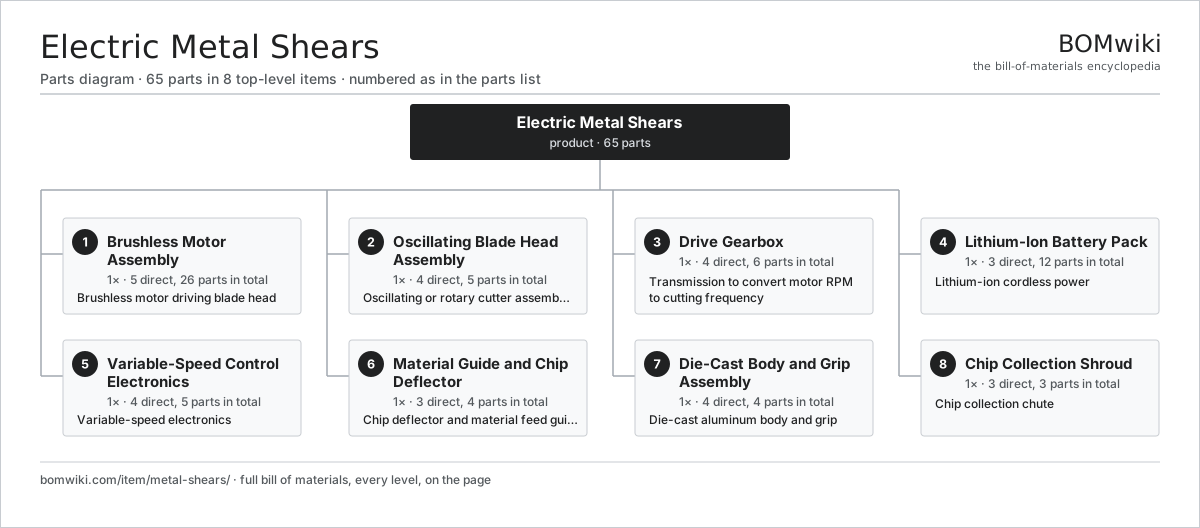
| # | Part | Qty | What it does |
|---|---|---|---|
| 1 | Brushless Motor Assembly 5 parts | 1× | Brushless motor driving blade head |
| 2 | Oscillating Blade Head Assembly 4 parts | 1× | Oscillating or rotary cutter assembly |
| 3 | Drive Gearbox 4 parts | 1× | Transmission to convert motor RPM to cutting frequency |
| 4 | Lithium-Ion Battery Pack 3 parts | 1× | Lithium-ion cordless power |
| 5 | Variable-Speed Control Electronics 4 parts | 1× | Variable-speed electronics |
| 6 | Material Guide and Chip Deflector 3 parts | 1× | Chip deflector and material feed guide |
| 7 | Die-Cast Body and Grip Assembly 4 parts | 1× | Die-cast aluminum body and grip |
| 8 | Chip Collection Shroud 3 parts | 1× | Chip collection chute |
3D model
No 3D model yet. Have a CAD file of this? Add a 3D model. STL renders right on this page; STEP, FreeCAD, and OpenSCAD sources are welcome too (openly licensed, like all 3D models on BOMwiki).
Build & assembly graph
expand / collapse · shared sub-assemblies converge · links to related products · est. labourTap an assembly to expand/collapse · tap a part to open it · use “Open page” for any node · drag to pan, scroll to zoom.
Bill of materials for Electric Metal Shears
8 top-level lines · 42 rows shown · 65 parts total · indented to 3 levels| # | Item / sub-assembly | Part no. | Qty/assy | Ext. qty | Parts | Type |
|---|---|---|---|---|---|---|
| 1 | Brushless Motor Assembly 5 parts | metal-shears-motor | 1× | 1 | 26 | assembly |
| 1.1 | Motor Housing | motor-housing | 1× | 1 | · | part |
| 1.2 | Rotor Assembly 4 parts | rotor-assembly | 1× | 1 | 19 | assembly |
| 1.2.1 | Rotor Shaft | rotor-shaft | 1× | 1 | · | part |
| 1.2.2 | Rotor Core | rotor-core | 1× | 1 | · | part |
| 1.2.3 | Neodymium Magnet | neodymium-magnet | 16× | 16 | · | part |
| 1.2.4 | Ball Bearing | ball-bearing | 1× | 1 | · | part |
| 1.3 | Copper Winding | copper-winding | 2× | 2 | · | part |
| 1.4 | Hall Sensor | hall-sensor | 2× | 2 | · | part |
| 1.5 | Ball Bearing | ball-bearing | 2× | 2 | · | part |
| 2 | Oscillating Blade Head Assembly 4 parts | metal-shears-blade-head | 1× | 1 | 5 | assembly |
| 2.1 | Fixed Upper Blade | metal-shears-blade-fixed | 1× | 1 | · | part |
| 2.2 | Reciprocating Lower Blade | metal-shears-blade-moving | 1× | 1 | · | part |
| 2.3 | Blade Drive Connector | metal-shears-blade-connector | 1× | 1 | · | part |
| 2.4 | Ball Bearing | ball-bearing | 2× | 2 | · | part |
| 3 | Drive Gearbox 4 parts | metal-shears-gearbox | 1× | 1 | 6 | assembly |
| 3.1 | Helical Gear Pair | gear-pair | 2× | 2 | · | part |
| 3.2 | Output Crankshaft | metal-shears-crankshaft | 1× | 1 | · | part |
| 3.3 | Gearbox Housing | gearbox-housing | 1× | 1 | · | part |
| 3.4 | Ball Bearing | ball-bearing | 2× | 2 | · | part |
| 4 | Lithium-Ion Battery Pack 3 parts | metal-shears-battery | 1× | 1 | 12 | assembly |
| 4.1 | Li-ion Cell, 18650 | li-cell-18650 | 10× | 10 | · | part |
| 4.2 | BMS Board | bms-board | 1× | 1 | · | part |
| 4.3 | Battery Connector | metal-shears-battery-connector | 1× | 1 | · | part |
| 5 | Variable-Speed Control Electronics 4 parts | metal-shears-trigger-speed-control | 1× | 1 | 5 | assembly |
| 5.1 | Bare PCB | pcb-bare | 1× | 1 | · | part |
| 5.2 | Power MOSFET | mosfet | 2× | 2 | · | part |
| 5.3 | SMD Passive (R/C/L) | smd-passives | 1× | 1 | · | part |
| 5.4 | Microcontroller | mcu | 1× | 1 | · | part |
| 6 | Material Guide and Chip Deflector 3 parts | metal-shears-blade-guides | 1× | 1 | 4 | assembly |
| 6.1 | Workpiece Guide Rail | metal-shears-guide-rail | 2× | 2 | · | part |
| 6.2 | Chip Deflector Plate | metal-shears-chip-deflector | 1× | 1 | · | part |
| 6.3 | Fastener Set | fastener-set | 1× | 1 | · | part |
| 7 | Die-Cast Body and Grip Assembly 4 parts | metal-shears-housing | 1× | 1 | 4 | assembly |
| 7.1 | Main Housing Body | metal-shears-main-body | 1× | 1 | · | part |
| 7.2 | Rubberized Grip Sleeve | metal-shears-grip-rubber | 1× | 1 | · | part |
| 7.3 | Top Carry Handle | metal-shears-handle | 1× | 1 | · | part |
| 7.4 | Fastener Set | fastener-set | 1× | 1 | · | part |
| 8 | Chip Collection Shroud 3 parts | metal-shears-dust-shroud | 1× | 1 | 3 | assembly |
| 8.1 | Main Shroud Enclosure | metal-shears-shroud-body | 1× | 1 | · | part |
| 8.2 | Chip Collection Chute | metal-shears-collection-chute | 1× | 1 | · | part |
| 8.3 | Fastener Set | fastener-set | 1× | 1 | · | part |
Something wrong in this list? Report a problem with this BOM.
Related products
same domain, ranked by shared parts Electric Nibbler
60 parts · shares 7 with this page
Electric Nibbler
60 parts · shares 7 with this page
 Reciprocating Saw
85 parts · shares 7 with this page
Right-Angle Drill
51 parts · shares 7 with this page
Reciprocating Saw
85 parts · shares 7 with this page
Right-Angle Drill
51 parts · shares 7 with this page
 Airless Paint Sprayer
97 parts · shares 5 with this page
Airless Paint Sprayer
97 parts · shares 5 with this page
 Impact Wrench
87 parts · shares 6 with this page
Impact Wrench
87 parts · shares 6 with this page
Sourcing: possible vendors
Browse the supplier directory → Prices, MOQ, and lead times are algorithmic estimates, not quotes, and not claims about these companies. Company mappings are curated by keyword; est. price band $30–$800. How estimates work| Vendor | HQ | Specialty | MOQ | Lead time |
|---|---|---|---|---|
| stanleyblackanddecker.com ↗ | New Britain, US | Tools (DeWalt, Craftsman) | 500 units | 6–12 wks |
| bosch-professional.com ↗ | Leinfelden, DE | Power tools | 500 units | 6–12 wks |
| ttigroup.com ↗ | Hong Kong, CN | Tools (Milwaukee, Ryobi) | 500 units | 6–12 wks |
|
🇯🇵Makita
makita.com ↗
|
Anjo, JP | Power tools | 500 units | 6–12 wks |
|
🇨🇭Hilti
hilti.com ↗
|
Schaan, CH | Construction tools | 500 units | 6–12 wks |
1,211-word article