MIG Welder
ProductOverview
A MIG welder performs gas metal arc welding (GMAW): an arc burns between the workpiece and a consumable wire electrode that is fed continuously through the torch, melting both to form the joint while a shielding gas excludes air from the molten pool. Because the electrode feeds itself, the operator only steers the torch, there is no electrode to swap as in stick welding and no separate filler rod as in TIG, which makes MIG the easiest arc process to learn and the fastest for production work on steel from car-body gauge up to structural sections. Strictly, "MIG" (metal inert gas) applies to pure-argon shielding on aluminium; steel is welded "MAG" (metal active gas) under argon–CO₂ mixes, but the name MIG covers both in trade use.
Power source
Modern machines are inverters. The Input Rectifier turns 230 V mains into a ~325 V DC bus held by the Bus Capacitors; an IGBT Power Module pair chops that bus at 40–100 kHz into the small ferrite HF Transformer, whose secondary is rectified by the Output Rectifier and smoothed by the Output Inductor into welding power at 14–28 V. Running the transformer at tens of kilohertz instead of 50 Hz is why a 200 A machine weighs 12 kg where its 1990s transformer ancestor weighed 60.
MIG runs on a constant-voltage characteristic, and that choice is what makes the process self-regulating. The power source holds the set voltage; arc current is whatever the wire burn-off demands. If the operator drifts closer to the work, the arc shortens, current rises, the wire burns off faster, and the arc length restores itself, all without any control action. The Current Shunt feeds current back to the controller for display and for dynamic control of short-circuit transfer, where the inductance value sets how hard each short clears and therefore how much spatter the weld throws.
Wire feed
The Wire Feed Unit unit pulls wire off the braked Spool Holder and pushes it down the torch at a precisely held 2–20 m/min, wire speed is the current control in practice. The Feed Motor, a worm-geared PM motor with Encoder feedback, drives grooved Drive Rolls sized to the wire; the sprung Tension Arm presses just hard enough to feed without crushing. Soft aluminium wire deforms easily, so it gets U-grooved rolls, minimum tension and a PTFE Torch Liner; flux-cored wire gets knurled rolls.
Torch and consumables
Everything meets at the MIG Torch. The Torch Cable bundles welding current, gas, trigger wires and the wire-guiding Torch Liner into one lead, attached to the machine by the standardised Euro Connector. At the head, welding current transfers to the moving wire inside the Contact Tip, a copper bore a few hundredths of a millimetre over wire diameter, and the highest-wear consumable on the machine. Around it the Gas Diffuser and Gas Nozzle form a laminar gas column over the pool. Spatter slowly closes the nozzle and erodes the tip; both are minutes-to-change service parts.
The Torch Trigger sequences the weld: the Gas Solenoid Valve opens for pre-flow, wire feed and arc voltage start together, and on release the gas runs a post-flow to shield the cooling crater. The Flow Regulator on the cylinder meters 8–15 L/min; too little gas gives porosity, too much creates turbulence that drags air in.
Controls
On the Control Panel, the two Encoder Knobs set voltage and wire speed. Synergic machines collapse these to one knob: the Microcontroller looks up matched voltage/wire-speed pairs for the selected wire size, material and gas, so the operator dials in "more" or "less". The Mode Buttons select 2T/4T trigger latching and programs. Welding current returns through the Work Lead, the Earth Clamp must bite clean metal, since a resistive ground connection robs arc voltage and wanders the arc.
Duty cycle and cooling
Output ratings follow IEC 60974-1 duty cycle: 200 A at 30% means 3 minutes welding in a 10-minute window before the Thermal Fuse thermostat pauses the machine. The Cooling Fan runs on demand from Heatsink temperature, which keeps grinding dust out of the electronics during the majority of shop time when the arc is off.
MIG Welder parts and their functions
7 top-level parts · 77 parts in total · full bill of materials below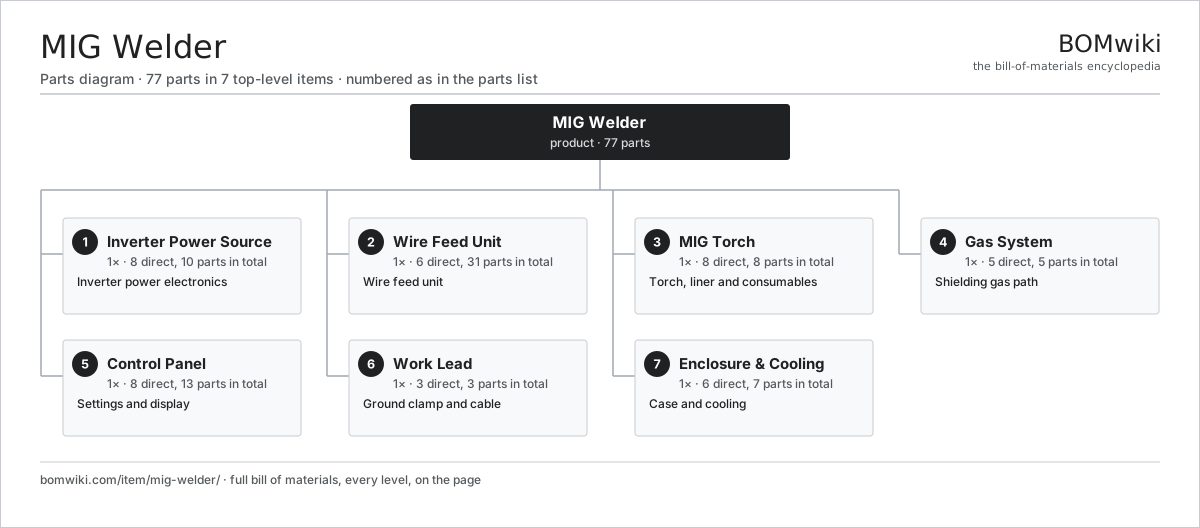
| # | Part | Qty | What it does |
|---|---|---|---|
| 1 | Inverter Power Source 8 parts | 1× | Inverter power electronics |
| 2 | Wire Feed Unit 6 parts | 1× | Wire feed unit |
| 3 | MIG Torch 8 parts | 1× | Torch, liner and consumables |
| 4 | Gas System 5 parts | 1× | Shielding gas path |
| 5 | Control Panel 8 parts | 1× | Settings and display |
| 6 | Work Lead 3 parts | 1× | Ground clamp and cable |
| 7 | Enclosure & Cooling 6 parts | 1× | Case and cooling |
3D model
No 3D model yet. Have a CAD file of this? Add a 3D model. STL renders right on this page; STEP, FreeCAD, and OpenSCAD sources are welcome too (openly licensed, like all 3D models on BOMwiki).
Build & assembly graph
expand / collapse · shared sub-assemblies converge · links to related products · est. labourTap an assembly to expand/collapse · tap a part to open it · use “Open page” for any node · drag to pan, scroll to zoom.
Bill of materials for MIG Welder
7 top-level lines · 56 rows shown · 77 parts total · indented to 3 levels| # | Item / sub-assembly | Part no. | Qty/assy | Ext. qty | Parts | Type |
|---|---|---|---|---|---|---|
| 1 | Inverter Power Source 8 parts | mig-welder-power-source | 1× | 1 | 10 | assembly |
| 1.1 | Input Rectifier | mig-welder-input-rectifier | 1× | 1 | · | part |
| 1.2 | Bus Capacitors | mig-welder-bus-capacitors | 1× | 1 | · | part |
| 1.3 | IGBT Power Module | igbt-module | 2× | 2 | · | part |
| 1.4 | HF Transformer | mig-welder-hf-transformer | 1× | 1 | · | part |
| 1.5 | Output Rectifier | mig-welder-output-rectifier | 1× | 1 | · | part |
| 1.6 | Output Inductor | mig-welder-output-inductor | 1× | 1 | · | part |
| 1.7 | Current Shunt | mig-welder-current-shunt | 1× | 1 | · | part |
| 1.8 | Bare PCB | pcb-bare | 2× | 2 | · | part |
| 2 | Wire Feed Unit 6 parts | mig-welder-wire-feed | 1× | 1 | 31 | assembly |
| 2.1 | Feed Motor 5 parts | mig-welder-feed-motor | 1× | 1 | 25 | assembly |
| 2.1.1 | Rotor Assembly 4 parts + deeper › | rotor-assembly | 1× | 1 | 19 | assembly |
| 2.1.2 | Neodymium Magnet | neodymium-magnet | 2× | 2 | · | part |
| 2.1.3 | Helical Gear Pair | gear-pair | 1× | 1 | · | part |
| 2.1.4 | Gearbox Housing | gearbox-housing | 1× | 1 | · | part |
| 2.1.5 | Ball Bearing | ball-bearing | 2× | 2 | · | part |
| 2.2 | Drive Rolls | mig-welder-drive-rolls | 2× | 2 | · | part |
| 2.3 | Tension Arm | mig-welder-tension-arm | 1× | 1 | · | part |
| 2.4 | Spool Holder | mig-welder-spool-holder | 1× | 1 | · | part |
| 2.5 | Inlet Guide | mig-welder-inlet-guide | 1× | 1 | · | part |
| 2.6 | Encoder | encoder | 1× | 1 | · | part |
| 3 | MIG Torch 8 parts | mig-welder-torch | 1× | 1 | 8 | assembly |
| 3.1 | Torch Body | mig-welder-torch-body | 1× | 1 | · | part |
| 3.2 | Torch Trigger | mig-welder-torch-trigger | 1× | 1 | · | part |
| 3.3 | Torch Liner | mig-welder-liner | 1× | 1 | · | part |
| 3.4 | Contact Tip | mig-welder-contact-tip | 1× | 1 | · | part |
| 3.5 | Gas Nozzle | mig-welder-gas-nozzle | 1× | 1 | · | part |
| 3.6 | Gas Diffuser | mig-welder-gas-diffuser | 1× | 1 | · | part |
| 3.7 | Torch Cable | mig-welder-torch-cable | 1× | 1 | · | part |
| 3.8 | Euro Connector | mig-welder-euro-connector | 1× | 1 | · | part |
| 4 | Gas System 5 parts | mig-welder-gas-system | 1× | 1 | 5 | assembly |
| 4.1 | Gas Solenoid Valve | mig-welder-gas-solenoid | 1× | 1 | · | part |
| 4.2 | Gas Inlet Fitting | mig-welder-gas-inlet | 1× | 1 | · | part |
| 4.3 | Internal Gas Hose | mig-welder-gas-hose-internal | 1× | 1 | · | part |
| 4.4 | Flow Regulator | mig-welder-flow-regulator | 1× | 1 | · | part |
| 4.5 | O-Ring Set | oring-set | 1× | 1 | · | part |
| 5 | Control Panel 8 parts | mig-welder-control-panel | 1× | 1 | 13 | assembly |
| 5.1 | Bare PCB | pcb-bare | 1× | 1 | · | part |
| 5.2 | Microcontroller | mcu | 1× | 1 | · | part |
| 5.3 | LCD Panel | lcd-panel | 1× | 1 | · | part |
| 5.4 | Encoder Knobs | mig-welder-encoder-knobs | 2× | 2 | · | part |
| 5.5 | Mode Buttons | mig-welder-mode-buttons | 1× | 1 | · | part |
| 5.6 | SMD Passive (R/C/L) | smd-passives | 1× | 1 | · | part |
| 5.7 | Connector | connector | 5× | 5 | · | part |
| 5.8 | Wire Bundle | wire-bundle | 1× | 1 | · | part |
| 6 | Work Lead 3 parts | mig-welder-work-lead | 1× | 1 | 3 | assembly |
| 6.1 | Earth Clamp | mig-welder-earth-clamp | 1× | 1 | · | part |
| 6.2 | Work Cable | mig-welder-work-cable | 1× | 1 | · | part |
| 6.3 | Dinse Plug | mig-welder-dinse-plug | 1× | 1 | · | part |
| 7 | Enclosure & Cooling 6 parts | mig-welder-enclosure | 1× | 1 | 7 | assembly |
| 7.1 | Sheet Metal Panel | sheet-panel | 2× | 2 | · | part |
| 7.2 | Cooling Fan | mig-welder-cooling-fan | 1× | 1 | · | part |
| 7.3 | Heatsink | mig-welder-heatsink | 1× | 1 | · | part |
| 7.4 | Thermal Fuse | thermal-fuse | 1× | 1 | · | part |
| 7.5 | Carry Handle | mig-welder-carry-handle | 1× | 1 | · | part |
| 7.6 | Fastener Set | fastener-set | 1× | 1 | · | part |
Something wrong in this list? Report a problem with this BOM.
Related products
same domain, ranked by shared parts Airless Paint Sprayer
97 parts · shares 6 with this page
Demolition Hammer
51 parts · shares 2 with this page
Airless Paint Sprayer
97 parts · shares 6 with this page
Demolition Hammer
51 parts · shares 2 with this page
 Heat Gun
183 parts · shares 4 with this page
Heat Gun
183 parts · shares 4 with this page
 Desktop 3D Printer
56 parts · shares 1 with this page
Desktop 3D Printer
56 parts · shares 1 with this page
 Electronic Torque Wrench
42 parts · shares 3 with this page
Electronic Torque Wrench
42 parts · shares 3 with this page
 Rotary Hammer
100 parts · shares 5 with this page
Rotary Hammer
100 parts · shares 5 with this page
Sourcing: possible vendors
Browse the supplier directory → Prices, MOQ, and lead times are algorithmic estimates, not quotes, and not claims about these companies. Company mappings are curated by keyword; est. price band $30–$800. How estimates work| Vendor | HQ | Specialty | MOQ | Lead time |
|---|---|---|---|---|
| stanleyblackanddecker.com ↗ | New Britain, US | Tools (DeWalt, Craftsman) | 500 units | 6–12 wks |
| bosch-professional.com ↗ | Leinfelden, DE | Power tools | 500 units | 6–12 wks |
| ttigroup.com ↗ | Hong Kong, CN | Tools (Milwaukee, Ryobi) | 500 units | 6–12 wks |
|
🇯🇵Makita
makita.com ↗
|
Anjo, JP | Power tools | 500 units | 6–12 wks |
|
🇨🇭Hilti
hilti.com ↗
|
Schaan, CH | Construction tools | 500 units | 6–12 wks |
766-word article