Robotic Milking System
ProductOverview
A robotic milking system milks cows without a human operator. Cows visit the stall voluntarily, attracted by a concentrate ration dispensed in the Feed Manger, at whatever hour suits them; a well-loaded single stall completes 160–180 milkings a day across 55–70 cows. The machine replaces the milker's three jobs, udder preparation, cup attachment and post-milking disinfection, with a sensor-guided hydraulic arm, and adds per-quarter measurement no parlour milker can match.
The first commercial system, the Lely Astronaut, went onto a Dutch farm in 1992. Today roughly 40,000 units operate worldwide, with DeLaval, Lely, GEA and Fullwood as the main suppliers. The Milking Stall is the fixed frame of the process: pneumatic Entry Gate and Exit Gate admit one cow at a time, and the RFID Cow Identifier identifies her by ISO 11784/11785 transponder before she is fully inside.
How it works
When a cow enters, the Main Process Controller checks her milking permission, typically a minimum interval of six hours or an expected yield threshold. If she was milked too recently the exit gate simply releases her without feed, which trains cows not to queue idly.
For an admitted cow, the Feed Dosing Auger starts dosing concentrate and the Robot Attachment Arm swings under the udder. Teat preparation comes first: counter-rotating Teat Cleaning Brushes scrub each teat for around 25 seconds, which both cleans the skin and triggers oxytocin release so milk letdown coincides with attachment.
Teat location is the part that makes the machine possible. The 3D ToF Camera takes a depth image of the udder and the Vision Processing Board segments the four teats from it at 25 frames per second, using the cow's stored udder map as a prior, teat coordinates from her last milkings seed the search. For the final approach the Laser Scanner refines the tip position to about ±3 mm. A Camera Wash Nozzle nozzle keeps the optics usable in an environment where manure splash is routine.
The Teat Cup Gripper then takes each Teat Cup from the Teat Cup Magazine and lifts it onto its teat, rear quarters first. System vacuum of 42–44 kPa, held by the Vacuum Pump, draws the teat into the Teat Cup Liner; each Electronic Pulsator then alternates the shell chamber between vacuum and atmosphere at 60 cycles per minute, collapsing the liner against the teat in the rest phase to maintain blood circulation. Because every quarter has its own pulsator and Quarter Milk Meter, the machine detaches each cup individually when that quarter's flow drops below threshold, eliminating the overmilking that fixed-cluster parlours inflict on unevenly yielding quarters.
Milk passes through the meters into the Milk Receiver Jar, and the Milk Transfer Pump sends it through the Inline Milk Filter to the bulk tank. Milk that fails quality checks, elevated conductivity suggesting mastitis, blood detection, or milk from treated cows, is diverted to a separate line automatically.
Cleaning and milk quality
Hygiene is continuous rather than per-shift. Between cows, each Cup Rinse Jetter backflushes the liners with water or peracetic rinse to limit pathogen transfer. After milking, the Teat Spray Nozzle coats the teats with disinfectant dip before the exit gate opens. Two or three times daily the whole milk path runs a circulation wash: the Wash Water Boiler supplies 85 °C water and the Detergent Dosing Pumps alternate alkaline and acid detergent cycles, the same chemistry as a bulk tank CIP.
Arm and control architecture
The arm is hydraulic rather than pneumatic on most current machines: the Proportional Valve Block's proportional valves give smooth, force-limited motion, and the circuit is deliberately compliant so a kick displaces the arm instead of injuring the cow or wrecking the mechanism. A 1.5 kW Pump Motor drives the Hydraulic Gear Pump at about 40 bar from a 20 L Hydraulic Reservoir. Joint Encoders close the position loop against the vision coordinates.
Every milking generates a data record, per-quarter yield, flow curve, conductivity, attachment time, kick-offs, feed consumed, pushed over Ethernet to the herd management system. This dataset, accumulated three times daily per cow, is the basis for early mastitis alerts and feeding adjustments, and is as much a reason for adoption as the labour saving. Typical investment is €120,000–150,000 per stall; the operating trade-off is electricity, water and liner consumables against roughly one hour of milking labour saved per stall per day.
Robotic Milking System parts and their functions
7 top-level parts · 153 parts in total · full bill of materials below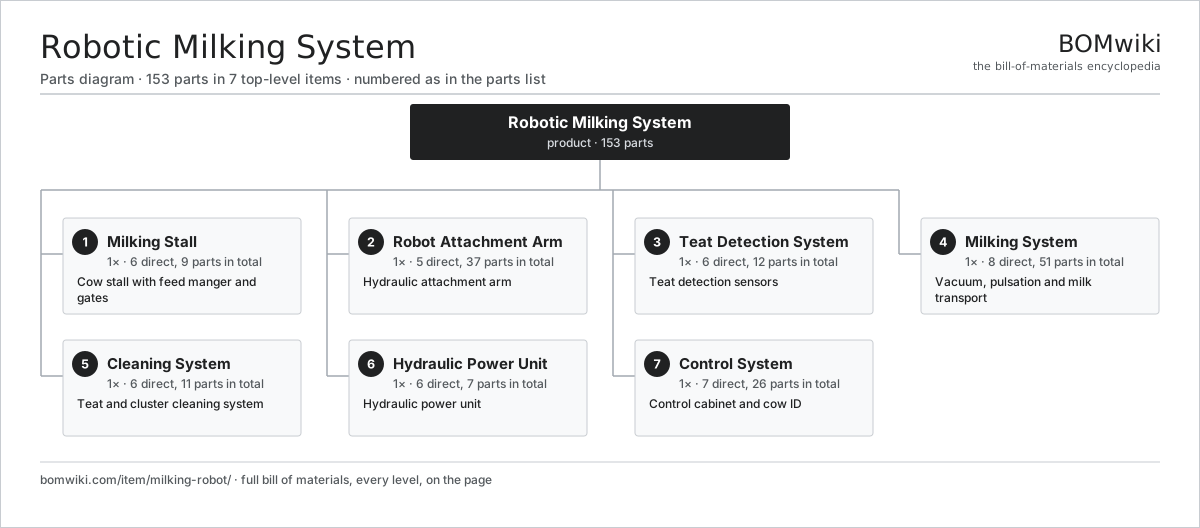
| # | Part | Qty | What it does |
|---|---|---|---|
| 1 | Milking Stall 6 parts | 1× | Cow stall with feed manger and gates |
| 2 | Robot Attachment Arm 5 parts | 1× | Hydraulic attachment arm |
| 3 | Teat Detection System 6 parts | 1× | Teat detection sensors |
| 4 | Milking System 8 parts | 1× | Vacuum, pulsation and milk transport |
| 5 | Cleaning System 6 parts | 1× | Teat and cluster cleaning system |
| 6 | Hydraulic Power Unit 6 parts | 1× | Hydraulic power unit |
| 7 | Control System 7 parts | 1× | Control cabinet and cow ID |
3D model
No 3D model yet. Have a CAD file of this? Add a 3D model. STL renders right on this page; STEP, FreeCAD, and OpenSCAD sources are welcome too (openly licensed, like all 3D models on BOMwiki).
Build & assembly graph
expand / collapse · shared sub-assemblies converge · links to related products · est. labourTap an assembly to expand/collapse · tap a part to open it · use “Open page” for any node · drag to pan, scroll to zoom.
Bill of materials for Robotic Milking System
7 top-level lines · 75 rows shown · 153 parts total · indented to 3 levels| # | Item / sub-assembly | Part no. | Qty/assy | Ext. qty | Parts | Type |
|---|---|---|---|---|---|---|
| 1 | Milking Stall 6 parts | milking-robot-stall | 1× | 1 | 9 | assembly |
| 1.1 | Stall Frame | milking-robot-stall-frame | 1× | 1 | · | part |
| 1.2 | Entry Gate | milking-robot-entry-gate | 1× | 1 | · | part |
| 1.3 | Exit Gate | milking-robot-exit-gate | 1× | 1 | · | part |
| 1.4 | Feed Manger | milking-robot-feed-manger | 1× | 1 | · | part |
| 1.5 | Feed Dosing Auger | milking-robot-feed-auger | 1× | 1 | · | part |
| 1.6 | Fastener Set | fastener-set | 4× | 4 | · | part |
| 2 | Robot Attachment Arm 5 parts | milking-robot-arm | 1× | 1 | 37 | assembly |
| 2.1 | Arm Slewing Base | milking-robot-arm-base | 1× | 1 | · | part |
| 2.2 | Arm Link Set | milking-robot-arm-links | 1× | 1 | · | part |
| 2.3 | Teat Cup Gripper 4 parts | milking-robot-gripper | 1× | 1 | 29 | assembly |
| 2.3.1 | Gripper Jaw | milking-robot-gripper-jaw | 2× | 2 | · | part |
| 2.3.2 | Teat Cup Magazine | milking-robot-cup-magazine | 1× | 1 | · | part |
| 2.3.3 | Servo Motor 4 parts + deeper › | servo-motor | 1× | 1 | 24 | assembly |
| 2.3.4 | Hall Sensor | hall-sensor | 2× | 2 | · | part |
| 2.4 | Arm Hydraulic Cylinder | milking-robot-arm-cylinder | 3× | 3 | · | part |
| 2.5 | Encoder | encoder | 3× | 3 | · | part |
| 3 | Teat Detection System 6 parts | milking-robot-vision | 1× | 1 | 12 | assembly |
| 3.1 | 3D ToF Camera | milking-robot-tof-camera | 1× | 1 | · | part |
| 3.2 | Laser Scanner | milking-robot-laser-unit | 1× | 1 | · | part |
| 3.3 | Lens Assembly | camera-lens | 1× | 1 | · | part |
| 3.4 | CMOS Image Sensor | image-sensor | 1× | 1 | · | part |
| 3.5 | Vision Processing Board 4 parts | milking-robot-vision-board | 1× | 1 | 7 | assembly |
| 3.5.1 | Bare PCB | pcb-bare | 1× | 1 | · | part |
| 3.5.2 | Compute SoC Module | soc-module | 1× | 1 | · | part |
| 3.5.3 | SMD Passive (R/C/L) | smd-passives | 1× | 1 | · | part |
| 3.5.4 | Connector | connector | 4× | 4 | · | part |
| 3.6 | Camera Wash Nozzle | milking-robot-camera-wash | 1× | 1 | · | part |
| 4 | Milking System 8 parts | milking-robot-milk-system | 1× | 1 | 51 | assembly |
| 4.1 | Teat Cup 3 parts | milking-robot-teat-cup | 4× | 4 | 3 | assembly |
| 4.1.1 | Teat Cup Shell | milking-robot-cup-shell | 1× | 4 | · | part |
| 4.1.2 | Teat Cup Liner | milking-robot-liner | 1× | 4 | · | part |
| 4.1.3 | Short Milk Tube | milking-robot-short-milk-tube | 1× | 4 | · | part |
| 4.2 | Vacuum Pump 5 parts | milking-robot-vacuum-pump | 1× | 1 | 26 | assembly |
| 4.2.1 | Rotor Assembly 4 parts + deeper › | rotor-assembly | 1× | 1 | 19 | assembly |
| 4.2.2 | Stator Assembly 3 parts + deeper › | stator-assembly | 1× | 1 | 3 | assembly |
| 4.2.3 | Motor Housing | motor-housing | 1× | 1 | · | part |
| 4.2.4 | Ball Bearing | ball-bearing | 2× | 2 | · | part |
| 4.2.5 | Oil Seal | oil-seal | 1× | 1 | · | part |
| 4.3 | Electronic Pulsator | milking-robot-pulsator | 4× | 4 | · | part |
| 4.4 | Quarter Milk Meter | milking-robot-milk-meter | 4× | 4 | · | part |
| 4.5 | Milk Receiver Jar | milking-robot-milk-receiver | 1× | 1 | · | part |
| 4.6 | Milk Transfer Pump | milking-robot-milk-pump | 1× | 1 | · | part |
| 4.7 | Inline Milk Filter | milking-robot-milk-filter | 1× | 1 | · | part |
| 4.8 | Pressure Sensor | pressure-sensor | 2× | 2 | · | part |
| 5 | Cleaning System 6 parts | milking-robot-cleaning | 1× | 1 | 11 | assembly |
| 5.1 | Teat Cleaning Brush | milking-robot-teat-brush | 2× | 2 | · | part |
| 5.2 | Teat Spray Nozzle | milking-robot-spray-nozzle | 1× | 1 | · | part |
| 5.3 | Wash Water Boiler | milking-robot-wash-boiler | 1× | 1 | · | part |
| 5.4 | Detergent Dosing Pump | milking-robot-dosing-pump | 2× | 2 | · | part |
| 5.5 | Cup Rinse Jetter | milking-robot-cup-rinse-jetter | 4× | 4 | · | part |
| 5.6 | Heating Element | heating-element | 1× | 1 | · | part |
| 6 | Hydraulic Power Unit 6 parts | milking-robot-hydraulics | 1× | 1 | 7 | assembly |
| 6.1 | Hydraulic Gear Pump | milking-robot-hyd-pump | 1× | 1 | · | part |
| 6.2 | Pump Motor | milking-robot-hyd-motor | 1× | 1 | · | part |
| 6.3 | Hydraulic Reservoir | milking-robot-hyd-tank | 1× | 1 | · | part |
| 6.4 | Proportional Valve Block | milking-robot-valve-block | 1× | 1 | · | part |
| 6.5 | O-Ring Set | oring-set | 1× | 1 | · | part |
| 6.6 | Oil Seal | oil-seal | 2× | 2 | · | part |
| 7 | Control System 7 parts | milking-robot-controls | 1× | 1 | 26 | assembly |
| 7.1 | Main Process Controller 4 parts | milking-robot-main-controller | 1× | 1 | 11 | assembly |
| 7.1.1 | Bare PCB | pcb-bare | 1× | 1 | · | part |
| 7.1.2 | Microcontroller | mcu | 1× | 1 | · | part |
| 7.1.3 | SMD Passive (R/C/L) | smd-passives | 1× | 1 | · | part |
| 7.1.4 | Connector | connector | 8× | 8 | · | part |
| 7.2 | RFID Cow Identifier | milking-robot-rfid-reader | 1× | 1 | · | part |
| 7.3 | Operator Terminal 4 parts | milking-robot-hmi | 1× | 1 | 5 | assembly |
| 7.3.1 | LCD Panel | lcd-panel | 1× | 1 | · | part |
| 7.3.2 | Touch Digitizer | touch-digitizer | 1× | 1 | · | part |
| 7.3.3 | Bare PCB | pcb-bare | 1× | 1 | · | part |
| 7.3.4 | Connector | connector | 2× | 2 | · | part |
| 7.4 | Power Supply | power-supply | 1× | 1 | · | part |
| 7.5 | Relay | relay | 6× | 6 | · | part |
| 7.6 | Wire Bundle | wire-bundle | 1× | 1 | · | part |
| 7.7 | 12 V Battery | lv-battery | 1× | 1 | · | part |
Something wrong in this list? Report a problem with this BOM.
Related products
same domain, ranked by shared parts Combine Harvester
203 parts · shares 18 with this page
Agricultural Drone Sprayer
751 parts · shares 15 with this page
Combine Harvester
203 parts · shares 18 with this page
Agricultural Drone Sprayer
751 parts · shares 15 with this page
 Large Round Baler
783 parts · shares 20 with this page
Large Round Baler
783 parts · shares 20 with this page
 Agricultural Spray Drone
721 parts · shares 17 with this page
Agricultural Spray Drone
721 parts · shares 17 with this page
 Strip-Till Implement
124 parts · shares 14 with this page
Laser Land Leveler
66 parts · shares 14 with this page
Strip-Till Implement
124 parts · shares 14 with this page
Laser Land Leveler
66 parts · shares 14 with this page
Sourcing: possible vendors
Browse the supplier directory → Prices, MOQ, and lead times are algorithmic estimates, not quotes, and not claims about these companies. Company mappings are curated by keyword; est. price band $5k–$800k. How estimates work| Vendor | HQ | Specialty | MOQ | Lead time |
|---|---|---|---|---|
| deere.com ↗ | Moline, US | Agriculture & turf | made to order | 14–24 wks |
| cnh.com ↗ | Basildon, GB | Agriculture (Case IH, New Holland) | made to order | 14–24 wks |
|
🇺🇸AGCO
agcocorp.com ↗
|
Duluth, US | Agriculture (Fendt, Massey Ferguson) | made to order | 14–24 wks |
|
🇩🇪Claas
claas.com ↗
|
Harsewinkel, DE | Harvesters & tractors | made to order | 14–24 wks |
|
🇯🇵Kubota
kubota.com ↗
|
Osaka, JP | Compact tractors & equipment | made to order | 14–24 wks |
786-word article