Nail Polish Filling Machine
ProductOverview
A nail polish filling machine is a specialized system for bottling nail lacquer formulations (typically 12–15% solids resins, plasticizers, solvents) with precision volume control, integrated steel ball agitators, brush-cap applicator placement, and torque-controlled capping. The machine is designed for nail polish brands producing 5,000–100,000+ units monthly, ensuring consistent color distribution, proper mixing ball placement, and secure seal integrity.
The system addresses the unique challenges of nail polish: high viscosity (50–300 cP), solvent volatility, and the critical requirement that each bottle contains exactly one steel ball (or agitator marble) that allows users to shake and remix separated pigment before application.
How It Works
Nail polish formulation is stored in the Reservoir, a 150-liter stainless steel tank heated to 25–35 °C via a Heating Jacket. This temperature range keeps the polish flowable without causing excessive solvent evaporation. A Stirrer Motor-driven Stirrer Shaft (2 kW, 30 rpm outlet) with broad paddle blades continuously agitates the polish, preventing pigment and resin separation. A Viscosity Sensor continuously monitors viscosity; if it drifts outside spec (typically 100–200 cP at 25 °C), the PLC adjusts heating or alerts the operator.
Empty nail polish bottles arrive on the Bottle Feeder, a 6-position stepper-driven carousel. Pneumatic clamps (Bottle Clamps) hold each bottle at fill, ball insertion, applicator, and capping stations. The carousel indexes every 3–5 seconds, advancing bottles sequentially through all operations.
At the fill station, the Piston Filler dispenses nail polish. This is a servo-controlled metering pump with a 25 mm bore and 80 mm stroke. A Proportional Solenoid controls piston extension; when energized for 0.4–0.8 seconds (depending on fill volume), it meters 8–15 ml of polish into the bottle through hardened steel nozzles (Fill Nozzles, 1.5 mm orifice). Check valves (Check Valve (Inlet) and Check Valve (Outlet)) prevent siphoning and backflow.
After fill, the carousel advances to the ball insertion station. A Ball Hopper vibratory feeder (Ball Vibrator, 150 Hz) feeds 5 mm diameter steel balls one at a time into a pickup track. A pneumatic Ball Pickup Arm with a magnetic gripper (Ball Gripper) picks up a single ball, and a Ball Insertion Cylinder (20 mm bore, 60 mm stroke) rapidly inserts it into the filled bottle. A Ball Presence Sensor confirms a ball was present before insertion; if not, that bottle is marked for rejection or manual intervention.
The filled, ball-loaded bottle then moves to the brush applicator station. Pre-assembled brush-cap units (typically nylon bristles 20 mm wide, ferrule-and-cap assembly) are fed by a vibratory bowl (Applicator Feeder). A pneumatic Applicator Placement Arm (150 mm range) with soft jaws (Applicator Gripper) grasps the brush cap by its ferrule and inserts it into the bottle. An Insertion Depth Stop mechanical stop ensures the brush wets to a consistent depth (typically 15–20 mm), allowing polish to be drawn up into bristles but preventing over-wetting that would clog the brush. A Applicator Presence Sensor confirms the applicator was loaded successfully.
Finally, the bottle advances to the capping station. Plastic threaded caps are fed by a vibratory bowl (Cap Feeder Bowl) with an orientation chute. A Cap Chuck collet gripper picks up a cap and places it loosely on the bottle. A servo motor (Capping Motor, 0.5 kW, 2000 rpm) then engages and rotates the cap. An inline Cap Torque Transducer monitors torque feedback; when torque reaches setpoint (typically 0.8–1.0 N·m, indicating full seating), the servo decelerates and stops, then retracts. The capped bottle is released to the exit conveyor.
The entire cycle, fill, ball insertion, applicator placement, capping, eject, takes 10–20 seconds, sustaining 30–60 bottles per minute depending on fill volume and capping torque.
Polish Viscosity Management
Nail polish viscosity changes with temperature and solvent evaporation. The Viscosity Sensor continuously measures flow resistance; the PLC adjusts heater output to maintain target viscosity. This is critical: if polish is too thin, fill accuracy suffers (overfilling); if too thick, the piston pump struggles and fill times exceed recipe limits, slowing production.
Most nail polish formulations operate in the 100–200 cP range at 25 °C. Some specialty formulations (thixotropic, shimmer-loaded) may be 250+ cP; recipes stored in the HMI allow setting different viscosity targets for different polish types.
Ball Agitator Criticality
The steel ball is essential. Without it, pigments and resins settle to the bottle bottom within weeks, creating a separated, unusable product. Each bottle must contain exactly one ball, no more and no fewer. The Ball Presence Sensor ensures this; if a ball is not present before insertion, the bottle is rejected automatically.
Applicator Brush Wetting Control
The Insertion Depth Stop mechanical stop is carefully calibrated. If the brush is inserted too shallowly, bristles dry out and polish clogs; if too deeply, bristles saturate, excess polish drips into the bottle, and the brush becomes stiff and unusable. Typical insertion depth is 15–20 mm from the ferrule, leaving 5–10 mm of bristle above the polish surface for air-drying.
Capping Torque and Seal Integrity
The servo motor provides repeatable capping torque. Over-torquing can crack plastic bottles or strip the cap threads; under-torquing leaves a loose seal, allowing solvent to evaporate during shelf life. Typical torque setpoint is 0.8–1.0 N·m. The Cap Torque Transducer provides digital feedback, ensuring every bottle is capped consistently. Torque data is logged per bottle, enabling statistical process control.
Recipe Flexibility
The Touchscreen 7-inch HMI stores multiple recipes for different nail polish SKUs. A recipe includes:
- Fill volume (ml)
- Piston dwell time (ms)
- Applicator insertion depth (mm)
- Capping torque setpoint (N·m)
- Tank heating setpoint (°C)
- Viscosity alarm band (cP range)
Switching from a glitter polish (slower fill, higher viscosity, shorter dwell) to a sheer polish (faster fill, lower viscosity) takes seconds, just select the recipe and press start.
Pneumatic System and Air Quality
The pneumatic system operates at 6 bar, sufficient for gripper force and cylinder actuation. A 5 µm air filter (Air Regulator Filter) removes moisture and contaminants; dry, clean air prevents sticky solenoid valves and ensures smooth, consistent gripper clamping.
Related Subsystems
- Reservoir maintains polish at proper viscosity and temperature.
- Piston Filler meters precise fill volumes.
- Bottle Feeder indexes bottles through all stations.
- Ball Inserter places one agitator ball per bottle.
- Brush Applicator Station positions pre-assembled brush caps.
- Capper Spindle applies and torques plastic caps.
- Control System orchestrates all operations and recipe storage.
Consumables and Maintenance
The piston pump seals wear with exposure to solvent; typical seal life is 300–500 hours before leakage or slow fill-rate degradation. Piston rod seals are replaced as a maintenance kit annually. Brush applicator bristles wear and may fray after 50,000–100,000 cycles; replacement bristle packs are stocked. The vibratory bowl feeding brushes can scratch over time and is resurfaced or replaced every 6–12 months. Polish residue on nozzles and caps is cleaned weekly to prevent buildup that could clog fill orifices or jam capping threads.
Nail Polish Filling Machine parts and their functions
8 top-level parts · 82 parts in total · full bill of materials below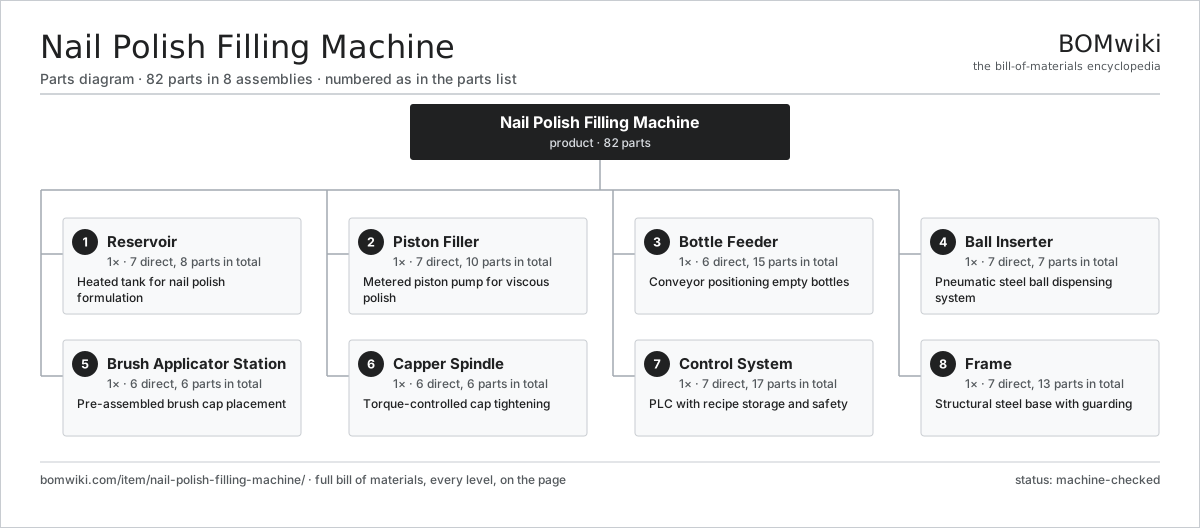
| # | Part | Qty | What it does |
|---|---|---|---|
| 1 | Reservoir 7 parts | 1× | Heated tank for nail polish formulation |
| 2 | Piston Filler 7 parts | 1× | Metered piston pump for viscous polish |
| 3 | Bottle Feeder 6 parts | 1× | Conveyor positioning empty bottles |
| 4 | Ball Inserter 7 parts | 1× | Pneumatic steel ball dispensing system |
| 5 | Brush Applicator Station 6 parts | 1× | Pre-assembled brush cap placement |
| 6 | Capper Spindle 6 parts | 1× | Torque-controlled cap tightening |
| 7 | Control System 7 parts | 1× | PLC with recipe storage and safety |
| 8 | Frame 7 parts | 1× | Structural steel base with guarding |
3D model
No 3D model yet. Have a CAD file of this? Add a 3D model — STL renders right on this page; STEP, FreeCAD, and OpenSCAD sources are welcome too (openly licensed, like all 3D models on BOMwiki).
Build & assembly graph
expand / collapse · shared sub-assemblies converge · links to related products · est. labourTap an assembly to expand/collapse · tap a part to open it · use “Open page” for any node · drag to pan, scroll to zoom.
Bill of materials for Nail Polish Filling Machine
8 top-level lines · 61 rows shown · 82 parts total · indented to 3 levels| # | Item / sub-assembly | Part no. | Qty/assy | Ext. qty | Parts | Type |
|---|---|---|---|---|---|---|
| 1 | Reservoir 7 parts | nail-polish-filling-machine-reservoir | 1× | 1 | 8 | assembly |
| 1.1 | Tank Body | nail-polish-filling-machine-tank-body | 1× | 1 | · | part |
| 1.2 | Heating Jacket | nail-polish-filling-machine-heating-jacket | 1× | 1 | · | part |
| 1.3 | Stirrer Motor | nail-polish-filling-machine-stirrer-motor | 1× | 1 | · | part |
| 1.4 | Stirrer Shaft | nail-polish-filling-machine-stirrer-shaft | 1× | 1 | · | part |
| 1.5 | Viscosity Sensor | nail-polish-filling-machine-viscosity-sensor | 1× | 1 | · | part |
| 1.6 | Temperature Sensor | temperature-sensor | 1× | 1 | · | part |
| 1.7 | Connector | connector | 2× | 2 | · | part |
| 2 | Piston Filler 7 parts | nail-polish-filling-machine-piston-filler | 1× | 1 | 10 | assembly |
| 2.1 | Pump Cylinder | nail-polish-filling-machine-pump-cylinder | 1× | 1 | · | part |
| 2.2 | Check Valve (Inlet) | nail-polish-filling-machine-check-valve-inlet | 1× | 1 | · | part |
| 2.3 | Check Valve (Outlet) | nail-polish-filling-machine-check-valve-outlet | 1× | 1 | · | part |
| 2.4 | Proportional Solenoid | nail-polish-filling-machine-proportional-solenoid | 1× | 1 | · | part |
| 2.5 | Fill Nozzle | nail-polish-filling-machine-fill-nozzle | 4× | 4 | · | part |
| 2.6 | Microcontroller | mcu | 1× | 1 | · | part |
| 2.7 | Connector | connector | 1× | 1 | · | part |
| 3 | Bottle Feeder 6 parts | nail-polish-filling-machine-bottle-feeder | 1× | 1 | 15 | assembly |
| 3.1 | Index Table | nail-polish-filling-machine-index-table | 1× | 1 | · | part |
| 3.2 | Bottle Clamp | nail-polish-filling-machine-bottle-clamp | 6× | 6 | · | part |
| 3.3 | Position Sensor | nail-polish-filling-machine-position-sensor | 4× | 4 | · | part |
| 3.4 | Pneumatic Clamp Solenoid | nail-polish-filling-machine-pneumatic-clamp-solenoid | 1× | 1 | · | part |
| 3.5 | Ball Bearing | ball-bearing | 2× | 2 | · | part |
| 3.6 | Encoder | encoder | 1× | 1 | · | part |
| 4 | Ball Inserter 7 parts | nail-polish-filling-machine-ball-inserter | 1× | 1 | 7 | assembly |
| 4.1 | Ball Hopper | nail-polish-filling-machine-ball-hopper | 1× | 1 | · | part |
| 4.2 | Ball Vibrator | nail-polish-filling-machine-ball-vibrator | 1× | 1 | · | part |
| 4.3 | Ball Pickup Arm | nail-polish-filling-machine-ball-pickup-arm | 1× | 1 | · | part |
| 4.4 | Ball Gripper | nail-polish-filling-machine-ball-gripper | 1× | 1 | · | part |
| 4.5 | Ball Insertion Cylinder | nail-polish-filling-machine-ball-insertion-cylinder | 1× | 1 | · | part |
| 4.6 | Ball Presence Sensor | nail-polish-filling-machine-ball-presence-sensor | 1× | 1 | · | part |
| 4.7 | Connector | connector | 1× | 1 | · | part |
| 5 | Brush Applicator Station 6 parts | nail-polish-filling-machine-brush-applicator-station | 1× | 1 | 6 | assembly |
| 5.1 | Applicator Feeder | nail-polish-filling-machine-applicator-feeder | 1× | 1 | · | part |
| 5.2 | Applicator Placement Arm | nail-polish-filling-machine-applicator-placement-arm | 1× | 1 | · | part |
| 5.3 | Applicator Gripper | nail-polish-filling-machine-applicator-gripper | 1× | 1 | · | part |
| 5.4 | Applicator Presence Sensor | nail-polish-filling-machine-applicator-presence-sensor | 1× | 1 | · | part |
| 5.5 | Insertion Depth Stop | nail-polish-filling-machine-applicator-insertion-depth-stop | 1× | 1 | · | part |
| 5.6 | Connector | connector | 1× | 1 | · | part |
| 6 | Capper Spindle 6 parts | nail-polish-filling-machine-capper-spindle | 1× | 1 | 6 | assembly |
| 6.1 | Capping Motor | nail-polish-filling-machine-capping-motor | 1× | 1 | · | part |
| 6.2 | Cap Chuck | nail-polish-filling-machine-cap-chuck | 1× | 1 | · | part |
| 6.3 | Cap Torque Transducer | nail-polish-filling-machine-cap-torque-transducer | 1× | 1 | · | part |
| 6.4 | Cap Feeder Bowl | nail-polish-filling-machine-cap-feeder-bowl | 1× | 1 | · | part |
| 6.5 | Cap Presence Sensor | nail-polish-filling-machine-cap-presence-sensor | 1× | 1 | · | part |
| 6.6 | Servo Drive | nail-polish-filling-machine-servo-drive | 1× | 1 | · | part |
| 7 | Control System 7 parts | nail-polish-filling-machine-control-system | 1× | 1 | 17 | assembly |
| 7.1 | Microcontroller | mcu | 1× | 1 | · | part |
| 7.2 | Relay | relay | 8× | 8 | · | part |
| 7.3 | Main Servo Amplifier | nail-polish-filling-machine-servo-amplifier-main | 1× | 1 | · | part |
| 7.4 | Touchscreen | nail-polish-filling-machine-touchscreen | 1× | 1 | · | part |
| 7.5 | Bare PCB | pcb-bare | 1× | 1 | · | part |
| 7.6 | Power Supply | power-supply | 2× | 2 | · | part |
| 7.7 | Thermal Fuse | thermal-fuse | 3× | 3 | · | part |
| 8 | Frame 7 parts | nail-polish-filling-machine-frame | 1× | 1 | 13 | assembly |
| 8.1 | Frame Tubing | nail-polish-filling-machine-frame-tubing | 1× | 1 | · | part |
| 8.2 | Pneumatic Manifold | nail-polish-filling-machine-pneumatic-manifold | 1× | 1 | · | part |
| 8.3 | Air Regulator Filter | nail-polish-filling-machine-air-regulator-filter | 1× | 1 | · | part |
| 8.4 | Emergency Stop | nail-polish-filling-machine-emergency-stop | 1× | 1 | · | part |
| 8.5 | Sheet Metal Panel | sheet-panel | 4× | 4 | · | part |
| 8.6 | Fastener Set | fastener-set | 1× | 1 | · | part |
| 8.7 | Wheels | nail-polish-filling-machine-wheels | 4× | 4 | · | part |
Related products
same domain, ranked by shared parts Wet Wipes Machine
104 parts · shares 5 with this page
Wet Wipes Machine
104 parts · shares 5 with this page
 Industrial FDM Printer
98 parts · shares 7 with this page
Industrial FDM Printer
98 parts · shares 7 with this page
 Cosmetic Powder Press
92 parts · shares 6 with this page
Desiccant Resin Dryer
88 parts · shares 6 with this page
Cosmetic Powder Press
92 parts · shares 6 with this page
Desiccant Resin Dryer
88 parts · shares 6 with this page
Sourcing: possible vendors
Prices, MOQ, and lead times are algorithmic estimates, not quotes, and not claims about these companies. Company mappings are curated by keyword; est. price band $5k–$2M. How estimates work| Vendor | HQ | Specialty | MOQ | Lead time |
|---|---|---|---|---|
| atlascopco.com ↗ | Stockholm, SE | Compressors & industrial | 10 units | 12–20 wks |
|
🇦🇹Andritz
andritz.com ↗
|
Graz, AT | Process plants & machinery | 10 units | 12–20 wks |
| buhlergroup.com ↗ | Uzwil, CH | Food & materials processing | 10 units | 12–20 wks |
| gea.com ↗ | Düsseldorf, DE | Process technology | 10 units | 12–20 wks |
| mhi.com ↗ | Tokyo, JP | Heavy machinery | 10 units | 12–20 wks |
1,342-word article