Electric Nibbler
ProductOverview
An electric nibbler is a specialized sheet-metal cutting tool that removes metal by punching a series of small overlapping holes, leaving a clean cut line. Unlike shears that require two opposing blades or saws that use abrasive cutting, nibblers excel at curved cuts, internal openings, and complex geometry where straight-line cutting tools are impractical.
The tool is essential in HVAC fabrication, automotive bodywork, appliance manufacturing, and restoration work. Curved ductwork, trim rings, access holes, and geometric cutouts are far faster and cleaner with a nibbler than with alternative methods.
How it Works
The Brushless Motor Assembly brushless motor runs at 4500 RPM, powered by the Lithium-Ion Battery Pack 20V lithium-ion pack. The motor output couples to the Drive Gearbox and Crankshaft, a planetary gear reducer stepping speed down to approximately 800–1000 strokes per minute while multiplying torque.
The gearbox output is the Output Crankshaft, an eccentric lobe. As it rotates, the eccentric drives the Punch Drive Carrier link, oscillating the Oscillating Punch (upper punch) in rapid up-and-down motion. The Fixed Die Plate (lower die) remains stationary.
As the operator positions the Material Engagement Guide against the material and pulls the trigger, the Oscillating Punch descends into the die socket, punching out a small circular disc (approximately 7 mm diameter) of the material. The punch retracts, ejects the spent slug through the Slug Diverter Plate into the collection chute, and repositions for the next punch.
At 800+ strokes per minute, this punching sequence repeats rapidly. The operator advances the tool along a scribed cut line, and successive overlapping punches create a continuous cut. The overlap between adjacent punch holes is typically 2–3 mm, creating a clean interior edge with minimal burr.
The Variable-Speed Control Electronics board allows proportional speed modulation: half-trigger delivers slower punch rate (approximately 400 strokes/min), full-trigger maximum rate. Slower speeds provide better control for intricate curves; faster speeds maximize productivity on straight cuts.
Punch and Die Design
The Oscillating Punch and Fixed Die Plate are hardened tool steel, typically 58–62 HRC (Rockwell hardness). The punch face is hardened for wear resistance and sharpened to a keen edge. The die backing plate has a precision socket slightly oversize to the punch, allowing free punch motion while containing the cut metal.
Punch diameters vary: 5 mm (fine, slow-cutting), 7 mm (standard), and 10 mm (coarse, fast) are common. The larger the punch, the faster the cutting but the larger the tooth spacing in the cut and the harder the punch load (higher motor torque required).
Over 50–100 hours of heavy cutting, punch edges dull and cutting slows. Most professional operators replace punch-die sets every 60–80 hours of use. Replacement costs are modest ($20–40), and swap-out takes 2–3 minutes.
Material Cutting Capability
This model cuts mild steel up to 2.4 mm (16 gauge) and aluminum up to 3.2 mm. Stainless steel is harder and typically limited to 1.6–2.0 mm. Copper, brass, and other soft metals cut easily at maximum thickness.
Maximum thickness is determined by punch force (motor torque) and die support. Attempting to punch thicker material causes motor stalling or chattering; the operator must either thin the stock or select a smaller-diameter punch.
Curved Cutting and Complex Geometry
The nibbler excels at curves of any radius. By contrast, shears require straight-line feed and produce poor results on radii less than 50 mm. Nibblers can cut radii of 10 mm or tighter with proper control.
For internal openings (holes, cutouts), the operator drills a small pilot hole, inserts the punch through it, and nibblers the perimeter. This is impossible with shears or saws without starting damage.
Professional operators freehand curved cuts along scribed lines, developing feel for feed rate and punch engagement. Smooth operation (steady advance, minimal vibration) indicates proper technique; chattering or slowing indicates the feed is too fast or the material thickness exceeds design limits.
Slug and Chip Ejection
Each punch removes a small disc-shaped "slug" of metal. The Slug Diverter Plate angled deflector guides these slugs away from the operator into the Chip Collection Port. Over a single cutting operation lasting 5–10 minutes, dozens of slugs accumulate; a collection bin or vacuum system catches them.
Slugs are sharp and warm but not dangerously hot like shear chips. Proper training teaches operators never to attempt to clear jams by hand or to reach toward the punch.
Speed Control and Precision
The Variable-Speed Control Electronics proportional trigger allows deliberate speed adjustment. For delicate materials or precise curves, reduce speed to 50% for maximum control. For production runs on straight or gentle curves, full speed maximizes productivity.
Experienced nibblers adjust speed mid-cut, slowing for corner work and accelerating on straightaways. This requires practice but significantly improves both speed and cut quality.
Vibration and Operator Control
Reciprocating punch mechanisms generate substantial vibration. The Rubberized Grip Sleeve elastomer dampens high-frequency vibration, but the user still feels the punch action through the handle. On extended cutting (6+ hours), operator fatigue becomes limiting.
Hand-wrapping the grip with additional elastomer tape can further reduce vibration. Some operators prefer a bench-mounted vice setup for high-volume repetitive cutting, supporting the nibbler on a stand and advancing the material by hand instead of supporting the tool.
Battery Runtime
A 2.0 Ah battery provides approximately 1–2 hours of continuous cutting on aluminum, less on steel due to higher punch load. Most job sites use two batteries, rotating between charge and active use.
Thermal Management
Sustained punching generates heat in the motor and gearbox, dissipated passively through the Main Housing Body aluminum casting. The tool reaches thermal equilibrium within 30 minutes of continuous operation and maintains temperature unless the ambient is extreme (over 45°C).
Applications
HVAC Fabrication: Cutting curved ductwork sections, return-air openings, and trim rings.
Automotive Restoration: Internal openings, trim cutouts, and geometric patches on body panels.
Appliance Manufacturing: Access holes for control panels, water inlets, and internal bracing.
Sheet-Metal Art and Decoration: Complex geometric cutouts and sculptural piercing.
Light Structural Fabrication: Bolt holes, cable routing, and vent openings in light gauge steel frames.
Comparison to Shears and Saws
Shears produce poor results on tight curves (less than 100 mm radius) and cannot punch internal openings without breaking the tool. Saws can cut tight curves but produce heat, dust, and extensive burr requiring post-cutting cleanup.
Nibblers sacrifice some speed compared to shears on straight cuts but excel on curves and internal geometry, and produce nearly burr-free edges that often require no finishing. For diverse cutting tasks on a job site, nibblers are more versatile than either shears or saws.
Comparison to Hand Nibblers
Manual lever-operated nibblers are still used for occasional light cutting but require significant hand force and slow productivity (typically 20–30 meters per hour versus 100+ meters per hour with electric nibblers). The cordless electric variant is universally preferred on commercial job sites.
Maintenance
Punch and die replacement is the primary service. The Brushless Motor Assembly is brushless and requires no maintenance. The Drive Gearbox and Crankshaft runs in sealed oil and requires no user service. Periodic inspection of the Material Engagement Guide for wear and replacement if deformed ensures consistent cut quality.
Electric Nibbler parts and their functions
8 top-level parts · 60 parts in total · full bill of materials below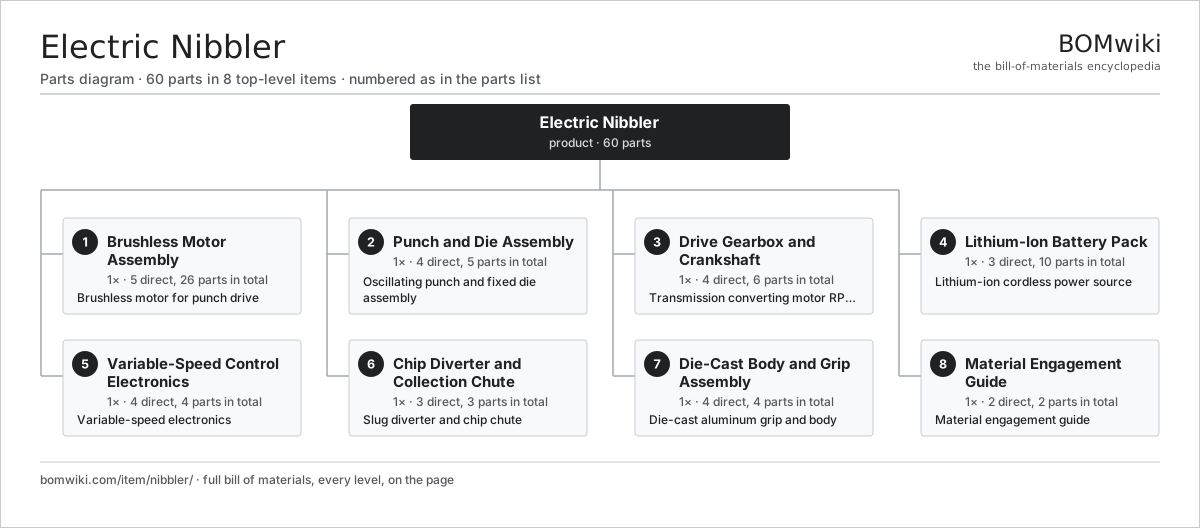
| # | Part | Qty | What it does |
|---|---|---|---|
| 1 | Brushless Motor Assembly 5 parts | 1× | Brushless motor for punch drive |
| 2 | Punch and Die Assembly 4 parts | 1× | Oscillating punch and fixed die assembly |
| 3 | Drive Gearbox and Crankshaft 4 parts | 1× | Transmission converting motor RPM to punching frequency |
| 4 | Lithium-Ion Battery Pack 3 parts | 1× | Lithium-ion cordless power source |
| 5 | Variable-Speed Control Electronics 4 parts | 1× | Variable-speed electronics |
| 6 | Chip Diverter and Collection Chute 3 parts | 1× | Slug diverter and chip chute |
| 7 | Die-Cast Body and Grip Assembly 4 parts | 1× | Die-cast aluminum grip and body |
| 8 | Material Engagement Guide 2 parts | 1× | Material engagement guide |
3D model
No 3D model yet. Have a CAD file of this? Add a 3D model. STL renders right on this page; STEP, FreeCAD, and OpenSCAD sources are welcome too (openly licensed, like all 3D models on BOMwiki).
Build & assembly graph
expand / collapse · shared sub-assemblies converge · links to related products · est. labourTap an assembly to expand/collapse · tap a part to open it · use “Open page” for any node · drag to pan, scroll to zoom.
Bill of materials for Electric Nibbler
8 top-level lines · 41 rows shown · 60 parts total · indented to 3 levels| # | Item / sub-assembly | Part no. | Qty/assy | Ext. qty | Parts | Type |
|---|---|---|---|---|---|---|
| 1 | Brushless Motor Assembly 5 parts | nibbler-motor | 1× | 1 | 26 | assembly |
| 1.1 | Motor Housing | motor-housing | 1× | 1 | · | part |
| 1.2 | Rotor Assembly 4 parts | rotor-assembly | 1× | 1 | 19 | assembly |
| 1.2.1 | Rotor Shaft | rotor-shaft | 1× | 1 | · | part |
| 1.2.2 | Rotor Core | rotor-core | 1× | 1 | · | part |
| 1.2.3 | Neodymium Magnet | neodymium-magnet | 16× | 16 | · | part |
| 1.2.4 | Ball Bearing | ball-bearing | 1× | 1 | · | part |
| 1.3 | Copper Winding | copper-winding | 2× | 2 | · | part |
| 1.4 | Hall Sensor | hall-sensor | 2× | 2 | · | part |
| 1.5 | Ball Bearing | ball-bearing | 2× | 2 | · | part |
| 2 | Punch and Die Assembly 4 parts | nibbler-punch-die-head | 1× | 1 | 5 | assembly |
| 2.1 | Oscillating Punch | nibbler-punch | 1× | 1 | · | part |
| 2.2 | Fixed Die Plate | nibbler-fixed-die | 1× | 1 | · | part |
| 2.3 | Punch Drive Carrier | nibbler-punch-carrier | 1× | 1 | · | part |
| 2.4 | Ball Bearing | ball-bearing | 2× | 2 | · | part |
| 3 | Drive Gearbox and Crankshaft 4 parts | nibbler-gearbox | 1× | 1 | 6 | assembly |
| 3.1 | Helical Gear Pair | gear-pair | 2× | 2 | · | part |
| 3.2 | Output Crankshaft | nibbler-crankshaft | 1× | 1 | · | part |
| 3.3 | Gearbox Housing | gearbox-housing | 1× | 1 | · | part |
| 3.4 | Ball Bearing | ball-bearing | 2× | 2 | · | part |
| 4 | Lithium-Ion Battery Pack 3 parts | nibbler-battery | 1× | 1 | 10 | assembly |
| 4.1 | Li-ion Cell, 18650 | li-cell-18650 | 8× | 8 | · | part |
| 4.2 | BMS Board | bms-board | 1× | 1 | · | part |
| 4.3 | Battery Connector | nibbler-battery-connector | 1× | 1 | · | part |
| 5 | Variable-Speed Control Electronics 4 parts | nibbler-speed-control | 1× | 1 | 4 | assembly |
| 5.1 | Bare PCB | pcb-bare | 1× | 1 | · | part |
| 5.2 | Power MOSFET | mosfet | 1× | 1 | · | part |
| 5.3 | SMD Passive (R/C/L) | smd-passives | 1× | 1 | · | part |
| 5.4 | Microcontroller | mcu | 1× | 1 | · | part |
| 6 | Chip Diverter and Collection Chute 3 parts | nibbler-chip-collection | 1× | 1 | 3 | assembly |
| 6.1 | Slug Diverter Plate | nibbler-slug-diverter | 1× | 1 | · | part |
| 6.2 | Chip Collection Port | nibbler-collection-chute | 1× | 1 | · | part |
| 6.3 | Fastener Set | fastener-set | 1× | 1 | · | part |
| 7 | Die-Cast Body and Grip Assembly 4 parts | nibbler-housing | 1× | 1 | 4 | assembly |
| 7.1 | Main Housing Body | nibbler-main-body | 1× | 1 | · | part |
| 7.2 | Rubberized Grip Sleeve | nibbler-grip-rubber | 1× | 1 | · | part |
| 7.3 | Trigger Switch | nibbler-trigger-switch | 1× | 1 | · | part |
| 7.4 | Fastener Set | fastener-set | 1× | 1 | · | part |
| 8 | Material Engagement Guide 2 parts | nibbler-guide-shoe | 1× | 1 | 2 | assembly |
| 8.1 | Shoe Guide Plate | nibbler-shoe-plate | 1× | 1 | · | part |
| 8.2 | Fastener Set | fastener-set | 1× | 1 | · | part |
Something wrong in this list? Report a problem with this BOM.
Related products
same domain, ranked by shared parts Reciprocating Saw
85 parts · shares 7 with this page
Right-Angle Drill
51 parts · shares 7 with this page
Reciprocating Saw
85 parts · shares 7 with this page
Right-Angle Drill
51 parts · shares 7 with this page
 Airless Paint Sprayer
97 parts · shares 5 with this page
Airless Paint Sprayer
97 parts · shares 5 with this page
 Impact Wrench
87 parts · shares 6 with this page
Impact Wrench
87 parts · shares 6 with this page
Sourcing: possible vendors
Browse the supplier directory → Prices, MOQ, and lead times are algorithmic estimates, not quotes, and not claims about these companies. Company mappings are curated by keyword; est. price band $30–$800. How estimates work| Vendor | HQ | Specialty | MOQ | Lead time |
|---|---|---|---|---|
| stanleyblackanddecker.com ↗ | New Britain, US | Tools (DeWalt, Craftsman) | 500 units | 6–12 wks |
| bosch-professional.com ↗ | Leinfelden, DE | Power tools | 500 units | 6–12 wks |
| ttigroup.com ↗ | Hong Kong, CN | Tools (Milwaukee, Ryobi) | 500 units | 6–12 wks |
|
🇯🇵Makita
makita.com ↗
|
Anjo, JP | Power tools | 500 units | 6–12 wks |
|
🇨🇭Hilti
hilti.com ↗
|
Schaan, CH | Construction tools | 500 units | 6–12 wks |
1,210-word article