Ophthalmic YAG/SLT Laser
ProductOverview
An ophthalmic YAG laser is a surgical precision instrument used for two main procedures: selective laser trabeculoplasty (SLT) to lower intraocular pressure in glaucoma, and YAG capsulotomy/hyaloidotomy to ablate posterior capsule opacification or vitreous membranes. The laser fires nanosecond pulses of near-infrared light at highly specific anatomical targets inside or on the eye surface. Because the laser light focuses to a spot size of 50–100 micrometers and the pulse duration is less than a microsecond, the energy is concentrated enough to vaporize tissue without collateral heat damage, a property unique to pulsed lasers and impossible with continuous-wave systems.
The Laser Cavity & Pump contains a neodymium-doped crystal rod pumped by a flash lamp or diode array, generating coherent 1064 nm light. The Beam Delivery System route this light through an optical fiber into the Slit Lamp Delivery Head, where a Aiming Beam Path shows the surgeon where the shot will land. The surgeon positions the Slit Lamp Delivery Head against the patient's eye with a contact lens, sets energy and pulse count via the Energy Control & Display Unit, and fires by stepping on the Foot Pedal Firing Control.
How it works
The Nd:YAG crystal is pumped by a pulsed xenon Flash Lamp or Diode Pump or, in newer designs, a semiconductor diode pump array. The flash lamp emits broad-spectrum light; only photons matching the Nd absorption band (around 805 nm) excite electrons in the crystal. Those excited electrons fall back to the metastable state, where they stimulate emission of 1064 nm photons. The Cavity Mirror Assembly form a Fabry-Pérot cavity, bouncing light back and forth through the crystal many times per microsecond until a coherent pulse builds and exits through the output coupler.
Each pulse is typically 1–3 nanoseconds long and carries 0.5–1.5 joules of energy (for SLT) or 2–10 millijoules (for YAG-cap ablation). That energy arrives in an incredibly brief timespan, all 1.5 joules delivered in a fraction of a microsecond, creating an irradiance (power per unit area) of gigawatts per square centimeter. This extreme irradiance causes tissue to rapidly vaporize (ablate) without allowing surrounding tissue time to conduct and dissipate heat; in essence, the laser creates a tiny plasma column on the tissue surface.
For SLT, the target is the trabecular meshwork inside the eye's anterior chamber. Melanin-rich trabecular cells absorb the 1064 nm light; the resulting photomechanical effect (pressure from vaporization) opens up the trabecular spaces and increases aqueous humor outflow, lowering intraocular pressure. The low power and wide spot size (400–600 µm) mean minimal collateral damage, most of the energy is absorbed by melanin-rich cells rather than vaporizing tissue wholesale.
For YAG capsulotomy, the surgeon targets the posterior lens capsule (or a vitreous membrane) behind the intraocular lens. The Aiming Beam Path is a low-power red diode laser (650 nm) coaxial with the treatment beam; it shows a small red dot exactly where the YAG pulse will strike. The surgeon focuses the slit lamp and fine-tunes position with a joystick. Once aligned, stepping the Foot Pedal Firing Control triggers the control electronics to fire one or more YAG pulses. The lens Treatment Focusing Lens converges the light to a tight point; the Optical Contact Lens may be pressed against the cornea to improve optics.
The Water Cooling & Chiller is critical because the flash lamp converts only 0.5–3% of electrical input into useful 1064 nm light; the rest becomes heat. A Heat Exchanger Radiator dissipates this waste heat to room air, and a Temperature Control Valve maintains water temperature at 20–25 °C. If the laser chamber temperature exceeds 35 °C, the Energy Control & Display Unit automatically shuts down firing until the system cools.
All outputs, lamp pulse timing, shutter control, cooling pump speed, are orchestrated by the Energy Control & Display Unit. An operator adjusts the Energy Adjustment Dial to set the pulse energy (in joules), selects pulse repetition rate, and enters the number of shots to fire. The console ensures that each shot is preceded by a cooling-down period so the crystal does not overheat and lase prematurely; this is called cavity dumping or Q-switching and is essential for reliable nanosecond pulse generation.
The Interlocked Safety Shutter is an interlocked mechanical shutter that remains closed unless the slit lamp microscope is properly positioned and the eye is in the optical path, a fail-safe preventing accidental firing into empty space or the surgeon's hand.
Ophthalmic YAG/SLT Laser parts and their functions
9 top-level parts · 46 parts in total · full bill of materials below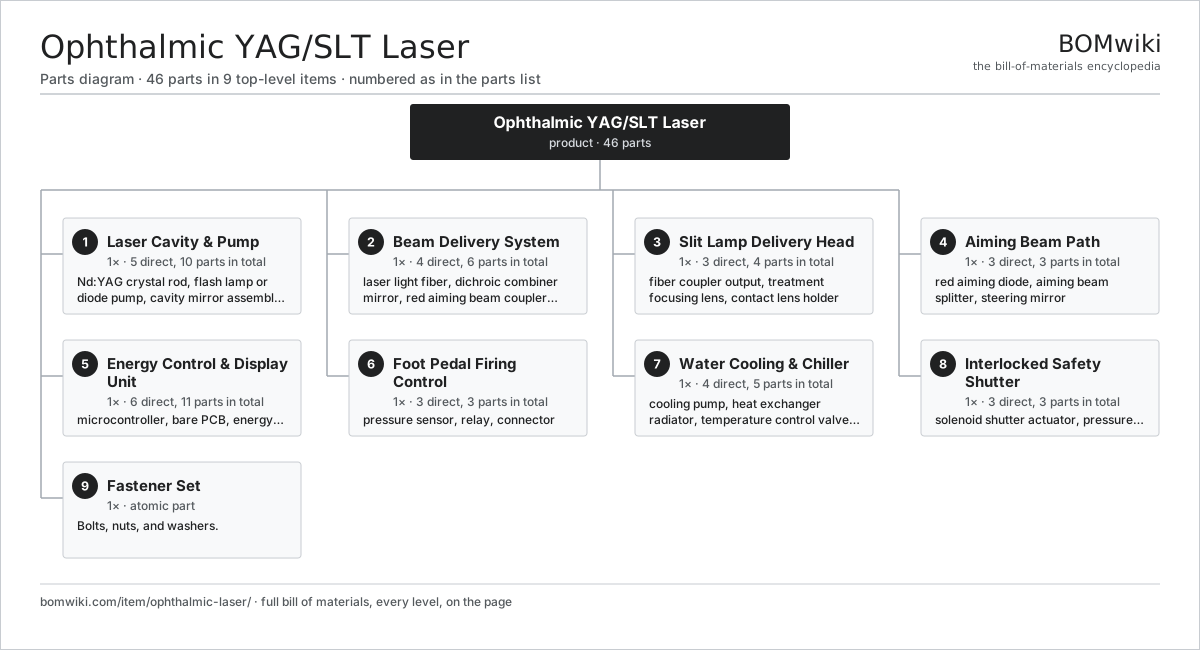
| # | Part | Qty | What it does |
|---|---|---|---|
| 1 | Laser Cavity & Pump 5 parts | 1× | YAG or frequency-doubled Nd:YAG crystal excited by flash lamp or diode pump. |
| 2 | Beam Delivery System 4 parts | 1× | Waveguide or fiber-coupled optics routing laser light to the slit lamp. |
| 3 | Slit Lamp Delivery Head 3 parts | 1× | Optical path that integrates laser light into the clinical slit lamp for precise targeting. |
| 4 | Aiming Beam Path 3 parts | 1× | Red dot guidance system helping clinician target the laser spot onto anatomy. |
| 5 | Energy Control & Display Unit 6 parts | 1× | Microcontroller allowing operator to set pulse energy, duration, rate, and trigger firing. |
| 6 | Foot Pedal Firing Control 3 parts | 1× | Sterile footswitch allowing hands-free laser firing during procedure. |
| 7 | Water Cooling & Chiller 4 parts | 1× | Recirculating water loop removing flash lamp or diode pump heat. |
| 8 | Interlocked Safety Shutter 3 parts | 1× | Automatic shutter closes if slit lamp is not properly positioned to prevent stray firing. |
| 9 | Fastener Set | 1× | Bolts, nuts, and washers. |
3D model
No 3D model yet. Have a CAD file of this? Add a 3D model. STL renders right on this page; STEP, FreeCAD, and OpenSCAD sources are welcome too (openly licensed, like all 3D models on BOMwiki).
Build & assembly graph
expand / collapse · shared sub-assemblies converge · links to related products · est. labourTap an assembly to expand/collapse · tap a part to open it · use “Open page” for any node · drag to pan, scroll to zoom.
Bill of materials for Ophthalmic YAG/SLT Laser
9 top-level lines · 51 rows shown · 46 parts total · indented to 3 levels| # | Item / sub-assembly | Part no. | Qty/assy | Ext. qty | Parts | Type |
|---|---|---|---|---|---|---|
| 1 | Laser Cavity & Pump 5 parts | ophthalmic-laser-cavity | 1× | 1 | 10 | assembly |
| 1.1 | Nd:YAG Crystal Rod | ophthalmic-laser-crystal | 1× | 1 | · | part |
| 1.2 | Flash Lamp or Diode Pump | ophthalmic-laser-pump-lamp | 1× | 1 | · | part |
| 1.3 | Cavity Mirror Assembly 2 parts | ophthalmic-laser-mirrors | 2× | 2 | 3 | assembly |
| 1.3.1 | Mirror Glass Substrate | ophthalmic-laser-mirror-substrate | 2× | 4 | · | part |
| 1.3.2 | Dielectric Coating | ophthalmic-laser-mirror-coating | 1× | 2 | · | part |
| 1.4 | Cooling Water Jacket | ophthalmic-laser-cooling-conduit | 1× | 1 | · | part |
| 1.5 | Thermal Fuse | thermal-fuse | 1× | 1 | · | part |
| 2 | Beam Delivery System 4 parts | ophthalmic-laser-delivery-optics | 1× | 1 | 6 | assembly |
| 2.1 | Laser Light Fiber | ophthalmic-laser-optical-fiber | 1× | 1 | · | part |
| 2.2 | Dichroic Combiner Mirror | ophthalmic-laser-dichroic-mirror | 1× | 1 | · | part |
| 2.3 | Red Aiming Beam Coupler 3 parts | ophthalmic-laser-aiming-coupler | 1× | 1 | 3 | assembly |
| 2.3.1 | Red Aiming Diode | ophthalmic-laser-red-diode | 1× | 1 | · | part |
| 2.3.2 | Bare PCB | pcb-bare | 1× | 1 | · | part |
| 2.3.3 | Connector | connector | 1× | 1 | · | part |
| 2.4 | Mechanical Shutter | ophthalmic-laser-shutter | 1× | 1 | · | part |
| 3 | Slit Lamp Delivery Head 3 parts | ophthalmic-laser-slit-lamp | 1× | 1 | 4 | assembly |
| 3.1 | Fiber Coupler Output | ophthalmic-laser-fiber-terminus | 1× | 1 | · | part |
| 3.2 | Treatment Focusing Lens | ophthalmic-laser-focusing-lens | 1× | 1 | · | part |
| 3.3 | Contact Lens Holder 2 parts | ophthalmic-laser-contact-lens-mount | 1× | 1 | 2 | assembly |
| 3.3.1 | Optical Contact Lens | ophthalmic-laser-contact-lens | 1× | 1 | · | part |
| 3.3.2 | Fastener Set | fastener-set | 1× | 1 | · | part |
| 4 | Aiming Beam Path 3 parts | ophthalmic-laser-aiming-beam | 1× | 1 | 3 | assembly |
| 4.1 | Red Aiming Diode | ophthalmic-laser-red-diode | 1× | 1 | · | part |
| 4.2 | Aiming Beam Splitter | ophthalmic-laser-beam-splitter | 1× | 1 | · | part |
| 4.3 | Steering Mirror | ophthalmic-laser-mirror | 1× | 1 | · | part |
| 5 | Energy Control & Display Unit 6 parts | ophthalmic-laser-energy-console | 1× | 1 | 11 | assembly |
| 5.1 | Microcontroller | mcu | 1× | 1 | · | part |
| 5.2 | Bare PCB | pcb-bare | 1× | 1 | · | part |
| 5.3 | Energy Adjustment Dial | ophthalmic-laser-energy-dial | 1× | 1 | · | part |
| 5.4 | LCD Power Display 2 parts | ophthalmic-laser-display | 1× | 1 | 2 | assembly |
| 5.4.1 | LCD Panel | lcd-panel | 1× | 1 | · | part |
| 5.4.2 | Connector | connector | 1× | 1 | · | part |
| 5.5 | Relay | relay | 2× | 2 | · | part |
| 5.6 | Connector | connector | 4× | 4 | · | part |
| 6 | Foot Pedal Firing Control 3 parts | ophthalmic-laser-footswitch | 1× | 1 | 3 | assembly |
| 6.1 | Pressure Sensor | pressure-sensor | 1× | 1 | · | part |
| 6.2 | Relay | relay | 1× | 1 | · | part |
| 6.3 | Connector | connector | 1× | 1 | · | part |
| 7 | Water Cooling & Chiller 4 parts | ophthalmic-laser-cooling-system | 1× | 1 | 5 | assembly |
| 7.1 | Cooling Pump 2 parts | ophthalmic-laser-pump | 1× | 1 | 2 | assembly |
| 7.1.1 | Blower Motor | blower-motor | 1× | 1 | · | part |
| 7.1.2 | Motor Housing | motor-housing | 1× | 1 | · | part |
| 7.2 | Heat Exchanger Radiator | ophthalmic-laser-radiator | 1× | 1 | · | part |
| 7.3 | Temperature Control Valve | ophthalmic-laser-thermostat | 1× | 1 | · | part |
| 7.4 | Thermal Fuse | thermal-fuse | 1× | 1 | · | part |
| 8 | Interlocked Safety Shutter 3 parts | ophthalmic-laser-safety-shutter | 1× | 1 | 3 | assembly |
| 8.1 | Solenoid Shutter Actuator | ophthalmic-laser-shutter-solenoid | 1× | 1 | · | part |
| 8.2 | Pressure Sensor | pressure-sensor | 1× | 1 | · | part |
| 8.3 | Relay | relay | 1× | 1 | · | part |
| 9 | Fastener Set | fastener-set | 1× | 1 | · | part |
Something wrong in this list? Report a problem with this BOM.
Related products
same domain, ranked by shared parts Dermatology Laser
58 parts · shares 6 with this page
Endoscope Washer-Disinfector
87 parts · shares 6 with this page
Dermatology Laser
58 parts · shares 6 with this page
Endoscope Washer-Disinfector
87 parts · shares 6 with this page
 PET-CT Scanner
514 parts · shares 6 with this page
PET-CT Scanner
514 parts · shares 6 with this page
 Tympanometer
55 parts · shares 5 with this page
Tympanometer
55 parts · shares 5 with this page
 Oxygen Concentrator
155 parts · shares 5 with this page
Heart-Lung Machine
298 parts · shares 5 with this page
Oxygen Concentrator
155 parts · shares 5 with this page
Heart-Lung Machine
298 parts · shares 5 with this page
Sourcing: possible vendors
Browse the supplier directory → Prices, MOQ, and lead times are algorithmic estimates, not quotes, and not claims about these companies. Company mappings are curated by keyword; est. price band $500–$3M. How estimates work| Vendor | HQ | Specialty | MOQ | Lead time |
|---|---|---|---|---|
| gehealthcare.com ↗ | Chicago, US | Medical imaging & devices | 100 units | 12–20 wks |
| siemens-healthineers.com ↗ | Erlangen, DE | Medical systems | 100 units | 12–20 wks |
|
🇳🇱Philips
philips.com ↗
|
Amsterdam, NL | Health technology | 100 units | 12–20 wks |
| medtronic.com ↗ | Minneapolis, US | Medical devices | 100 units | 12–20 wks |
|
🇨🇳Mindray
mindray.com ↗
|
Shenzhen, CN | Medical devices | 100 units | 12–20 wks |
761-word article