Orbital Welding Machine
ProductOverview
An orbital welding machine automates the joining of tubes and pipes by rotating a TIG (Tungsten Inert Gas) torch around the tube circumference while feeding filler metal and modulating power. The key advantage over manual tube welding is repeatability: the torch maintains a constant arc angle, arc length, and travel speed, eliminating the hand-wobble and inconsistency of manual TIG. Orbital welding is essential for critical applications, aerospace tubing, semiconductor process piping, medical devices, heat-exchanger bundles, where weld quality is non-negotiable and 100 % visual and radiographic inspection is routine.
The tube is held in a Tube Clamp & Chuck, which can optionally rotate the tube. The Orbital Torch Head Assembly orbits around the tube in a horizontal plane while the Control Pendant & HMI software synchronizes the Orbital Drive Motor rotation with the Precision Wire Feeder advance rate and the TIG Power Supply current profile. Typically, the first 1–2 passes (root and intermediate) are made without filler wire at lower current, and subsequent fill passes add wire at higher current. The result is a weld that is consistent in penetration, width, and bead appearance from start to finish around the entire circumference.
Orbital motion and arc positioning
The Orbital Drive Motor is a stepper or servo motor (NEMA 23/24) that rotates the Torch Carriage Arm in a horizontal plane. As the carriage orbits, the Orbital Torch Head Assembly traces a circular path around the tube. The torch is mounted on a fixed arm extending from the carriage center, so the Electrode Collet Holder traces a circle concentric with the tube axis.
Stepper motors are preferred in simple machines: they allow precise positioning without feedback, and the number of steps per revolution directly sets the torch speed. A NEMA 23 stepper at 200 steps/rev, geared 10:1, gives 2,000 steps per mechanical revolution, each step advances the torch tangentially by ~0.3 mm. At 100 Hz step rate, the torch speed is 30 mm/s or 1.8 m/min linear travel along the circumference.
Program sequencing: root, intermediate, fill
A typical 4-pass weld schedule is:
Root pass (no filler): 1–2 orbits at low current (100–150 A), 0.5–1.0 m/min travel. This establishes the weld pool and achieves fusion without buildup.
Intermediate pass (light filler): 1–2 orbits at moderate current (150–200 A), wire feed 1–3 m/min.
Fill passes (full filler): 2–3 orbits at higher current (200–300 A), wire feed 3–6 m/min. Each pass covers the previous weld and builds toward the final bead profile.
Finish pass (optional)**: 0.5–1 orbit at lower current for cosmetic appearance.
The Control Pendant & HMI stores 50–100 weld "recipes" (programs), each specifying current, wire feed, travel speed, and orbital speed for each pass. Selection is by button or touchscreen; the machine then executes the sequence automatically.
Filler metal and feed control
Filler wire is a critical variable. For 0.5 mm wall 316L stainless 6 mm OD tube, a typical filler is ER308L wire, 1.6 mm diameter. The wire feed rate is automatically ramped by the Control Pendant & HMI: during the root pass (no wire) it is zero, then it ramps to 1.5 m/min during the first fill pass, and up to 5 m/min on the final fill. Wire speed is maintained by a closed-loop Wire Feed Motor servo with Encoder feedback; the control loop adjusts motor power to maintain the setpoint feed rate even as wire reel diameter changes.
Poor wire feed causes under-fill (incomplete fusion between passes) or porosity (gas pockets in the weld). Erratic feed (slip-stick, speed oscillation) creates wavy bead edges and uneven width. A servo-controlled feeder ensures ± 5 % consistency, essential for inspecting joints radiographically at full-volume X-ray.
Current and arc length feedback
The TIG Power Supply is a DC inverter with arc-length regulation. The Current Feedback Sensor measures arc current in real-time. If arc length rises (torch drifting back), secondary voltage rises, and the current-control loop increases primary current to compensate, shortening the arc. If arc length drops (torch drifting forward), secondary voltage falls and the loop reduces current, extending the arc. This feedback compensates for surface irregularities and keeps the arc centered in the joint.
Gas tungsten-arc welding is sensitive to arc length: ±1 mm changes the arc voltage by ~2 V, altering heat input and weld penetration. Orbital machines achieve ±0.5 mm arc length stability, which is why orbital welds are more consistent than hand welds.
Root-pass geometry and tube fit-up
Orbital welding is forgiving of tube fit-up because the arc is always perpendicular to the tube surface and the travel speed is consistent. However, gap geometry matters: a 0–2 mm root gap is typical; larger gaps (> 3 mm) cause incomplete root fusion or melt-through on thin wall. Many orbital welding procedures specify a maximum root gap of 1 mm and a maximum angular misalignment of 2 degrees.
Root-pass penetration is verified by sectioning and macro-etching; production runs include witness samples (practice welds on the same material batch) cut and examined before production tubes are welded.
Shielding gas and environmental control
Argon shielding gas is standard for steel and stainless; Argon/Helium mix (50/50) is used for thicker sections (> 2 mm) to increase heat input. Helium alone is rarely used because it doesn't stabilize the arc as well. Gas flow is typically 15–25 L/min.
Orbital machines are often enclosed in a purge box, a polycarbonate or steel enclosure around the weld zone, that controls the back-side gas atmosphere. Stainless steel and high-nickel alloys (Inconel) oxidize on the root side if back-side oxygen is not eliminated. The purge box is filled with Argon or a mixture (98 % Argon / 2 % hydrogen for stainless) at 2–5 L/min, creating an inert atmosphere on both sides of the joint.
Torch cooling and water management
The Orbital Torch Head Assembly generates significant heat, especially on high-duty applications (multiple welds per shift, high amperage). The Cooling Water System circulates chilled water through the torch cable and electrode holder at 5–10 L/min. Without cooling, the tungsten electrode can overheat and bulge or break, and the gas cup can melt.
The water path is: pump → Torch Lead Cable → torch → return hose → Coolant Tank → chiller → back to pump. Chilled water (15–25 °C) is maintained by a small Chiller Unit, usually thermoelectric for low-duty applications or compressor-based for high-duty.
Application: aerospace tubing (6G certification)
Aerospace engine and airframe tubes must meet ASME, AMS, or BAC specifications, including 6G root certification (root pass in all positions without filler). An orbital welder executing a root-pass-only recipe demonstrates repeatability and control, satisfying certification requirements. The weld is macro-etched, radiographed, and checked for penetration, grain structure, and freedom from defects.
Production rates vary: a 10 mm OD × 1 mm wall stainless tube joint might require 3 orbits at 1.5 m/min = 30 mm/min × 60 mm circumference / 30 mm/min ≈ 2 minutes per joint (including settle time). A typical 8-hour shift produces 200–300 joints.
Maintenance and electrode replacement
Tungsten electrodes are consumables. After 5–10 hours of orbital welding, the electrode tip erodes to a blunt sphere or fractures. Replacement involves loosening the Electrode Collet Holder collet, removing the old electrode, and inserting a new one. Collet contact cleanliness is critical: oxide buildup on the collet interior reduces current conduction. Periodic (monthly) de-oxidation using a soft wire brush maintains electrical contact.
The Feed Rollers also wears: after 100–200 hours, the knurled surface polishes smooth and loses wire grip. Rollers are replaced as a matched pair (top and bottom) to prevent skew.
Orbital Welding Machine parts and their functions
8 top-level parts · 58 parts in total · full bill of materials below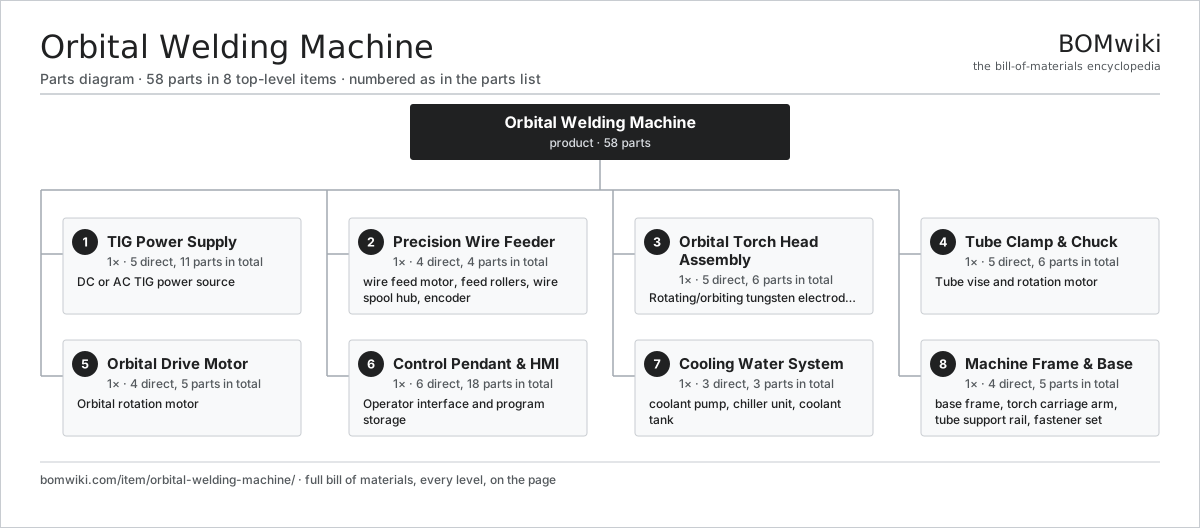
| # | Part | Qty | What it does |
|---|---|---|---|
| 1 | TIG Power Supply 5 parts | 1× | DC or AC TIG power source |
| 2 | Precision Wire Feeder 4 parts | 1× | Servo-controlled wire feed unit managing filler metal delivery during the orbital weld cycle. |
| 3 | Orbital Torch Head Assembly 5 parts | 1× | Rotating/orbiting tungsten electrode holder |
| 4 | Tube Clamp & Chuck 5 parts | 1× | Tube vise and rotation motor |
| 5 | Orbital Drive Motor 4 parts | 1× | Orbital rotation motor |
| 6 | Control Pendant & HMI 6 parts | 1× | Operator interface and program storage |
| 7 | Cooling Water System 3 parts | 1× | Chilled water circulation for torch cooling. |
| 8 | Machine Frame & Base 4 parts | 1× | Structural frame with tube support rails. |
3D model
No 3D model yet. Have a CAD file of this? Add a 3D model. STL renders right on this page; STEP, FreeCAD, and OpenSCAD sources are welcome too (openly licensed, like all 3D models on BOMwiki).
Build & assembly graph
expand / collapse · shared sub-assemblies converge · links to related products · est. labourTap an assembly to expand/collapse · tap a part to open it · use “Open page” for any node · drag to pan, scroll to zoom.
Bill of materials for Orbital Welding Machine
8 top-level lines · 44 rows shown · 58 parts total · indented to 3 levels| # | Item / sub-assembly | Part no. | Qty/assy | Ext. qty | Parts | Type |
|---|---|---|---|---|---|---|
| 1 | TIG Power Supply 5 parts | orbital-welding-machine-power-supply | 1× | 1 | 11 | assembly |
| 1.1 | Bare PCB | pcb-bare | 2× | 2 | · | part |
| 1.2 | IGBT Power Module | igbt-module | 4× | 4 | · | part |
| 1.3 | DC-Link Capacitor | dc-link-cap | 3× | 3 | · | part |
| 1.4 | Power Supply | power-supply | 1× | 1 | · | part |
| 1.5 | Current Feedback Sensor | orbital-welding-machine-current-sensor | 1× | 1 | · | part |
| 2 | Precision Wire Feeder 4 parts | orbital-welding-machine-wire-feeder | 1× | 1 | 4 | assembly |
| 2.1 | Wire Feed Motor | orbital-welding-machine-feeder-motor | 1× | 1 | · | part |
| 2.2 | Feed Rollers | orbital-welding-machine-feed-roller-set | 1× | 1 | · | part |
| 2.3 | Wire Spool Hub | orbital-welding-machine-wire-spool-holder | 1× | 1 | · | part |
| 2.4 | Encoder | encoder | 1× | 1 | · | part |
| 3 | Orbital Torch Head Assembly 5 parts | orbital-welding-machine-torch-head | 1× | 1 | 6 | assembly |
| 3.1 | Electrode Collet Holder | orbital-welding-machine-electrode-holder | 1× | 1 | · | part |
| 3.2 | Gas Lens Cup | orbital-welding-machine-gas-lens | 1× | 1 | · | part |
| 3.3 | Torch Lead Cable | orbital-welding-machine-torch-cable | 1× | 1 | · | part |
| 3.4 | Slip Ring Bearing | orbital-welding-machine-rotation-bearing | 1× | 1 | · | part |
| 3.5 | Ball Bearing | ball-bearing | 2× | 2 | · | part |
| 4 | Tube Clamp & Chuck 5 parts | orbital-welding-machine-clamp-chuck | 1× | 1 | 6 | assembly |
| 4.1 | Chuck Housing | orbital-welding-machine-chuck-body | 1× | 1 | · | part |
| 4.2 | Chuck Collet | orbital-welding-machine-chuck-collet | 1× | 1 | · | part |
| 4.3 | Chuck Rotation Motor | orbital-welding-machine-chuck-motor | 1× | 1 | · | part |
| 4.4 | Ball Bearing | ball-bearing | 2× | 2 | · | part |
| 4.5 | Pneumatic Cylinder | pneumatic-cylinder | 1× | 1 | · | part |
| 5 | Orbital Drive Motor 4 parts | orbital-welding-machine-weld-head-motor | 1× | 1 | 5 | assembly |
| 5.1 | Stepper Motor | orbital-welding-machine-stepper-motor | 1× | 1 | · | part |
| 5.2 | Gear Reduction | orbital-welding-machine-gear-reduction | 1× | 1 | · | part |
| 5.3 | Encoder | encoder | 1× | 1 | · | part |
| 5.4 | Ball Bearing | ball-bearing | 2× | 2 | · | part |
| 6 | Control Pendant & HMI 6 parts | orbital-welding-machine-control-pendant | 1× | 1 | 18 | assembly |
| 6.1 | Bare PCB | pcb-bare | 1× | 1 | · | part |
| 6.2 | Microcontroller | mcu | 1× | 1 | · | part |
| 6.3 | Display Panel | orbital-welding-machine-display-panel | 1× | 1 | · | part |
| 6.4 | Relay | relay | 6× | 6 | · | part |
| 6.5 | Encoder | encoder | 1× | 1 | · | part |
| 6.6 | Connector | connector | 8× | 8 | · | part |
| 7 | Cooling Water System 3 parts | orbital-welding-machine-water-cooler | 1× | 1 | 3 | assembly |
| 7.1 | Coolant Pump | orbital-welding-machine-cooler-pump | 1× | 1 | · | part |
| 7.2 | Chiller Unit | orbital-welding-machine-cooler-unit | 1× | 1 | · | part |
| 7.3 | Coolant Tank | orbital-welding-machine-cooler-tank | 1× | 1 | · | part |
| 8 | Machine Frame & Base 4 parts | orbital-welding-machine-frame | 1× | 1 | 5 | assembly |
| 8.1 | Base Frame | orbital-welding-machine-base-frame | 1× | 1 | · | part |
| 8.2 | Torch Carriage Arm | orbital-welding-machine-torch-carriage | 1× | 1 | · | part |
| 8.3 | Tube Support Rail | orbital-welding-machine-tube-rails | 2× | 2 | · | part |
| 8.4 | Fastener Set | fastener-set | 1× | 1 | · | part |
Something wrong in this list? Report a problem with this BOM.
Related products
same domain, ranked by shared parts CNC Lathe
511 parts · shares 3 with this page
CNC Lathe
511 parts · shares 3 with this page
 CNC Milling Machine
400 parts · shares 3 with this page
CNC Wire Forming Machine
1,438 parts · shares 3 with this page
CNC Milling Machine
400 parts · shares 3 with this page
CNC Wire Forming Machine
1,438 parts · shares 3 with this page
 Compression Spring Coiler
1,167 parts · shares 3 with this page
Compression Spring Coiler
1,167 parts · shares 3 with this page
Sourcing: possible vendors
Browse the supplier directory → Prices, MOQ, and lead times are algorithmic estimates, not quotes, and not claims about these companies. Company mappings are curated by keyword; est. price band $10k–$1M. How estimates work| Vendor | HQ | Specialty | MOQ | Lead time |
|---|---|---|---|---|
|
🇩🇪DMG MORI
dmgmori.com ↗
|
Bielefeld, DE | Machine tools | 5 units | 12–20 wks |
|
🇯🇵Mazak
mazak.com ↗
|
Oguchi, JP | Machine tools | 5 units | 12–20 wks |
| haascnc.com ↗ | Oxnard, US | CNC machine tools | 5 units | 12–20 wks |
|
🇯🇵Okuma
okuma.com ↗
|
Niwa, JP | Machine tools | 5 units | 12–20 wks |
|
🇩🇪Trumpf
trumpf.com ↗
|
Ditzingen, DE | Laser & sheet-metal machines | 5 units | 12–20 wks |
1,355-word article