Studio Patch Bay
ProductOverview
A patch bay is the nerve center of a professional recording studio, consolidating signal routing from all outboard gear through a single, standardized interface. Rather than reaching behind racks to patch cables directly into equipment, engineers use patch cords at the patch bay to connect any output to any input, with the Normalling Switch Block providing default routing to eliminate common patching.
The unit comprises a large Jack Field Assembly (typically 24, 48, or 96 pairs of jacks arranged in vertical columns), a Rear Punchdown Panel with DB25 and Molex connectors that terminate to the studio equipment, and internal Normalling Switch Blocks that determine which outputs are pre-routed to which inputs. A patch cord inserted into a jack automatically breaks the normalling connection, allowing custom routing on demand.
How it works
The Jack Field Assembly is the front interface: each jack position corresponds to one audio signal line from the studio. Internally, each jack is electrically independent, with hot, cold, and ground connections soldered to the Normalling Switch Block and the Punchdown Terminal Block at the rear. When no patch cord is inserted into a jack pair, Switch Block contacts silently connect the output jack to its corresponding input jack; this is the "normal" path. When an engineer inserts a patch cord into an output jack, a Switching Contact is mechanically pushed open, breaking the normal connection and forcing the signal through the patch cord to wherever the engineer plugs it.
The Rear Punchdown Panel uses DB25 Connector or Molex Connector connectors to link the patch bay to studio devices, mixing consoles, EQ racks, compressors, effects processors, and tape machines. This rear interface allows the patch bay to be fed from and to route to all equipment without any loose cables in the studio itself. The Punchdown Terminal Block terminates each twisted pair in an Punchdown Row, with individual Connector points that can be changed in the field to reroute signals.
Inside, the Internal Cable Harness consists of carefully soldered copper or silver-plated wiring from the Jack Field Assembly to the normalling block and trunk connectors. Solder Joints are the critical mechanical and electrical interfaces; poor soldering introduces noise and intermittent connections. The entire assembly is mounted in an Frame Assembly with Mounting Kit for secure 19" rack installation, isolation feet to prevent vibration transmission, and cable ties to manage the rear wiring neatly.
Patch bays are offered with different normalling schemes: some jacks are permanently normalized (output to input), others are half-normalized (broken only when the output is used), and some are isolated (no normalling at all). Advanced patch bays allow the engineer to change normalling on the fly using push-button Switch Block controls, eliminating the need to physically reprogram the termination block each time the studio signal flow changes.
Technical considerations
Professional patch bays use 600 Ω impedance for analog audio and sometimes 110 Ω for AES/EBU digital audio. The choice of jack format, TT (tiny telephone, 2.5 mm) or TRS (tip-ring-sleeve, 1/4"), depends on studio size and legacy equipment; TT is more compact and allows higher density, while TRS is more common in smaller studios. patch-bay-insertion-loss through a good patch bay is negligible (< 0.5 dB), and isolation between adjacent jacks should exceed 80 dB to prevent crosstalk.
The Rear Punchdown Panel connector choice (DB25 vs. Molex) is determined by the patch bay's target market: DB25 is the traditional audio industry standard, while Molex Micro-Fit connectors are lighter and more compact. Field-upgradeable Punchdown Terminal Blocks allow studios to change signal assignments without rewiring the entire backend.
Studio Patch Bay parts and their functions
6 top-level parts · 227 parts in total · full bill of materials below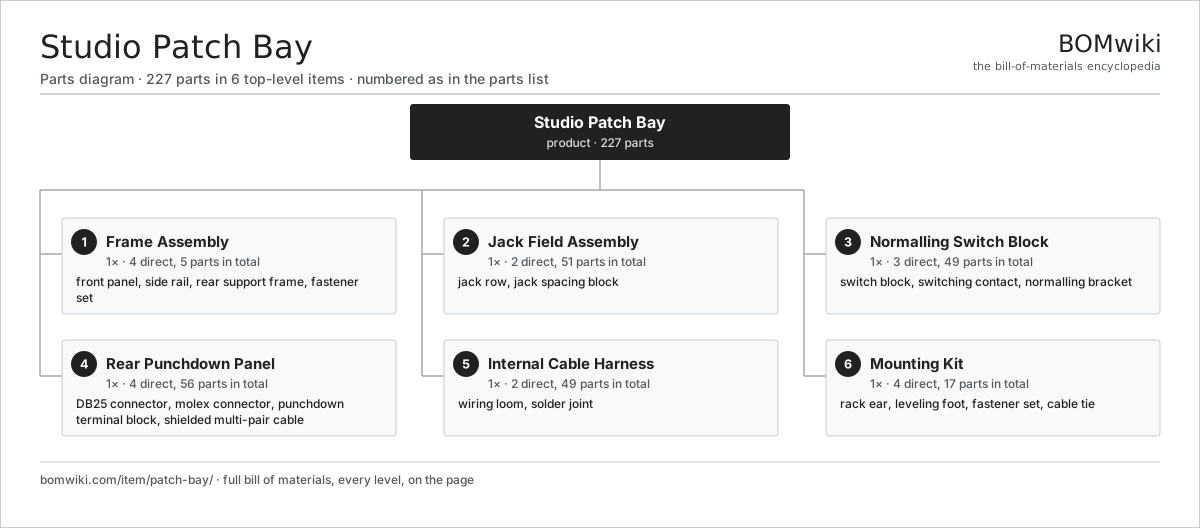
| # | Part | Qty | What it does |
|---|---|---|---|
| 1 | Frame Assembly 4 parts | 1× | Modular aluminum or steel frame that holds the jack field and rear panel as a cohesive rack-mount unit. |
| 2 | Jack Field Assembly 2 parts | 1× | Array of 24 or 48 TT or TRS jacks mounted in rows, each electrically independent. |
| 3 | Normalling Switch Block 3 parts | 1× | Bank of electromechanical switches that automatically connects output jacks to input jacks unless overridden by a patch cord. |
| 4 | Rear Punchdown Panel 4 parts | 1× | DB25 or Molex connectors terminating the jack field to studio outboard gear. |
| 5 | Internal Cable Harness 2 parts | 1× | Soldered copper or stranded silver-plated wire linking jacks to normalling block to punchdown. |
| 6 | Mounting Kit 4 parts | 1× | Ears, feet, cable ties, and fasteners for rack installation. |
3D model
No 3D model yet. Have a CAD file of this? Add a 3D model. STL renders right on this page; STEP, FreeCAD, and OpenSCAD sources are welcome too (openly licensed, like all 3D models on BOMwiki).
Build & assembly graph
expand / collapse · shared sub-assemblies converge · links to related products · est. labourTap an assembly to expand/collapse · tap a part to open it · use “Open page” for any node · drag to pan, scroll to zoom.
Bill of materials for Studio Patch Bay
6 top-level lines · 33 rows shown · 227 parts total · indented to 3 levels| # | Item / sub-assembly | Part no. | Qty/assy | Ext. qty | Parts | Type |
|---|---|---|---|---|---|---|
| 1 | Frame Assembly 4 parts | patch-bay-frame | 1× | 1 | 5 | assembly |
| 1.1 | Front Panel | patch-bay-front-panel | 1× | 1 | · | part |
| 1.2 | Side Rail | patch-bay-side-rails | 2× | 2 | · | part |
| 1.3 | Rear Support Frame | patch-bay-rear-support | 1× | 1 | · | part |
| 1.4 | Fastener Set | fastener-set | 1× | 1 | · | part |
| 2 | Jack Field Assembly 2 parts | patch-bay-jack-field | 1× | 1 | 51 | assembly |
| 2.1 | Jack Row 3 parts | patch-bay-jack-row | 2× | 2 | 25 | assembly |
| 2.1.1 | TT Jack | patch-bay-jack | 12× | 24 | · | part |
| 2.1.2 | Bare PCB | pcb-bare | 1× | 2 | · | part |
| 2.1.3 | Jack Contact Spring | patch-bay-jack-spring | 12× | 24 | · | part |
| 2.2 | Jack Spacing Block | patch-bay-jack-spacing-block | 1× | 1 | · | part |
| 3 | Normalling Switch Block 3 parts | patch-bay-normalling-block | 1× | 1 | 49 | assembly |
| 3.1 | Switch Block 4 parts | patch-bay-switch-assembly | 4× | 4 | 6 | assembly |
| 3.1.1 | Switch Lever | patch-bay-switch-lever | 1× | 4 | · | part |
| 3.1.2 | Switch Rotor | patch-bay-switch-rotor | 1× | 4 | · | part |
| 3.1.3 | Switch Spring | patch-bay-switch-spring | 3× | 12 | · | part |
| 3.1.4 | Fastener Set | fastener-set | 1× | 4 | · | part |
| 3.2 | Switching Contact | patch-bay-switching-contact | 24× | 24 | · | part |
| 3.3 | Normalling Bracket | patch-bay-normalling-bracket | 1× | 1 | · | part |
| 4 | Rear Punchdown Panel 4 parts | patch-bay-rear-panel | 1× | 1 | 56 | assembly |
| 4.1 | DB25 Connector | patch-bay-db25-connector | 2× | 2 | · | part |
| 4.2 | Molex Connector | patch-bay-molex-connector | 2× | 2 | · | part |
| 4.3 | Punchdown Terminal Block 1 parts | patch-bay-punchdown-block | 1× | 1 | 50 | assembly |
| 4.3.1 | Punchdown Row 1 parts + deeper › | patch-bay-punchdown-row | 2× | 2 | 25 | assembly |
| 4.4 | Shielded Multi-Pair Cable | patch-bay-shielded-cable | 2× | 2 | · | part |
| 5 | Internal Cable Harness 2 parts | patch-bay-cable-harness | 1× | 1 | 49 | assembly |
| 5.1 | Wiring Loom | patch-bay-wiring-loom | 1× | 1 | · | part |
| 5.2 | Solder Joint | patch-bay-solder-joint | 48× | 48 | · | part |
| 6 | Mounting Kit 4 parts | patch-bay-mounting-hardware | 1× | 1 | 17 | assembly |
| 6.1 | Rack Ear | patch-bay-rack-ear | 2× | 2 | · | part |
| 6.2 | Leveling Foot | patch-bay-leveling-foot | 4× | 4 | · | part |
| 6.3 | Fastener Set | fastener-set | 1× | 1 | · | part |
| 6.4 | Cable Tie | patch-bay-tie | 10× | 10 | · | part |
Something wrong in this list? Report a problem with this BOM.
Sourcing: possible vendors
Browse the supplier directory → Prices, MOQ, and lead times are algorithmic estimates, not quotes, and not claims about these companies. Company mappings are curated by keyword; est. price band $50–$3k. How estimates work| Vendor | HQ | Specialty | MOQ | Lead time |
|---|---|---|---|---|
|
🇯🇵Sony
sony.com ↗
|
Tokyo, JP | Consumer electronics | 1,000 units | 8–12 wks |
| samsung.com ↗ | Suwon, KR | Electronics & displays | 1,000 units | 8–12 wks |
|
🇺🇸Harman
harman.com ↗
|
Stamford, US | Audio (JBL, AKG) | 1,000 units | 8–12 wks |
|
🇺🇸Bose
bose.com ↗
|
Framingham, US | Audio | 1,000 units | 8–12 wks |
| yamaha.com ↗ | Hamamatsu, JP | Audio & instruments | 1,000 units | 8–12 wks |
636-word article