PEM Electrolyzer Stack
ProductOverview
A proton exchange membrane (PEM) electrolyzer stack is the core electrochemical module that converts electrical energy and liquid water into high-purity hydrogen gas, oxygen gas, and heat. The stack consists of multiple membrane electrode assemblies (MEAs) arranged in series, each capable of splitting H₂O molecules through electrolysis at the anode (oxygen evolution) and cathode (hydrogen evolution) simultaneously.
Unlike alkaline electrolyzers, PEM stacks operate on solid-state ionic transport via a perfluorinated sulfonic acid polymer membrane (Nafion). Water molecules are oxidized at the anode to produce O₂, protons (H⁺), and electrons; the protons travel through the membrane to the cathode, where they combine with electrons to form H₂. This design eliminates the need for caustic potassium hydroxide electrolyte, allowing operation at higher current densities (1–4 A/cm²) and producing dry, pressurized gas streams suitable for direct feed into hydrogen distribution or fuel cell systems.
How it works
Electrochemical Reaction
The MEA Cell Block contains multiple MEA sheets, each with a MEA Sheet at its core. Water entering the Manifold Block flows through the Bipolar Plate Assembly to the anode side of each MEA. At the anode catalyst layer (typically platinum-group metal or iron–nickel oxides), water undergoes oxidation:
$$\text{H}_2\text{O} \to \frac{1}{2}\text{O}_2 + 2\text{H}^+ + 2e^-$$
The protons traverse the Interlayer Gasket and MEA Sheet to the cathode, where electrons arriving via the Bipolar Plate reduce them:
$$2\text{H}^+ + 2e^- \to \text{H}_2$$
Oxygen is collected from the anode compartment and expelled through the Manifold Block; hydrogen is collected from the cathode and routed to a Hydrogen Dispenser or storage system.
Mechanical Assembly
The MEA Cell Block is sandwiched between End Plate Assembly components, which apply uniform compression via Tie Rod Assembly tie rods. This clamping force (typically 200–500 kN) is critical to maintain contact pressure between the Bipolar Plate, MEA, and adjacent plates, ensuring low contact resistance and preventing gas crossover leakage. The Pressure Spring maintains constant compression despite thermal cycling and component creep.
Fluid Management
The Manifold Block directs deionized water to the anode inlet. Water not consumed in electrolysis returns to an external recirculation loop or buffer tank. The Coolant Circuit extracts heat from the exothermic electrolysis reaction; at 80 °C stack temperature, approximately 60–80% of input electrical power converts to heat, requiring robust cooling to maintain efficiency and avoid membrane dehydration.
Gas Separation and Safety
The manifold incorporates Check Valve cartridges that prevent hydrogen from diffusing backward into the oxygen circuit during shutdown or startup transients. Oxygen gas naturally bubbles out on the anode side; hydrogen bubbles out on the cathode side, both driven upward by buoyancy and pressure into their respective collection and metering systems.
Electrical Integration
The Control Board regulates input DC voltage (typically 48–380 V depending on stack rating) to maintain safe current levels. Higher voltages reduce I²R losses in external wiring but increase electrochemical irreversibility; most stacks operate in the 1–4 A/cm² range for optimal efficiency. Current is monitored via Pressure Sensor (differential, measuring pressure drop across the water inlet) and Temperature Sensor feedback to prevent thermal runaway or membrane dehydration.
Key Performance Drivers
Current density: Higher densities (>2 A/cm²) favor faster H₂ production but increase overpotential losses and heat generation. Typical design sweet spot is 1.5–2.5 A/cm² for distributed production scenarios.
Membrane thickness and proton conductivity: Thinner membranes reduce ohmic resistance but are mechanically weaker. Nafion membranes are tuned to 50–200 µm thickness; too much water (>100% hydration) reduces conductivity, while dehydration (cold startup) increases it.
Catalyst loading: Anode catalyst layers use platinum-group metals or corrosion-resistant metal oxides (IrO₂, RuO₂) in concentrations of 1–10 mg/cm². Higher loading reduces overpotential but increases cost.
Pressure operation: PEM stacks running at 10–30 bar absolute pressure reduce downstream gas compression energy, making the entire H₂ distribution chain more efficient.
End-of-Life Cycling
MEA stacks typically reach 40,000–80,000 operating hours (5–10 years) before membrane proton conductivity degrades below acceptable levels. The MEA Cell Block is the primary wear item; other components (Bipolar Plate Assembly, Manifold Block, Tie Rod Assembly) are largely reusable after MEA replacement.
PEM Electrolyzer Stack parts and their functions
8 top-level parts · 101 parts in total · full bill of materials below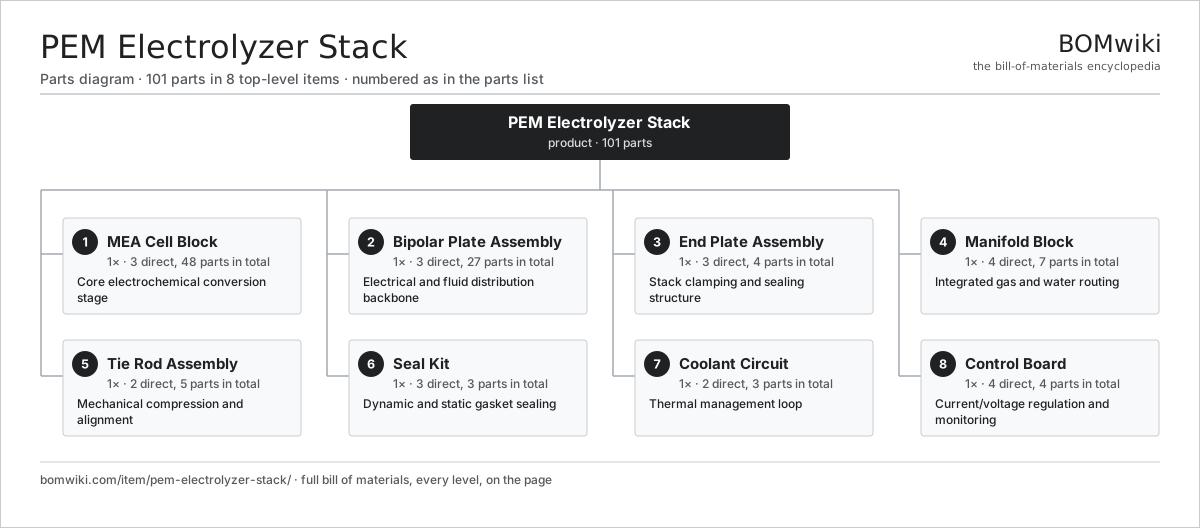
| # | Part | Qty | What it does |
|---|---|---|---|
| 1 | MEA Cell Block 3 parts | 1× | Core electrochemical conversion stage |
| 2 | Bipolar Plate Assembly 3 parts | 1× | Electrical and fluid distribution backbone |
| 3 | End Plate Assembly 3 parts | 1× | Stack clamping and sealing structure |
| 4 | Manifold Block 4 parts | 1× | Integrated gas and water routing |
| 5 | Tie Rod Assembly 2 parts | 1× | Mechanical compression and alignment |
| 6 | Seal Kit 3 parts | 1× | Dynamic and static gasket sealing |
| 7 | Coolant Circuit 2 parts | 1× | Thermal management loop |
| 8 | Control Board 4 parts | 1× | Current/voltage regulation and monitoring |
3D model
No 3D model yet. Have a CAD file of this? Add a 3D model. STL renders right on this page; STEP, FreeCAD, and OpenSCAD sources are welcome too (openly licensed, like all 3D models on BOMwiki).
Build & assembly graph
expand / collapse · shared sub-assemblies converge · links to related products · est. labourTap an assembly to expand/collapse · tap a part to open it · use “Open page” for any node · drag to pan, scroll to zoom.
Bill of materials for PEM Electrolyzer Stack
8 top-level lines · 32 rows shown · 101 parts total · indented to 3 levels| # | Item / sub-assembly | Part no. | Qty/assy | Ext. qty | Parts | Type |
|---|---|---|---|---|---|---|
| 1 | MEA Cell Block 3 parts | pem-electrolyzer-stack-mea-cell-block | 1× | 1 | 48 | assembly |
| 1.1 | MEA Sheet | pem-electrolyzer-stack-mea-sheet | 12× | 12 | · | part |
| 1.2 | Interlayer Gasket | pem-electrolyzer-stack-interlayer-gasket | 12× | 12 | · | part |
| 1.3 | Carbon Cloth | pem-electrolyzer-stack-carbon-cloth | 24× | 24 | · | part |
| 2 | Bipolar Plate Assembly 3 parts | pem-electrolyzer-stack-bipolar-plate-assembly | 1× | 1 | 27 | assembly |
| 2.1 | Bipolar Plate | pem-electrolyzer-stack-bipolar-plate | 13× | 13 | · | part |
| 2.2 | Channel Insert | pem-electrolyzer-stack-channel-insert | 13× | 13 | · | part |
| 2.3 | Fastener Set | fastener-set | 1× | 1 | · | part |
| 3 | End Plate Assembly 3 parts | pem-electrolyzer-stack-end-plate-assembly | 1× | 1 | 4 | assembly |
| 3.1 | End Plate | pem-electrolyzer-stack-end-plate | 2× | 2 | · | part |
| 3.2 | Pressure Spring | pem-electrolyzer-stack-pressure-spring | 1× | 1 | · | part |
| 3.3 | Fastener Set | fastener-set | 1× | 1 | · | part |
| 4 | Manifold Block 4 parts | pem-electrolyzer-stack-manifold-block | 1× | 1 | 7 | assembly |
| 4.1 | Manifold Body | pem-electrolyzer-stack-manifold-body | 1× | 1 | · | part |
| 4.2 | Connector | connector | 3× | 3 | · | part |
| 4.3 | Check Valve | pem-electrolyzer-stack-check-valve | 2× | 2 | · | part |
| 4.4 | Temperature Sensor | pem-electrolyzer-stack-temperature-sensor | 1× | 1 | · | part |
| 5 | Tie Rod Assembly 2 parts | pem-electrolyzer-stack-tie-rod-assembly | 1× | 1 | 5 | assembly |
| 5.1 | Tie Rod | pem-electrolyzer-stack-tie-rod | 4× | 4 | · | part |
| 5.2 | Fastener Set | fastener-set | 1× | 1 | · | part |
| 6 | Seal Kit 3 parts | pem-electrolyzer-stack-seal-kit | 1× | 1 | 3 | assembly |
| 6.1 | O-Ring Set | oring-set | 1× | 1 | · | part |
| 6.2 | Nafion Gasket | pem-electrolyzer-stack-nafion-gasket | 1× | 1 | · | part |
| 6.3 | PTFE Spacer | pem-electrolyzer-stack-ptfe-spacer | 1× | 1 | · | part |
| 7 | Coolant Circuit 2 parts | pem-electrolyzer-stack-coolant-circuit | 1× | 1 | 3 | assembly |
| 7.1 | Coolant Passage | pem-electrolyzer-stack-coolant-passage | 1× | 1 | · | part |
| 7.2 | Connector | connector | 2× | 2 | · | part |
| 8 | Control Board 4 parts | pem-electrolyzer-stack-control-board | 1× | 1 | 4 | assembly |
| 8.1 | Bare PCB | pcb-bare | 1× | 1 | · | part |
| 8.2 | Buck Converter | pem-electrolyzer-stack-buck-converter | 1× | 1 | · | part |
| 8.3 | Pressure Sensor | pressure-sensor | 1× | 1 | · | part |
| 8.4 | SMD Passive (R/C/L) | smd-passives | 1× | 1 | · | part |
Something wrong in this list? Report a problem with this BOM.
Related products
same domain, ranked by shared parts Autotransformer
7,784 parts · shares 2 with this page
Bottom Ash Handling System
1,782 parts · shares 2 with this page
Autotransformer
7,784 parts · shares 2 with this page
Bottom Ash Handling System
1,782 parts · shares 2 with this page
 Combined Heat and Power Unit
522 parts · shares 2 with this page
Containerized Diesel Genset
655 parts · shares 2 with this page
Combined Heat and Power Unit
522 parts · shares 2 with this page
Containerized Diesel Genset
655 parts · shares 2 with this page
 DEF Dispenser
35 parts · shares 2 with this page
DEF Dispenser
35 parts · shares 2 with this page
 Distribution Ring Main Unit
443 parts · shares 2 with this page
Distribution Ring Main Unit
443 parts · shares 2 with this page
Sourcing: possible vendors
Browse the supplier directory → Prices, MOQ, and lead times are algorithmic estimates, not quotes, and not claims about these companies. Company mappings are curated by keyword; est. price band $5k–$50M. How estimates work| Vendor | HQ | Specialty | MOQ | Lead time |
|---|---|---|---|---|
| gevernova.com ↗ | Cambridge, US | Power generation | made to order | 20–40 wks |
| siemens-energy.com ↗ | Munich, DE | Power & grid | made to order | 20–40 wks |
| hitachienergy.com ↗ | Zurich, CH | Grid & transformers | made to order | 20–40 wks |
|
🇨🇭ABB
abb.com ↗
|
Zurich, CH | Electrification & automation | made to order | 20–40 wks |
| se.com ↗ | Rueil-Malmaison, FR | Electrical & automation | made to order | 20–40 wks |
772-word article