Pencil Making Machine
ProductOverview
Pencil making machines are high-speed integrated systems that transform raw materials, wood slats and graphite cores, into finished pencils through a coordinated sequence of grooving, lead laying, gluing, shaping, and finishing operations. These machines typically achieve throughput of 800 to 1200 pencils per minute on a single line, making them essential for large-scale pencil manufacturing operations. The machines combine mechanical precision, pneumatic and hydraulic actuation, and programmed motion control to ensure consistent dimensional tolerances and surface finish across millions of units annually.
Traditional pencil manufacturing involves milling a semicircular groove into paired wooden slats, laying a graphite core (or synthetic lead rod) into one slat, gluing both slats together, then shaping the composite blank into a hexagonal prism, adding an eraser and ferrule. Modern machines automate all these steps in a single integrated line, with individual stations handling infeed, grooving, lead placement, gluing, shaping, finishing, and eraser assembly. The coordinated timing of each station ensures that work pieces flow at constant takt rate without starvation or queue buildup.
How It Works
Infeed and Stock Preparation
The Infeed Station receives unprepared slats and graphite rods through separate hoppers. Vibration decks and stepper motors meter components one at a time into the main conveyor line, where they are indexed at fixed intervals. The Encoder monitors slat thickness and lead rod diameter to verify incoming stock meets tolerance before the first processing station begins.
Grooving
At the Groove Unit station, a pair of rotating spindle heads with hardened steel cutters mill a shallow V-groove or half-round channel into the face of each slat. The Slat Chuck Fixture fixture positions paired slats with precise center-to-center spacing. Coolant from the Coolant Pump removes swarf and reduces tool wear. The groove dimension (0.5–1 mm depth) is critical; Pressure Sensor feedback monitors cutter loading to avoid chatter.
Lead Rod Placement and Alignment
The Lead Laying Unit unit automatically transfers a graphite rod from the Lead Rod Magazine and positions it into the grooved slat. A pneumatic Lead Rod Pickup Head head with integrated O-Ring Set seals extracts the rod; the Centering Guide Bushing verifies centering before the rod is dropped into the assembly queue. This stage ensures perfect registration between lead and slat before adhesive is applied.
Adhesive Application and Pressing
At the Glue and Press Station station, the Adhesive Metering Unit sprays or rolls polyvinyl acetate or urea-formaldehyde adhesive onto the lead rod and slat contact surfaces. Paired slats are then fed into the Press Clamp Head, a hydraulic or pneumatic clamping mechanism that applies 5–15 bar force for 2–5 seconds to ensure solid bonding. A Heating Element (IR lamps or hot platen) accelerates glue polymerization, allowing the blank to exit the press ready for next-stage machining within one cycle.
Shaping and Point Cutting
The blank is then indexed into the Shaping Station station, where it rotates against hardened steel cutting dies and profile wheels at 3000 rpm. The Hexagonal Shaping Die mills the hexagonal cross-section (6 mm per flat) from the circular glued blank. Simultaneously or in a second pass, the Point Cutting Cone, a rotating cone cutter, machines the tip to a 45° taper at 50–75 mm length. Coolant spray controls heat and evacuation of cutting debris.
Sanding and Polishing
The Finishing and Polish Unit station removes tooling marks and imperfections. Multiple Sanding Drum stages progress through grit grades (120, 180, 240 grit) to achieve dimensional uniformity and acceptable surface finish. A final Polishing Wheel with buffing compound imparts gloss and uniformity to the barrel. Blower Motor extraction removes fine sawdust and chalk.
Eraser and Ferrule Assembly
At the Eraser and Ferrule Assembly station, a synthetic rubber eraser slug is loaded from the Eraser Slug Feeder, and a brass ferrule is picked from the Ferrule Collet Loader. The eraser and ferrule are simultaneously positioned onto the pencil butt end, and the Ferrule Crimp Head, a rotary die block with radial crimp jaws, compresses the ferrule under 500–1000 N force to permanently secure both components.
Synchronization and Control
All station motors, solenoids, and pneumatic actuators are orchestrated by the Control and Drive System unit. A programmable controller or Microcontroller issues step/direction pulses to indexing steppers and supplies synchronized enable signals to spindle drives via Relay outputs. Encoder feedback from the main conveyor ensures that work pieces are presented to each station at the correct time, maintaining constant throughput and preventing collisions or misfeeds.
Engineering Considerations
Precision and Tolerance: Hexagonal shaping requires rigid spindle and die mounting to hold 0.1 mm parallelism. Any groove offset of >0.2 mm results in asymmetric lead positioning and risk of lead breakage during point cutting.
Thermal Management: High-speed spindles and grinding wheels generate significant heat. Coolant circulation and spindle bearing cooling are essential to maintain accuracy over 8–12 hour production runs.
Lead Rod Supply: Graphite core diameter uniformity is critical; rods >±0.05 mm out-of-spec create binding or gaps during layup.
Adhesive Chemistry: Glue cure time must align with line speed; too slow and press time becomes a bottleneck; too fast and the blank is damaged during ejection before polymerization is complete.
Maintenance: Cutter dies wear progressively, requiring replacement every 500,000–2,000,000 pencils depending on wood species hardness and graphite core brittleness.
Production Metrics
A typical pencil-making line produces 800–1200 pencils per minute, equivalent to 48,000–72,000 pencils per hour on a single shift. Power consumption is 15–22 kW, with pneumatic and hydraulic subsystems accounting for 40% of total energy draw. Changeover between pencil grades (length, wood type, eraser style) typically requires 15–30 minutes of fixture and tooling adjustment.
Pencil Making Machine parts and their functions
8 top-level parts · 43 parts in total · full bill of materials below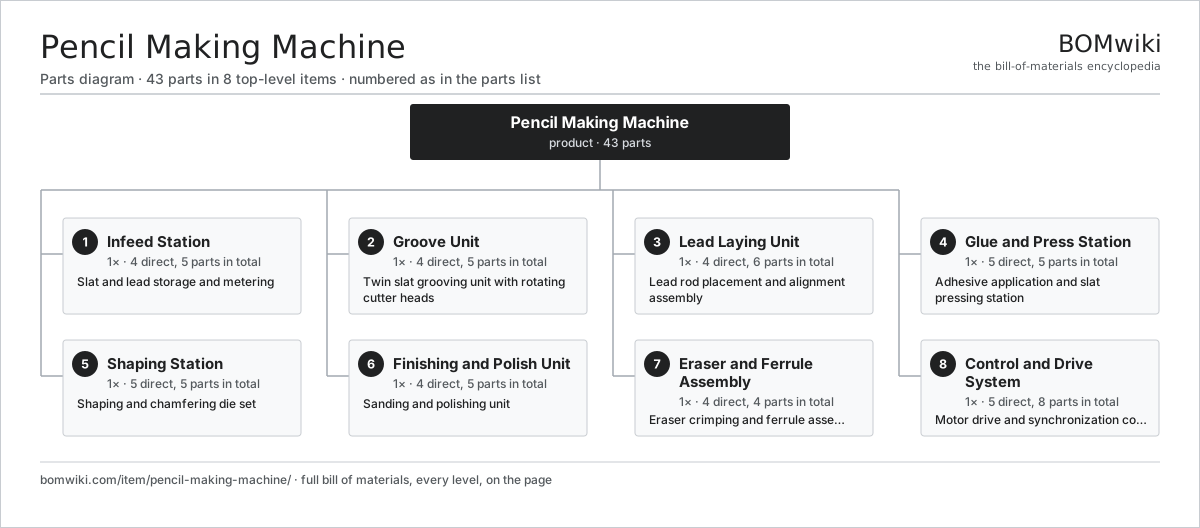
| # | Part | Qty | What it does |
|---|---|---|---|
| 1 | Infeed Station 4 parts | 1× | Slat and lead storage and metering |
| 2 | Groove Unit 4 parts | 1× | Twin slat grooving unit with rotating cutter heads |
| 3 | Lead Laying Unit 4 parts | 1× | Lead rod placement and alignment assembly |
| 4 | Glue and Press Station 5 parts | 1× | Adhesive application and slat pressing station |
| 5 | Shaping Station 5 parts | 1× | Shaping and chamfering die set |
| 6 | Finishing and Polish Unit 4 parts | 1× | Sanding and polishing unit |
| 7 | Eraser and Ferrule Assembly 4 parts | 1× | Eraser crimping and ferrule assembly |
| 8 | Control and Drive System 5 parts | 1× | Motor drive and synchronization control |
3D model
No 3D model yet. Have a CAD file of this? Add a 3D model. STL renders right on this page; STEP, FreeCAD, and OpenSCAD sources are welcome too (openly licensed, like all 3D models on BOMwiki).
Build & assembly graph
expand / collapse · shared sub-assemblies converge · links to related products · est. labourTap an assembly to expand/collapse · tap a part to open it · use “Open page” for any node · drag to pan, scroll to zoom.
Bill of materials for Pencil Making Machine
8 top-level lines · 43 rows shown · 43 parts total · indented to 3 levels| # | Item / sub-assembly | Part no. | Qty/assy | Ext. qty | Parts | Type |
|---|---|---|---|---|---|---|
| 1 | Infeed Station 4 parts | pencil-making-machine-infeed | 1× | 1 | 5 | assembly |
| 1.1 | Slat Hopper | pencil-making-machine-slat-hopper | 1× | 1 | · | part |
| 1.2 | Lead Rod Magazine | pencil-making-machine-lead-magazine | 1× | 1 | · | part |
| 1.3 | Stepper Motor | stepper-motor | 2× | 2 | · | part |
| 1.4 | Encoder | encoder | 1× | 1 | · | part |
| 2 | Groove Unit 4 parts | pencil-making-machine-groove | 1× | 1 | 5 | assembly |
| 2.1 | Spindle Head Assembly | pencil-making-machine-spindle-head | 2× | 2 | · | part |
| 2.2 | Slat Chuck Fixture | pencil-making-machine-slat-chuck | 1× | 1 | · | part |
| 2.3 | Blower Motor | blower-motor | 1× | 1 | · | part |
| 2.4 | Pressure Sensor | pressure-sensor | 1× | 1 | · | part |
| 3 | Lead Laying Unit 4 parts | pencil-making-machine-layup | 1× | 1 | 6 | assembly |
| 3.1 | Lead Rod Pickup Head | pencil-making-machine-lead-pickup | 1× | 1 | · | part |
| 3.2 | Centering Guide Bushing | pencil-making-machine-centering-guide | 1× | 1 | · | part |
| 3.3 | O-Ring Set | oring-set | 2× | 2 | · | part |
| 3.4 | Connector | connector | 2× | 2 | · | part |
| 4 | Glue and Press Station 5 parts | pencil-making-machine-gluing | 1× | 1 | 5 | assembly |
| 4.1 | Adhesive Metering Unit | pencil-making-machine-glue-applicator | 1× | 1 | · | part |
| 4.2 | Press Clamp Head | pencil-making-machine-press-head | 1× | 1 | · | part |
| 4.3 | Pressure Sensor | pressure-sensor | 1× | 1 | · | part |
| 4.4 | Heating Element | heating-element | 1× | 1 | · | part |
| 4.5 | Fastener Set | fastener-set | 1× | 1 | · | part |
| 5 | Shaping Station 5 parts | pencil-making-machine-shaping | 1× | 1 | 5 | assembly |
| 5.1 | Hexagonal Shaping Die | pencil-making-machine-shape-die | 1× | 1 | · | part |
| 5.2 | Pencil Spindle Rotor | pencil-making-machine-spindle-rotor | 1× | 1 | · | part |
| 5.3 | Point Cutting Cone | pencil-making-machine-point-cutter | 1× | 1 | · | part |
| 5.4 | Encoder | encoder | 1× | 1 | · | part |
| 5.5 | Coolant Pump | coolant-pump | 1× | 1 | · | part |
| 6 | Finishing and Polish Unit 4 parts | pencil-making-machine-finishing | 1× | 1 | 5 | assembly |
| 6.1 | Sanding Drum | pencil-making-machine-sanding-drum | 2× | 2 | · | part |
| 6.2 | Polishing Wheel | pencil-making-machine-polish-wheel | 1× | 1 | · | part |
| 6.3 | Blower Motor | blower-motor | 1× | 1 | · | part |
| 6.4 | Sheet Metal Panel | sheet-panel | 1× | 1 | · | part |
| 7 | Eraser and Ferrule Assembly 4 parts | pencil-making-machine-eraser | 1× | 1 | 4 | assembly |
| 7.1 | Eraser Slug Feeder | pencil-making-machine-eraser-hopper | 1× | 1 | · | part |
| 7.2 | Ferrule Collet Loader | pencil-making-machine-ferrule-magazine | 1× | 1 | · | part |
| 7.3 | Ferrule Crimp Head | pencil-making-machine-crimp-head | 1× | 1 | · | part |
| 7.4 | Pressure Sensor | pressure-sensor | 1× | 1 | · | part |
| 8 | Control and Drive System 5 parts | pencil-making-machine-control | 1× | 1 | 8 | assembly |
| 8.1 | Microcontroller | mcu | 1× | 1 | · | part |
| 8.2 | Bare PCB | pcb-bare | 1× | 1 | · | part |
| 8.3 | Relay | relay | 4× | 4 | · | part |
| 8.4 | Power Supply | power-supply | 1× | 1 | · | part |
| 8.5 | Encoder | encoder | 1× | 1 | · | part |
Something wrong in this list? Report a problem with this BOM.
Related products
same domain, ranked by shared parts Industrial FDM Printer
98 parts · shares 10 with this page
Binder Jetting Printer
112 parts · shares 9 with this page
Electron Beam PBF
128 parts · shares 9 with this page
Wash & Cure Station
65 parts · shares 8 with this page
Industrial FDM Printer
98 parts · shares 10 with this page
Binder Jetting Printer
112 parts · shares 9 with this page
Electron Beam PBF
128 parts · shares 9 with this page
Wash & Cure Station
65 parts · shares 8 with this page
 Industrial SLA Printer
94 parts · shares 8 with this page
WAAM System
83 parts · shares 7 with this page
Industrial SLA Printer
94 parts · shares 8 with this page
WAAM System
83 parts · shares 7 with this page
Sourcing: possible vendors
Browse the supplier directory → Prices, MOQ, and lead times are algorithmic estimates, not quotes, and not claims about these companies. Company mappings are curated by keyword; est. price band $5k–$2M. How estimates work| Vendor | HQ | Specialty | MOQ | Lead time |
|---|---|---|---|---|
| atlascopco.com ↗ | Stockholm, SE | Compressors & industrial | 10 units | 12–20 wks |
|
🇦🇹Andritz
andritz.com ↗
|
Graz, AT | Process plants & machinery | 10 units | 12–20 wks |
| buhlergroup.com ↗ | Uzwil, CH | Food & materials processing | 10 units | 12–20 wks |
| gea.com ↗ | Düsseldorf, DE | Process technology | 10 units | 12–20 wks |
| mhi.com ↗ | Tokyo, JP | Heavy machinery | 10 units | 12–20 wks |
985-word article