PET-CT Scanner
ProductOverview
A PET-CT scanner combines two imaging methods in one gantry. Positron emission tomography (PET) maps where a positron-emitting tracer has concentrated, showing function such as glucose metabolism, while X-ray computed tomography (CT) provides the surrounding anatomy at high spatial resolution. Acquired back to back without moving the patient, the two datasets are fused so a metabolically active spot, for example an FDG-avid tumour, is pinned to an exact anatomical location. Hybrid PET-CT, introduced clinically around 2001, quickly replaced standalone PET because the CT also supplies the attenuation map PET reconstruction needs.
The system pairs a stationary PET Detector Ring with a rotating CT Subsystem in a common Gantry, a precise Patient Table, Coincidence Electronics, and a Reconstruction Computer.
How PET detection works
The patient receives a tracer such as fluorine-18 FDG, a glucose analogue. Each F-18 nucleus emits a positron, which travels a short distance and then annihilates with an electron, converting their mass into two 511 keV gamma photons flying out in almost exactly opposite directions. The PET Detector Ring surrounds the patient with hundreds of Detector Blocks, each a LYSO Crystal Array array read by a SiPM Array. When a gamma is absorbed the crystal scintillates and the silicon photomultiplier records the event's energy and arrival time. LYSO is chosen because it is dense, stopping 511 keV gammas efficiently, and fast, giving the sub-nanosecond timing that time-of-flight imaging requires.
Detection alone is not enough; PET needs to know that two gammas came from the same annihilation. The Coincidence Electronics handle this: the Coincidence Processor accepts two events only if they arrive within a roughly 4 ns window, which means they almost certainly came from one annihilation somewhere along the line joining the two detectors, the line of response. Modern scanners add time-of-flight: the Time-of-Flight Timing Board measures the tiny difference in arrival times, around 200–400 picoseconds, and from it estimates where along that line the annihilation occurred, sharpening the image and cutting noise.
How the CT works
The CT Subsystem is a conventional CT mounted just in front of the PET ring. Its X-ray Tube and opposed CT Detector Arc spin together on the CT Rotor several times per second, the High-Voltage Generator supplying 80–140 kV. As they rotate, the CT Detector Arc records how much each X-ray path is attenuated, and these projections reconstruct into cross-sectional slices. Power and the high data rate cross the spinning joint through the CT Slip Ring. Besides its diagnostic images, the CT provides a map of tissue density that PET reconstruction uses to correct for the gammas absorbed inside the body before they reached the ring, without this attenuation correction, deep structures would falsely appear cold.
Reconstruction and fusion
Event data from every block is gathered by the Data Concentrator and sent to the Reconstruction Computer, where the Reconstruction Server and its GPU Boards run iterative algorithms that build the PET volume from millions of lines of response, applying CT-based attenuation and scatter correction. The PET and CT volumes are inherently co-registered because the patient did not move between them, and the Operator Console displays the fused result.
Mechanics and support systems
The Patient Table must advance the patient through both fields of view with very little sag, so its carbon-fibre Carbon-Fibre Table Top includes Deflection Compensation to keep PET and CT slices aligned. Detector performance depends on temperature: the Cooling System holds the LYSO and SiPM at a stable temperature with the Detector Temperature Sensor feedback, because both scintillation light yield and SiPM gain drift with temperature, while the Water Chiller also removes the considerable heat of the X-ray tube. The Power Distribution cabinet conditions three-phase mains for the high-power CT generator and the sensitive PET electronics alike, and the Covers and Bore Liner and smooth Bore Liner hide the spinning CT behind a clean 70–80 cm patient tunnel.
PET-CT Scanner parts and their functions
9 top-level parts · 514 parts in total · full bill of materials below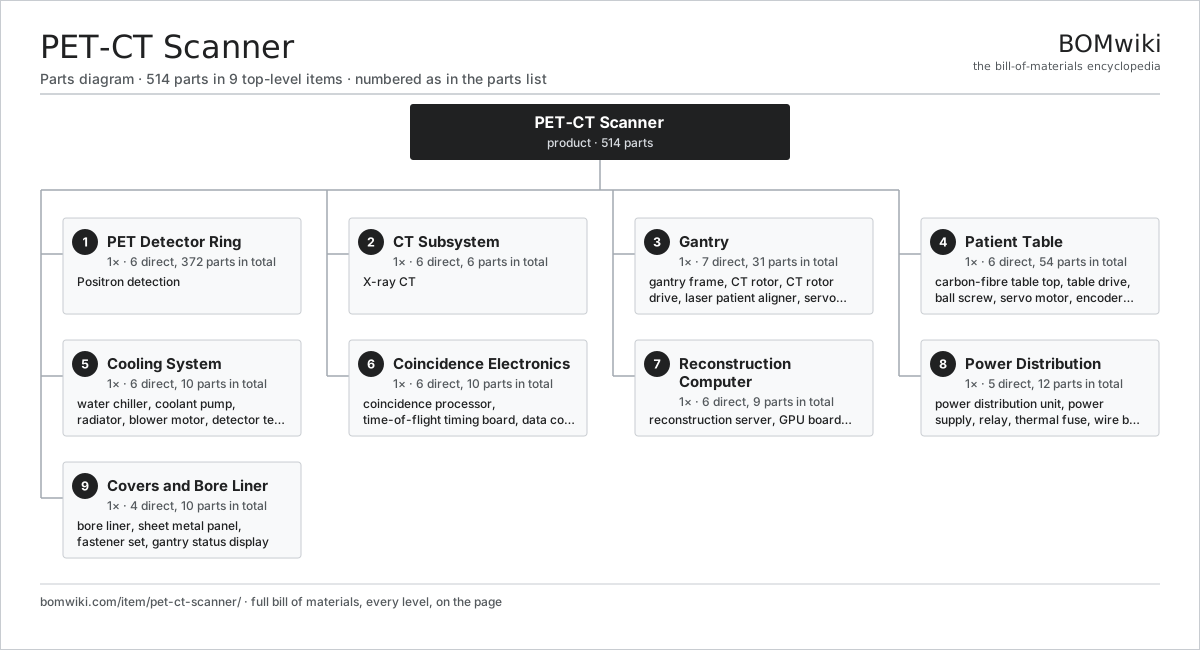
| # | Part | Qty | What it does |
|---|---|---|---|
| 1 | PET Detector Ring 6 parts | 1× | Positron detection |
| 2 | CT Subsystem 6 parts | 1× | X-ray CT |
| 3 | Gantry 7 parts | 1× | Tandem structure housing the stationary PET ring and the spinning CT assembly behind a single bore. |
| 4 | Patient Table 6 parts | 1× | Cantilevered couch advancing the patient through the common field of view with low deflection. |
| 5 | Cooling System 6 parts | 1× | Chilled-air and water loops stabilising the detector temperature and removing X-ray tube heat. |
| 6 | Coincidence Electronics 6 parts | 1× | Timing electronics that pair opposite gammas arriving within a few nanoseconds to define a line of response. |
| 7 | Reconstruction Computer 6 parts | 1× | GPU-accelerated cluster that reconstructs PET and CT volumes and fuses them into co-registered images. |
| 8 | Power Distribution 5 parts | 1× | Mains distribution and conditioning feeding the high-power CT generator and sensitive PET electronics. |
| 9 | Covers and Bore Liner 4 parts | 1× | Outer enclosure and smooth bore liner presenting a clean surface and concealing the rotating CT. |
3D model
No 3D model yet. Have a CAD file of this? Add a 3D model. STL renders right on this page; STEP, FreeCAD, and OpenSCAD sources are welcome too (openly licensed, like all 3D models on BOMwiki).
Build & assembly graph
expand / collapse · shared sub-assemblies converge · links to related products · est. labourTap an assembly to expand/collapse · tap a part to open it · use “Open page” for any node · drag to pan, scroll to zoom.
Bill of materials for PET-CT Scanner
9 top-level lines · 69 rows shown · 514 parts total · indented to 3 levels| # | Item / sub-assembly | Part no. | Qty/assy | Ext. qty | Parts | Type |
|---|---|---|---|---|---|---|
| 1 | PET Detector Ring 6 parts | pet-ct-scanner-pet-detector-ring | 1× | 1 | 372 | assembly |
| 1.1 | Detector Block | pet-ct-scanner-detector-block | 360× | 360 | · | part |
| 1.2 | LYSO Crystal Array | pet-ct-scanner-lyso-crystal | 1× | 1 | · | part |
| 1.3 | SiPM Array | pet-ct-scanner-sipm-array | 1× | 1 | · | part |
| 1.4 | Block Front-End Electronics | pet-ct-scanner-block-electronics | 1× | 1 | · | part |
| 1.5 | Detector Ring Frame | pet-ct-scanner-ring-frame | 1× | 1 | · | part |
| 1.6 | Bare PCB | pcb-bare | 8× | 8 | · | part |
| 2 | CT Subsystem 6 parts | pet-ct-scanner-ct-subsystem | 1× | 1 | 6 | assembly |
| 2.1 | X-ray Tube | pet-ct-scanner-x-ray-tube | 1× | 1 | · | part |
| 2.2 | CT Detector Arc | pet-ct-scanner-ct-detector-arc | 1× | 1 | · | part |
| 2.3 | CT Collimator | pet-ct-scanner-ct-collimator | 1× | 1 | · | part |
| 2.4 | High-Voltage Generator | pet-ct-scanner-ct-generator | 1× | 1 | · | part |
| 2.5 | CT Slip Ring | pet-ct-scanner-slip-ring | 1× | 1 | · | part |
| 2.6 | Power Supply | power-supply | 1× | 1 | · | part |
| 3 | Gantry 7 parts | pet-ct-scanner-gantry | 1× | 1 | 31 | assembly |
| 3.1 | Gantry Frame | pet-ct-scanner-gantry-frame | 1× | 1 | · | part |
| 3.2 | CT Rotor | pet-ct-scanner-ct-rotor | 1× | 1 | · | part |
| 3.3 | CT Rotor Drive | pet-ct-scanner-ct-drive | 1× | 1 | · | part |
| 3.4 | Laser Patient Aligner | pet-ct-scanner-laser-aligner | 1× | 1 | · | part |
| 3.5 | Servo Motor 4 parts | servo-motor | 1× | 1 | 24 | assembly |
| 3.5.1 | Stator Assembly 3 parts + deeper › | stator-assembly | 1× | 1 | 3 | assembly |
| 3.5.2 | Rotor Assembly 4 parts + deeper › | rotor-assembly | 1× | 1 | 19 | assembly |
| 3.5.3 | Encoder | encoder | 1× | 1 | · | part |
| 3.5.4 | Motor Housing | motor-housing | 1× | 1 | · | part |
| 3.6 | Encoder | encoder | 1× | 1 | · | part |
| 3.7 | Ball Bearing | ball-bearing | 2× | 2 | · | part |
| 4 | Patient Table 6 parts | pet-ct-scanner-patient-table | 1× | 1 | 54 | assembly |
| 4.1 | Carbon-Fibre Table Top | pet-ct-scanner-table-top | 1× | 1 | · | part |
| 4.2 | Table Drive | pet-ct-scanner-table-drive | 1× | 1 | · | part |
| 4.3 | Ball Screw | ball-screw | 1× | 1 | · | part |
| 4.4 | Servo Motor 4 parts | servo-motor | 2× | 2 | 24 | assembly |
| 4.4.1 | Stator Assembly 3 parts + deeper › | stator-assembly | 1× | 2 | 3 | assembly |
| 4.4.2 | Rotor Assembly 4 parts + deeper › | rotor-assembly | 1× | 2 | 19 | assembly |
| 4.4.3 | Encoder | encoder | 1× | 2 | · | part |
| 4.4.4 | Motor Housing | motor-housing | 1× | 2 | · | part |
| 4.5 | Encoder | encoder | 2× | 2 | · | part |
| 4.6 | Deflection Compensation | pet-ct-scanner-deflection-comp | 1× | 1 | · | part |
| 5 | Cooling System 6 parts | pet-ct-scanner-cooling-system | 1× | 1 | 10 | assembly |
| 5.1 | Water Chiller | pet-ct-scanner-chiller | 1× | 1 | · | part |
| 5.2 | Coolant Pump | coolant-pump | 1× | 1 | · | part |
| 5.3 | Radiator | radiator | 1× | 1 | · | part |
| 5.4 | Blower Motor | blower-motor | 2× | 2 | · | part |
| 5.5 | Detector Temperature Sensor | pet-ct-scanner-temp-sensor | 4× | 4 | · | part |
| 5.6 | Pressure Sensor | pressure-sensor | 1× | 1 | · | part |
| 6 | Coincidence Electronics 6 parts | pet-ct-scanner-coincidence-electronics | 1× | 1 | 10 | assembly |
| 6.1 | Coincidence Processor | pet-ct-scanner-coincidence-processor | 1× | 1 | · | part |
| 6.2 | Time-of-Flight Timing Board | pet-ct-scanner-tof-timing-board | 1× | 1 | · | part |
| 6.3 | Data Concentrator | pet-ct-scanner-data-concentrator | 1× | 1 | · | part |
| 6.4 | Bare PCB | pcb-bare | 4× | 4 | · | part |
| 6.5 | Microcontroller | mcu | 2× | 2 | · | part |
| 6.6 | SMD Passive (R/C/L) | smd-passives | 1× | 1 | · | part |
| 7 | Reconstruction Computer 6 parts | pet-ct-scanner-reconstruction-computer | 1× | 1 | 9 | assembly |
| 7.1 | Reconstruction Server | pet-ct-scanner-recon-server | 1× | 1 | · | part |
| 7.2 | GPU Board | pet-ct-scanner-gpu-board | 2× | 2 | · | part |
| 7.3 | Operator Console | pet-ct-scanner-operator-console | 1× | 1 | · | part |
| 7.4 | LCD Panel | lcd-panel | 2× | 2 | · | part |
| 7.5 | Compute SoC Module | soc-module | 1× | 1 | · | part |
| 7.6 | Bare PCB | pcb-bare | 2× | 2 | · | part |
| 8 | Power Distribution 5 parts | pet-ct-scanner-power-distribution | 1× | 1 | 12 | assembly |
| 8.1 | Power Distribution Unit | pet-ct-scanner-pdu | 1× | 1 | · | part |
| 8.2 | Power Supply | power-supply | 2× | 2 | · | part |
| 8.3 | Relay | relay | 4× | 4 | · | part |
| 8.4 | Thermal Fuse | thermal-fuse | 4× | 4 | · | part |
| 8.5 | Wire Bundle | wire-bundle | 1× | 1 | · | part |
| 9 | Covers and Bore Liner 4 parts | pet-ct-scanner-covers | 1× | 1 | 10 | assembly |
| 9.1 | Bore Liner | pet-ct-scanner-bore-liner | 1× | 1 | · | part |
| 9.2 | Sheet Metal Panel | sheet-panel | 6× | 6 | · | part |
| 9.3 | Fastener Set | fastener-set | 1× | 1 | · | part |
| 9.4 | Gantry Status Display | pet-ct-scanner-display-bezel | 2× | 2 | · | part |
Something wrong in this list? Report a problem with this BOM.
Related products
same domain, ranked by shared parts Medical Linear Accelerator
485 parts · shares 20 with this page
Heart-Lung Machine
298 parts · shares 21 with this page
Medical Linear Accelerator
485 parts · shares 20 with this page
Heart-Lung Machine
298 parts · shares 21 with this page
 ECMO Machine
142 parts · shares 20 with this page
ECMO Machine
142 parts · shares 20 with this page
 MRI Scanner
207 parts · shares 15 with this page
MRI Scanner
207 parts · shares 15 with this page
 Gamma Camera
421 parts · shares 20 with this page
Gamma Camera
421 parts · shares 20 with this page
 X-Ray Machine
205 parts · shares 16 with this page
X-Ray Machine
205 parts · shares 16 with this page
Sourcing: possible vendors
Browse the supplier directory → Prices, MOQ, and lead times are algorithmic estimates, not quotes, and not claims about these companies. Company mappings are curated by keyword; est. price band $500–$3M. How estimates work| Vendor | HQ | Specialty | MOQ | Lead time |
|---|---|---|---|---|
| gehealthcare.com ↗ | Chicago, US | Medical imaging & devices | 100 units | 12–20 wks |
| siemens-healthineers.com ↗ | Erlangen, DE | Medical systems | 100 units | 12–20 wks |
|
🇳🇱Philips
philips.com ↗
|
Amsterdam, NL | Health technology | 100 units | 12–20 wks |
| medtronic.com ↗ | Minneapolis, US | Medical devices | 100 units | 12–20 wks |
|
🇨🇳Mindray
mindray.com ↗
|
Shenzhen, CN | Medical devices | 100 units | 12–20 wks |
761-word article