Phono Preamplifier
ProductOverview
A phono preamplifier is the essential interface between a vinyl record turntable and an audio system. It performs two critical functions: (1) providing massive gain (40–60 dB) to bring microvolt-level cartridge signals to line level (+4 dBu), and (2) applying RIAA equalization, a standardized inverse curve that compensates for the bass-reduced, treble-boosted encoding applied to all vinyl records during pressing.
Modern mixing consoles and receivers often omit phono inputs, requiring a dedicated external phono preamp. The Cartridge Input Buffer accepts balanced-to-ground cartridge signals with precise impedance tuning to optimize cartridge resonance. The RIAA Equalization Network applies the inverse curve, restoring flat spectral response. The Amplification Stage boosts the weak signal to line level with minimal noise. Finally, the Balanced Output Driver delivers balanced XLR output suitable for mixing console or active speaker input.
How it Works
Vinyl Groove Physics
A vinyl groove is a spiral path cut into the record surface. A moving stylus (needle) physically traces this groove, vibrating side-to-side and up-and-down. The stylus is mounted on a cantilever arm (in a moving-magnet cartridge) or a tiny moving-coil (in a moving-coil cartridge). As the stylus vibrates, the cantilever vibrates, inducing voltage in a coil or generating magnetic flux that the cartridge's fixed magnets sense.
The stylus motion is minuscule, typically a few micrometers. The resulting signal is equally tiny: moving-magnet cartridges output 5–10 mV at normal groove velocity, while moving-coil cartridges output 0.5–2 mV. Both require amplification to line level (1.23 V, or +4 dBu).
RIAA Equalization and Vinyl Standards
The Recording Industry Association of America (RIAA) established a standardized equalization curve in the 1950s. During record pressing, low frequencies are reduced (attenuated) and high frequencies are boosted. This unusual curve serves multiple purposes:
Groove velocity control: Without bass reduction, the stylus must move very fast at low frequencies, making the groove wider and reducing playing time per record.
Surface noise masking: Vinyl records contain surface noise (dust particles, scratches). By boosting treble, the RIAA curve masks this noise beneath the musical content.
Preventing harmonic distortion: Heavily boosted bass would cause the record-cutting stylus to distort.
The RIAA curve is characterized by three corner frequencies: 50 Hz, 500 Hz, and 2122 Hz. The curve provides approximately −20 dB/decade slope above 500 Hz (high frequencies are boosted by the reverse curve) and −10 dB/decade below 50 Hz (low frequencies are attenuated).
The phono preamp's RIAA Equalization Network network applies the inverse curve: low frequencies are boosted, high frequencies are reduced, restoring flat response. A precision phono preamp achieves ±0.5 dB accuracy across the audible band.
Cartridge Impedance Matching
The Cartridge Input Buffer impedance is critical because the cartridge exhibits resonance behavior. A moving-magnet cartridge's generator impedance (typically 1 kΩ) is loaded by the preamp's input impedance (nominally 47 kΩ per RIAA standard). The cartridge's compliance and mass form an LC resonant circuit with the load impedance. A resonance peak at the correct frequency (typically 8–12 Hz) aids deep bass response; if resonance is too high or too low, bass response becomes boomy or thin.
The Load Capacitance Network trim capacitor adjusts total loading capacitance. Longer turntable cables add stray capacitance (approximately 100 pF per meter); the trim potentiometer allows the operator to compensate, ensuring the resonance peak lands at the design frequency.
Noise Performance and Bipolar Supply
Phono preamps are among the most noise-critical audio circuits. The input signal (1–10 mV) is just 40–60 dB above the noise floor. A preamp contributing even a few microvolts of noise becomes noticeable. Therefore:
Ultra-low-noise op-amps: The Input Buffer Op-Amp uses FET-input devices with noise floor below −125 dBV/√Hz (equivalent input noise < 2 nV/√Hz).
Dual-polarity supply: The Dual-Polarity Power Supply delivers ±15 V rails, allowing op-amps to be biased at mid-supply (0 V). Single-polarity supplies require coupling capacitors at various stages, introducing additional noise and phase shift.
Ripple filtering: The power supply includes Active Supply Filter active ripple filtering reducing mains-frequency noise well below the audio band.
Vibration isolation: The Elastomer Isolation Foot elastomer feet isolate the preamp from turntable vibration, preventing microphonic feedback.
Moving-Magnet vs. Moving-Coil Trade-offs
Moving-Magnet (MM) cartridges:
- Higher output (5–10 mV)
- Higher impedance (50–1000 Ω)
- Replaceable stylus
- Lower cost
- Require moderate gain (40 dB)
Moving-Coil (MC) cartridges:
- Lower output (0.5–2 mV)
- Lower impedance (2–40 Ω)
- Integral stylus (entire cartridge replacement when stylus wears)
- Higher cost
- Require high gain (60 dB)
The Cartridge Type Switch switch allows selection of impedance-optimized preamp gain and input loading for each cartridge type. MM preamps are simpler; MC preamps require lower-impedance preamp input and two gain stages.
Loading Adjustment and Cartridge Voicing
Different cartridges exhibit different resonance peaks. A preamp must allow loading impedance adjustment to optimize response. Older turntable designs integrated the preamp directly into the turntable chassis, making loading adjustment internal. Modern phono preamps expose loading via internal trimmers or external controls.
An engineer might measure a cartridge's frequency response in a specific turntable system and discover a presence peak at 12 kHz. By reducing load capacitance slightly (moving the resonance peak lower in frequency), the engineer can shift the presence peak away from the problem frequency, voicing the cartridge to taste.
Output Stage and Balanced Transmission
The Balanced Output Driver converts the single-ended output of the gain stage to balanced XLR. True balanced output uses either an output transformer (Output Isolation Transformer) or an active transformer-free balanced driver (differential amplifier outputting to pins 2 and 3 of XLR, with pin 1 grounded).
Balanced output is preferred because it allows the phono preamp to sit several feet away from the mixing console (on a shelf beside the turntable, for example) without picking up RF or hum. The balanced pair and shield reject common-mode noise.
Modern Vinyl Resurgence
Vinyl records experienced a resurgence in the 2010s and 2020s, driven by younger music consumers and audiophile appreciation for analog warmth. Most modern preamps include switching for MM and MC cartridges, adjustable loading, and sophisticated RIAA filtering. Some enthusiast models offer tube gain stages (warmer sound, though more microphonic) or discrete MOSFET input buffers (minimal noise, maximum speed).
Cartridge Selection and System Matching
The preamp's noise floor and gain must match the cartridge's output. A high-output MM cartridge (8 mV) driving a 60 dB high-gain MC preamp may overdrive the input stage, causing distortion. Conversely, a low-output MC cartridge (0.5 mV) connected to a 40 dB MM preamp may fail to reach optimal output level. Professional installers measure cartridge output and preamp specification to ensure matching.
Maintenance and Stylus Care
The cartridge stylus is a sapphire or diamond tip worn at a 0.05 mm radius. Over approximately 1000 hours of playing time, the stylus radius grows to 0.07 mm, degrading tracking force and increasing groove wear. Stylus replacement or entire cartridge replacement is required. The phono preamp itself is maintenance-free if the power supply's filter capacitors age (every 10–15 years, capacitors may lose capacitance or increase ESR), requiring replacement.
Phono Preamplifier parts and their functions
8 top-level parts · 53 parts in total · full bill of materials below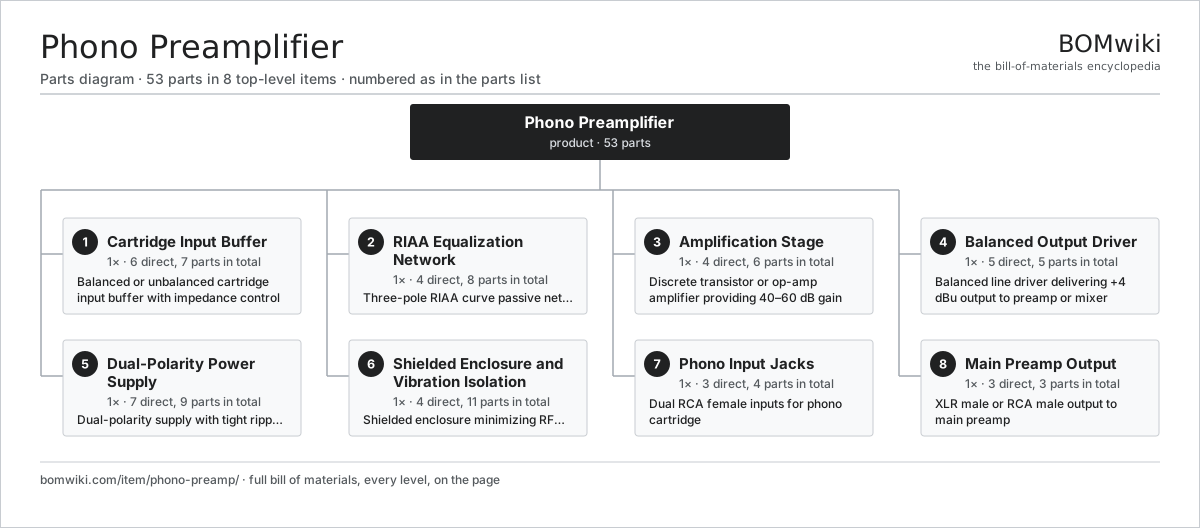
| # | Part | Qty | What it does |
|---|---|---|---|
| 1 | Cartridge Input Buffer 6 parts | 1× | Balanced or unbalanced cartridge input buffer with impedance control |
| 2 | RIAA Equalization Network 4 parts | 1× | Three-pole RIAA curve passive network providing -20 dB/decade slope |
| 3 | Amplification Stage 4 parts | 1× | Discrete transistor or op-amp amplifier providing 40–60 dB gain |
| 4 | Balanced Output Driver 5 parts | 1× | Balanced line driver delivering +4 dBu output to preamp or mixer |
| 5 | Dual-Polarity Power Supply 7 parts | 1× | Dual-polarity supply with tight ripple filtering for noise-free operation |
| 6 | Shielded Enclosure and Vibration Isolation 4 parts | 1× | Shielded enclosure minimizing RF and hum pickup |
| 7 | Phono Input Jacks 3 parts | 1× | Dual RCA female inputs for phono cartridge |
| 8 | Main Preamp Output 3 parts | 1× | XLR male or RCA male output to main preamp |
3D model
No 3D model yet. Have a CAD file of this? Add a 3D model. STL renders right on this page; STEP, FreeCAD, and OpenSCAD sources are welcome too (openly licensed, like all 3D models on BOMwiki).
Build & assembly graph
expand / collapse · shared sub-assemblies converge · links to related products · est. labourTap an assembly to expand/collapse · tap a part to open it · use “Open page” for any node · drag to pan, scroll to zoom.
Bill of materials for Phono Preamplifier
8 top-level lines · 44 rows shown · 53 parts total · indented to 3 levels| # | Item / sub-assembly | Part no. | Qty/assy | Ext. qty | Parts | Type |
|---|---|---|---|---|---|---|
| 1 | Cartridge Input Buffer 6 parts | phono-preamp-input-stage | 1× | 1 | 7 | assembly |
| 1.1 | Cartridge Type Switch | phono-preamp-input-selector | 1× | 1 | · | part |
| 1.2 | Load Resistor Network | phono-preamp-load-resistor | 1× | 1 | · | part |
| 1.3 | Load Capacitance Network | phono-preamp-load-capacitor | 1× | 1 | · | part |
| 1.4 | Input Buffer Op-Amp | phono-preamp-input-buffer-opamp | 1× | 1 | · | part |
| 1.5 | Connector | connector | 2× | 2 | · | part |
| 1.6 | SMD Passive (R/C/L) | smd-passives | 1× | 1 | · | part |
| 2 | RIAA Equalization Network 4 parts | phono-preamp-riaa-equalizer | 1× | 1 | 8 | assembly |
| 2.1 | RIAA Network Resistor | phono-preamp-riaa-resistor | 3× | 3 | · | part |
| 2.2 | RIAA Network Capacitor | phono-preamp-riaa-capacitor | 3× | 3 | · | part |
| 2.3 | RIAA HF Boost Inductor | phono-preamp-riaa-inductor | 1× | 1 | · | part |
| 2.4 | Bare PCB | pcb-bare | 1× | 1 | · | part |
| 3 | Amplification Stage 4 parts | phono-preamp-gain-stage | 1× | 1 | 6 | assembly |
| 3.1 | Gain Stage Op-Amp | phono-preamp-gain-opamp | 1× | 1 | · | part |
| 3.2 | Gain Feedback Resistor | phono-preamp-gain-resistor | 2× | 2 | · | part |
| 3.3 | Coupling Capacitor | phono-preamp-gain-capacitor | 2× | 2 | · | part |
| 3.4 | Bare PCB | pcb-bare | 1× | 1 | · | part |
| 4 | Balanced Output Driver 5 parts | phono-preamp-output-stage | 1× | 1 | 5 | assembly |
| 4.1 | Output Driver Op-Amp | phono-preamp-output-opamp | 1× | 1 | · | part |
| 4.2 | Output Isolation Transformer | phono-preamp-output-transformer | 1× | 1 | · | part |
| 4.3 | Output Level Potentiometer | phono-preamp-output-level-pot | 1× | 1 | · | part |
| 4.4 | Connector | connector | 1× | 1 | · | part |
| 4.5 | Fastener Set | fastener-set | 1× | 1 | · | part |
| 5 | Dual-Polarity Power Supply 7 parts | phono-preamp-power-supply | 1× | 1 | 9 | assembly |
| 5.1 | Power Transformer | phono-preamp-mains-transformer | 1× | 1 | · | part |
| 5.2 | Rectifier Assembly | phono-preamp-rectifier | 1× | 1 | · | part |
| 5.3 | Supply Filter Capacitor | phono-preamp-filter-capacitor | 2× | 2 | · | part |
| 5.4 | Voltage Regulator IC | phono-preamp-reg-ic | 2× | 2 | · | part |
| 5.5 | Active Supply Filter | phono-preamp-active-filter | 1× | 1 | · | part |
| 5.6 | Thermal Fuse | thermal-fuse | 1× | 1 | · | part |
| 5.7 | Connector | connector | 1× | 1 | · | part |
| 6 | Shielded Enclosure and Vibration Isolation 4 parts | phono-preamp-chassis | 1× | 1 | 11 | assembly |
| 6.1 | Sheet Metal Panel | sheet-panel | 4× | 4 | · | part |
| 6.2 | Faraday Shield | phono-preamp-shield-can | 1× | 1 | · | part |
| 6.3 | Elastomer Isolation Foot | phono-preamp-vibration-foot | 4× | 4 | · | part |
| 6.4 | Fastener Set | fastener-set | 2× | 2 | · | part |
| 7 | Phono Input Jacks 3 parts | phono-preamp-rca-connectors | 1× | 1 | 4 | assembly |
| 7.1 | Connector | connector | 2× | 2 | · | part |
| 7.2 | RCA Connector Shield | phono-preamp-input-shield | 1× | 1 | · | part |
| 7.3 | Fastener Set | fastener-set | 1× | 1 | · | part |
| 8 | Main Preamp Output 3 parts | phono-preamp-output-connector | 1× | 1 | 3 | assembly |
| 8.1 | Connector | connector | 1× | 1 | · | part |
| 8.2 | Internal Output Cable | phono-preamp-output-cable | 1× | 1 | · | part |
| 8.3 | Fastener Set | fastener-set | 1× | 1 | · | part |
Something wrong in this list? Report a problem with this BOM.
Related products
same domain, ranked by shared parts AV Matrix Switcher
112 parts · shares 2 with this page
AV Matrix Switcher
112 parts · shares 2 with this page
 CD Player
47 parts · shares 2 with this page
CD Player
47 parts · shares 2 with this page
 Channel Strip
55 parts · shares 2 with this page
Digital Stage Box
567 parts · shares 2 with this page
Channel Strip
55 parts · shares 2 with this page
Digital Stage Box
567 parts · shares 2 with this page
 DJ Mixer
86 parts · shares 2 with this page
DJ Mixer
86 parts · shares 2 with this page
Sourcing: possible vendors
Browse the supplier directory → Prices, MOQ, and lead times are algorithmic estimates, not quotes, and not claims about these companies. Company mappings are curated by keyword; est. price band $50–$3k. How estimates work| Vendor | HQ | Specialty | MOQ | Lead time |
|---|---|---|---|---|
|
🇯🇵Sony
sony.com ↗
|
Tokyo, JP | Consumer electronics | 1,000 units | 8–12 wks |
| samsung.com ↗ | Suwon, KR | Electronics & displays | 1,000 units | 8–12 wks |
|
🇺🇸Harman
harman.com ↗
|
Stamford, US | Audio (JBL, AKG) | 1,000 units | 8–12 wks |
|
🇺🇸Bose
bose.com ↗
|
Framingham, US | Audio | 1,000 units | 8–12 wks |
| yamaha.com ↗ | Hamamatsu, JP | Audio & instruments | 1,000 units | 8–12 wks |
1,237-word article