Neonatal Phototherapy Unit
ProductOverview
Neonatal jaundice (hyperbilirubinemia) occurs in up to 80% of term and preterm newborns when unconjugated bilirubin accumulates faster than the liver can process it. Excessive bilirubin crosses the blood-brain barrier and causes kernicterus, permanent neurological damage. Phototherapy interrupts this cascade by shining blue light on the infant's exposed skin. The light is absorbed by bilirubin molecules in capillaries just below the skin surface, converting them into water-soluble photoisomers (lumirubin and configurational isomers) that are rapidly excreted in urine and stool without liver processing. A phototherapy unit mounts above or beside the infant's crib and delivers high-intensity, spectrally pure blue light for hours or days until serum bilirubin levels decline to safe thresholds.
The Neonatal Phototherapy Unit consists of a Blue LED Light Panel generating intense blue photons, mounted on an Positioning Arm so it can be positioned at optimal distance and angle above the infant. An Intensity Control Module module lets nursing staff dial light power up or down, and a Timer & Irradiance Display counts elapsed treatment time. A Active Cooling System removes the substantial heat produced by the LEDs, keeping the light panel cool to the touch and preventing thermal stress to the neonate.
How it works
The Blue LED Light Panel contains two dozen or more high-brightness blue High-Brightness Blue LED chips wired in series on a Bare PCB, each emitting around 3–5 watts of optical power in the 470 nm band. This wavelength is optimal for bilirubin absorption: longer wavelengths (green, yellow, red) penetrate deeper skin but are absorbed less efficiently by the pigment; shorter wavelengths (ultraviolet) are dangerously absorbed by DNA. The 470 nm sweet spot balances penetration and absorption.
The Collimating Lens Array spreads the light from the concentrated LED cluster into a uniform circular or rectangular illumination pattern across the infant's body. Without diffusing optics, the light would be a bright spot surrounded by darkness, leading to uneven treatment. The lenses are designed to give an even irradiance of 15–35 µW/cm²/nm at a typical treatment distance (30 cm above the infant).
The Intensity Control Module module uses pulse-width modulation (PWM) and an IGBT Power Module to vary the current through the LED array. The clinician adjusts brightness via a dial or touchscreen, and a LED Current Monitor resistor provides feedback to the controller to linearize the output. Higher intensity treats jaundice faster but generates more heat; clinicians balance treatment urgency against LED life and thermal safety.
During phototherapy, the infant is undressed to maximize skin exposure. The infant typically remains under treatment for 12–48 hours continuously, with frequent breaks for feeding and parent bonding. Protective eye patches are placed over the eyes to prevent potential retinal damage, though this concern is theoretical at therapeutic wavelengths. The Mechanical Safety Shutter blocks light when the infant is not under the lamp (during feeding or diaper changes), extending LED life and reducing unnecessary exposure.
The Active Cooling System is essential because the LEDs convert about 60% of electrical input into heat. A DC Cooling Fan draws ambient air through fins on the Aluminum Heat Sink, carrying away the waste heat. A Thermistor Temperature Sensor thermistor continuously measures the panel surface temperature; if it exceeds 50 °C, the control system automatically shuts down the LEDs to prevent user burns.
The Timer & Irradiance Display shows elapsed phototherapy time and optionally displays the calculated irradiance (derived from the Light Intensity Sensor, a photodiode that measures light intensity at the crib surface). This gives nursing staff continuous feedback on treatment progress and helps them decide when to restart treatment after laboratory-confirmed bilirubin recheck.
LED phototherapy has almost entirely replaced halogen and fluorescent phototherapy because of superior efficacy, cooler operation, longer lifespan, and the ability to achieve targeted spectral output. Modern units are compact, lightweight, and battery-powered options exist for transport incubators.
Neonatal Phototherapy Unit parts and their functions
8 top-level parts · 88 parts in total · full bill of materials below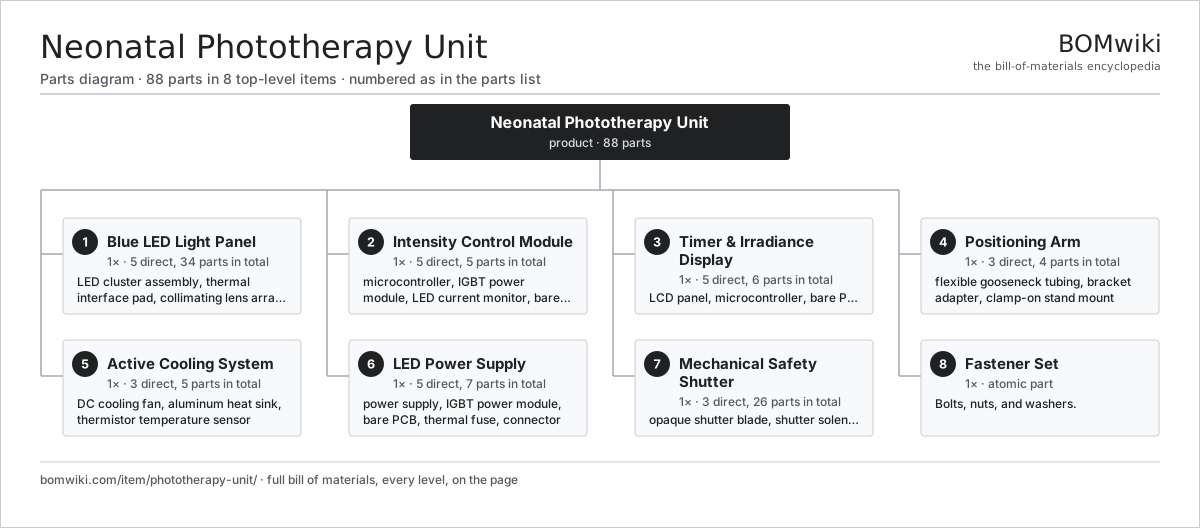
| # | Part | Qty | What it does |
|---|---|---|---|
| 1 | Blue LED Light Panel 5 parts | 1× | Array of high-brightness blue LEDs (420–470 nm) mounted on cooling plate. |
| 2 | Intensity Control Module 5 parts | 1× | PWM controller that modulates LED brightness from 0 to 100% based on clinician input. |
| 3 | Timer & Irradiance Display 5 parts | 1× | LCD showing elapsed phototherapy time and optical power output. |
| 4 | Positioning Arm 3 parts | 1× | Flexible articulated arm that positions the light panel above the infant bed. |
| 5 | Active Cooling System 3 parts | 1× | Thermoelectric or liquid cooler to dissipate LED heat and prevent overheating. |
| 6 | LED Power Supply 5 parts | 1× | Regulated constant-current source for LED array. |
| 7 | Mechanical Safety Shutter 3 parts | 1× | Manual or motorized shutter to block light when no treatment. |
| 8 | Fastener Set | 1× | Bolts, nuts, and washers. |
3D model
No 3D model yet. Have a CAD file of this? Add a 3D model. STL renders right on this page; STEP, FreeCAD, and OpenSCAD sources are welcome too (openly licensed, like all 3D models on BOMwiki).
Build & assembly graph
expand / collapse · shared sub-assemblies converge · links to related products · est. labourTap an assembly to expand/collapse · tap a part to open it · use “Open page” for any node · drag to pan, scroll to zoom.
Bill of materials for Neonatal Phototherapy Unit
8 top-level lines · 51 rows shown · 88 parts total · indented to 3 levels| # | Item / sub-assembly | Part no. | Qty/assy | Ext. qty | Parts | Type |
|---|---|---|---|---|---|---|
| 1 | Blue LED Light Panel 5 parts | phototherapy-blue-led-array | 1× | 1 | 34 | assembly |
| 1.1 | LED Cluster Assembly 3 parts | phototherapy-led-cluster | 1× | 1 | 26 | assembly |
| 1.1.1 | High-Brightness Blue LED | phototherapy-blue-led | 24× | 24 | · | part |
| 1.1.2 | Bare PCB | pcb-bare | 1× | 1 | · | part |
| 1.1.3 | SMD Passive (R/C/L) | smd-passives | 1× | 1 | · | part |
| 1.2 | Thermal Interface Pad | phototherapy-thermal-interface | 1× | 1 | · | part |
| 1.3 | Collimating Lens Array 2 parts | phototherapy-lens-array | 1× | 1 | 5 | assembly |
| 1.3.1 | Molded Acrylic Lens | phototherapy-lens-element | 4× | 4 | · | part |
| 1.3.2 | Lens Mount Frame | phototherapy-lens-holder | 1× | 1 | · | part |
| 1.4 | SMD Passive (R/C/L) | smd-passives | 1× | 1 | · | part |
| 1.5 | Connector | connector | 1× | 1 | · | part |
| 2 | Intensity Control Module 5 parts | phototherapy-intensity-control | 1× | 1 | 5 | assembly |
| 2.1 | Microcontroller | mcu | 1× | 1 | · | part |
| 2.2 | IGBT Power Module | igbt-module | 1× | 1 | · | part |
| 2.3 | LED Current Monitor | phototherapy-current-sense | 1× | 1 | · | part |
| 2.4 | Bare PCB | pcb-bare | 1× | 1 | · | part |
| 2.5 | SMD Passive (R/C/L) | smd-passives | 1× | 1 | · | part |
| 3 | Timer & Irradiance Display 5 parts | phototherapy-timer-display | 1× | 1 | 6 | assembly |
| 3.1 | LCD Panel | lcd-panel | 1× | 1 | · | part |
| 3.2 | Microcontroller | mcu | 1× | 1 | · | part |
| 3.3 | Bare PCB | pcb-bare | 1× | 1 | · | part |
| 3.4 | Light Intensity Sensor | phototherapy-brightness-sensor | 1× | 1 | · | part |
| 3.5 | Connector | connector | 2× | 2 | · | part |
| 4 | Positioning Arm 3 parts | phototherapy-mounting-arm | 1× | 1 | 4 | assembly |
| 4.1 | Flexible Gooseneck Tubing | phototherapy-gooseneck | 1× | 1 | · | part |
| 4.2 | Bracket Adapter | phototherapy-arm-bracket | 1× | 1 | · | part |
| 4.3 | Clamp-On Stand Mount 2 parts | phototherapy-clamp-mount | 1× | 1 | 2 | assembly |
| 4.3.1 | Quick-Release C-Clamp | phototherapy-clamp | 1× | 1 | · | part |
| 4.3.2 | Fastener Set | fastener-set | 1× | 1 | · | part |
| 5 | Active Cooling System 3 parts | phototherapy-cooling-system | 1× | 1 | 5 | assembly |
| 5.1 | DC Cooling Fan 3 parts | phototherapy-cooling-fan | 1× | 1 | 3 | assembly |
| 5.1.1 | Blower Motor | blower-motor | 1× | 1 | · | part |
| 5.1.2 | Fan Blade Impeller | phototherapy-fan-blade | 1× | 1 | · | part |
| 5.1.3 | Connector | connector | 1× | 1 | · | part |
| 5.2 | Aluminum Heat Sink | phototherapy-cooling-block | 1× | 1 | · | part |
| 5.3 | Thermistor Temperature Sensor | phototherapy-temperature-monitor | 1× | 1 | · | part |
| 6 | LED Power Supply 5 parts | phototherapy-power-supply | 1× | 1 | 7 | assembly |
| 6.1 | Power Supply | power-supply | 1× | 1 | · | part |
| 6.2 | IGBT Power Module | igbt-module | 1× | 1 | · | part |
| 6.3 | Bare PCB | pcb-bare | 1× | 1 | · | part |
| 6.4 | Thermal Fuse | thermal-fuse | 1× | 1 | · | part |
| 6.5 | Connector | connector | 3× | 3 | · | part |
| 7 | Mechanical Safety Shutter 3 parts | phototherapy-safety-shutter | 1× | 1 | 26 | assembly |
| 7.1 | Opaque Shutter Blade | phototherapy-shutter-blade | 1× | 1 | · | part |
| 7.2 | Shutter Solenoid | phototherapy-actuator | 1× | 1 | · | part |
| 7.3 | Servo Motor 4 parts | servo-motor | 1× | 1 | 24 | assembly |
| 7.3.1 | Stator Assembly 3 parts + deeper › | stator-assembly | 1× | 1 | 3 | assembly |
| 7.3.2 | Rotor Assembly 4 parts + deeper › | rotor-assembly | 1× | 1 | 19 | assembly |
| 7.3.3 | Encoder | encoder | 1× | 1 | · | part |
| 7.3.4 | Motor Housing | motor-housing | 1× | 1 | · | part |
| 8 | Fastener Set | fastener-set | 1× | 1 | · | part |
Something wrong in this list? Report a problem with this BOM.
Related products
same domain, ranked by shared parts PET-CT Scanner
514 parts · shares 16 with this page
PET-CT Scanner
514 parts · shares 16 with this page
 ECMO Machine
142 parts · shares 15 with this page
ECMO Machine
142 parts · shares 15 with this page
 Gamma Camera
421 parts · shares 15 with this page
Heart-Lung Machine
298 parts · shares 15 with this page
Infant Radiant Warmer
142 parts · shares 15 with this page
Rehabilitation Robot Arm
467 parts · shares 15 with this page
Gamma Camera
421 parts · shares 15 with this page
Heart-Lung Machine
298 parts · shares 15 with this page
Infant Radiant Warmer
142 parts · shares 15 with this page
Rehabilitation Robot Arm
467 parts · shares 15 with this page
Sourcing: possible vendors
Browse the supplier directory → Prices, MOQ, and lead times are algorithmic estimates, not quotes, and not claims about these companies. Company mappings are curated by keyword; est. price band $500–$3M. How estimates work| Vendor | HQ | Specialty | MOQ | Lead time |
|---|---|---|---|---|
| gehealthcare.com ↗ | Chicago, US | Medical imaging & devices | 100 units | 12–20 wks |
| siemens-healthineers.com ↗ | Erlangen, DE | Medical systems | 100 units | 12–20 wks |
|
🇳🇱Philips
philips.com ↗
|
Amsterdam, NL | Health technology | 100 units | 12–20 wks |
| medtronic.com ↗ | Minneapolis, US | Medical devices | 100 units | 12–20 wks |
|
🇨🇳Mindray
mindray.com ↗
|
Shenzhen, CN | Medical devices | 100 units | 12–20 wks |
645-word article