Planer Mill
ProductOverview
A planer mill (also called a four-square planer or four-sider) is a machine that mills all four sides of a board in a single pass, producing precisely dimensioned lumber with smooth faces. It is the final processing step in most sawmills, transforming rough-sawn or kiln-dried lumber into finished product ready for sale or further manufacturing.
The top, bottom, and two side cutterheads are arranged to form a rectangular opening through which the board passes. A Feed System with powered Feed Rollers advances the board, and all four cutterheads mill simultaneously, producing a finished board in seconds. The main Main Motor powers all heads through a transmission system, and the Control Panel adjusts feed speed and depth of cut.
How it works
A rough-sawn or dried board enters the planer, guided by the Pressure Bars and Hold-Down Rollers that hold it flat and centered. The Feed Motor drives the Feed Rollers, which grip the board and pull it through the milling zone at a preset speed (100–300 ft/min).
As the board passes under the Top Cutterhead, the rotating Cutting Knifes plane the top surface. Simultaneously, the Bottom Cutterhead planes the bottom, and the two Side Cutterheads plane the left and right edges. All four operations occur at the same time, each removing a preset amount of material (depth of cut, typically 1/16 to 1/4 inch per pass).
The Main Motor (60–150 horsepower) powers all the heads through a transmission: the output of the motor is distributed via pulleys and Drive Belts to the Top Gearbox, Bottom Gearbox, and Side Gearbox. Each gearbox reduces the motor speed to the optimal cutterhead speed (3,000–5,000 rpm for top and bottom, 2,000–4,000 rpm for sides, depending on wood species and finish requirements).
The board exits as a finished four-square product with:
- Top and bottom surfaces parallel and flat
- Left and right edges parallel and perpendicular to top/bottom
- All four surfaces smooth (typical surface finish: 80–120 micro-inch Ra)
- Dimensional tolerance typically ±0.010 inches
Typical cycle time for a 12-foot-long, 1-inch-thick board: 2–4 seconds.
Cutterhead design
Each cutterhead is a rotating spindle carrying Cutting Knifes (typically 4–6 per head) arranged helically around the shaft. The helical arrangement ensures that multiple knives are always lightly engaged, producing a continuous shaving rather than a series of chatter marks. This generates a superior surface finish compared to straight-knife designs.
The Cutting Knifes are typically made of tungsten carbide (lasting 50–150 hours of operation before resharpening) or high-speed steel (lasting 20–40 hours). Each knife can be rotated four times before disposal (once per edge). Dull knives produce a rough surface and require excessive feed force.
Top and bottom cutterheads rotate at similar speeds (3,000–5,000 rpm) to maintain grain direction; they can even be driven from a single gearbox with their shafts mechanically synchronized. Side cutterheads often run at slightly lower speeds (2,000–4,000 rpm) because the knife contact is more perpendicular and they encounter more varied grain direction.
The Cutterhead Shaft is a precision spindle, typically made of hardened steel and supported by two or more Cutterhead Bearings (ball or taper-roller) that handle radial and thrust loads.
Feed system
The Feed System controls board advancement and is critical to mill performance. The Feed Rollers are typically rubber-covered cylinders, 3–4 inches in diameter, driven by the Feed Motor. The Pressure Bars (spring-loaded steel bars) press down on the board with a force of 200–500 lbf, holding it flat and preventing it from lifting as it passes under the top cutterhead.
The Hold-Down Rollers are smooth or ribbed rollers that ride on the top surface of the board, preventing excessive lift due to top cutterhead knife contact. They are spring-loaded and follow the board's profile, accommodating slight curvature or crown.
Feed speed is adjustable from 100 to 300 feet per minute. Slow feeds (100–150 ft/min) are used on hardwood or when a superior finish is needed; fast feeds (250–300 ft/min) are used on softwood or for high throughput. The Control Panel may automatically adjust feed speed based on motor current draw, slowing the feed if the load (wood resistance) is excessive.
Depth of cut and dimensional control
The spacing between the top and bottom cutterheads is fixed or adjustable, determining the final board thickness. For example, a spacing of 0.75 inches produces 0.75-inch-thick boards. The spacing between the side cutterheads determines the final board width.
Depth of cut (the amount removed per pass) is typically 1/16 to 1/4 inch, depending on wood species and knife condition. Multiple passes may be required if the input is very rough or if a superior finish is needed.
A position transducer can continuously monitor the top and bottom spacing, allowing the Control Panel to issue alarms if boards are too thick (risking knife contact) or too thin (poor yield).
Surface finish
Finish quality depends on:
- Knife sharpness: Sharp knives produce a smooth shaving; dull knives produce tearout or a scratchy surface.
- Cutterhead speed: Higher speeds (5,000 rpm) produce finer finishes; lower speeds produce slight chatter marks.
- Feed speed: Slower feeds allow knives more time to cut cleanly; faster feeds can produce chatter marks if feed speed exceeds knife cutting frequency.
- Grain direction: The milling direction relative to grain direction: if the knives are cutting "with the grain" (downhill), finish is superior; if "against the grain" (uphill), tearout is likely, requiring lower feed speed.
- Helical vs. straight knives: Helical knives produce superior finish due to continuous engagement.
Typical surface finish on four-square planers: 80–120 micro-inch Ra (centerline average roughness), which is acceptable for most lumber grades and requires no further sanding for casual applications.
Drive transmission
The Main Motor (60–150 hp) drives a large-diameter pulley, which is connected via heavy Drive Belts to pulleys on each of the Top Gearbox, Bottom Gearbox, and Side Gearbox inputs. Each gearbox reduces speed appropriately and couples the output to its respective cutterhead.
Modern mills use a variable-frequency drive on the Main Motor, allowing the operator to adjust motor speed and thus all cutterhead speeds proportionally. Softer woods may run at higher speeds for better throughput; harder woods may run at lower speeds for improved finish.
Maintenance and adjustments
Daily maintenance:
- Inspect Cutting Knifes for dullness or edge chips.
- Check Feed Roller grip (they should not slip).
- Listen for unusual sounds from Cutterhead Bearings or gearboxes.
- Empty dust collection hopper.
Weekly:
- Rotate or replace dull Cutting Knifes if finish deteriorates.
- Lubricate Cutterhead Bearings and pulley bearings.
- Check Pressure Bar springs for loss of tension.
Adjustments:
- Knife height: The top and bottom cutterheads must be set to the same height (shim adjustment on bearing blocks) so both knives engage the board simultaneously.
- Parallelism: The spacing between top and bottom must be constant across the board width, or finished boards will be tapered.
- Side cutterhead tilt: Side heads may be tilted slightly to adjust the angle of edge cut.
Integration and throughput
Typical mill sequence: Log → Debarker → Headrig → Edger/Resaw → Kiln Dry → Planer Mill → Grade & Sort → Wrap/Ship.
A single four-square planer producing 1.5×5.5 inch boards at 200 ft/min processes roughly:
- (200 ft/min ÷ 16 feet per board) × 60 min/hr = 750 boards/hr
- Each board yields (1.5 × 5.5 ÷ 12) ≈ 0.69 board feet
- Total output: ~500 board feet per hour per planer
Large mills operate multiple planers in parallel, each fed by a sorter or optimizer that routes logs to the best equipment for their grade or dimension. Planer throughput is often the mill bottleneck, so proper maintenance and setup are critical to overall productivity.
Planer Mill parts and their functions
8 top-level parts · 78 parts in total · full bill of materials below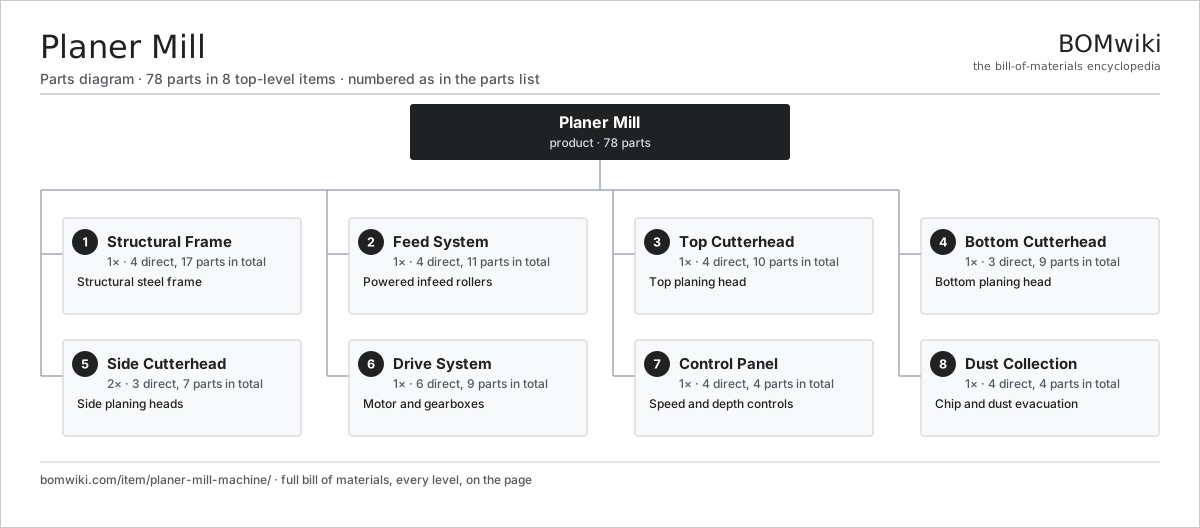
| # | Part | Qty | What it does |
|---|---|---|---|
| 1 | Structural Frame 4 parts | 1× | Structural steel frame |
| 2 | Feed System 4 parts | 1× | Powered infeed rollers |
| 3 | Top Cutterhead 4 parts | 1× | Top planing head |
| 4 | Bottom Cutterhead 3 parts | 1× | Bottom planing head |
| 5 | Side Cutterhead 3 parts | 2× | Side planing heads |
| 6 | Drive System 6 parts | 1× | Motor and gearboxes |
| 7 | Control Panel 4 parts | 1× | Speed and depth controls |
| 8 | Dust Collection 4 parts | 1× | Chip and dust evacuation |
3D model
No 3D model yet. Have a CAD file of this? Add a 3D model. STL renders right on this page; STEP, FreeCAD, and OpenSCAD sources are welcome too (openly licensed, like all 3D models on BOMwiki).
Build & assembly graph
expand / collapse · shared sub-assemblies converge · links to related products · est. labourTap an assembly to expand/collapse · tap a part to open it · use “Open page” for any node · drag to pan, scroll to zoom.
Bill of materials for Planer Mill
8 top-level lines · 40 rows shown · 78 parts total · indented to 3 levels| # | Item / sub-assembly | Part no. | Qty/assy | Ext. qty | Parts | Type |
|---|---|---|---|---|---|---|
| 1 | Structural Frame 4 parts | planer-mill-machine-frame | 1× | 1 | 17 | assembly |
| 1.1 | Frame Beam | planer-mill-machine-frame-beam | 4× | 4 | · | part |
| 1.2 | Vertical Column | planer-mill-machine-frame-vertical | 4× | 4 | · | part |
| 1.3 | Cross Member | planer-mill-machine-frame-cross-member | 6× | 6 | · | part |
| 1.4 | Fastener Set | fastener-set | 3× | 3 | · | part |
| 2 | Feed System 4 parts | planer-mill-machine-feed-system | 1× | 1 | 11 | assembly |
| 2.1 | Feed Roller | planer-mill-machine-feed-roller | 4× | 4 | · | part |
| 2.2 | Feed Motor | planer-mill-machine-feed-motor | 1× | 1 | · | part |
| 2.3 | Pressure Bar | planer-mill-machine-pressure-bar | 4× | 4 | · | part |
| 2.4 | Hold-Down Roller | planer-mill-machine-hold-down-roller | 2× | 2 | · | part |
| 3 | Top Cutterhead 4 parts | planer-mill-machine-cutterhead-top | 1× | 1 | 10 | assembly |
| 3.1 | Cutting Knife | planer-mill-machine-knife-helical | 6× | 6 | · | part |
| 3.2 | Cutterhead Shaft | planer-mill-machine-cutterhead-shaft | 1× | 1 | · | part |
| 3.3 | Cutterhead Bearing | planer-mill-machine-cutterhead-bearing | 2× | 2 | · | part |
| 3.4 | Copper Winding | copper-winding | 1× | 1 | · | part |
| 4 | Bottom Cutterhead 3 parts | planer-mill-machine-cutterhead-bottom | 1× | 1 | 9 | assembly |
| 4.1 | Cutting Knife | planer-mill-machine-knife-helical | 6× | 6 | · | part |
| 4.2 | Cutterhead Shaft | planer-mill-machine-cutterhead-shaft | 1× | 1 | · | part |
| 4.3 | Cutterhead Bearing | planer-mill-machine-cutterhead-bearing | 2× | 2 | · | part |
| 5 | Side Cutterhead 3 parts | planer-mill-machine-cutterhead-side | 2× | 2 | 7 | assembly |
| 5.1 | Cutting Knife | planer-mill-machine-knife-helical | 4× | 8 | · | part |
| 5.2 | Cutterhead Shaft | planer-mill-machine-cutterhead-shaft | 1× | 2 | · | part |
| 5.3 | Cutterhead Bearing | planer-mill-machine-cutterhead-bearing | 2× | 4 | · | part |
| 6 | Drive System 6 parts | planer-mill-machine-drive-system | 1× | 1 | 9 | assembly |
| 6.1 | Main Motor | planer-mill-machine-main-motor | 1× | 1 | · | part |
| 6.2 | Top Gearbox | planer-mill-machine-top-gearbox | 1× | 1 | · | part |
| 6.3 | Bottom Gearbox | planer-mill-machine-bottom-gearbox | 1× | 1 | · | part |
| 6.4 | Side Gearbox | planer-mill-machine-side-gearbox | 1× | 1 | · | part |
| 6.5 | Motor Pulley | planer-mill-machine-pulley-main | 2× | 2 | · | part |
| 6.6 | Drive Belt | drive-belt | 3× | 3 | · | part |
| 7 | Control Panel 4 parts | planer-mill-machine-control-panel | 1× | 1 | 4 | assembly |
| 7.1 | Microcontroller | mcu | 1× | 1 | · | part |
| 7.2 | Variable Drive | planer-mill-machine-vsd | 1× | 1 | · | part |
| 7.3 | Depth Sensor | planer-mill-machine-depth-sensor | 1× | 1 | · | part |
| 7.4 | Bare PCB | pcb-bare | 1× | 1 | · | part |
| 8 | Dust Collection 4 parts | planer-mill-machine-dust-collection | 1× | 1 | 4 | assembly |
| 8.1 | Dust Duct | planer-mill-machine-dust-duct | 1× | 1 | · | part |
| 8.2 | Dust Blower | planer-mill-machine-dust-blower | 1× | 1 | · | part |
| 8.3 | Dust Motor | planer-mill-machine-dust-motor | 1× | 1 | · | part |
| 8.4 | Dust Filter | planer-mill-machine-dust-filter | 1× | 1 | · | part |
Something wrong in this list? Report a problem with this BOM.
Related products
same domain, ranked by shared parts All-Electric Injection Molding Machine
851 parts · shares 3 with this page
Automated Paint Spray Line
2,003 parts · shares 3 with this page
All-Electric Injection Molding Machine
851 parts · shares 3 with this page
Automated Paint Spray Line
2,003 parts · shares 3 with this page
 Briquetting Press
92 parts · shares 3 with this page
Chipper Canter
63 parts · shares 3 with this page
Briquetting Press
92 parts · shares 3 with this page
Chipper Canter
63 parts · shares 3 with this page
 Continuous Galvanizing Line
1,296 parts · shares 3 with this page
Continuous Galvanizing Line
1,296 parts · shares 3 with this page
Sourcing: possible vendors
Browse the supplier directory → Prices, MOQ, and lead times are algorithmic estimates, not quotes, and not claims about these companies. Company mappings are curated by keyword; est. price band $5k–$2M. How estimates work| Vendor | HQ | Specialty | MOQ | Lead time |
|---|---|---|---|---|
| atlascopco.com ↗ | Stockholm, SE | Compressors & industrial | 10 units | 12–20 wks |
|
🇦🇹Andritz
andritz.com ↗
|
Graz, AT | Process plants & machinery | 10 units | 12–20 wks |
| buhlergroup.com ↗ | Uzwil, CH | Food & materials processing | 10 units | 12–20 wks |
| gea.com ↗ | Düsseldorf, DE | Process technology | 10 units | 12–20 wks |
| mhi.com ↗ | Tokyo, JP | Heavy machinery | 10 units | 12–20 wks |
1,555-word article