Underwater Pelletizer
ProductOverview
Plastic pelletizing converts scrap plastic, production waste, or virgin resin into uniform 3–5 mm pellets for downstream processing (extrusion, injection molding, blow molding). The underwater pelletizer is the industry-standard approach: plastic strands extruded into a water-filled tank are immediately cut by a high-speed rotating cutter, producing pellets that are instantly quenched and cooled. The wet pellets are separated from water via a centrifuge or dewatering screen, then dried in a hot-air chamber.
Pelletizers are essential for plastic manufacturers recycling internal scrap (rejected parts, sprues, trim, off-spec material) back into usable feed material. Regrind reduces material cost by 30–50% vs. virgin resin and supports circular-economy initiatives, though regrind quality degrades with each recycle cycle (polymers break down, cross-link, and embrittle).
Process Flow
Extrusion into Water
Virgin or scrap plastic (pellets or ground plastic) is melted in a 40–90 mm extruder screw. The molten plastic is forced through a die plate with 16–100 small holes (typically 2–5 mm diameter each), forming thin strands (spaghetti-like) that drop vertically into a water tank below.
Die temperature: typically 200–260 °C depending on polymer. Strand diameter: approximately matches die hole diameter (2–5 mm). Extrusion speed: 50–300 kg/h depending on die design and screw speed.
The water tank is kept at 15–40 °C to cool the hot strands immediately upon entry. The cooling water may be ambient temperature (cheaper but slower cooling) or chilled (faster cooling, better for moisture-sensitive resins like nylon).
Strand Cutting
Submerged in the water tank, strands are cut by a high-speed rotating cutter (typically a rotor-stator pair):
- Rotor: A steel drum (100–200 mm diameter) with knives on its perimeter, rotating at 500–3000 RPM.
- Stator: Fixed counter-knives in the housing, opposing the rotor.
The knives shear the strands into 3–5 mm pellets. Pellet length is controlled by:
- Cutter speed (RPM): Faster = shorter pellets; slower = longer pellets.
- Strand extrusion speed: Faster strand extrusion = longer pellets.
Pellet size must be uniform for downstream processing (extrusion/molding equipment requires consistent melt flow).
The underwater cutting keeps pellets cool and wet, preventing fines (powder) generation that occurs with dry-cutting methods. Wet pellets also have lower friction between them, easing handling and separation.
Water Separation
Wet pellets slurry (70–80% water) exits the cutter housing and flows to a centrifugal separator or dewatering screen. A rotating basket or screen removes most water, leaving pellets at ~10–20% moisture.
Centrifugal separator: Pellets are spun at 1000–3000 RPM; water is flung outward and drains through perforations, while pellets accumulate at the center and are discharged to the dryer.
Time in separator: 5–15 minutes depending on basket size.
Drying
Wet pellets (~15–20% moisture) are fed into a hot-air dryer chamber (heated to 80–120 °C by electric heaters). A blower circulates hot air through the pellet bed, evaporating residual water.
Drying time: typically 30–60 minutes depending on pellet size, moisture content, and drying air flow.
Final moisture: <0.5% for most applications (critical for moisture-sensitive polymers like PET, nylon).
A moisture sensor (Karl Fischer, capacitive, or infrared) detects when target moisture is achieved and triggers discharge of dried pellets to a hopper or bagging system.
Advantages Over Strand Drying Methods
Underwater pelletizers are vastly superior to older strand-drying methods (where strands are extruded into air, cooled on conveyor belts, then granulated):
- No fines: Wet cutting produces uniform pellets with minimal powder (<1–2%). Dry cutting generates 5–15% fines (very small pellets and dust) that are difficult to handle and process.
- No odor: Water cooling prevents oxidation and decomposition odors common with air-cooled strands.
- Better thermal control: Water instantly cools strands, reducing thermal stress and degradation.
- Faster processing: Entire strand-to-pellet cycle is 10–15 minutes (vs. 20–30 minutes for air cooling + conveyor + granulation).
- Smaller footprint: No conveyor belts or granulator equipment needed.
Material Considerations
Virgin Resin Processing
New plastic resin (pre-production material that hasn't been processed before) is pelleted to:
- Standardize form factor: Bagged virgin pellets are easier to feed to extrusion/injection machines than bulk powder.
- Quality control: Each pelleting run is tested for density, melt flow, and color; pellets are certified before distribution.
Virgin HDPE, LDPE, PP, and PET are routinely pelleted and sold as commodity materials.
Scrap & Regrind Processing
Post-consumer or post-industrial plastic waste is reprocessed:
Industrial scrap (production off-spec material, trim, sprues): High-quality regrind because source material is known and uncontaminated. Regrind can be blended at 10–50% with virgin material without property loss.
Post-consumer scrap (used bottles, packaging, containers): Lower quality because of contamination, color mixing, and unknown additives. Recycled post-consumer plastic is typically 100% regrind or blended at <20% with virgin. Over-recycling (multiple processing cycles) leads to chain scission, embrittlement, and color degradation.
Recycle count: Each pelletization cycle reduces molecular weight by ~5–10%, degrading mechanical properties and melt flow. After 3–5 recycles, plastic becomes too brittle for most applications and is typically down-cycled (used for non-structural, lower-performance products like plastic lumber or fillers).
Moisture-Sensitive Polymers
PET and nylon must be dried to <0.03% moisture before injection/extrusion, or hydrolysis (reaction with water) degrades polymer chains. Dedicated desiccant drying (using silica gel or molecular sieve) followed by hot-air drying in the pelletizer is standard for these materials. Some pelletizers include integrated desiccant dryers ahead of extrusion.
PVC and LDPE are less sensitive to moisture; <0.1% is acceptable for most applications.
Die Plate Engineering
The die insert with strand holes is critical:
- Hole diameter: 2–5 mm typical, drilled or EDM-machined into hardened steel or aluminum.
- Hole pattern: Drilled in a grid pattern ensuring even polymer distribution across the die face.
- Number of holes: 16–100 holes depending on extrusion capacity and desired strand thickness.
- Hole depth: Typically 1–2 times diameter (3–10 mm), providing sufficient material contact to stabilize flow.
A typical 100 kg/h pelletizer might have a 2.5 mm diameter, 64-hole die insert, extruding ~1.5 kg/h per strand, cutting into ~300–400 pellets/second.
Die inserts wear over time (hole walls smooth, reducing strand uniformity) and must be replaced every 1000–2000 operating hours depending on polymer type. Worn inserts produce irregular strands and larger-sized pellets.
Cutter Head Maintenance
The rotor knives and stator counter-knives dull over time, producing uneven cuts and powder generation. Maintenance:
- Weekly inspection: Feel for dull spots; monitor for increased powder generation.
- Monthly sharpening: Use a stone to hone knife edges (extends life another 100–200 hours).
- Quarterly replacement: Replace knives when sharpening no longer restores cutting performance (typically after 500–1000 hours operation).
Cost of rotor blade set: ~$200–500; stator blades: ~$100–300. Regular maintenance prevents product quality degradation and extends equipment life.
Quality Control
Pellet Size Uniformity
Measure pellet length with calipers or digital gauge on random samples. Target ±0.5 mm variance. Excessive variance indicates dull cutter blades or uneven strand extrusion speed.
Moisture Content
Measure with Karl Fischer titration (lab method, ±0.01% accuracy) or real-time moisture gauge (±0.1% accuracy). For PET and nylon, moisture must be <0.03% before re-extrusion.
Bulk Density
Weight a fixed volume of pellets (e.g., 1 liter). Typical density:
- HDPE pellets: ~0.95 g/cm³
- PET pellets: ~1.35 g/cm³
- PP pellets: ~0.90 g/cm³
Low density indicates fines generation or air pockets.
Melt Flow Index (MFI)
ASTM D1238 test: measure how much plastic flows through a standard nozzle at 230 °C under a 2.16 kg load in 10 minutes. Units: grams/10 min.
Virgin HDPE: ~0.5–2 g/10 min. After each recycle, MFI increases slightly (lower viscosity, shorter chains) but change should be <10% per cycle.
Color & Transparency
Visual inspection. Acceptable variation within one "shade range". Over-recycled material appears darker or more opaque.
Economics & ROI
A typical pelletizer system (extruder + pelletizer + dryer) costs $100k–$300k. For a plastic manufacturing facility generating 50–200 kg/day of scrap, ROI is typically 2–4 years through material cost savings.
Material cost comparison:
- Virgin HDPE: ~$1.5–2.5/kg
- Regrind (1st cycle): ~$0.8–1.2/kg
- Post-consumer regrind: ~$0.3–0.8/kg
A facility processing 100 kg/day of scrap into usable regrind saves ~$25k–$40k/year in material cost, offsetting depreciation and labor.
Sustainability & Circular Economy
Plastic pelletizing is essential for circular-economy initiatives:
- Reduces virgin plastic consumption: 50% regrind blend cuts virgin material use by half.
- Diverts waste from landfill: Industrial scrap that would be incinerated or buried is converted into usable feedstock.
- Supports regulatory compliance: Extended Producer Responsibility (EPR) schemes in EU, Canada, and other regions incentivize manufacturers to recycle plastic.
Challenges:
- Degradation with recycles: After 3–5 cycles, plastic is too embrittled for virgin-grade use.
- Contamination: Post-consumer plastic may contain PVC, metals, paper, or other incompatible materials that must be manually removed or detected and sorted.
- Economics of collection: Small quantities of waste from distributed sources are expensive to collect; centralized pelletizing facilities (regional recycling hubs) are more economical.
Modern facilities are exploring advanced recycling (chemical/depolymerization) that breaks plastic back down to monomers or base chemicals, enabling unlimited recycling without degradation. However, this requires capital-intensive equipment and is not yet cost-competitive with mechanical recycling for commodity plastics.
Underwater Pelletizer parts and their functions
8 top-level parts · 73 parts in total · full bill of materials below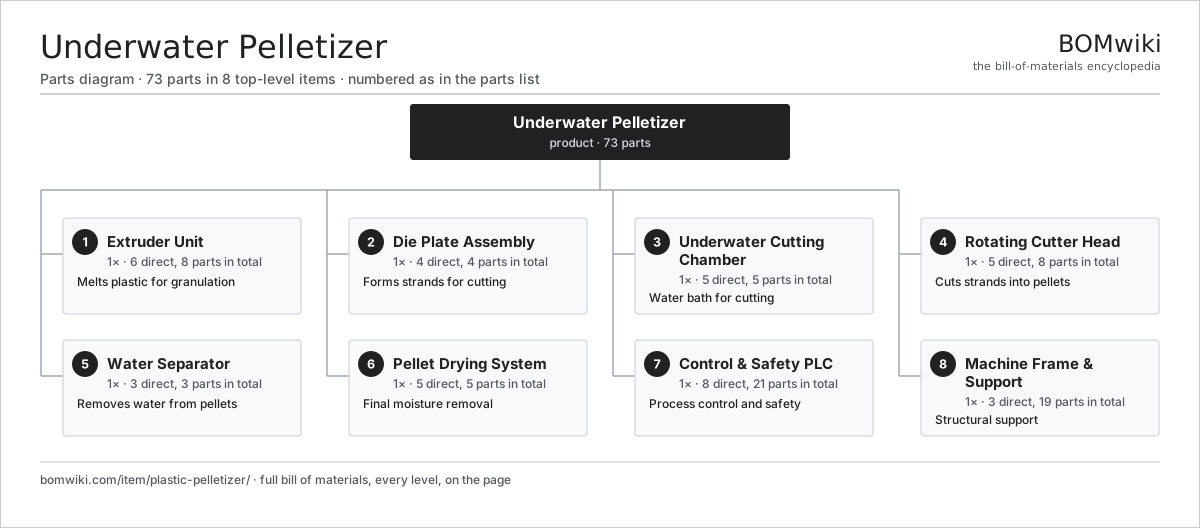
| # | Part | Qty | What it does |
|---|---|---|---|
| 1 | Extruder Unit 6 parts | 1× | Melts plastic for granulation |
| 2 | Die Plate Assembly 4 parts | 1× | Forms strands for cutting |
| 3 | Underwater Cutting Chamber 5 parts | 1× | Water bath for cutting |
| 4 | Rotating Cutter Head 5 parts | 1× | Cuts strands into pellets |
| 5 | Water Separator 3 parts | 1× | Removes water from pellets |
| 6 | Pellet Drying System 5 parts | 1× | Final moisture removal |
| 7 | Control & Safety PLC 8 parts | 1× | Process control and safety |
| 8 | Machine Frame & Support 3 parts | 1× | Structural support |
3D model
No 3D model yet. Have a CAD file of this? Add a 3D model. STL renders right on this page; STEP, FreeCAD, and OpenSCAD sources are welcome too (openly licensed, like all 3D models on BOMwiki).
Build & assembly graph
expand / collapse · shared sub-assemblies converge · links to related products · est. labourTap an assembly to expand/collapse · tap a part to open it · use “Open page” for any node · drag to pan, scroll to zoom.
Bill of materials for Underwater Pelletizer
8 top-level lines · 47 rows shown · 73 parts total · indented to 3 levels| # | Item / sub-assembly | Part no. | Qty/assy | Ext. qty | Parts | Type |
|---|---|---|---|---|---|---|
| 1 | Extruder Unit 6 parts | plastic-pelletizer-extruder-input | 1× | 1 | 8 | assembly |
| 1.1 | Screw-Barrel Assembly | plastic-pelletizer-screw-barrel | 1× | 1 | · | part |
| 1.2 | Hopper | plastic-pelletizer-hopper | 1× | 1 | · | part |
| 1.3 | Heater Band | plastic-pelletizer-heater-zones | 3× | 3 | · | part |
| 1.4 | Motor Housing | motor-housing | 1× | 1 | · | part |
| 1.5 | Gearbox Housing | gearbox-housing | 1× | 1 | · | part |
| 1.6 | Breaker Plate | plastic-pelletizer-breaker-plate | 1× | 1 | · | part |
| 2 | Die Plate Assembly 4 parts | plastic-pelletizer-die-plate | 1× | 1 | 4 | assembly |
| 2.1 | Die Insert | plastic-pelletizer-die-insert | 1× | 1 | · | part |
| 2.2 | Die Body | plastic-pelletizer-die-body | 1× | 1 | · | part |
| 2.3 | Die Heater | plastic-pelletizer-die-heater | 1× | 1 | · | part |
| 2.4 | Adapter Block | plastic-pelletizer-adapter-block | 1× | 1 | · | part |
| 3 | Underwater Cutting Chamber 5 parts | plastic-pelletizer-underwater-chamber | 1× | 1 | 5 | assembly |
| 3.1 | Chamber Tank | plastic-pelletizer-chamber-tank | 1× | 1 | · | part |
| 3.2 | Cutter Housing | plastic-pelletizer-cutter-housing | 1× | 1 | · | part |
| 3.3 | Strand Guide | plastic-pelletizer-strand-guide | 1× | 1 | · | part |
| 3.4 | Drain Valve | plastic-pelletizer-drain-valve | 1× | 1 | · | part |
| 3.5 | Water Supply Port | plastic-pelletizer-water-inlet | 1× | 1 | · | part |
| 4 | Rotating Cutter Head 5 parts | plastic-pelletizer-rotating-cutter | 1× | 1 | 8 | assembly |
| 4.1 | Rotor Knife | plastic-pelletizer-cutter-rotor | 1× | 1 | · | part |
| 4.2 | Stator Knife | plastic-pelletizer-cutter-stator | 1× | 1 | · | part |
| 4.3 | Cutter Motor | plastic-pelletizer-cutter-motor | 1× | 1 | · | part |
| 4.4 | Bearing Housing | plastic-pelletizer-bearing-housing | 1× | 1 | · | part |
| 4.5 | Ball Bearing | ball-bearing | 4× | 4 | · | part |
| 5 | Water Separator 3 parts | plastic-pelletizer-water-separator | 1× | 1 | 3 | assembly |
| 5.1 | Separator Basket | plastic-pelletizer-separator-basket | 1× | 1 | · | part |
| 5.2 | Separator Motor | plastic-pelletizer-separator-motor | 1× | 1 | · | part |
| 5.3 | Discharge Chute | plastic-pelletizer-discharge-chute | 1× | 1 | · | part |
| 6 | Pellet Drying System 5 parts | plastic-pelletizer-drying-system | 1× | 1 | 5 | assembly |
| 6.1 | Dryer Chamber | plastic-pelletizer-dryer-chamber | 1× | 1 | · | part |
| 6.2 | Drying Blower | plastic-pelletizer-hot-air-blower | 1× | 1 | · | part |
| 6.3 | Drying Heater | plastic-pelletizer-heater-element | 1× | 1 | · | part |
| 6.4 | Moisture Sensor | plastic-pelletizer-moisture-monitor | 1× | 1 | · | part |
| 6.5 | Discharge Screw | plastic-pelletizer-discharge-screw | 1× | 1 | · | part |
| 7 | Control & Safety PLC 8 parts | plastic-pelletizer-control-system | 1× | 1 | 21 | assembly |
| 7.1 | Microcontroller | mcu | 1× | 1 | · | part |
| 7.2 | Bare PCB | pcb-bare | 2× | 2 | · | part |
| 7.3 | LCD Panel | lcd-panel | 1× | 1 | · | part |
| 7.4 | Relay | relay | 10× | 10 | · | part |
| 7.5 | Power Supply | power-supply | 1× | 1 | · | part |
| 7.6 | Temperature Sensor | temperature-sensor | 4× | 4 | · | part |
| 7.7 | Pressure Sensor | pressure-sensor | 1× | 1 | · | part |
| 7.8 | Encoder | encoder | 1× | 1 | · | part |
| 8 | Machine Frame & Support 3 parts | plastic-pelletizer-frame | 1× | 1 | 19 | assembly |
| 8.1 | Base Frame | plastic-pelletizer-base-frame | 1× | 1 | · | part |
| 8.2 | Support Column | plastic-pelletizer-support-columns | 2× | 2 | · | part |
| 8.3 | Fastener Set | fastener-set | 16× | 16 | · | part |
Something wrong in this list? Report a problem with this BOM.
Related products
same domain, ranked by shared parts Pipe Extrusion Line
85 parts · shares 8 with this page
Pipe Extrusion Line
85 parts · shares 8 with this page
 Profile Extrusion Line
78 parts · shares 8 with this page
Profile Extrusion Line
78 parts · shares 8 with this page
 Sheet Extrusion Line
81 parts · shares 8 with this page
Sheet Extrusion Line
81 parts · shares 8 with this page
 Rotational Molding Machine
87 parts · shares 6 with this page
Rotational Molding Machine
87 parts · shares 6 with this page
 Thermoforming Machine
82 parts · shares 6 with this page
Thermoforming Machine
82 parts · shares 6 with this page
Sourcing: possible vendors
Browse the supplier directory → Prices, MOQ, and lead times are algorithmic estimates, not quotes, and not claims about these companies. Company mappings are curated by keyword; est. price band $5k–$2M. How estimates work| Vendor | HQ | Specialty | MOQ | Lead time |
|---|---|---|---|---|
| atlascopco.com ↗ | Stockholm, SE | Compressors & industrial | 10 units | 12–20 wks |
|
🇦🇹Andritz
andritz.com ↗
|
Graz, AT | Process plants & machinery | 10 units | 12–20 wks |
| buhlergroup.com ↗ | Uzwil, CH | Food & materials processing | 10 units | 12–20 wks |
| gea.com ↗ | Düsseldorf, DE | Process technology | 10 units | 12–20 wks |
| mhi.com ↗ | Tokyo, JP | Heavy machinery | 10 units | 12–20 wks |
1,599-word article