Sheet Extrusion Line
ProductAlso known as: Plastic Sheet Extrusion Line
Overview
Sheet extrusion is a high-volume, continuous process transforming plastic resin into flat sheets of controlled thickness. Molten plastic from an extruder flows through a wide, flat slot die, then is cooled by passing between precision-ground steel rollers, and finally wound onto cardboard cores or stacked into sheets.
Sheet extrusion is the primary manufacturing method for rigid plastic sheet stock used in thermoforming (clamshells, food trays), signage, and architectural panels. Modern lines produce 50–500 kg/hour of sheet, width 500 mm to 2.5 m, thickness 0.5–5 mm, with tight thickness tolerance (±5–10%).
Process Flow
Extrusion & Melting
Plastic resin (typically HIPS, PP, or recycled PET) is gravity-fed into an extruder hopper. A screw (40–90 mm diameter) rotates at 20–120 RPM, conveying pellets forward while heating them via friction and electric heaters. The melt is pressurized to 40–100 bar at the die inlet.
Barrel zone temperatures are carefully controlled:
- Feed zone: 80–100 °C (minimal melting, mostly mechanical shearing)
- Transition zone: 150–180 °C (melting progresses)
- Metering zone: 200–260 °C (depends on material; HIPS ~200–220 °C, PMMA ~240–260 °C)
Sheet Die
Molten polymer exits the extruder into a thermostatic die, a precision-machined cavity with a wide slot opening (width = final sheet width, gap = initial sheet thickness). The die has internal manifolds ensuring even pressure distribution across the width, so sheet thickness is uniform (not thin at edges).
Die temperature is typically 10–20 °C above barrel temperature to maintain melt fluidity without degradation. Precision control of lip gap (0.5–5 mm) and pressure enables thickness variation <±5%.
Cooling Stack
The extruded sheet (soft, malleable) exits the die and immediately contacts the top surface of the first cooling roll. The three-roll stack configuration is standard:
- Upper roll: Initial contact point, cools outer surface.
- Middle roll: Sheet wraps around this roll, cooled on both sides.
- Lower roll: Final cooling before haul-off.
Rolls are precision-ground steel (runout <0.02 mm) and water-cooled internally to 30–50 °C. The nip pressure (force pressing rolls together) is critical: too little, and the sheet is not in firm contact (poor cooling, wavy surface); too much, and the sheet is over-compressed, altering dimensions.
Cooling time in the roll stack: typically 10–30 seconds depending on thickness and line speed.
Haul-Off
A motorized puller (variable-speed AC or DC motor, 2–10 kW) draws the cooled sheet through the line at a constant, programmable speed (5–50 m/min). The haul-off is the "pacemaker" of the line: if it pulls faster, the sheet becomes thinner (more polymer is drawn out per unit time); if slower, the sheet becomes thicker.
Real-time feedback from a laser thickness gauge or ultrasonic sensor enables automatic haul-off speed adjustment to maintain target thickness within ±2–3%.
Winding or Stacking
Cooled, solid sheet is wound onto a cardboard core (for rolls) or stacked into neat piles (for flat sheets). Winding tension must be carefully controlled: too low, and the roll is loose and wavy; too high, and internal stress builds up, causing future warping.
Sheet Properties & Quality
Thickness Uniformity
Target thickness tolerance: ±0.1–0.2 mm on a 2 mm sheet (±5–10% tolerance). Variation is caused by:
- Uneven die pressure: Leads to thin edges, thick center. Fixed by internal die manifold balancing.
- Uneven cooling: Solved by proper roll temperature control and nip pressure adjustment.
- Haul-off speed variation: Real-time laser gauge feedback maintains consistent thickness.
Surface Quality
Smooth, glossy finish is preferred for most applications. Surface defects (orange-peel, gels, dirt) are caused by:
- Orange-peel texture: Resin degradation or contamination in hopper. Fixed by barrel cleaning or material replacement.
- Gel spots: Over-melted plastic clumps. Caused by excessive heater temperature or stuck material. Fixed by temperature reduction and breaker-plate cleaning.
- Wavy sheet: Insufficient roll cooling or too-low nip pressure. Fixed by increasing cooling water flow or adjusting nip.
Crystal Structure
Cooling rate during the roll stack affects crystal formation, especially in semicrystalline polymers like PP and HDPE. Slow cooling yields larger crystals and a hazy, stiff sheet; fast cooling yields fine crystals and a flexible, slightly clearer sheet. Most lines employ controlled cooling to balance stiffness and clarity.
Materials
HIPS (High-Impact Polystyrene)
Standard sheet material. Thermoforming temperature ~115–125 °C. Excellent clarity, cost-effective. Typical sheet: 1–3 mm thick, 0.5–2 m wide.
PP (Polypropylene)
Higher stiffness and thermal resistance than HIPS. More difficult to extrude (higher melt viscosity, narrower processing window). Thermoforming temperature ~140–160 °C. Used for durable, chemical-resistant applications.
PET (Polyethylene Terephthalate)
High clarity, stiffness, and barrier properties. Extrusion must be done carefully to avoid crystallization (slow cooling causes hazing). Cost 2–3× higher than HIPS.
PMMA (Polymethyl Methacrylate, Acrylic)
Excellent optical clarity, UV resistance. High extrusion temperature (240–260 °C). Cost ~2–3× HIPS. Used for premium transparency needs (display cases, light-diffusing panels).
Machine Configuration
Chill Roll Stack
The standard 3-roll design allows excellent heat transfer:
- Sheet contact area: ~0.3–1 m² on each roll depending on width and line speed.
- Heat flux: ~100–200 kW/m² (depends on roll temperature difference).
- Cooling time: 10–30 seconds to reach ~50 °C (moldable temperature).
Some advanced lines employ 4–5 roll stacks for thicker sheet or faster cooling.
Temperature Control
Each roll is independently water-cooled via a chiller unit (typically 30–50 kW for a full line). Temperature setpoint is ±1–2 °C. Too cold, and the plastic crystallizes prematurely; too warm, and it remains soft and wavy.
Thickness Gauge Feedback
Modern lines employ:
- Ultrasonic gauge: Measures sheet thickness in real-time (±0.05 mm accuracy); signal feeds back to haul-off motor speed control.
- Laser gauge: Non-contact optical measurement; detects thickness variation across sheet width (profile control).
Feedback-control loops maintain thickness within ±2–3% automatically, requiring minimal operator intervention.
Production Challenges
Die Starvation
If the extruder cannot supply enough melt at the die inlet, the sheet becomes thin and variable. Causes: low screw speed, clogged breaker plate, or insufficient heater power. Fixed by increasing screw RPM or checking/cleaning breaker plate.
Die Pressure Fluctuation
Fluctuating head pressure (visible in die pressure gauge) causes sheet thickness variation. Causes: polymer degradation (sticking in screw), or fluctuating extruder screw speed. Fixed by cleaning screw or adjusting motor speed controller.
Sheet Warping
Sheets cooled too slowly or unevenly can warp (curl, twist) after leaving the line. Causes: insufficient roll cooling, or too-high nip pressure causing residual stress. Fixed by increasing cooling water flow and adjusting nip pressure.
Breakage
Occasionally, thin sheet will snap as it passes over rolls, halting production. Causes: ultra-thin sheet (0.5 mm or less), high line speed, or weak plastic formulation. Fixed by reducing line speed or increasing sheet thickness.
Waste & Sustainability
Sheet extrusion produces:
- Process scrap: Edge trim (discarded due to uneven cooling), startup waste, and off-spec sheets. Typically 5–10% of total production.
- Regrind: Scrap is pelletized and recycled back into the hopper (20–50% of next batch). Regrind reduces cost but can affect sheet clarity if overused.
Modern lines minimize scrap by optimizing die design and online thickness control.
Economics
A mid-range sheet extrusion line (200 kg/h capacity, 1 m width) costs $200k–$400k. High-speed lines (400+ kg/h) cost $500k–$1M.
Production cost for 2 mm HIPS sheet (1 m wide):
- Material (HIPS resin): ~$1.20/kg × 2 kg/m = $2.40/m
- Energy (extrusion + cooling): ~$0.30/m
- Labor + depreciation: ~$0.50/m
- Total: ~$3.20/m (wholesale); retail $5–8/m
High-volume producers (Arkema, Dow) operate dedicated lines 24/7, achieving cost <$2.50/m through economies of scale.
Applications
Thermoforming
Sheet is sold in rolls (500 m) or stacks to thermoforming converters who heat, form, and trim into food trays, clamshells, and packaging.
Signage
Rigid plastic sheet is printed, carved, or routed into indoor/outdoor signs, display panels, and architectural elements (building trim, ceiling tiles).
Industrial & Construction
Protective barriers, machine guards, equipment housings, and weather-resistant panels.
Arts & Crafts
Artists and makers purchase small quantities of colored sheet for model-making, jewelry, and decorative projects.
Sheet Extrusion Line parts and their functions
7 top-level parts · 81 parts in total · full bill of materials below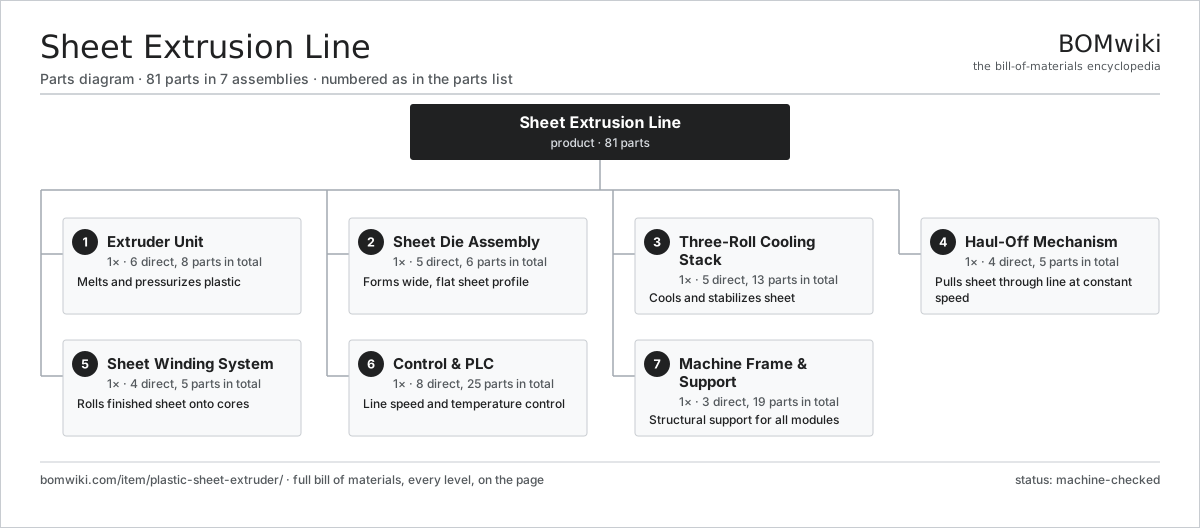
| # | Part | Qty | What it does |
|---|---|---|---|
| 1 | Extruder Unit 6 parts | 1× | Melts and pressurizes plastic |
| 2 | Sheet Die Assembly 5 parts | 1× | Forms wide, flat sheet profile |
| 3 | Three-Roll Cooling Stack 5 parts | 1× | Cools and stabilizes sheet |
| 4 | Haul-Off Mechanism 4 parts | 1× | Pulls sheet through line at constant speed |
| 5 | Sheet Winding System 4 parts | 1× | Rolls finished sheet onto cores |
| 6 | Control & PLC 8 parts | 1× | Line speed and temperature control |
| 7 | Machine Frame & Support 3 parts | 1× | Structural support for all modules |
3D model
No 3D model yet. Have a CAD file of this? Add a 3D model. STL renders right on this page; STEP, FreeCAD, and OpenSCAD sources are welcome too (openly licensed, like all 3D models on BOMwiki).
Build & assembly graph
expand / collapse · shared sub-assemblies converge · links to related products · est. labourTap an assembly to expand/collapse · tap a part to open it · use “Open page” for any node · drag to pan, scroll to zoom.
Bill of materials for Sheet Extrusion Line
7 top-level lines · 46 rows shown · 81 parts total · indented to 3 levels| # | Item / sub-assembly | Part no. | Qty/assy | Ext. qty | Parts | Type |
|---|---|---|---|---|---|---|
| 1 | Extruder Unit 6 parts | plastic-sheet-extruder-extruder-unit | 1× | 1 | 8 | assembly |
| 1.1 | Screw-Barrel Assembly | plastic-sheet-extruder-screw-barrel | 1× | 1 | · | part |
| 1.2 | Material Hopper | plastic-sheet-extruder-hopper | 1× | 1 | · | part |
| 1.3 | Heater Band | plastic-sheet-extruder-heater-zone | 3× | 3 | · | part |
| 1.4 | Motor Housing | motor-housing | 1× | 1 | · | part |
| 1.5 | Gearbox Housing | gearbox-housing | 1× | 1 | · | part |
| 1.6 | Breaker Plate | plastic-sheet-extruder-breaker-plate | 1× | 1 | · | part |
| 2 | Sheet Die Assembly 5 parts | plastic-sheet-extruder-sheet-die | 1× | 1 | 6 | assembly |
| 2.1 | Die Body | plastic-sheet-extruder-die-body | 1× | 1 | · | part |
| 2.2 | Manifold Block | plastic-sheet-extruder-manifold-block | 1× | 1 | · | part |
| 2.3 | Die Lip | plastic-sheet-extruder-die-lips | 2× | 2 | · | part |
| 2.4 | Lip Spacer | plastic-sheet-extruder-die-spacer | 1× | 1 | · | part |
| 2.5 | Torpedo Insert | plastic-sheet-extruder-torpedo | 1× | 1 | · | part |
| 3 | Three-Roll Cooling Stack 5 parts | plastic-sheet-extruder-three-roll-stack | 1× | 1 | 13 | assembly |
| 3.1 | Cooling Roll | plastic-sheet-extruder-cooling-roll | 3× | 3 | · | part |
| 3.2 | Roll Bearing House | plastic-sheet-extruder-roll-bearing-house | 3× | 3 | · | part |
| 3.3 | Roll Cooling System 4 parts | plastic-sheet-extruder-cooling-circuit | 1× | 1 | 5 | assembly |
| 3.3.1 | Chiller Unit | extrusion-blow-molder-chiller-unit | 1× | 1 | · | part |
| 3.3.2 | Coolant Pump | extrusion-blow-molder-pump | 1× | 1 | · | part |
| 3.3.3 | Flow Meter | extrusion-blow-molder-flow-meter | 1× | 1 | · | part |
| 3.3.4 | Temperature Sensor | temperature-sensor | 2× | 2 | · | part |
| 3.4 | Nip Adjustment Motor | plastic-sheet-extruder-roll-nip-motor | 1× | 1 | · | part |
| 3.5 | Pressure Gauge | plastic-sheet-extruder-roll-gap-adjustment | 1× | 1 | · | part |
| 4 | Haul-Off Mechanism 4 parts | plastic-sheet-extruder-haul-off-unit | 1× | 1 | 5 | assembly |
| 4.1 | Haul Motor | plastic-sheet-extruder-haul-motor | 1× | 1 | · | part |
| 4.2 | Haul Gearbox | plastic-sheet-extruder-haul-gearbox | 1× | 1 | · | part |
| 4.3 | Haul Roller | plastic-sheet-extruder-haul-rollers | 2× | 2 | · | part |
| 4.4 | Speed Encoder | plastic-sheet-extruder-speed-sensor | 1× | 1 | · | part |
| 5 | Sheet Winding System 4 parts | plastic-sheet-extruder-winder-system | 1× | 1 | 5 | assembly |
| 5.1 | Winder Motor | plastic-sheet-extruder-winder-motor | 1× | 1 | · | part |
| 5.2 | Winder Shaft | plastic-sheet-extruder-winder-shaft | 1× | 1 | · | part |
| 5.3 | Edge Guide | plastic-sheet-extruder-sheet-guide | 2× | 2 | · | part |
| 5.4 | Tension Roller | plastic-sheet-extruder-tension-roller | 1× | 1 | · | part |
| 6 | Control & PLC 8 parts | plastic-sheet-extruder-control-system | 1× | 1 | 25 | assembly |
| 6.1 | Microcontroller | mcu | 1× | 1 | · | part |
| 6.2 | Bare PCB | pcb-bare | 2× | 2 | · | part |
| 6.3 | LCD Panel | lcd-panel | 1× | 1 | · | part |
| 6.4 | Relay | relay | 10× | 10 | · | part |
| 6.5 | Power Supply | power-supply | 1× | 1 | · | part |
| 6.6 | Temperature Sensor | temperature-sensor | 6× | 6 | · | part |
| 6.7 | Encoder | encoder | 2× | 2 | · | part |
| 6.8 | Pressure Sensor | pressure-sensor | 2× | 2 | · | part |
| 7 | Machine Frame & Support 3 parts | plastic-sheet-extruder-frame-structure | 1× | 1 | 19 | assembly |
| 7.1 | Base Frame | plastic-sheet-extruder-base-frame | 1× | 1 | · | part |
| 7.2 | Side Support Frame | plastic-sheet-extruder-side-frames | 2× | 2 | · | part |
| 7.3 | Fastener Set | fastener-set | 16× | 16 | · | part |
Something wrong in this list? Report a problem with this BOM.
Related products
same domain, ranked by shared parts Pipe Extrusion Line
85 parts · shares 11 with this page
Pipe Extrusion Line
85 parts · shares 11 with this page
 Profile Extrusion Line
78 parts · shares 11 with this page
Profile Extrusion Line
78 parts · shares 11 with this page
 Thermoforming Machine
82 parts · shares 8 with this page
Thermoforming Machine
82 parts · shares 8 with this page
 Injection Blow Molding Machine
54 parts · shares 10 with this page
Extrusion Blow Molding Machine
71 parts · shares 9 with this page
Injection Blow Molding Machine
54 parts · shares 10 with this page
Extrusion Blow Molding Machine
71 parts · shares 9 with this page
Sourcing: possible vendors
Browse the supplier directory → Prices, MOQ, and lead times are algorithmic estimates, not quotes, and not claims about these companies. Company mappings are curated by keyword; est. price band $5k–$2M. How estimates work| Vendor | HQ | Specialty | MOQ | Lead time |
|---|---|---|---|---|
| atlascopco.com ↗ | Stockholm, SE | Compressors & industrial | 10 units | 12–20 wks |
|
🇦🇹Andritz
andritz.com ↗
|
Graz, AT | Process plants & machinery | 10 units | 12–20 wks |
| buhlergroup.com ↗ | Uzwil, CH | Food & materials processing | 10 units | 12–20 wks |
| gea.com ↗ | Düsseldorf, DE | Process technology | 10 units | 12–20 wks |
| mhi.com ↗ | Tokyo, JP | Heavy machinery | 10 units | 12–20 wks |
1,371-word article