Polysomnography System
ProductOverview
Polysomnography (PSG) systems provide objective sleep-stage scoring by continuous multi-modal physiological recording. The system integrates 32 simultaneous channels capturing electroencephalography, electrooculography, chin electromyography, thoracic and abdominal respiratory effort, nasal/oral airflow, peripheral oxygen saturation, and cardiac rhythm over 6–10 hours. Synchronized infrared video documents behavioral correlates (arousals, seizures, REM atonia loss). Clinical neurologists and sleep medicine specialists use PSG to diagnose obstructive/central/mixed apnea, periodic breathing, sleep-stage disorders, and nocturnal seizures; it remains the gold-standard diagnostic test for sleep-disordered breathing.
How it works
The Amplifier Headbox amplifies low-voltage scalp potentials (EEG 10–100 µV) and ocular movements (EOG 50–200 µV) to line-level voltages; onboard analog filtering attenuates 50/60 Hz powerline noise and out-of-band muscle artifact. Subject-worn Electrode and Sensor Set transducers convert airflow, respiratory effort, pulse oxygen, and heart rhythm into electrical signals routed to the headbox for real-time amplification. The Acquisition PC samples all 32 channels synchronously via a 16-bit analog-to-digital converter, timestamps each sample to the system clock, and streams raw waveforms to SSD storage. The Video Recording Subsystem simultaneously records dual infrared video feeds, frontal and lateral, with frame-rate synchronization to ensure precise correlation between behavioral events (apnea onset, arousal movement) and physiological transitions.
Clinical measurement and electrode placement
EEG electrode placement follows the 10–20 international standard: 20 active leads distributed across the scalp (Fp1/Fp2, F3/F4, C3/C4, P3/P4, O1/O2 midline) plus two reference (M1/M2 mastoid) and ground. EOG leads are placed at the lateral canthi to detect eye movements; submental EMG monitors chin muscle tone (hypotonia indicates REM sleep). Respiratory-effort Respiratory Effort Belt strain gauges measure thoracic and abdominal excursion independently (critical for detecting paradoxical breathing in mixed apnea). The Airflow Thermistor Probe thermistor probe detects inspiratory-phase airflow cooling; when apnea occurs, the thermistor signal ceases while respiratory effort persists (confirming obstructive vs. central apnea type).
Pre-test calibration and impedance validation
Before recording, the Calibration and Impedance Unit performs two validation steps. First, the impedance meter measures electrode-to-skin contact resistance at each of the 20 active EEG leads; values >5 kΩ indicate poor contact and require electrode repositioning or paste reapplication. Second, the signal generator injects a known 10 µV, 10 Hz sinusoid into the amplifier chain; the acquisition system must recover the signal within ±5% amplitude and ±2° phase, confirming analog frontend linearity and absence of input-stage saturation.
Data acquisition and storage
The acquisition PC runs proprietary sleep-analysis software that displays real-time spectrograms of EEG frequency bands (delta 0.5–4 Hz, theta 4–8 Hz, alpha 8–12 Hz, beta 12–30 Hz), raw waveform traces, and automated apnea/hypopnea detection. A 2 TB SSD records ~4 GB per 8-hour study. The software time-stamps each block of 256 samples at microsecond resolution to ensure drift <1 ms per hour; post-study, the technician reviews the 30-second epoch-by-epoch sleep stages (wake, N1, N2, N3, REM) and scores arousals and respiratory events offline.
Signal integrity and noise management
The headbox enclosure is a full Faraday cage reducing environmental 50/60 Hz interference by >60 dB. All analog cables are shielded twisted-pair with star-point grounding to the acquisition system's single-point earth to prevent ground loops. The preamp power supply uses isolated linear regulators (±15V, 3.3V) with <0.5 mV ripple; any power-supply noise couples directly to the input amplifier input-referred noise, so low-noise design is critical. The 200 Hz analog low-pass filter on the acquisition card attenuates muscle EMG (>60 Hz) and high-frequency noise before sampling, preventing aliasing artifacts that would corrupt sleep-stage classification.
Video synchronization
The infrared video system captures low-light behavior unsuitable for visible light due to patient privacy and sleep disruption. Each camera frame is tagged with a hardware time-code derived from the acquisition clock's phase-lock loop; the sync module ensures camera frame 0 and physiological sample 0 share the same microsecond timestamp. During analysis, the sleep technician can click any epoch in the EEG trace and instantly jump to the corresponding video frame to visually confirm an arousal, apnea, or seizure event.
Typical workflow
Patient arrives at a sleep-center lab in the evening. A trained technician applies the 20 scalp EEG electrodes using the 10–20 map, EOG canthal leads, submental EMG pair, and respiratory-effort belts; sensor placement takes 15–20 minutes. The impedance meter validates all contacts; any lead >5 kΩ is cleaned and reapplied. The signal generator test confirms amplifier response. At lights-out, the technician begins acquisition; the system records continuously through 7–8 hours of sleep and morning awakening. The following day, a sleep physician scores the study in 30-second epochs, reviews video for parasomnias or seizures, counts respiratory events, and issues a diagnostic report.
Polysomnography System parts and their functions
6 top-level parts · 31 parts in total · full bill of materials below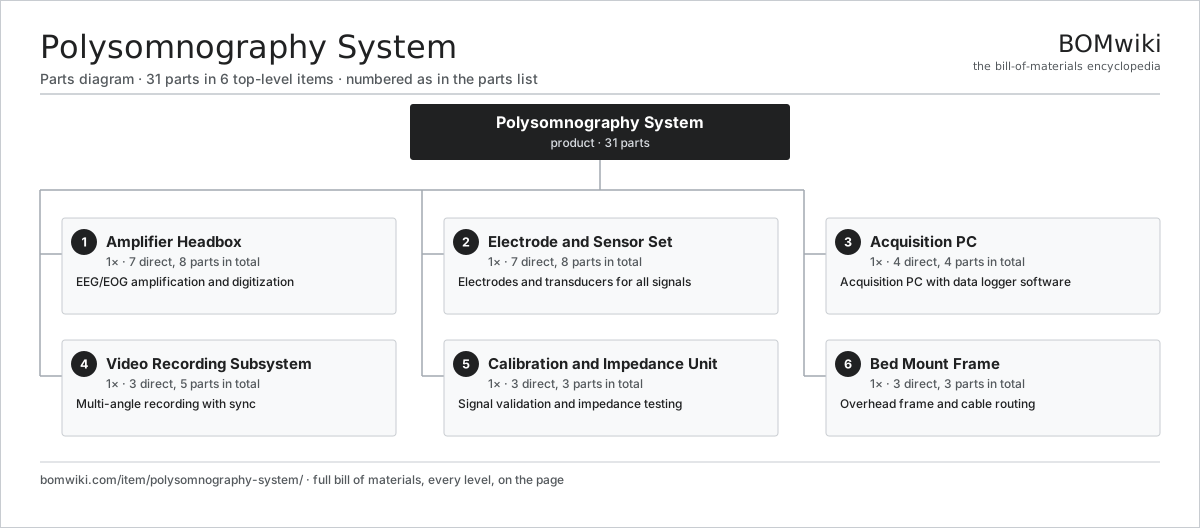
| # | Part | Qty | What it does |
|---|---|---|---|
| 1 | Amplifier Headbox 7 parts | 1× | EEG/EOG amplification and digitization |
| 2 | Electrode and Sensor Set 7 parts | 1× | Electrodes and transducers for all signals |
| 3 | Acquisition PC 4 parts | 1× | Acquisition PC with data logger software |
| 4 | Video Recording Subsystem 3 parts | 1× | Multi-angle recording with sync |
| 5 | Calibration and Impedance Unit 3 parts | 1× | Signal validation and impedance testing |
| 6 | Bed Mount Frame 3 parts | 1× | Overhead frame and cable routing |
3D model
No 3D model yet. Have a CAD file of this? Add a 3D model. STL renders right on this page; STEP, FreeCAD, and OpenSCAD sources are welcome too (openly licensed, like all 3D models on BOMwiki).
Build & assembly graph
expand / collapse · shared sub-assemblies converge · links to related products · est. labourTap an assembly to expand/collapse · tap a part to open it · use “Open page” for any node · drag to pan, scroll to zoom.
Bill of materials for Polysomnography System
6 top-level lines · 33 rows shown · 31 parts total · indented to 3 levels| # | Item / sub-assembly | Part no. | Qty/assy | Ext. qty | Parts | Type |
|---|---|---|---|---|---|---|
| 1 | Amplifier Headbox 7 parts | polysomnography-system-headbox | 1× | 1 | 8 | assembly |
| 1.1 | EEG Amplifier Card | polysomnography-system-eeg-amp-board | 1× | 1 | · | part |
| 1.2 | EOG Amplifier Card | polysomnography-system-eog-amp-board | 1× | 1 | · | part |
| 1.3 | Preamp Power Supply | polysomnography-system-preamp-psu | 1× | 1 | · | part |
| 1.4 | Connector | connector | 2× | 2 | · | part |
| 1.5 | Faraday Enclosure | polysomnography-system-shielding-can | 1× | 1 | · | part |
| 1.6 | Bare PCB | pcb-bare | 1× | 1 | · | part |
| 1.7 | Fastener Set | fastener-set | 1× | 1 | · | part |
| 2 | Electrode and Sensor Set 7 parts | polysomnography-system-sensor-set | 1× | 1 | 8 | assembly |
| 2.1 | Scalp Electrode Set | polysomnography-system-scalp-electrode-kit | 1× | 1 | · | part |
| 2.2 | EOG Lead Pair | polysomnography-system-eog-lead-pair | 1× | 1 | · | part |
| 2.3 | EMG Lead Pair | polysomnography-system-emg-lead-pair | 1× | 1 | · | part |
| 2.4 | Respiratory Effort Belt | polysomnography-system-resp-belt | 2× | 2 | · | part |
| 2.5 | Airflow Thermistor Probe | polysomnography-system-thermistor-airflow | 1× | 1 | · | part |
| 2.6 | SpO₂ Sensor Probe | polysomnography-system-pulse-oximeter-probe | 1× | 1 | · | part |
| 2.7 | ECG Lead Set | polysomnography-system-ecg-lead-set | 1× | 1 | · | part |
| 3 | Acquisition PC 4 parts | polysomnography-system-acq-pc | 1× | 1 | 4 | assembly |
| 3.1 | Acquisition PC Mainboard | polysomnography-system-pc-mainboard | 1× | 1 | · | part |
| 3.2 | USB Acquisition Card | polysomnography-system-usb-acq-card | 1× | 1 | · | part |
| 3.3 | Acquisition Storage | polysomnography-system-storage | 1× | 1 | · | part |
| 3.4 | Power Supply | power-supply | 1× | 1 | · | part |
| 4 | Video Recording Subsystem 3 parts | polysomnography-system-video-subsystem | 1× | 1 | 5 | assembly |
| 4.1 | Infrared Camera | polysomnography-system-ir-camera | 2× | 2 | · | part |
| 4.2 | Video Sync Module | polysomnography-system-sync-module | 1× | 1 | · | part |
| 4.3 | Video Cable | polysomnography-system-video-cable | 2× | 2 | · | part |
| 5 | Calibration and Impedance Unit 3 parts | polysomnography-system-calibration-unit | 1× | 1 | 3 | assembly |
| 5.1 | Impedance Meter | polysomnography-system-impedance-meter | 1× | 1 | · | part |
| 5.2 | Signal Generator | polysomnography-system-signal-generator | 1× | 1 | · | part |
| 5.3 | Test Lead Harness | polysomnography-system-test-harness | 1× | 1 | · | part |
| 6 | Bed Mount Frame 3 parts | polysomnography-system-bed-mount | 1× | 1 | 3 | assembly |
| 6.1 | Aluminum Frame | polysomnography-system-aluminum-frame | 1× | 1 | · | part |
| 6.2 | Cable Tray | polysomnography-system-cable-tray | 1× | 1 | · | part |
| 6.3 | Fastener Set | fastener-set | 1× | 1 | · | part |
Something wrong in this list? Report a problem with this BOM.
Related products
same domain, ranked by shared parts Anesthesia Machine
562 parts · shares 1 with this page
Anesthesia Machine
562 parts · shares 1 with this page
 Apheresis Machine
199 parts · shares 1 with this page
Apheresis Machine
199 parts · shares 1 with this page
 Autorefractor
513 parts · shares 1 with this page
Autorefractor
513 parts · shares 1 with this page
 Blood Bank Refrigerator
79 parts · shares 1 with this page
Blood Gas Analyzer
386 parts · shares 1 with this page
Blood Bank Refrigerator
79 parts · shares 1 with this page
Blood Gas Analyzer
386 parts · shares 1 with this page
 Blood/Fluid Warmer
28 parts · shares 1 with this page
Blood/Fluid Warmer
28 parts · shares 1 with this page
Sourcing: possible vendors
Browse the supplier directory → Prices, MOQ, and lead times are algorithmic estimates, not quotes, and not claims about these companies. Company mappings are curated by keyword; est. price band $500–$3M. How estimates work| Vendor | HQ | Specialty | MOQ | Lead time |
|---|---|---|---|---|
| gehealthcare.com ↗ | Chicago, US | Medical imaging & devices | 100 units | 12–20 wks |
| siemens-healthineers.com ↗ | Erlangen, DE | Medical systems | 100 units | 12–20 wks |
|
🇳🇱Philips
philips.com ↗
|
Amsterdam, NL | Health technology | 100 units | 12–20 wks |
| medtronic.com ↗ | Minneapolis, US | Medical devices | 100 units | 12–20 wks |
|
🇨🇳Mindray
mindray.com ↗
|
Shenzhen, CN | Medical devices | 100 units | 12–20 wks |
829-word article