Portable PA System
ProductOverview
The portable column PA collapses a small sound system, speakers, subwoofer, power amplifiers, mixer, and often a wireless microphone, into a tower one person assembles in two minutes: a subwoofer base on the floor, spacer poles, and a slim driver column on top. It serves the events that once required either a van of gear or unacceptable sound: weddings, conference rooms, buskers, fitness classes, street markets. Battery versions cut the last cable, putting full-bandwidth sound anywhere a person can roll a 20 kg box.
Why a column
The defining acoustics live in the Line Array Column. Stack 6–10 small Speaker drivers vertically at close spacing and they couple into a line source: vertical dispersion narrows to roughly 30° while horizontal stays near 170° through the Array Waveguide flares. The narrow vertical lobe is the whole trick. A conventional point-source box on a tripod wastes energy on the ceiling and the first row's heads; a line source's cylindrical wavefront also decays at 3 dB per doubling of distance in its near field rather than 6 dB, so the back row gets several dB more than geometry would otherwise allow, and less energy hits the room's reflective surfaces, which is why columns sound unusually intelligible in echoey halls, the same reason line arrays conquered concert sound. A single HF Tweeter at the column's acoustic center extends response past the small drivers' breakup, the Array Wiring Ladder ladder presents the stack as one amplifier load, and a stiff Column Extrusion keeps the slender housing from singing along.
Small drivers cannot make bass, so the Subwoofer Base carries the 40–120 Hz band with a long-excursion Subwoofer Driver in a braced Sub Cabinet of 20–40 litres, vented by a flared Reflex Port tuned near 45 Hz. The cabinet is also the system's chassis: its mass anchors the tower, its top Pole Socket locates the poles and carries their electrical contacts, and its Trolley Gear wheels make it the road case.
Electronics replace the rack
The Mixer/Amplifier Module module in the sub's rear replaces what used to be a rack: mixer, crossover, EQ, limiters, and power amps. Two Class-D Amplifiers channels, one for the sub, one for the column, deliver 500–2000 W peak at better than 90 % efficiency, the figure that makes battery operation arithmetically possible. Upstream, the DSP Crossover splits the bands near 180 Hz, applies per-driver EQ, and runs the multiband limiters that let an operator with no audio training push the master to the stop all night without damage, the DSP, not the user, protects the voice coils.
The Mixer Front End provides 3–8 combo XLR/jack channels with phantom power, per-channel EQ, and reverb, eliminating the external mixer for typical jobs; Bluetooth Receiver handles break music and, on current units, app-based mixing from the floor. Status and metering appear on the LCD Panel.
Battery power
The Battery System is what created the category's second life. A 40-cell Li-ion Cell, 18650 pack under a BMS Board runs 4–12 hours, the spread is honest, because draw varies an order of magnitude with program level, and the Power Monitor's coulomb counter converts that into remaining hours on the display. The Battery Tray makes packs swappable in seconds, and spare packs are the format's best-selling accessory. On mains, the Power Supply runs the system and charges simultaneously.
The microphone and the tower
Most units in this class are bought to amplify speech, so a pre-paired Wireless Microphone Set ships in the box: a digital Handheld Transmitter on 2.4 GHz or UHF with about 5 ms codec latency, received by a diversity Receiver Module inside the mixer bay with zero frequency coordination required. The Microphone Capsule's cardioid rear rejection matters acutely here, because the typical user stands directly in front of the column, the column's smooth off-axis response is, again, what makes that survivable without feedback.
The Rigging & Poles completes the industrial design: keyed Spacer Poles raise the column's acoustic center to 1.6–2.2 m, over a standing crowd, while Pole Contacts carry signal and power through the poles so the assembled tower shows no cable at all. Padded Carry Covers protect the column and poles in transit.
Position in the market
The column PA sits between the powered point-source speaker on a tripod (cheaper, fine for background music) and the true compact line array (rigged, flown, an order of magnitude costlier). Against the tripod speaker it trades a little maximum SPL for far better speech intelligibility, even coverage, and a footprint guests can stand next to without being blasted; against trad PA it trades scalability for two-minute setup. Typical systems weigh 12–25 kg, produce 118–127 dB peak, and cover up to about 300 people, beyond that, the physics asks for more cone area than one person can carry.
Portable PA System parts and their functions
7 top-level parts · 86 parts in total · full bill of materials below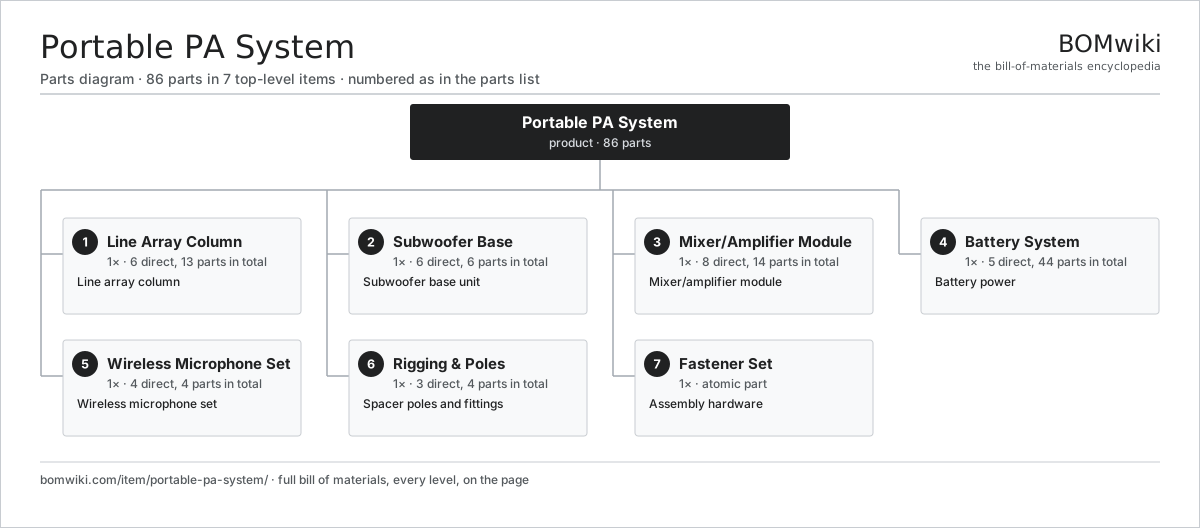
| # | Part | Qty | What it does |
|---|---|---|---|
| 1 | Line Array Column 6 parts | 1× | Line array column |
| 2 | Subwoofer Base 6 parts | 1× | Subwoofer base unit |
| 3 | Mixer/Amplifier Module 8 parts | 1× | Mixer/amplifier module |
| 4 | Battery System 5 parts | 1× | Battery power |
| 5 | Wireless Microphone Set 4 parts | 1× | Wireless microphone set |
| 6 | Rigging & Poles 3 parts | 1× | Spacer poles and fittings |
| 7 | Fastener Set | 1× | Assembly hardware |
3D model
No 3D model yet. Have a CAD file of this? Add a 3D model. STL renders right on this page; STEP, FreeCAD, and OpenSCAD sources are welcome too (openly licensed, like all 3D models on BOMwiki).
Build & assembly graph
expand / collapse · shared sub-assemblies converge · links to related products · est. labourTap an assembly to expand/collapse · tap a part to open it · use “Open page” for any node · drag to pan, scroll to zoom.
Bill of materials for Portable PA System
7 top-level lines · 39 rows shown · 86 parts total · indented to 3 levels| # | Item / sub-assembly | Part no. | Qty/assy | Ext. qty | Parts | Type |
|---|---|---|---|---|---|---|
| 1 | Line Array Column 6 parts | ppa-column-array | 1× | 1 | 13 | assembly |
| 1.1 | Speaker | speaker | 8× | 8 | · | part |
| 1.2 | HF Tweeter | ppa-hf-tweeter | 1× | 1 | · | part |
| 1.3 | Array Waveguide | ppa-array-waveguide | 1× | 1 | · | part |
| 1.4 | Column Extrusion | ppa-column-extrusion | 1× | 1 | · | part |
| 1.5 | Column Grille | ppa-column-grille | 1× | 1 | · | part |
| 1.6 | Array Wiring Ladder | ppa-array-wiring | 1× | 1 | · | part |
| 2 | Subwoofer Base 6 parts | ppa-subwoofer-base | 1× | 1 | 6 | assembly |
| 2.1 | Subwoofer Driver | ppa-sub-driver | 1× | 1 | · | part |
| 2.2 | Sub Cabinet | ppa-sub-cabinet | 1× | 1 | · | part |
| 2.3 | Reflex Port | ppa-sub-port | 1× | 1 | · | part |
| 2.4 | Pole Socket | ppa-pole-socket | 1× | 1 | · | part |
| 2.5 | Sub Grille | ppa-sub-grille | 1× | 1 | · | part |
| 2.6 | Trolley Gear | ppa-trolley-gear | 1× | 1 | · | part |
| 3 | Mixer/Amplifier Module 8 parts | ppa-mixer-amp | 1× | 1 | 14 | assembly |
| 3.1 | Class-D Amplifiers | ppa-classd-amps | 2× | 2 | · | part |
| 3.2 | DSP Crossover | ppa-dsp-crossover | 1× | 1 | · | part |
| 3.3 | Mixer Front End | ppa-mixer-frontend | 1× | 1 | · | part |
| 3.4 | Bluetooth Receiver | ppa-bt-streaming | 1× | 1 | · | part |
| 3.5 | Microcontroller | mcu | 1× | 1 | · | part |
| 3.6 | Bare PCB | pcb-bare | 1× | 1 | · | part |
| 3.7 | LCD Panel | lcd-panel | 1× | 1 | · | part |
| 3.8 | Connector | connector | 6× | 6 | · | part |
| 4 | Battery System 5 parts | ppa-battery-system | 1× | 1 | 44 | assembly |
| 4.1 | Li-ion Cell, 18650 | li-cell-18650 | 40× | 40 | · | part |
| 4.2 | BMS Board | bms-board | 1× | 1 | · | part |
| 4.3 | Battery Tray | ppa-battery-tray | 1× | 1 | · | part |
| 4.4 | Power Supply | power-supply | 1× | 1 | · | part |
| 4.5 | Power Monitor | ppa-power-monitor | 1× | 1 | · | part |
| 5 | Wireless Microphone Set 4 parts | ppa-wireless-mic | 1× | 1 | 4 | assembly |
| 5.1 | Handheld Transmitter | ppa-handheld-tx | 1× | 1 | · | part |
| 5.2 | Microphone Capsule | ppa-mic-capsule | 1× | 1 | · | part |
| 5.3 | Receiver Module | ppa-rx-module | 1× | 1 | · | part |
| 5.4 | LiPo Cell | lipo-cell | 1× | 1 | · | part |
| 6 | Rigging & Poles 3 parts | ppa-rigging | 1× | 1 | 4 | assembly |
| 6.1 | Spacer Poles | ppa-spacer-poles | 2× | 2 | · | part |
| 6.2 | Pole Contacts | ppa-pole-contacts | 1× | 1 | · | part |
| 6.3 | Carry Covers | ppa-carry-covers | 1× | 1 | · | part |
| 7 | Fastener Set | fastener-set | 1× | 1 | · | part |
Something wrong in this list? Report a problem with this BOM.
Related products
same domain, ranked by shared parts Studio Headphones
265 parts · shares 3 with this page
Studio Headphones
265 parts · shares 3 with this page
 Karaoke Machine
59 parts · shares 5 with this page
Karaoke Machine
59 parts · shares 5 with this page
 Portable Boombox
47 parts · shares 5 with this page
Portable Boombox
47 parts · shares 5 with this page
 Wireless In-Ear Monitor System
75 parts · shares 4 with this page
UHF Wireless Microphone System
291 parts · shares 3 with this page
Wireless Video TX/RX Kit
448 parts · shares 3 with this page
Wireless In-Ear Monitor System
75 parts · shares 4 with this page
UHF Wireless Microphone System
291 parts · shares 3 with this page
Wireless Video TX/RX Kit
448 parts · shares 3 with this page
Sourcing: possible vendors
Browse the supplier directory → Prices, MOQ, and lead times are algorithmic estimates, not quotes, and not claims about these companies. Company mappings are curated by keyword; est. price band $50–$3k. How estimates work| Vendor | HQ | Specialty | MOQ | Lead time |
|---|---|---|---|---|
|
🇯🇵Sony
sony.com ↗
|
Tokyo, JP | Consumer electronics | 1,000 units | 8–12 wks |
| samsung.com ↗ | Suwon, KR | Electronics & displays | 1,000 units | 8–12 wks |
|
🇺🇸Harman
harman.com ↗
|
Stamford, US | Audio (JBL, AKG) | 1,000 units | 8–12 wks |
|
🇺🇸Bose
bose.com ↗
|
Framingham, US | Audio | 1,000 units | 8–12 wks |
| yamaha.com ↗ | Hamamatsu, JP | Audio & instruments | 1,000 units | 8–12 wks |
850-word article