Power Optimizer
ProductOverview
A power optimizer is a per-panel DC power electronics module that sits between the solar panel and the string combiner, performing panel-level maximum power point tracking (MPPT) while leaving the string architecture largely intact. Unlike a microinverter (which inverts panel DC to 240V AC at each panel), an optimizer keeps everything in DC, resulting in higher efficiency and compatibility with existing string inverters.
The key innovation is the "buck-boost" topology: the optimizer can either step-up or step-down the panel voltage to match whatever the string inverter is commanding. If the string inverter is operating at 400 VDC and a panel wants to output at 35 V, the optimizer boosts 35 V up to roughly 400 V for injection into the string. Meanwhile, the optimizer's onboard MPPT algorithm continuously adjusts the converter duty cycle to ensure the panel is always operating at its maximum power point, independent of what other panels in the string are doing.
Architecture
Buck-Boost DC/DC Converter
The buck-boost converter is a half-bridge topology: a single IGBT switch alternately connects and disconnects the panel from a series inductor. When the switch is on, current builds up in the inductor, storing energy. When the switch turns off, the inductor's magnetic field forces current to flow through a freewheeling diode and into an output capacitor, stepping up the voltage.
By adjusting the duty cycle (the ratio of on-time to off-time), the converter can smoothly vary the output voltage. For a 35 V panel needing to match a 400 V string, the converter operates at roughly 91% duty cycle, stepping voltage up by a factor of 11×. The energy storage inductor (22 µH) limits ripple current to <5% of the panel current, and the Input Filter Capacitor and filter capacitors smooth voltage transients.
Per-Panel MPPT
The control processor continuously samples the panel voltage and current (via a Voltage Sense ADC and Hall-Effect Current Sensor), calculates instantaneous power, and applies a perturb-and-observe algorithm: if increasing duty cycle increases power, continue; if power decreases, reverse. This simple algorithm reliably tracks within 2% of the theoretical maximum power point (Pmp).
MPPT runs once per second, a slow cadence compared to microinverter MPPT (runs every 10 milliseconds), because panel voltage is naturally stable in DC mode. The slower update rate reduces computational load and power consumption, allowing the optimizer to be powered entirely by the panel itself with minimal quiescent drain (<20 mW).
String Integration and Monitoring
The optimizer output is connected in series to the next panel/optimizer pair, maintaining the traditional string topology. From the inverter's perspective, the string looks like a normal series of panels, except each panel now operates at its optimal point. The inverter's central MPPT (if it has one) becomes redundant but still functional; the two MPPT loops don't fight because the optimizer layer operates so quickly.
For monitoring, each optimizer modulates data onto the string DC bus using a power-line carrier coupler operating at 50–100 kHz. An aggregator gateway listens to all optimizer reports and uploads them to the cloud. This per-panel data visibility enables rapid fault diagnosis: if a module's power suddenly drops, technicians know which physical panel failed and can schedule replacement within hours rather than days.
Safety Features
The input connector block includes a bypass diode that allows current to flow around the optimizer if it fails (maintaining series continuity) and a ground-fault detection module that monitors insulation resistance. If the panel develops a ground fault (insulation breakdown), the GFDI circuit detects the leakage current and can either alert the system or open a string disconnect relay, protecting downstream equipment.
The arc suppression stage uses a varistor and freewheeling diode to clamp transient voltages if the string is suddenly disconnected (e.g., an upstream breaker opens while the optimizer is delivering current). Without suppression, the inductor would try to maintain current flow, building up voltage spikes (>1000 V) capable of damaging the IGBT or causing arcing. The suppression network clamps these spikes to safe levels.
Installation and Retrofit
Optimizers are particularly valuable for retrofit installations on existing string arrays. An electrician can install optimizers incrementally:
- De-energize one panel at a time.
- Disconnect the panel leads from the string combiner.
- Plug the panel into the optimizer input and the optimizer output back into the combiner.
- Repeat for each panel.
The string inverter continues operating throughout, powered by unoptimized panels, and gradually benefits from optimization as more optimizers are installed. This phased approach allows property owners to spread costs and upgrade gradually.
New installations often include optimizers on all panels for consistency, but some projects optimize only shaded or underperforming panels, reducing cost.
Energy Gains and Performance
Optimizers improve system output in scenarios where panels operate at different conditions:
Partial shading: In a 20-panel string where 5 panels are shaded by a tree for 4 hours/day, a string inverter drops all 20 panels to match the shaded string current. Optimizers allow the 15 unshaded panels to continue at full power while the 5 shaded panels contribute proportionally less. Productivity gain: 10–20% on shady days, 2–5% annual average depending on shading pattern.
Temperature mismatch: North and south roof faces experience different temperatures. Optimizers allow each panel to operate at its optimal voltage simultaneously. Gain: 1–3% annual.
Soiling and degradation: If some panels accumulate dirt or leaves while others are clean, optimizers equalize output. Gain: 3–8% in dusty or pollen-heavy climates.
Module mismatch during initial installation: Manufacturing tolerance causes modules to have slightly different I-V curves. Optimizers mitigate this. Gain: 1–2% over the array's lifetime.
Total annual productivity improvement: 5–20% depending on the specific installation environment. Cost is typically $200–$350 per panel, so a 10 kW array (25 panels) costs $5,000–$8,750 for full optimization. At a 5% average productivity improvement and $0.15/kWh rates, break-even is 4–6 years, with the optimizer providing benefit for 25+ years.
Communication and Integration
Optimizers integrate with modern inverter ecosystems:
- Power-line carrier: Data is modulated onto the string DC bus at frequencies beyond the inverter's switching frequency, allowing the inverter to continue normal operation while aggregator gateways receive per-panel telemetry.
- Cloud-based monitoring: A dedicated cloud app displays power, temperature, and health status for each panel, enabling rapid diagnosis of failures or degradation.
- Demand response coordination: Some implementations allow cloud systems to send "reduce power" commands via the power-line carrier, asking specific panels to reduce output to manage grid voltage or frequency. This is experimental but shows promise for distributed demand response.
Standards and Certifications
Power optimizers comply with:
- IEEE 1547: Interconnection and Interoperability of Distributed Energy Resources.
- UL 1741: Standard for Static Inverters and Charge Controllers.
- IEC 61000-3-2: Harmonic current limits.
- Local electrical codes: NEC Article 690 (solar installations) in the USA.
Testing labs verify that optimizers maintain safe string voltage and current under worst-case shading and fault scenarios.
Comparison to Microinverters
| Feature | Microinverter | Power Optimizer |
|---|---|---|
| Topology | DC→AC conversion per panel | DC→DC step-up/down per panel |
| Efficiency | 92–96% (DC→AC) | 98%+ (DC→DC only) |
| Output Voltage | 240 VAC single-phase | String DC (200–600 VDC) |
| Cost | $150–$250 per panel | $200–$350 per panel |
| String Combiner | Not needed; paralleled AC | Still needed |
| Retrofit-Friendly | Requires complete rewiring | Can upgrade existing systems |
| Monitoring | Per-panel power, AC output | Per-panel power, DC output |
Microinverters excel in new installations and home systems where wiring is flexible. Optimizers excel in retrofit and commercial arrays where string topology is entrenched and skilled labor is expensive to rewire.
Power Optimizer parts and their functions
8 top-level parts · 40 parts in total · full bill of materials below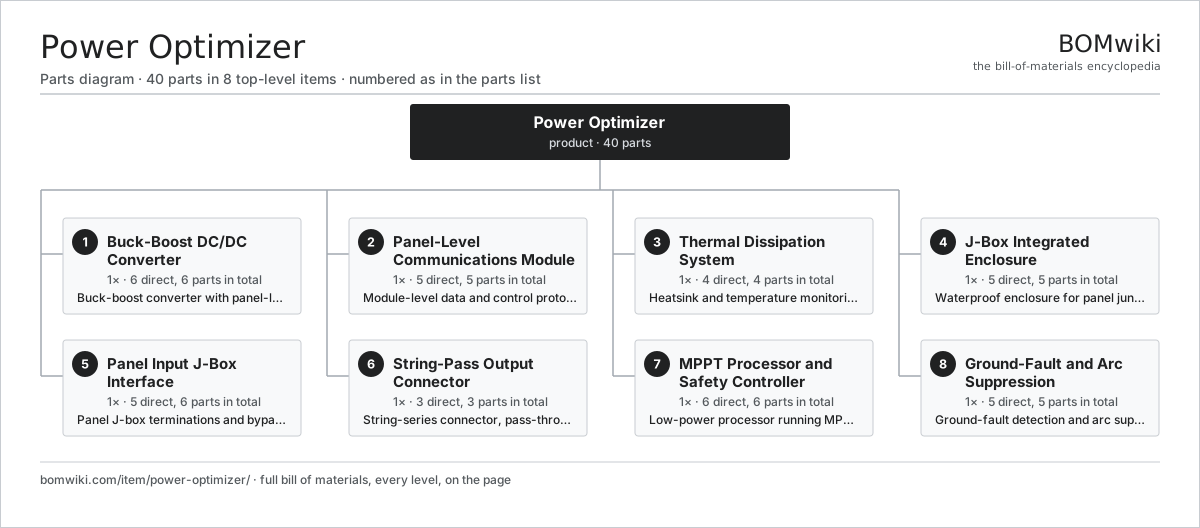
| # | Part | Qty | What it does |
|---|---|---|---|
| 1 | Buck-Boost DC/DC Converter 6 parts | 1× | Buck-boost converter with panel-level MPPT |
| 2 | Panel-Level Communications Module 5 parts | 1× | Module-level data and control protocol handler |
| 3 | Thermal Dissipation System 4 parts | 1× | Heatsink and temperature monitoring |
| 4 | J-Box Integrated Enclosure 5 parts | 1× | Waterproof enclosure for panel junction box integration |
| 5 | Panel Input J-Box Interface 5 parts | 1× | Panel J-box terminations and bypass diode |
| 6 | String-Pass Output Connector 3 parts | 1× | String-series connector, pass-through to next optimizer |
| 7 | MPPT Processor and Safety Controller 6 parts | 1× | Low-power processor running MPPT and safety checks |
| 8 | Ground-Fault and Arc Suppression 5 parts | 1× | Ground-fault detection and arc suppression |
3D model
No 3D model yet. Have a CAD file of this? Add a 3D model. STL renders right on this page; STEP, FreeCAD, and OpenSCAD sources are welcome too (openly licensed, like all 3D models on BOMwiki).
Build & assembly graph
expand / collapse · shared sub-assemblies converge · links to related products · est. labourTap an assembly to expand/collapse · tap a part to open it · use “Open page” for any node · drag to pan, scroll to zoom.
Bill of materials for Power Optimizer
8 top-level lines · 47 rows shown · 40 parts total · indented to 3 levels| # | Item / sub-assembly | Part no. | Qty/assy | Ext. qty | Parts | Type |
|---|---|---|---|---|---|---|
| 1 | Buck-Boost DC/DC Converter 6 parts | power-optimizer-dcdc-stage | 1× | 1 | 6 | assembly |
| 1.1 | IGBT Power Module | igbt-module | 1× | 1 | · | part |
| 1.2 | Input Filter Capacitor | power-optimizer-input-capacitor | 1× | 1 | · | part |
| 1.3 | Output Filter Capacitor | power-optimizer-output-capacitor | 1× | 1 | · | part |
| 1.4 | Energy Storage Inductor | power-optimizer-converter-inductor | 1× | 1 | · | part |
| 1.5 | Bare PCB | pcb-bare | 1× | 1 | · | part |
| 1.6 | SMD Passive (R/C/L) | smd-passives | 1× | 1 | · | part |
| 2 | Panel-Level Communications Module 5 parts | power-optimizer-communications | 1× | 1 | 5 | assembly |
| 2.1 | Power-Line Carrier Coupler | power-optimizer-signal-coupler | 1× | 1 | · | part |
| 2.2 | Wireless Communication Module (Optional) | power-optimizer-rf-module | 1× | 1 | · | part |
| 2.3 | Bare PCB | pcb-bare | 1× | 1 | · | part |
| 2.4 | Microcontroller | mcu | 1× | 1 | · | part |
| 2.5 | SMD Passive (R/C/L) | smd-passives | 1× | 1 | · | part |
| 3 | Thermal Dissipation System 4 parts | power-optimizer-thermal-management | 1× | 1 | 4 | assembly |
| 3.1 | Aluminum Heatsink | power-optimizer-heatsink | 1× | 1 | · | part |
| 3.2 | Thermal Interface Material | power-optimizer-thermal-compound | 1× | 1 | · | part |
| 3.3 | Thermistor Temperature Probe | power-optimizer-temperature-sensor | 1× | 1 | · | part |
| 3.4 | Fastener Set | fastener-set | 1× | 1 | · | part |
| 4 | J-Box Integrated Enclosure 5 parts | power-optimizer-housing | 1× | 1 | 5 | assembly |
| 4.1 | Encapsulation Epoxy | power-optimizer-potting-compound | 1× | 1 | · | part |
| 4.2 | Input Terminal | power-optimizer-input-terminal | 1× | 1 | · | part |
| 4.3 | Output Terminal | power-optimizer-output-terminal | 1× | 1 | · | part |
| 4.4 | Bypass Schottky Diode | power-optimizer-bypass-diode | 1× | 1 | · | part |
| 4.5 | Fastener Set | fastener-set | 1× | 1 | · | part |
| 5 | Panel Input J-Box Interface 5 parts | power-optimizer-input-connectors | 1× | 1 | 6 | assembly |
| 5.1 | Connector | connector | 2× | 2 | · | part |
| 5.2 | Bypass Schottky Diode | power-optimizer-bypass-diode | 1× | 1 | · | part |
| 5.3 | Ground-Fault Detect and Interrupt Module | power-optimizer-gfdi | 1× | 1 | · | part |
| 5.4 | Bare PCB | pcb-bare | 1× | 1 | · | part |
| 5.5 | SMD Passive (R/C/L) | smd-passives | 1× | 1 | · | part |
| 6 | String-Pass Output Connector 3 parts | power-optimizer-output-connectors | 1× | 1 | 3 | assembly |
| 6.1 | Connector | connector | 1× | 1 | · | part |
| 6.2 | Bare PCB | pcb-bare | 1× | 1 | · | part |
| 6.3 | SMD Passive (R/C/L) | smd-passives | 1× | 1 | · | part |
| 7 | MPPT Processor and Safety Controller 6 parts | power-optimizer-control-logic | 1× | 1 | 6 | assembly |
| 7.1 | Microcontroller | mcu | 1× | 1 | · | part |
| 7.2 | Voltage Sense ADC | power-optimizer-voltage-monitor | 1× | 1 | · | part |
| 7.3 | Hall-Effect Current Sensor | power-optimizer-current-monitor | 1× | 1 | · | part |
| 7.4 | Bare PCB | pcb-bare | 1× | 1 | · | part |
| 7.5 | Relay | relay | 1× | 1 | · | part |
| 7.6 | SMD Passive (R/C/L) | smd-passives | 1× | 1 | · | part |
| 8 | Ground-Fault and Arc Suppression 5 parts | power-optimizer-isolation-monitoring | 1× | 1 | 5 | assembly |
| 8.1 | Isolation Impedance Analyzer | power-optimizer-iso-tester | 1× | 1 | · | part |
| 8.2 | Transient Suppression Network | power-optimizer-arc-suppression | 1× | 1 | · | part |
| 8.3 | Bare PCB | pcb-bare | 1× | 1 | · | part |
| 8.4 | Relay | relay | 1× | 1 | · | part |
| 8.5 | SMD Passive (R/C/L) | smd-passives | 1× | 1 | · | part |
Something wrong in this list? Report a problem with this BOM.
Related products
same domain, ranked by shared parts Battery Swap Station
108 parts · shares 1 with this page
Battery Swap Station
108 parts · shares 1 with this page
 DC Fast Charger
1,097 parts · shares 1 with this page
DC Fast Charger
1,097 parts · shares 1 with this page
 Flywheel Energy Storage
285 parts · shares 1 with this page
Flywheel Energy Storage
285 parts · shares 1 with this page
 Home Battery Storage
292 parts · shares 1 with this page
Industrial UPS System
150 parts · shares 1 with this page
Home Battery Storage
292 parts · shares 1 with this page
Industrial UPS System
150 parts · shares 1 with this page
Sourcing: possible vendors
Browse the supplier directory → Prices, MOQ, and lead times are algorithmic estimates, not quotes, and not claims about these companies. Company mappings are curated by keyword; est. price band $5k–$50M. How estimates work| Vendor | HQ | Specialty | MOQ | Lead time |
|---|---|---|---|---|
| gevernova.com ↗ | Cambridge, US | Power generation | made to order | 20–40 wks |
| siemens-energy.com ↗ | Munich, DE | Power & grid | made to order | 20–40 wks |
| hitachienergy.com ↗ | Zurich, CH | Grid & transformers | made to order | 20–40 wks |
|
🇨🇭ABB
abb.com ↗
|
Zurich, CH | Electrification & automation | made to order | 20–40 wks |
| se.com ↗ | Rueil-Malmaison, FR | Electrical & automation | made to order | 20–40 wks |
1,326-word article