Presentation Clicker
ProductOverview
A presentation clicker lets a speaker advance slides from anywhere in the room and point at the screen with a laser, untethering them from the lectern keyboard. The design problem is mostly about invisibility: the device must pair with any computer without drivers or setup, respond instantly after weeks in a bag, and run for months on one cell. The solution that the industry converged on is a 2.4 GHz proprietary radio link into a USB dongle that masquerades as an ordinary keyboard.
The handheld contains the RF Transmitter Board, the Laser Pointer Module module, the Button Assembly, and the Battery Compartment bay, all inside a palm-contoured Housing that even stores the USB Receiver Dongle in an internal slot so the pair travel together.
How it works
When the presenter presses the forward key, the Dome Switch closure wakes the RF SoC from a sleep state drawing under 2 µA. Within a few milliseconds the chip powers its radio, and transmits a short GFSK packet on a 2.4 GHz ISM channel: a sync word, the unit's unique address, the button code, and a checksum. The Chip Antenna radiates this at about 1 mW, ample for 15–30 m indoors, and the SoC listens briefly for an acknowledgment, retransmitting on an alternate channel if Wi-Fi traffic stepped on the first attempt. Total latency from press to keystroke is well under 50 ms, below what a presenter can perceive.
The Receiver SoC in the dongle receives the packet, checks the address against its paired unit, and reports a key to the host over USB. This is the trick that makes the device universal: the dongle enumerates as a HID keyboard, and "next slide" is simply the Page Down keycode (with Page Up, the B key for blank-screen, and F5 for start mapped to the other buttons). Every operating system and every presentation application already understands a keyboard, so nothing installs and nothing configures. Address pairing is set at the factory, which is why a lost dongle usually means a dead product.
The laser module
The pointing function is an independent optical subsystem gated by its own button. The Laser Diode is a red 650 nm emitter; its raw output diverges in a wide cone, so the Collimating Lens lens, focused at assembly by threading the Module Barrel, collapses it into a beam under 1.5 mrad of divergence, a spot a few centimetres across at the back wall of a lecture theatre. The Laser Driver holds optical power constant using the monitor photodiode built into the diode package, compensating for temperature and the sagging cell voltage; this regulation is also the safety mechanism that keeps emission below the 1 mW Class 2 limit of IEC 60825-1, the class where the human blink reflex provides adequate eye protection. Green-laser variants use a diode-pumped frequency-doubled module that appears several times brighter to the eye at the same power, at the cost of battery draw an order of magnitude higher.
Power budget
The whole design rests on duty cycle. The radio transmits for roughly a millisecond per press; a one-hour talk with a few hundred presses costs less charge than a single minute of laser use, and the laser itself draws around 20–30 mA only while held. Between events the Boost Converter and SoC sleep, so the AAA Cell self-discharge becomes a meaningful fraction of total consumption, which is why one alkaline cell lasts about six months of normal use, and why the Power Switch exists mainly to guard against a key held down by luggage. The firmware samples cell voltage on each wake and blinks a low-battery warning through the status indicator well before the radio becomes unreliable.
The Keypad layout is tuned for blind operation: the forward key is largest, centered, and ridged, so a presenter's thumb finds it mid-sentence without a glance down, the entire product judged by whether that one press always works.
Presentation Clicker parts and their functions
6 top-level parts · 107 parts in total · full bill of materials below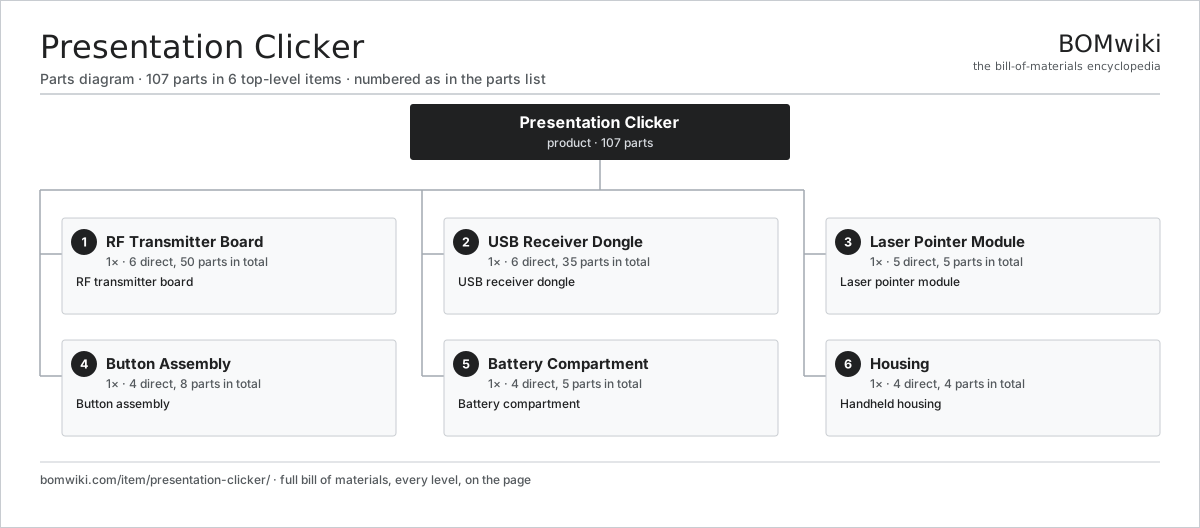
| # | Part | Qty | What it does |
|---|---|---|---|
| 1 | RF Transmitter Board 6 parts | 1× | RF transmitter board |
| 2 | USB Receiver Dongle 6 parts | 1× | USB receiver dongle |
| 3 | Laser Pointer Module 5 parts | 1× | Laser pointer module |
| 4 | Button Assembly 4 parts | 1× | Button assembly |
| 5 | Battery Compartment 4 parts | 1× | Battery compartment |
| 6 | Housing 4 parts | 1× | Handheld housing |
3D model
No 3D model yet. Have a CAD file of this? Add a 3D model. STL renders right on this page; STEP, FreeCAD, and OpenSCAD sources are welcome too (openly licensed, like all 3D models on BOMwiki).
Build & assembly graph
expand / collapse · shared sub-assemblies converge · links to related products · est. labourTap an assembly to expand/collapse · tap a part to open it · use “Open page” for any node · drag to pan, scroll to zoom.
Bill of materials for Presentation Clicker
6 top-level lines · 35 rows shown · 107 parts total · indented to 3 levels| # | Item / sub-assembly | Part no. | Qty/assy | Ext. qty | Parts | Type |
|---|---|---|---|---|---|---|
| 1 | RF Transmitter Board 6 parts | presentation-clicker-transmitter | 1× | 1 | 50 | assembly |
| 1.1 | RF SoC | presentation-clicker-rf-soc | 1× | 1 | · | part |
| 1.2 | Chip Antenna | presentation-clicker-chip-antenna | 1× | 1 | · | part |
| 1.3 | Reference Crystal | presentation-clicker-crystal | 1× | 1 | · | part |
| 1.4 | Bare PCB | pcb-bare | 1× | 1 | · | part |
| 1.5 | SMD Passive (R/C/L) | smd-passives | 45× | 45 | · | part |
| 1.6 | RF Shield | presentation-clicker-rf-shield | 1× | 1 | · | part |
| 2 | USB Receiver Dongle 6 parts | presentation-clicker-dongle | 1× | 1 | 35 | assembly |
| 2.1 | Receiver SoC | presentation-clicker-dongle-soc | 1× | 1 | · | part |
| 2.2 | Trace Antenna | presentation-clicker-dongle-antenna | 1× | 1 | · | part |
| 2.3 | Bare PCB | pcb-bare | 1× | 1 | · | part |
| 2.4 | USB-A Plug | presentation-clicker-usb-plug | 1× | 1 | · | part |
| 2.5 | Dongle Cap | presentation-clicker-dongle-case | 1× | 1 | · | part |
| 2.6 | SMD Passive (R/C/L) | smd-passives | 30× | 30 | · | part |
| 3 | Laser Pointer Module 5 parts | presentation-clicker-laser | 1× | 1 | 5 | assembly |
| 3.1 | Laser Diode | presentation-clicker-laser-diode | 1× | 1 | · | part |
| 3.2 | Collimating Lens | presentation-clicker-collimator | 1× | 1 | · | part |
| 3.3 | Laser Driver | presentation-clicker-laser-driver | 1× | 1 | · | part |
| 3.4 | Module Barrel | presentation-clicker-laser-barrel | 1× | 1 | · | part |
| 3.5 | Aperture Window | presentation-clicker-aperture | 1× | 1 | · | part |
| 4 | Button Assembly 4 parts | presentation-clicker-buttons | 1× | 1 | 8 | assembly |
| 4.1 | Dome Switch | presentation-clicker-dome-switch | 5× | 5 | · | part |
| 4.2 | Keypad | presentation-clicker-keypad | 1× | 1 | · | part |
| 4.3 | Key Bezel | presentation-clicker-key-bezel | 1× | 1 | · | part |
| 4.4 | Power Switch | presentation-clicker-power-switch | 1× | 1 | · | part |
| 5 | Battery Compartment 4 parts | presentation-clicker-battery | 1× | 1 | 5 | assembly |
| 5.1 | AAA Cell | presentation-clicker-aaa-cell | 1× | 1 | · | part |
| 5.2 | Battery Contact | presentation-clicker-battery-contact | 2× | 2 | · | part |
| 5.3 | Battery Door | presentation-clicker-battery-door | 1× | 1 | · | part |
| 5.4 | Boost Converter | presentation-clicker-boost-converter | 1× | 1 | · | part |
| 6 | Housing 4 parts | presentation-clicker-housing | 1× | 1 | 4 | assembly |
| 6.1 | Top Shell | presentation-clicker-top-shell | 1× | 1 | · | part |
| 6.2 | Bottom Shell | presentation-clicker-bottom-shell | 1× | 1 | · | part |
| 6.3 | Dongle Slot | presentation-clicker-dongle-slot | 1× | 1 | · | part |
| 6.4 | Fastener Set | fastener-set | 1× | 1 | · | part |
Something wrong in this list? Report a problem with this BOM.
Sourcing: possible vendors
Browse the supplier directory → Prices, MOQ, and lead times are algorithmic estimates, not quotes, and not claims about these companies. Company mappings are curated by keyword; est. price band $20–$3k. How estimates work| Vendor | HQ | Specialty | MOQ | Lead time |
|---|---|---|---|---|
| dell.com ↗ | Round Rock, US | Computers & infrastructure | 1,000 units | 8–14 wks |
|
🇺🇸HP
hp.com ↗
|
Palo Alto, US | Computers & printers | 1,000 units | 8–14 wks |
|
🇨🇳Lenovo
lenovo.com ↗
|
Beijing, CN | Computers | 1,000 units | 8–14 wks |
|
🇹🇼ASUS
asus.com ↗
|
Taipei, TW | Computers & components | 1,000 units | 8–14 wks |
|
🇨🇳Foxconn
foxconn.com ↗
|
Shenzhen, CN | Electronics contract mfg | 1,000 units | 8–14 wks |
696-word article