Pressotherapy System
ProductOverview
Pressotherapy is a non-invasive lymphatic drainage therapy using sequential pneumatic compression. The system delivers controlled air pressure pulses through graduated garments (sleeves, leggings, full-body suits), progressively compressing tissues from distal (hand/foot) to proximal (shoulder/hip) in waves. This mimics the natural skeletal muscle pump, propelling lymph and interstitial fluid toward central lymph nodes and the thoracic duct. Pressotherapy originated in France during the 1980s and is now standard in spas, sports medicine clinics, and post-surgical recovery centers worldwide.
The Console Assembly houses an oil-free Air Pump Assembly and Hose Manifold controlled by Controller Board microcontroller logic. The Garment Set comprises 4–6 multi-chamber sleeves that inflate sequentially at 30–100 kPa (adjustable), creating a peristaltic wave. Sessions last 30–50 minutes; typical protocols involve 2–3 sessions per week for lymphatic disorders or post-surgical edema, or 1–2 sessions weekly for preventive wellness.
How it works
The Console Assembly integrates all major components on a mobile cart. When the operator selects a preset program via the Touch Digitizer interface, the Main Control PCB initializes the treatment sequence.
The Air Pump Assembly activates: the Compressor Motor (0.5–1 HP AC induction motor, 220–240V, 50–60 Hz) drives the Pump Head (piston or scroll displacement pump, 4–6 cm³/rev). The pump draws ambient air through the Air Filter (particulate + desiccant stage, removing dust and moisture for medical-grade compressed air). Outlet pressure is regulated by the Regulator Valve (diaphragm valve, adjustable 0–300 kPa setpoint). A Safety Valve (spring-loaded relief, 300 kPa nominal) protects the system from overpressure.
Compressed air enters the Hose Manifold, an aluminum or ductile-iron block housing 6–8 Solenoid Valve normally-closed 3/2 directional valves (24V DC coils). Each solenoid controls air flow to one chamber (e.g., foot, calf, thigh, hip on a leg garment). The Main Control PCB microcontroller (ARM Cortex M4 with 16+ PWM outputs) cycles solenoids in a programmed sequence:
- Ramp phase: Distal chamber (foot) pressurizes first at a slow ramp rate (0.5–1 bar/second).
- Hold phase: Once distal reaches 100 kPa, it holds while the next proximal chamber (calf) pressurizes.
- Wave phase: Solenoids toggle in sequence (foot → calf → thigh → hip), creating a peristaltic wave propagating upward.
- Release phase: All chambers vent to atmosphere simultaneously; brief rest before next cycle.
The Pressure Sensor continuously monitors system pressure and feeds back to the microcontroller; if pressure exceeds setpoint, the regulator throttles air flow to the Hose Manifold. The Pressure Gauge Assembly displays real-time pressure (0–300 kPa range) and elapsed session time on the Gauge Display.
Garment design
Each Garment Set comprises a custom-fitted sleeve or pant made of neoprene or polyurethane-coated nylon (0.5–1 mm thickness), rated for 300 kPa burst pressure. Internal Chamber Baffles (air-tight polyester or rubber dividers) partition the garment into 4–6 sequential zones. Each zone has its own Inlet Valve (quick-couple ISO 6149 connector) fed by a Check Valve on the manifold. Garments are available in standard sizes (XS–XXL) with adjustable Velcro straps for snug fit.
The compression pattern is graduated: distal zones (hand/foot) experience higher pressure-to-diameter ratios, promoting fluid mobilization; proximal zones have larger cross-sections and lower effective pressure, preventing backflow. Typical compression starts at 30 kPa (gentle) and ramps to 100–150 kPa (vigorous) depending on program and patient tolerance.
Clinical mechanism
Sequential compression mobilizes stagnant lymph by mimicking the skeletal muscle pump. Normal lymph flow is driven by: (1) intrinsic lymph vessel contractions (1–10 contractions/min), (2) skeletal muscle contraction, and (3) respiratory pressure changes. Patients with lymphedema, venous insufficiency, or post-surgical immobility lose these natural pumps. Pressotherapy artificially restores the pump: the distal-to-proximal compression wave forces lymph toward central nodes, enhancing clearance of excess interstitial fluid and macromolecules.
Clinically documented benefits:
- Lymphedema: 40–60% volume reduction after 10–20 sessions.
- Cellulite: Improved skin texture via enhanced microcirculation (subjective reporting, limited RCT evidence).
- Post-surgical edema: Faster resolution (3–5 days vs. 7–10 days with elevation alone).
- Athletic recovery: Reduced delayed-onset muscle soreness (DOMS) when applied within 2 hours post-exercise.
- Venous insufficiency: Improved subjective symptoms (heaviness, pain) and objective leg volume reduction.
Program types
Standard machines ship with 5–10 preset programs:
- Lymphedema: Low pressure (50–100 kPa), slow ramp, long hold (2–5 min per zone).
- Athletic recovery: Higher pressure (100–150 kPa), faster ramp (1–2 sec), shorter hold.
- Cellulite: Oscillating pressure (on/off at 1–2 Hz) to disrupt subcutaneous fibrosis.
- Relaxation: Very low pressure (20–50 kPa), slow frequency, long session (45–60 min).
- Detox: Bilateral arm + leg simultaneous compression for whole-body lymphatic stimulation.
Therapists can customize programs on advanced units: adjusting pressure, ramp rate, hold duration, and chamber sequence per patient tolerance.
System architecture
The Air Pump Assembly is the longest-lasting component: the Pump Head (piston or scroll) is rated for 5000+ operating hours, typically lasting 10+ years in a busy clinic. The Compressor Motor (induction motor) carries a 2-year warranty; replacement is straightforward. The Air Filter is replaced every 500–1000 hours (~6 months in a 40-hour/week clinic).
The Hose Manifold and Solenoid Valve solenoids rarely fail; typical lifespan is 3000+ actuations each. The Main Control PCB microcontroller is sealed and carries a 2-year warranty.
The Garment Set garments are consumable: after 5–10 years of regular use, neoprene degrades, seams fail, or Velcro adhesion weakens. Replacement sets are $500–$2000 per complete set (arm + leg + shorts), depending on garment quality.
Contraindications
Pressotherapy is contraindicated in:
- Active deep vein thrombosis (DVT) or acute venous thromboembolism (risk of embolus dislodgement).
- Uncontrolled hypertension (>180/110 mmHg).
- Acute cellulitis or skin infection in the treatment zone.
- Severe congestive heart failure (risk of fluid overload).
- Recent surgery (<24 hours) or open wounds.
Therapists screen patients via intake questionnaire before initiating treatment.
Maintenance
The Air Filter is inspected monthly and replaced when visible clogging or moisture appears. The Hose Manifold solenoid coils are tested annually for electrical continuity. The Regulator Valve diaphragm is a wear item; replacement occurs every 2000–3000 hours. The Garment Set is hand-washed in warm water and mild detergent, air-dried, and inspected for punctures or seam separation.
Cost of therapy is typically $50–$100 per 45-minute session; clinics often bundle 5–10 sessions for discount pricing.
Pressotherapy System parts and their functions
6 top-level parts · 152 parts in total · full bill of materials below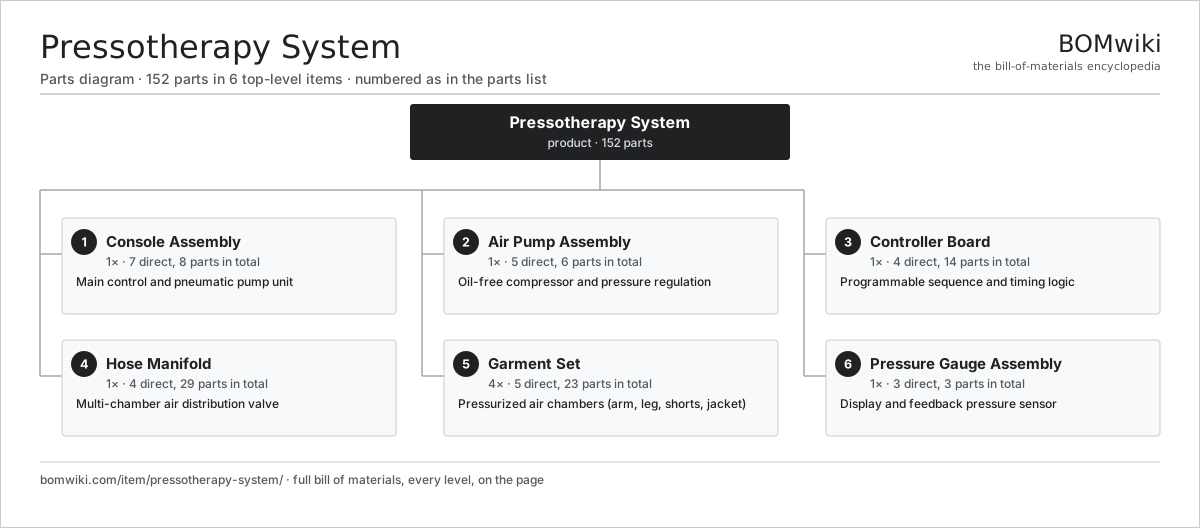
| # | Part | Qty | What it does |
|---|---|---|---|
| 1 | Console Assembly 7 parts | 1× | Main control and pneumatic pump unit |
| 2 | Air Pump Assembly 5 parts | 1× | Oil-free compressor and pressure regulation |
| 3 | Controller Board 4 parts | 1× | Programmable sequence and timing logic |
| 4 | Hose Manifold 4 parts | 1× | Multi-chamber air distribution valve |
| 5 | Garment Set 5 parts | 4× | Pressurized air chambers (arm, leg, shorts, jacket) |
| 6 | Pressure Gauge Assembly 3 parts | 1× | Display and feedback pressure sensor |
3D model
No 3D model yet. Have a CAD file of this? Add a 3D model. STL renders right on this page; STEP, FreeCAD, and OpenSCAD sources are welcome too (openly licensed, like all 3D models on BOMwiki).
Build & assembly graph
expand / collapse · shared sub-assemblies converge · links to related products · est. labourTap an assembly to expand/collapse · tap a part to open it · use “Open page” for any node · drag to pan, scroll to zoom.
Bill of materials for Pressotherapy System
6 top-level lines · 34 rows shown · 152 parts total · indented to 3 levels| # | Item / sub-assembly | Part no. | Qty/assy | Ext. qty | Parts | Type |
|---|---|---|---|---|---|---|
| 1 | Console Assembly 7 parts | pressotherapy-system-console | 1× | 1 | 8 | assembly |
| 1.1 | Compressor Unit | pressotherapy-system-compressor-unit | 1× | 1 | · | part |
| 1.2 | Air Filter | pressotherapy-system-air-filter | 1× | 1 | · | part |
| 1.3 | Regulator Valve | pressotherapy-system-regulator-valve | 1× | 1 | · | part |
| 1.4 | Power Supply | power-supply | 1× | 1 | · | part |
| 1.5 | Main Control PCB | pressotherapy-system-main-pcb | 1× | 1 | · | part |
| 1.6 | Touch Digitizer | touch-digitizer | 1× | 1 | · | part |
| 1.7 | Sheet Metal Panel | sheet-panel | 2× | 2 | · | part |
| 2 | Air Pump Assembly 5 parts | pressotherapy-system-air-pump | 1× | 1 | 6 | assembly |
| 2.1 | Compressor Motor | pressotherapy-system-compressor-motor | 1× | 1 | · | part |
| 2.2 | Pump Head | pressotherapy-system-pump-head | 1× | 1 | · | part |
| 2.3 | Check Valve | pressotherapy-system-check-valve | 2× | 2 | · | part |
| 2.4 | Safety Valve | pressotherapy-system-safety-valve | 1× | 1 | · | part |
| 2.5 | Pressure Sensor | pressure-sensor | 1× | 1 | · | part |
| 3 | Controller Board 4 parts | pressotherapy-system-controller-board | 1× | 1 | 14 | assembly |
| 3.1 | Microcontroller | mcu | 1× | 1 | · | part |
| 3.2 | Solenoid Valve | pressotherapy-system-solenoid-valve | 8× | 8 | · | part |
| 3.3 | Relay | relay | 4× | 4 | · | part |
| 3.4 | Bare PCB | pcb-bare | 1× | 1 | · | part |
| 4 | Hose Manifold 4 parts | pressotherapy-system-hose-manifold | 1× | 1 | 29 | assembly |
| 4.1 | Manifold Block | pressotherapy-system-manifold-block | 1× | 1 | · | part |
| 4.2 | Check Valve | pressotherapy-system-check-valve | 4× | 4 | · | part |
| 4.3 | Connector | connector | 16× | 16 | · | part |
| 4.4 | Fastener Set | fastener-set | 8× | 8 | · | part |
| 5 | Garment Set 5 parts | pressotherapy-system-garment-set | 4× | 4 | 23 | assembly |
| 5.1 | Garment Fabric | pressotherapy-system-garment-fabric | 1× | 4 | · | part |
| 5.2 | Chamber Baffles | pressotherapy-system-chamber-baffles | 6× | 24 | · | part |
| 5.3 | Inlet Valve | pressotherapy-system-inlet-valve | 4× | 16 | · | part |
| 5.4 | Fastener Set | fastener-set | 8× | 32 | · | part |
| 5.5 | O-Ring Set | oring-set | 4× | 16 | · | part |
| 6 | Pressure Gauge Assembly 3 parts | pressotherapy-system-pressure-gauge | 1× | 1 | 3 | assembly |
| 6.1 | Pressure Sensor | pressure-sensor | 1× | 1 | · | part |
| 6.2 | Gauge Display | pressotherapy-system-gauge-display | 1× | 1 | · | part |
| 6.3 | Connector | connector | 1× | 1 | · | part |
Something wrong in this list? Report a problem with this BOM.
Related products
same domain, ranked by shared parts Ultrasonic Cavitation Machine
42 parts · shares 4 with this page
Ultrasonic Cavitation Machine
42 parts · shares 4 with this page
Sourcing: possible vendors
Browse the supplier directory → Prices, MOQ, and lead times are algorithmic estimates, not quotes, and not claims about these companies. Company mappings are curated by keyword; est. price band $15–$500. How estimates work| Vendor | HQ | Specialty | MOQ | Lead time |
|---|---|---|---|---|
| philips.com ↗ | Amsterdam, NL | Grooming & care | 2,000 units | 6–10 wks |
|
🇩🇪Braun
braun.com ↗
|
Kronberg, DE | Grooming (P&G) | 2,000 units | 6–10 wks |
|
🇺🇸Conair
conair.com ↗
|
Stamford, US | Personal care appliances | 2,000 units | 6–10 wks |
|
🇬🇧Dyson
dyson.com ↗
|
Malmesbury, GB | Vacuums & hair care | 2,000 units | 6–10 wks |
| panasonic.com ↗ | Osaka, JP | Electronics & appliances | 2,000 units | 6–10 wks |
1,133-word article