Professional Power Amplifier
ProductOverview
Professional power amplifiers are the final stage in live sound reinforcement and fixed installation audio systems, converting low-level line-signal (approximately +4 dBu, or 1.23 V) into high-current speaker drive at frequencies spanning 20 Hz to 20 kHz. Modern pro amplifiers use class-D switching topology, achieving >90% efficiency compared to <70% for older linear (class-AB) designs. This efficiency advantage yields smaller heatsinks, lighter weight, and lower thermal load in venues with dozens of amplifiers stacked in server racks. The DSP Input Processor adds digital signal processing for crossovers, parametric EQ, and limiting directly in the amplifier, eliminating the need for external processors in many applications.
How it Works
Class-D Switching Principle
Unlike linear amplifiers that vary the voltage continuously to follow the audio waveform, class-D amplifiers work fundamentally differently. The Class-D Amplifier Module converts the analog audio signal into a PWM (pulse-width modulated) signal at 250 kHz, a frequency well above human hearing. The width of each pulse is proportional to the instantaneous amplitude of the audio signal: loud positive peaks produce wide pulses, quiet signals produce narrow pulses, and silence produces zero-width (no) pulses.
The PWM signal drives the IGBT Power Module high-current MOSFET bridge to switch full power-supply voltage on and off at the 250 kHz rate. When a MOSFET is on, it connects the speaker directly to the positive supply rail; when off, the speaker connects to the negative rail. The LC Output Filter LC network (inductor + capacitor) smooths this rail-to-rail switching, recovering the original audio waveform in the speaker cable. The switching frequency (250 kHz) is far above the speaker's passband (20 Hz – 20 kHz), so the speaker cone cannot follow the high-frequency pulses and effectively integrates them back to audio.
Efficiency Advantage
Linear amplifiers dissipate power as heat in large output transistors. A linear stage running at 80% of maximum output power generates approximately 20% of input power as heat. Class-D, by contrast, has transistors that are either fully on (near-zero resistance) or fully off (infinite resistance), spending minimal time in the linear (high-dissipation) transition region. This yields efficiency approaching the theoretical limit (>90%), dramatically reducing cooling requirements.
DSP Input Processing
The DSP Input Processor accepts balanced XLR audio via the Balanced Input Preamplifier preamplifier, digitizes it with a 24-bit ADC at up to 96 kHz sample rate, and processes the signal in real-time. Common DSP functions include:
- Digital crossovers: High-pass and low-pass filters separating woofer and tweeter signals before sending them to separate amplifier channels.
- Parametric EQ: Programmable equalization (boost/cut at specific frequencies) for room correction and speaker voicing.
- Limiting: Soft-knee or hard-knee dynamics processing protecting speakers from clipping.
- Delay: Millisecond-scale time alignment compensating for different speaker distances in a venue.
The processed digital signal is sent to the class-D modulator, which generates the 250 kHz PWM.
Power Supply
The Switched-Mode Power Supply is a high-efficiency switched-mode power supply converting AC mains to ±48 V for the class-D stages and +12 V for DSP and logic. The Power Factor Correction Preregulator power-factor correction stage ensures that the amplifier draws current from the AC mains nearly sinusoidally in phase with voltage, avoiding reactive power penalties and harmonic distortion on the venue's electrical system. This is critical: a venue running 20 high-powered amplifiers without PFC can draw leading or lagging current that destabilizes power distribution and triggers utility penalties.
Thermal Management
Class-D generates far less heat than linear amplifiers, but under sustained operation (e.g., nightclub bass reinforcement), the 10% of wasted power still accumulates. The Thermal Management System extruded aluminum heatsink is mounted directly to the MOSFET bridges, drawing heat away via fin surface area. A Blower Motor temperature-controlled fan automatically spins faster as heatsink temperature rises, maintaining thermal headroom and preventing over-temperature shutdown.
Protection Circuitry
The Protection and Monitoring Circuitry monitors multiple fault conditions:
- DC offset detection: Blocks the amplifier output if the average signal drifts from zero, preventing speaker damage from DC bias.
- Over-current limiting: A Current Sense Resistor resistor in each output stage detects speaker short-circuit, reducing drive current to prevent MOSFET failure.
- Thermal shutdown: If the heatsink Temperature Sensor exceeds approximately 85°C, a Relay cuts the amplifier enable signal, stopping operation until cool-down occurs.
Live Sound Deployment
In live sound reinforcement, pro amplifiers are stacked in 19-inch rack cases in the equipment closet or on a rolling cart. Multiple amplifier channels are deployed in a Rack Enclosure and Faceplate configuration: for example, a 4000 W system might use two 2000 W stereo amplifiers (4 channels), with a pair of channels driving the main left/right mains, another pair driving fill speakers, and a third pair driving subwoofers.
Balanced microphone cables (50 feet or more) run from the mixing console to the amplifiers, carrying low-level signals that are immune to RF interference because the balanced pair-and-shield configuration allows common-mode noise rejection. The DSP processing happens inside the amplifier, so a venue can apply consistent EQ and limiting to every speaker cluster from a single amp setup.
Fixed Installation Integration
In permanent installations (churches, auditoriums, boardrooms), amplifiers are often mounted in a wall closet or above a ceiling. The DSP allows installers to configure the amplifier once at setup time: set the crossover frequency, apply room EQ to compensate for hard surfaces, and program limiting curves appropriate to the venue. Once programmed, the amplifier requires no day-to-day adjustment, simply turning on the balanced signal from the mixer applies the pre-tuned processing.
Specifications Reference
Output power is specified at a single frequency (typically 1 kHz) into a resistive load (4 Ω, 8 Ω, or 2 Ω per channel). Real speakers are not purely resistive, impedance varies with frequency, so actual output power in the field depends on speaker impedance at the frequencies being reproduced. Professional amplifiers are conservatively rated to ensure reliability; bridged-mode operation (combining two channels into one ultra-high-power output) is available but reduces stereo separation.
Slew rate (measured in volts per microsecond) indicates how quickly the output can transition. A 30 V/µs slew rate permits faithful reproduction of 20 kHz signals without slew limiting, which would introduce harmonic distortion.
Professional Power Amplifier parts and their functions
8 top-level parts · 52 parts in total · full bill of materials below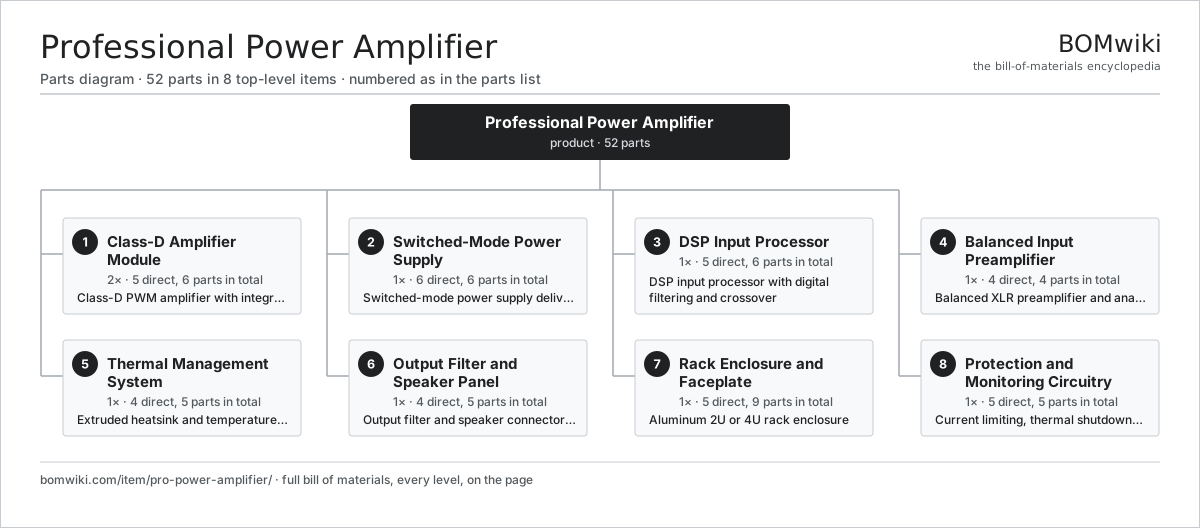
| # | Part | Qty | What it does |
|---|---|---|---|
| 1 | Class-D Amplifier Module 5 parts | 2× | Class-D PWM amplifier with integrated driver per channel |
| 2 | Switched-Mode Power Supply 6 parts | 1× | Switched-mode power supply delivering ±48 V and 12 V rails |
| 3 | DSP Input Processor 5 parts | 1× | DSP input processor with digital filtering and crossover |
| 4 | Balanced Input Preamplifier 4 parts | 1× | Balanced XLR preamplifier and analog-to-digital converter |
| 5 | Thermal Management System 4 parts | 1× | Extruded heatsink and temperature-controlled fan |
| 6 | Output Filter and Speaker Panel 4 parts | 1× | Output filter and speaker connector panel |
| 7 | Rack Enclosure and Faceplate 5 parts | 1× | Aluminum 2U or 4U rack enclosure |
| 8 | Protection and Monitoring Circuitry 5 parts | 1× | Current limiting, thermal shutdown, DC offset detection |
3D model
No 3D model yet. Have a CAD file of this? Add a 3D model. STL renders right on this page; STEP, FreeCAD, and OpenSCAD sources are welcome too (openly licensed, like all 3D models on BOMwiki).
Build & assembly graph
expand / collapse · shared sub-assemblies converge · links to related products · est. labourTap an assembly to expand/collapse · tap a part to open it · use “Open page” for any node · drag to pan, scroll to zoom.
Bill of materials for Professional Power Amplifier
8 top-level lines · 46 rows shown · 52 parts total · indented to 3 levels| # | Item / sub-assembly | Part no. | Qty/assy | Ext. qty | Parts | Type |
|---|---|---|---|---|---|---|
| 1 | Class-D Amplifier Module 5 parts | pro-power-amplifier-class-d-module | 2× | 2 | 6 | assembly |
| 1.1 | Class-D PWM Controller IC | pro-power-amplifier-pwm-controller | 1× | 2 | · | part |
| 1.2 | IGBT Power Module | igbt-module | 2× | 4 | · | part |
| 1.3 | LC Output Filter | pro-power-amplifier-output-filter | 1× | 2 | · | part |
| 1.4 | Output Isolation Transformer | pro-power-amplifier-output-transformer | 1× | 2 | · | part |
| 1.5 | Thermal Fuse | thermal-fuse | 1× | 2 | · | part |
| 2 | Switched-Mode Power Supply 6 parts | pro-power-amplifier-smps | 1× | 1 | 6 | assembly |
| 2.1 | Mains Transformer | pro-power-amplifier-mains-transformer | 1× | 1 | · | part |
| 2.2 | Power Factor Correction Preregulator | pro-power-amplifier-pfc-stage | 1× | 1 | · | part |
| 2.3 | SMPS Controller IC | pro-power-amplifier-switcher-ic | 1× | 1 | · | part |
| 2.4 | IGBT Power Module | igbt-module | 1× | 1 | · | part |
| 2.5 | LC Output Filter | pro-power-amplifier-output-filter | 1× | 1 | · | part |
| 2.6 | Thermal Fuse | thermal-fuse | 1× | 1 | · | part |
| 3 | DSP Input Processor 5 parts | pro-power-amplifier-dsp-engine | 1× | 1 | 6 | assembly |
| 3.1 | DSP Processor | pro-power-amplifier-dsp-chip | 1× | 1 | · | part |
| 3.2 | Audio ADC | pro-power-amplifier-adc-module | 1× | 1 | · | part |
| 3.3 | Bare PCB | pcb-bare | 1× | 1 | · | part |
| 3.4 | SMD Passive (R/C/L) | smd-passives | 2× | 2 | · | part |
| 3.5 | Audio Codec | pro-power-amplifier-codec-ic | 1× | 1 | · | part |
| 4 | Balanced Input Preamplifier 4 parts | pro-power-amplifier-input-stage | 1× | 1 | 4 | assembly |
| 4.1 | Input Transformer | pro-power-amplifier-input-transformer | 1× | 1 | · | part |
| 4.2 | Input Op-Amp | pro-power-amplifier-input-opamp | 1× | 1 | · | part |
| 4.3 | SMD Passive (R/C/L) | smd-passives | 1× | 1 | · | part |
| 4.4 | Connector | connector | 1× | 1 | · | part |
| 5 | Thermal Management System 4 parts | pro-power-amplifier-cooling-assembly | 1× | 1 | 5 | assembly |
| 5.1 | Radiator | radiator | 1× | 1 | · | part |
| 5.2 | Blower Motor | blower-motor | 1× | 1 | · | part |
| 5.3 | Fan Speed Controller | pro-power-amplifier-fan-controller | 1× | 1 | · | part |
| 5.4 | Fastener Set | fastener-set | 2× | 2 | · | part |
| 6 | Output Filter and Speaker Panel 4 parts | pro-power-amplifier-output-stage | 1× | 1 | 5 | assembly |
| 6.1 | LC Output Filter | pro-power-amplifier-output-filter | 1× | 1 | · | part |
| 6.2 | Speaker Binding Post | pro-power-amplifier-binding-post | 2× | 2 | · | part |
| 6.3 | Output Terminal Block | pro-power-amplifier-output-terminals | 1× | 1 | · | part |
| 6.4 | Fastener Set | fastener-set | 1× | 1 | · | part |
| 7 | Rack Enclosure and Faceplate 5 parts | pro-power-amplifier-rack-chassis | 1× | 1 | 9 | assembly |
| 7.1 | Sheet Metal Panel | sheet-panel | 2× | 2 | · | part |
| 7.2 | Front Faceplate | pro-power-amplifier-faceplate | 1× | 1 | · | part |
| 7.3 | Status Indicator LED | pro-power-amplifier-indicator-led | 3× | 3 | · | part |
| 7.4 | Power Rocker Switch | pro-power-amplifier-power-switch | 1× | 1 | · | part |
| 7.5 | Fastener Set | fastener-set | 2× | 2 | · | part |
| 8 | Protection and Monitoring Circuitry 5 parts | pro-power-amplifier-protection-board | 1× | 1 | 5 | assembly |
| 8.1 | Bare PCB | pcb-bare | 1× | 1 | · | part |
| 8.2 | Current Sense Resistor | pro-power-amplifier-current-sense | 1× | 1 | · | part |
| 8.3 | Temperature Sensor | pro-power-amplifier-thermal-sensor | 1× | 1 | · | part |
| 8.4 | Comparator IC | pro-power-amplifier-comparator-ic | 1× | 1 | · | part |
| 8.5 | Relay | relay | 1× | 1 | · | part |
Something wrong in this list? Report a problem with this BOM.
Related products
same domain, ranked by shared parts Loudspeaker Management Processor
42 parts · shares 3 with this page
Loudspeaker Management Processor
42 parts · shares 3 with this page
 DMX Dimmer Rack
71 parts · shares 3 with this page
DMX Dimmer Rack
71 parts · shares 3 with this page
 Stage Lighting Console
163 parts · shares 3 with this page
Stage Lighting Console
163 parts · shares 3 with this page
 Headphone Amplifier
56 parts · shares 3 with this page
Headphone Amplifier
56 parts · shares 3 with this page
 Laser Show Projector
36 parts · shares 3 with this page
Snow Effect Machine
115 parts · shares 2 with this page
Laser Show Projector
36 parts · shares 3 with this page
Snow Effect Machine
115 parts · shares 2 with this page
Sourcing: possible vendors
Browse the supplier directory → Prices, MOQ, and lead times are algorithmic estimates, not quotes, and not claims about these companies. Company mappings are curated by keyword; est. price band $50–$3k. How estimates work| Vendor | HQ | Specialty | MOQ | Lead time |
|---|---|---|---|---|
|
🇯🇵Sony
sony.com ↗
|
Tokyo, JP | Consumer electronics | 1,000 units | 8–12 wks |
| samsung.com ↗ | Suwon, KR | Electronics & displays | 1,000 units | 8–12 wks |
|
🇺🇸Harman
harman.com ↗
|
Stamford, US | Audio (JBL, AKG) | 1,000 units | 8–12 wks |
|
🇺🇸Bose
bose.com ↗
|
Framingham, US | Audio | 1,000 units | 8–12 wks |
| yamaha.com ↗ | Hamamatsu, JP | Audio & instruments | 1,000 units | 8–12 wks |
1,078-word article