PTZ Camera
ProductOverview
A pan-tilt-zoom (PTZ) camera is a robotic video camera that a director controls remotely from the production truck or studio control room. Instead of positioning a human camera operator in the studio, the director uses a joystick controller, or calls out coordinates in real-time, and the Pan-Tilt Head moves to frame the shot. The Motorized Zoom & Focus Block motorizes zoom and focus, so the director can pull back to a wide shot of the stage, then zoom in on a speaker's face, all without a human touching the camera. PTZ cameras are standard in broadcast news studios, houses of worship, lecture halls, and anywhere an operator cannot be stationed with the equipment.
The Pan-Tilt Head contains two stepper or brushless DC motors: one drives Pan Gear Train for left-right rotation (360° continuous), and one drives Tilt Gear Train for up-down tilt (typically −90° straight down to +90° straight up). A third motor controls Zoom Motor, varying the focal length of the Zoom Lens Group. The Motion Controller Card receives movement commands over Ethernet, via VISCA protocol (the broadcast standard), or HTTP API, decodes the command, and drives each motor. The Encoder Feedback tracks the actual position of pan, tilt, and zoom, feeding back to the controller so it can stop at the exact angle the director specified.
How it works
The director sits at a joystick controller (a Panasonic AW-RP120 or similar) in the control room. The joystick has a left stick for pan and tilt, a right stick or dial for zoom, and buttons for preset positions (e.g., "press button 1 to go to Camera 1 wide shot"). The controller is connected to the camera via a single Ethernet cable that carries control commands and, in some setups, camera video back to a monitor in the control room.
When the director pushes the left stick forward, the controller sends a VISCA packet over Ethernet: "Pan motor: start running at +50° per second." The Motion Controller Card card receives the packet, decodes it, and drives the Pan Motor via the Motor Driver IC (3× for pan/tilt/zoom). The Encoder on the pan motor reports the angle back to the Motion Controller Card so the camera knows when it has reached the target. If the director moves the stick in a diagonal, forward and left, both the Tilt Motor and Pan Motor move in parallel, creating a smooth diagonal pan across the stage.
For zoom, the Zoom Motor drives a cam or worm gear that opens or closes the zoom lens group, changing focal length. As the director twists the zoom knob, the focal length changes, and the Image Signal Processor automatically adjusts focus to keep the subject sharp, tracking the minimum focus distance as the lens is zoomed in and out.
Optical Image Stabilization
The Optical Image Stabilization uses a gyroscope to detect camera vibration (from rigging sway, stage vibration, or thermal expansion of the tripod), and drives a secondary lens element or sensor shift to counteract it. This is especially important in a PTZ camera because the motors themselves can introduce vibration, and the high zoom magnification (20× or more) makes even small vibrations visible as jitter on-screen.
VISCA protocol and presets
VISCA (Video System Control Architecture) is the broadcast standard for PTZ control. A command might be: "Move to pan position 2048 (out of 4096), tilt 2048, zoom 0000." The controller maps joystick inputs to pan/tilt rates (degrees per second) and sends the command stream, allowing smooth analog motion. Many productions define "presets", saved positions like "Camera 2, wide shot of stage," "Camera 3, close-up on guest," "Camera 1, two-shot of hosts." The director can press a button labeled with the preset name and the camera instantly moves to that position.
Network-powered and IP streaming
Modern PTZ cameras support Power-over-Ethernet (PoE), so the single Ethernet cable carries both control and power, simplifying studio wiring. The Network Control Interface has an RJ45 connector that feeds power to the Power Supply, and control commands are multiplexed on the same twisted pairs. Some PTZ cameras also stream video back over the network, the H.264 / H.265 Video Encoder compresses video to H.264 or H.265 (HEVC), and the camera sends RTSP (Real Time Streaming Protocol) to a monitor or streaming platform, so the director sees the camera view on a laptop without a separate SDI or HDMI cable.
Presets and automation
For news broadcasts, sports coverage, or worship services, the operator often memorizes a sequence of presets. In a news interview, the sequence might be: (1) two-shot of both hosts at the start, (2) Camera 1 hosts, (3) Camera 2 guest, (4) back to two-shot. The director calls out "go to Camera 1," the operator presses a button, and the head snaps to the preset position. Because motion is so fast (50–100° per second), the cut is almost as snappy as a human operator's pan, but more repeatable. Some systems can automate entire camera moves by recording keyframes (pan angle, tilt angle, zoom level) at different times in a production script, allowing the operator to trigger a 5-second motion sequence with a single button press.
PTZ Camera parts and their functions
11 top-level parts · 499 parts in total · full bill of materials below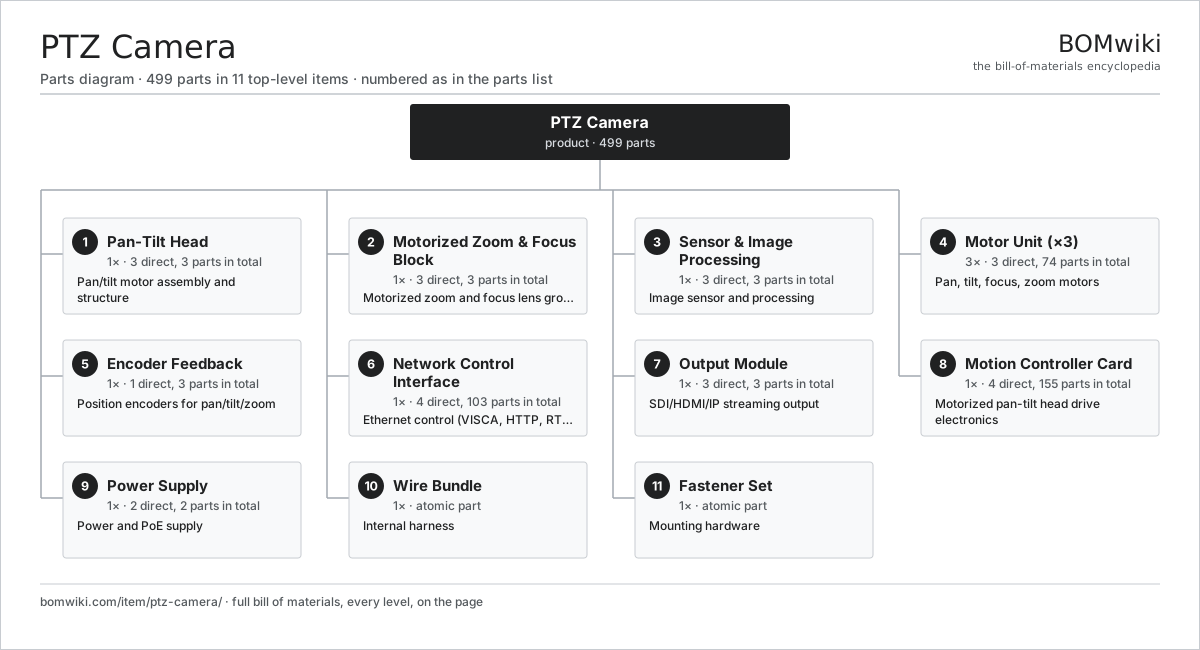
| # | Part | Qty | What it does |
|---|---|---|---|
| 1 | Pan-Tilt Head 3 parts | 1× | Pan/tilt motor assembly and structure |
| 2 | Motorized Zoom & Focus Block 3 parts | 1× | Motorized zoom and focus lens group |
| 3 | Sensor & Image Processing 3 parts | 1× | Image sensor and processing |
| 4 | Motor Unit (×3) 3 parts | 3× | Pan, tilt, focus, zoom motors |
| 5 | Encoder Feedback 1 parts | 1× | Position encoders for pan/tilt/zoom |
| 6 | Network Control Interface 4 parts | 1× | Ethernet control (VISCA, HTTP, RTSP) |
| 7 | Output Module 3 parts | 1× | SDI/HDMI/IP streaming output |
| 8 | Motion Controller Card 4 parts | 1× | Motorized pan-tilt head drive electronics |
| 9 | Power Supply 2 parts | 1× | Power and PoE supply |
| 10 | Wire Bundle | 1× | Internal harness |
| 11 | Fastener Set | 1× | Mounting hardware |
3D model
No 3D model yet. Have a CAD file of this? Add a 3D model. STL renders right on this page; STEP, FreeCAD, and OpenSCAD sources are welcome too (openly licensed, like all 3D models on BOMwiki).
Build & assembly graph
expand / collapse · shared sub-assemblies converge · links to related products · est. labourTap an assembly to expand/collapse · tap a part to open it · use “Open page” for any node · drag to pan, scroll to zoom.
Bill of materials for PTZ Camera
11 top-level lines · 41 rows shown · 499 parts total · indented to 3 levels| # | Item / sub-assembly | Part no. | Qty/assy | Ext. qty | Parts | Type |
|---|---|---|---|---|---|---|
| 1 | Pan-Tilt Head 3 parts | ptz-camera-head | 1× | 1 | 3 | assembly |
| 1.1 | Head Housing | ptz-camera-head-housing | 1× | 1 | · | part |
| 1.2 | Pan Gear Train | ptz-camera-pan-gear | 1× | 1 | · | part |
| 1.3 | Tilt Gear Train | ptz-camera-tilt-gear | 1× | 1 | · | part |
| 2 | Motorized Zoom & Focus Block 3 parts | ptz-camera-zoom-block | 1× | 1 | 3 | assembly |
| 2.1 | Zoom Lens Group | ptz-camera-zoom-lens-group | 1× | 1 | · | part |
| 2.2 | Focus Drive Motor | ptz-camera-focus-drive | 1× | 1 | · | part |
| 2.3 | Optical Image Stabilization | ptz-camera-optical-ois | 1× | 1 | · | part |
| 3 | Sensor & Image Processing 3 parts | ptz-camera-sensor-unit | 1× | 1 | 3 | assembly |
| 3.1 | CMOS Image Sensor | image-sensor | 1× | 1 | · | part |
| 3.2 | Image Signal Processor | ptz-camera-isp-processor | 1× | 1 | · | part |
| 3.3 | Color Wheel (if present) | ptz-camera-color-wheel | 1× | 1 | · | part |
| 4 | Motor Unit (×3) 3 parts | ptz-camera-motor-unit | 3× | 3 | 74 | assembly |
| 4.1 | Pan Motor 1 parts | ptz-camera-pan-motor | 1× | 3 | 24 | assembly |
| 4.1.1 | Servo Motor 4 parts + deeper › | servo-motor | 1× | 3 | 24 | assembly |
| 4.2 | Tilt Motor 2 parts | ptz-camera-tilt-motor | 1× | 3 | 26 | assembly |
| 4.2.1 | Servo Motor 4 parts + deeper › | servo-motor | 1× | 3 | 24 | assembly |
| 4.2.2 | Pan/Tilt Limit Switch | ptz-camera-limit-switch | 2× | 6 | · | part |
| 4.3 | Zoom Motor 1 parts | ptz-camera-zoom-motor | 1× | 3 | 24 | assembly |
| 4.3.1 | Servo Motor 4 parts + deeper › | servo-motor | 1× | 3 | 24 | assembly |
| 5 | Encoder Feedback 1 parts | ptz-camera-encoder-feedback | 1× | 1 | 3 | assembly |
| 5.1 | Encoder | encoder | 3× | 3 | · | part |
| 6 | Network Control Interface 4 parts | ptz-camera-network-interface | 1× | 1 | 103 | assembly |
| 6.1 | Bare PCB | pcb-bare | 1× | 1 | · | part |
| 6.2 | Microcontroller | mcu | 1× | 1 | · | part |
| 6.3 | Connector | connector | 1× | 1 | · | part |
| 6.4 | SMD Passive (R/C/L) | smd-passives | 100× | 100 | · | part |
| 7 | Output Module 3 parts | ptz-camera-output-module | 1× | 1 | 3 | assembly |
| 7.1 | HDMI Output Port | ptz-camera-hdmi-output | 1× | 1 | · | part |
| 7.2 | SDI Output Port | ptz-camera-sdi-output | 1× | 1 | · | part |
| 7.3 | H.264 / H.265 Video Encoder | ptz-camera-video-encoder | 1× | 1 | · | part |
| 8 | Motion Controller Card 4 parts | ptz-camera-controller | 1× | 1 | 155 | assembly |
| 8.1 | Bare PCB | pcb-bare | 1× | 1 | · | part |
| 8.2 | ARM Microcontroller | ptz-camera-arm-mcu | 1× | 1 | · | part |
| 8.3 | Motor Driver IC (3× for pan/tilt/zoom) | ptz-camera-motor-driver | 3× | 3 | · | part |
| 8.4 | SMD Passive (R/C/L) | smd-passives | 150× | 150 | · | part |
| 9 | Power Supply 2 parts | ptz-camera-power-supply | 1× | 1 | 2 | assembly |
| 9.1 | Power Supply | power-supply | 1× | 1 | · | part |
| 9.2 | PoE Injector Module | ptz-camera-poe-injector | 1× | 1 | · | part |
| 10 | Wire Bundle | wire-bundle | 1× | 1 | · | part |
| 11 | Fastener Set | fastener-set | 1× | 1 | · | part |
Something wrong in this list? Report a problem with this BOM.
Related products
same domain, ranked by shared parts Broadcast Pedestal
83 parts · shares 13 with this page
Motorized Curtain Track
210 parts · shares 12 with this page
Broadcast Pedestal
83 parts · shares 13 with this page
Motorized Curtain Track
210 parts · shares 12 with this page
 Revolving Stage
61 parts · shares 12 with this page
Revolving Stage
61 parts · shares 12 with this page
 Record Player
215 parts · shares 10 with this page
Record Player
215 parts · shares 10 with this page
 Projector
482 parts · shares 10 with this page
Projector
482 parts · shares 10 with this page
Sourcing: possible vendors
Browse the supplier directory → Prices, MOQ, and lead times are algorithmic estimates, not quotes, and not claims about these companies. Company mappings are curated by keyword; est. price band $50–$3k. How estimates work| Vendor | HQ | Specialty | MOQ | Lead time |
|---|---|---|---|---|
|
🇯🇵Sony
sony.com ↗
|
Tokyo, JP | Consumer electronics | 1,000 units | 8–12 wks |
| samsung.com ↗ | Suwon, KR | Electronics & displays | 1,000 units | 8–12 wks |
|
🇺🇸Harman
harman.com ↗
|
Stamford, US | Audio (JBL, AKG) | 1,000 units | 8–12 wks |
|
🇺🇸Bose
bose.com ↗
|
Framingham, US | Audio | 1,000 units | 8–12 wks |
| yamaha.com ↗ | Hamamatsu, JP | Audio & instruments | 1,000 units | 8–12 wks |
895-word article