Reciprocating Saw
ProductOverview
A reciprocating saw (commonly "recip saw" or by the trade name Sabre/Sawzall) drives a straight blade in a rapid push-pull stroke, 28–32 mm long at up to 3,000 strokes per minute. It is the standard demolition saw: it cuts framing lumber with embedded nails, steel and copper pipe, cast iron soil stacks, pallets and pruned branches, anywhere a circular saw cannot reach or would be destroyed. Accuracy is not the point; access and aggression are. The exposed blade can plunge into walls, work flush against floors and reach into cavities.
How it works
The Brushless Motor, a brushless unit on current cordless models, spins a pinion into the Reciprocating Gearbox, where a Helical Gear Pair drops the speed by roughly 5:1. The conversion from rotation to linear stroke is done by the Wobble Plate: a bearing mounted on the Wobble Shaft at a fixed cant angle. As the shaft spins, the bearing's outer ring cannot rotate; instead its drive arm nods forward and back once per revolution, sweeping an arc whose chord becomes the stroke. The arm engages the Plunger Shaft, a case-hardened spindle running in sintered-bronze Guide Bushings that take the side loads of the cut. The wobble mechanism's virtue over a simple crank is smoothness, the acceleration profile is sinusoidal and the angled bearing is inherently compact, and most designs add a Counterweight driven in antiphase to cancel the worst of the shaking force. Even so, hand-arm vibration of 15–25 m/s² is typical, among the highest of any power tool.
Many saws include a selectable Orbital Cam that superimposes a small elliptical motion: the blade lifts slightly on the return stroke and bites in on the cut stroke. Orbital action speeds wood cutting by up to 40 % but is switched off for metal, where it hammers the teeth.
Blade and clamp
Blades mount through a universal interface, a 1/2-inch tang with a single hole, shared across all manufacturers since the 1990s. The Blade Clamp is tool-free: twisting the Clamp Collar against its spring retracts the Clamp Pin, the blade drops in, and releasing the collar locks it. The Saw Blade itself is almost always bi-metal: high-speed-steel teeth electron-beam-welded onto a flexible spring-steel back, so the teeth survive nails while the body survives bending. Tooth pitch runs from 6 TPI for green wood to 14–18 TPI for steel; carbide-toothed blades extend life ten-fold in cast iron and fibre cement. Blades flex deliberately, bending the blade flat against a wall to cut a pipe flush is normal practice.
Shoe
The pivoting Shoe Assembly is what makes controlled cutting possible. Pressed firmly against the work, the Shoe Plate anchors the saw so the blade moves through the material rather than the saw bouncing on it; without shoe contact the tool pushes itself violently back and forth. The shoe telescopes on the Shoe Rail, locked by the Shoe Lock Lever lever, which shifts the cutting zone along the blade so an operator can use fresh teeth after one section dulls.
Electronics and power
The Variable-Speed Trigger is a Hall-effect device feeding the Microcontroller on the control board, which commutates the motor through a six-Power MOSFET inverter bridge using the rotor Hall Sensor. Speed is proportional to trigger travel from zero to maximum, with electronic current limiting protecting motor and cells during stalls. Power comes from the slide-on Battery Pack, ten Li-ion Cell, 18650 cells in 5S2P giving 18 V nominal and 4–5 Ah, supervised by a BMS Board that handles cell balancing and over-temperature cutoff via the Terminal Block.
Usage notes
Standard technique starts the cut at low speed to establish a kerf, then runs full speed with the shoe planted. Plunge cuts in drywall or sheathing start with the saw tipped onto the shoe edge and the blade rocked into the surface. The dominant failure modes are bent blades from binding cuts, worn guide bushings (felt as blade slop), and clamp pins rounded by chuck debris. Blade life in nail-embedded demolition lumber is measured in tens of cuts, which is why blades are sold in bulk packs.
Reciprocating Saw parts and their functions
9 top-level parts · 85 parts in total · full bill of materials below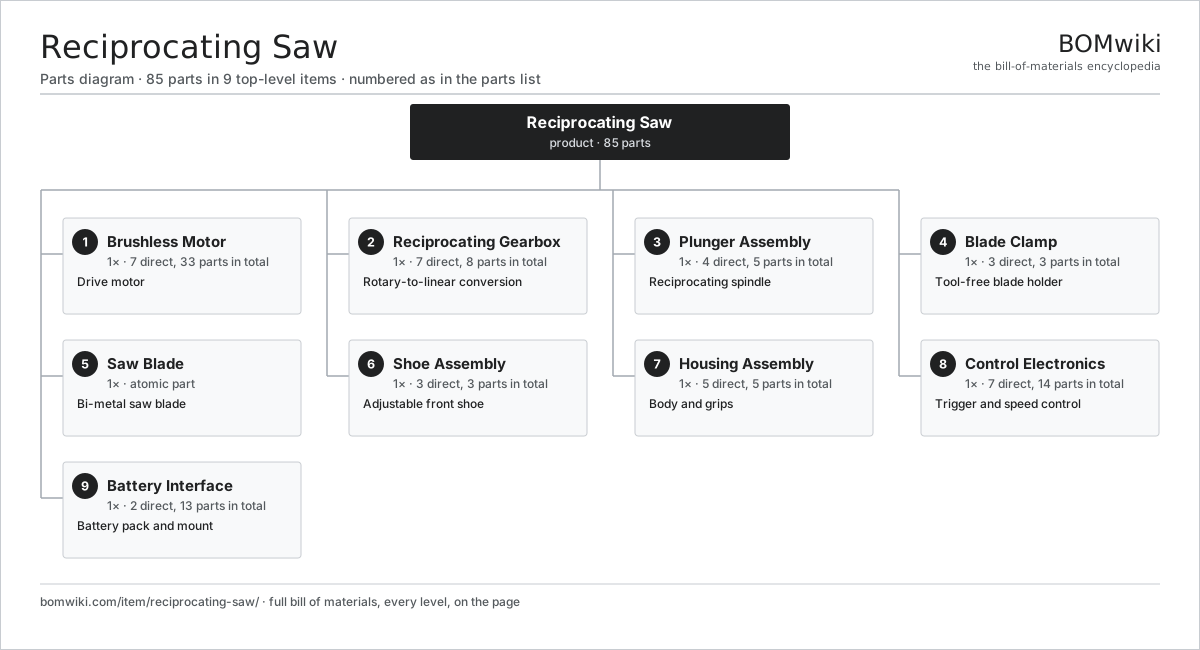
| # | Part | Qty | What it does |
|---|---|---|---|
| 1 | Brushless Motor 7 parts | 1× | Drive motor |
| 2 | Reciprocating Gearbox 7 parts | 1× | Rotary-to-linear conversion |
| 3 | Plunger Assembly 4 parts | 1× | Reciprocating spindle |
| 4 | Blade Clamp 3 parts | 1× | Tool-free blade holder |
| 5 | Saw Blade | 1× | Bi-metal saw blade |
| 6 | Shoe Assembly 3 parts | 1× | Adjustable front shoe |
| 7 | Housing Assembly 5 parts | 1× | Body and grips |
| 8 | Control Electronics 7 parts | 1× | Trigger and speed control |
| 9 | Battery Interface 2 parts | 1× | Battery pack and mount |
3D model
No 3D model yet. Have a CAD file of this? Add a 3D model. STL renders right on this page; STEP, FreeCAD, and OpenSCAD sources are welcome too (openly licensed, like all 3D models on BOMwiki).
Build & assembly graph
expand / collapse · shared sub-assemblies converge · links to related products · est. labourTap an assembly to expand/collapse · tap a part to open it · use “Open page” for any node · drag to pan, scroll to zoom.
Bill of materials for Reciprocating Saw
9 top-level lines · 57 rows shown · 85 parts total · indented to 3 levels| # | Item / sub-assembly | Part no. | Qty/assy | Ext. qty | Parts | Type |
|---|---|---|---|---|---|---|
| 1 | Brushless Motor 7 parts | reciprocating-saw-motor | 1× | 1 | 33 | assembly |
| 1.1 | Stator Assembly 3 parts | stator-assembly | 1× | 1 | 3 | assembly |
| 1.1.1 | Stator Core (laminations) | stator-core | 1× | 1 | · | part |
| 1.1.2 | Copper Winding | copper-winding | 1× | 1 | · | part |
| 1.1.3 | Slot Insulation | stator-insulation | 1× | 1 | · | part |
| 1.2 | Rotor Assembly 4 parts | rotor-assembly | 1× | 1 | 19 | assembly |
| 1.2.1 | Rotor Shaft | rotor-shaft | 1× | 1 | · | part |
| 1.2.2 | Rotor Core | rotor-core | 1× | 1 | · | part |
| 1.2.3 | Neodymium Magnet | neodymium-magnet | 16× | 16 | · | part |
| 1.2.4 | Ball Bearing | ball-bearing | 1× | 1 | · | part |
| 1.3 | Copper Winding | copper-winding | 3× | 3 | · | part |
| 1.4 | Neodymium Magnet | neodymium-magnet | 4× | 4 | · | part |
| 1.5 | Ball Bearing | ball-bearing | 2× | 2 | · | part |
| 1.6 | Hall Sensor | hall-sensor | 1× | 1 | · | part |
| 1.7 | Motor Fan | reciprocating-saw-motor-fan | 1× | 1 | · | part |
| 2 | Reciprocating Gearbox 7 parts | reciprocating-saw-gearbox | 1× | 1 | 8 | assembly |
| 2.1 | Gearbox Housing | gearbox-housing | 1× | 1 | · | part |
| 2.2 | Helical Gear Pair | gear-pair | 1× | 1 | · | part |
| 2.3 | Wobble Plate | reciprocating-saw-wobble-plate | 1× | 1 | · | part |
| 2.4 | Wobble Shaft | reciprocating-saw-wobble-shaft | 1× | 1 | · | part |
| 2.5 | Counterweight | reciprocating-saw-counterweight | 1× | 1 | · | part |
| 2.6 | Ball Bearing | ball-bearing | 2× | 2 | · | part |
| 2.7 | Oil Seal | oil-seal | 1× | 1 | · | part |
| 3 | Plunger Assembly 4 parts | reciprocating-saw-plunger | 1× | 1 | 5 | assembly |
| 3.1 | Plunger Shaft | reciprocating-saw-plunger-shaft | 1× | 1 | · | part |
| 3.2 | Guide Bushing | reciprocating-saw-guide-bushing | 2× | 2 | · | part |
| 3.3 | Orbital Cam | reciprocating-saw-orbital-cam | 1× | 1 | · | part |
| 3.4 | Oil Seal | oil-seal | 1× | 1 | · | part |
| 4 | Blade Clamp 3 parts | reciprocating-saw-blade-clamp | 1× | 1 | 3 | assembly |
| 4.1 | Clamp Collar | reciprocating-saw-clamp-collar | 1× | 1 | · | part |
| 4.2 | Clamp Pin | reciprocating-saw-clamp-pin | 1× | 1 | · | part |
| 4.3 | Coil Spring | coil-spring | 1× | 1 | · | part |
| 5 | Saw Blade | reciprocating-saw-blade | 1× | 1 | · | part |
| 6 | Shoe Assembly 3 parts | reciprocating-saw-shoe | 1× | 1 | 3 | assembly |
| 6.1 | Shoe Plate | reciprocating-saw-shoe-plate | 1× | 1 | · | part |
| 6.2 | Shoe Rail | reciprocating-saw-shoe-rail | 1× | 1 | · | part |
| 6.3 | Shoe Lock Lever | reciprocating-saw-shoe-lock | 1× | 1 | · | part |
| 7 | Housing Assembly 5 parts | reciprocating-saw-housing | 1× | 1 | 5 | assembly |
| 7.1 | Clamshell Body | reciprocating-saw-clamshell | 1× | 1 | · | part |
| 7.2 | Front Boot | reciprocating-saw-front-boot | 1× | 1 | · | part |
| 7.3 | Rear Grip | reciprocating-saw-rear-grip | 1× | 1 | · | part |
| 7.4 | LED Worklight | reciprocating-saw-led-light | 1× | 1 | · | part |
| 7.5 | Fastener Set | fastener-set | 1× | 1 | · | part |
| 8 | Control Electronics 7 parts | reciprocating-saw-electronics | 1× | 1 | 14 | assembly |
| 8.1 | Variable-Speed Trigger | reciprocating-saw-trigger | 1× | 1 | · | part |
| 8.2 | Bare PCB | pcb-bare | 1× | 1 | · | part |
| 8.3 | Microcontroller | mcu | 1× | 1 | · | part |
| 8.4 | Power MOSFET | mosfet | 6× | 6 | · | part |
| 8.5 | SMD Passive (R/C/L) | smd-passives | 1× | 1 | · | part |
| 8.6 | Connector | connector | 3× | 3 | · | part |
| 8.7 | Wire Bundle | wire-bundle | 1× | 1 | · | part |
| 9 | Battery Interface 2 parts | reciprocating-saw-battery-interface | 1× | 1 | 13 | assembly |
| 9.1 | Battery Pack 3 parts | reciprocating-saw-battery-pack | 1× | 1 | 12 | assembly |
| 9.1.1 | Li-ion Cell, 18650 | li-cell-18650 | 10× | 10 | · | part |
| 9.1.2 | BMS Board | bms-board | 1× | 1 | · | part |
| 9.1.3 | Pack Case | reciprocating-saw-pack-case | 1× | 1 | · | part |
| 9.2 | Terminal Block | reciprocating-saw-terminal-block | 1× | 1 | · | part |
Something wrong in this list? Report a problem with this BOM.
Related products
same domain, ranked by shared parts Impact Wrench
87 parts · shares 11 with this page
Impact Wrench
87 parts · shares 11 with this page
 Rotary Hammer
100 parts · shares 10 with this page
Rotary Hammer
100 parts · shares 10 with this page
 Airless Paint Sprayer
97 parts · shares 9 with this page
Airless Paint Sprayer
97 parts · shares 9 with this page
 Circular Saw
87 parts · shares 10 with this page
Circular Saw
87 parts · shares 10 with this page
Sourcing: possible vendors
Browse the supplier directory → Prices, MOQ, and lead times are algorithmic estimates, not quotes, and not claims about these companies. Company mappings are curated by keyword; est. price band $30–$800. How estimates work| Vendor | HQ | Specialty | MOQ | Lead time |
|---|---|---|---|---|
| stanleyblackanddecker.com ↗ | New Britain, US | Tools (DeWalt, Craftsman) | 500 units | 6–12 wks |
| bosch-professional.com ↗ | Leinfelden, DE | Power tools | 500 units | 6–12 wks |
| ttigroup.com ↗ | Hong Kong, CN | Tools (Milwaukee, Ryobi) | 500 units | 6–12 wks |
|
🇯🇵Makita
makita.com ↗
|
Anjo, JP | Power tools | 500 units | 6–12 wks |
|
🇨🇭Hilti
hilti.com ↗
|
Schaan, CH | Construction tools | 500 units | 6–12 wks |
738-word article