SCADA RTU
ProductOverview
Water utilities, gas distribution networks, and electric grid operators depend on remote terminal units (RTUs) to monitor and control infrastructure at unattended sites. A typical RTU lives on a utility pole at a water pump station, a gas gate valve, or a substation transformer, reading sensors and operating switches under remote command from the SCADA master hours or kilometres away. The unit must be utterly reliable: powering from its own solar panel and battery, surviving −25 °C winters and +60 °C summer peaks, staying online through thunderstorms and dust, and holding the state of critical equipment (is the pump running? did the tank overflow?) even during a multi-day power failure or communications blackout.
Traditional RTUs were hardwired with dedicated copper telemetry pairs running back to the control centre; those days are nearly gone, replaced by wireless, cellular modems (LTE, 5G), licensed microwave, or unlicensed ISM-band radios. The protocol stack is usually Modbus (RTU binary mode over serial or TCP), DNP3 (designed for utilities), or IEC 60870-5-104 (European standard).
Architecture and Real-Time Operation
The Processor Module is the RTU's brain. Its CPU PCB hosts a low-power ARM Cortex-M microcontroller (STM32L, SAM L), clocked at 8–16 MHz, drawing <10 mA idle. The Program Memory holds the compiled Modbus/DNP3 stack, state machine, and alarm logic. The Data EEPROM EEPROM stores configuration (RTU address, fieldbus parameters, polling intervals), calibration data for analog channels, and alarm history.
The Watchdog Timer is critical. Because the unit is unattended and communications may be spotty, the watchdog timer (external chip, 60-second timeout) enforces that the CPU must periodically reset it; if the CPU hangs (corrupted program, software deadlock), the watchdog power-cycles the entire unit, forcing a clean restart. This automatic recovery is non-negotiable for unattended sites.
I/O and Fieldside Instrumentation
The IO Terminal Block block is where the RTU touches the real world. The Digital Input Stage reads binary inputs: float switches (tank is full, pump running), relay contacts (breaker closed, solenoid energised), dry-contact pulse counters (flow totaliser). Each DI Optocoupler Channel isolates its input at 2 kV minimum, critical for long runs where a lightning strike on the solenoid coil cable can induce kilovolt transients that would otherwise destroy the CPU.
The Digital Output Stage executes commands: opening a solenoid pilot valve to start a pump, closing a motorised gate, energising an alarm horn. Relay outputs are preferred in utilities because they are galvanically isolated (no semiconductor leakage at high voltage) and can handle inductive loads (solenoids) directly without snubbing diodes. The Relay Output stages hold safe state (energised-to-run) during power-up, so a reset does not accidentally close a flow valve or trigger a pump start.
Analog channels measure continuous quantities. The Analog Input Stage accepts 4–20 mA current loop signals (pressure transmitter, water level gauge) or 0–10 V (local sensors). The AI Instrumentation Amp instrumentation amplifier converts 4–20 mA to 0–2.5 V (ratiometric to the ADC reference), and the ADC Converter converts this to 12-bit digital at 1 kHz. The 4–20 mA standard is universal in utilities because open-circuit (broken wire) reads as zero current, unambiguously signalling a fault; 0–10 V cannot distinguish a real zero from a broken sensor.
Analog outputs command proportional devices. The Analog Output Stage generates 4–20 mA or 0–10 V setpoints for pump speed drives, proportional solenoid pilot valves, and smart meters. The AO Current Source is a Howland current pump, an op-amp topology generating accurate current sinking or sourcing, independent of load impedance.
Power System: Off-Grid Autonomy
The RTU's power system is its heartbeat. Most RTUs are off-grid, powered by the Power System. A Solar Panel (20–100 W depending on latitude and site shading) charges a Battery Pack. In cloudy regions, a lead-acid battery bank (200–500 Ah @ 24 V) stores energy for 3–7 days without sun; in sunnier climates, smaller 48 V LiFePO₄ batteries (100 Ah) are increasingly chosen for their longer cycle life (3,000+ cycles vs 500–1,000 for lead-acid) and lower maintenance (no watering).
The Charge Controller is an MPPT (maximum power point tracking) controller that continuously adjusts the solar panel's operating voltage to maximise power extraction, a ~15–25% efficiency win over simple PWM regulators. At night or under clouds, the charger is inactive and the battery feeds the Power Distribution Stage, which generates isolated 5 V and 3.3 V for IC power, with brown-out detection that forces a safe shutdown if the battery voltage drops below a threshold (e.g. 20 V for a 24 V system).
A typical RTU draws:
- Processor + logic: 10 mA idle, 50 mA running
- Modem (sleep): <5 mA
- Modem (transmitting): 200–500 mA for 1–10 seconds every 15 minutes
- Daily average: 50–100 mA, easily covered by 50 W solar in most climates
In winter or persistently cloudy weather, an immersion heater (1–3 kW) maintains enclosure temperature above 15 °C, preventing battery damage.
Communications: Wireless Telemetry
The Radio or Cellular Modem is the lifeline connecting the RTU to the SCADA master. Three major choices exist:
Cellular (LTE / CAT-M1 / NB-IoT): Wide coverage in populated areas, no line-of-sight needed, but ongoing SIM fees ($10–50/month) and potential carrier shutdown risks.
Licensed microwave (900 MHz or 2.4 GHz): Point-to-point line-of-sight links with 10–20 mile range, private spectrum (no carrier), but requires FCC licensing and line-of-sight towers.
ISM-band radio (868 MHz Europe, 915 MHz US): License-free, <1 W power, 1–3 mile range depending on antenna and terrain, used in water utility networks with repeaters.
The Modem IC is a full transceiver IC drawing 50–500 mW during active transmission. The Antenna is either an omni-directional whip (cellular) or a directional Yagi (microwave). Power consumption is episodic: the modem sleeps at <5 mA between polls, wakes every 15–60 minutes, exchanges a 32–64 byte Modbus message (1–5 seconds transmission + acknowledgement), then returns to sleep. A 100 Ah battery can sustain 2–3 weeks of operation with no solar input and regular polling.
The GPS Module provides two critical functions. The GNSS Receiver receiver locks to GPS satellites, acquiring a position fix within 100 ms of signal acquisition and holding 1 PPS (pulse per second) phase-lock to UTC. The 1 PPS discipline is rare in RTUs but invaluable in networks where time-synchronisation of events across multiple sites is mandatory for fault analysis. The GPS Antenna is a compact patch mounted on the enclosure roof.
Environmental Hardiness
The Weatherproof Enclosure is a heavily spec'd box. Its Cabinet Body is hot-dip galvanised steel, NEMA 3R rated (rain, snow, sleet proof), with foam thermal insulation in cold climates. The Locking Door is stainless or powder-coated steel, with a rubber gasket and padlock provision for security. The Condensation Vent is a Gore-type membrane that lets internal pressure and humidity escape during daily temperature swings without admitting rain.
In −25 °C winters the RTU's battery and regulators must not freeze or become sluggish. An embedded Heating/Cooling Controller activates a 1–3 kW immersion heater whenever internal temperature drops below 15 °C. In +50 °C deserts, a 24 V fan runs to prevent processor throttling or battery damage.
Lightning and Surge Suppression
Unattended outdoor electronics attract lightning. The RTU's Lightning Protection Stage is multi-stage. The Primary Surge Device (gas discharge tube or MOV) on the main 24 V supply clamps kilovolt transients to ±20 V, preventing damage to the power regulators. The Secondary Arrester Array array of Zener diodes on each field input further limits transients to ±5.6 V, protecting the microcontroller I/O pins. The Star Ground Block star point gathers all protective grounds and bonds them to a copper Earth Rod and Conductor rod buried 8 feet deep, presenting a low-impedance path for lightning energy into the earth.
This multi-stage approach is standard practice; a single MOV alone is insufficient because it responds in nanoseconds but the transient's energy arrives in microseconds, and surging current can damage the device itself. Secondary clamping at the microcontroller boundary is the insurance policy.
Mounting and Installation
The Pole / Pedestal Mount fastens the enclosure to utility poles or concrete plinths. The Mounting Bracket is a galvanised U-bolt frame accepting 4–12 inch poles. Stainless fasteners are mandatory (galvanised fasteners corrode in damp climates). The Vibration Isolator vibration dampers reduce wind-induced oscillations that would otherwise fatigue the PCB solder joints.
Grounding is critical. The Earth Rod and Conductor rod is driven 8 feet into soil, connected to the enclosure via #6 AWG (13 mm²) copper wire. The enclosure body itself is bonded to this rod via short straps, creating a single equipotential surface. This grounding system serves three purposes: dissipating lightning energy, preventing ground loops in the Modbus signal lines, and providing a reference for any sensor or solenoid circuit wired to the site.
Field Commissioning and Maintenance
An RTU is commissioned by setting its Modbus address (via DIP switches or a keypad), configuring polling intervals, and wiring field devices to the terminal block. Most RTUs ship with pre-loaded Modbus firmware; custom applications are rare. Technicians monitor RTU health by periodically walking to the site, reading the status LEDs (power green, comms amber blink = good), and downloading the event log via a laptop serial port or by reading a microSD card if the unit has one.
Maintenance is minimal: inspect the antenna for corrosion, check the battery voltage (should trend stable across seasonal sun/shade cycles), replace the Gore vent membrane annually, and trim vegetation around the solar panel. Lead-acid batteries need water top-up every 6–12 months in hot climates; LiFePO₄ units require no watering and are increasingly preferred despite higher initial cost.
SCADA RTU parts and their functions
9 top-level parts · 266 parts in total · full bill of materials below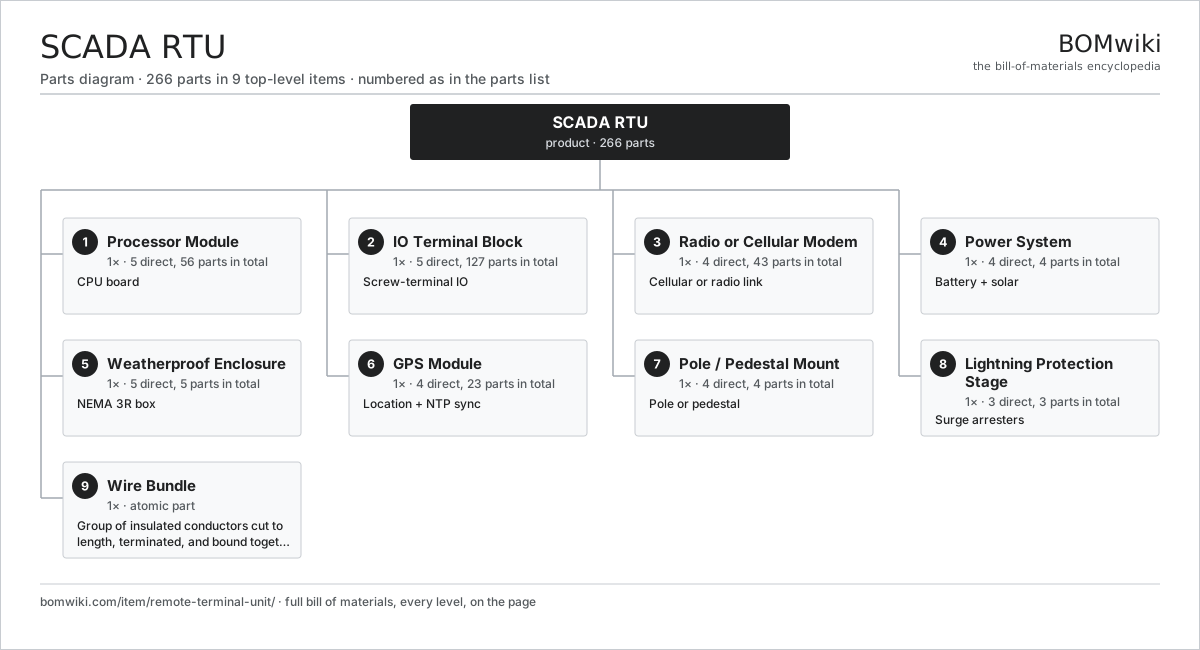
| # | Part | Qty | What it does |
|---|---|---|---|
| 1 | Processor Module 5 parts | 1× | CPU board |
| 2 | IO Terminal Block 5 parts | 1× | Screw-terminal IO |
| 3 | Radio or Cellular Modem 4 parts | 1× | Cellular or radio link |
| 4 | Power System 4 parts | 1× | Battery + solar |
| 5 | Weatherproof Enclosure 5 parts | 1× | NEMA 3R box |
| 6 | GPS Module 4 parts | 1× | Location + NTP sync |
| 7 | Pole / Pedestal Mount 4 parts | 1× | Pole or pedestal |
| 8 | Lightning Protection Stage 3 parts | 1× | Surge arresters |
| 9 | Wire Bundle | 1× | Group of insulated conductors cut to length, terminated, and bound together to carry power and signals between the assemblies of a machine. |
3D model
No 3D model yet. Have a CAD file of this? Add a 3D model. STL renders right on this page; STEP, FreeCAD, and OpenSCAD sources are welcome too (openly licensed, like all 3D models on BOMwiki).
Build & assembly graph
expand / collapse · shared sub-assemblies converge · links to related products · est. labourTap an assembly to expand/collapse · tap a part to open it · use “Open page” for any node · drag to pan, scroll to zoom.
Bill of materials for SCADA RTU
9 top-level lines · 56 rows shown · 266 parts total · indented to 3 levels| # | Item / sub-assembly | Part no. | Qty/assy | Ext. qty | Parts | Type |
|---|---|---|---|---|---|---|
| 1 | Processor Module 5 parts | remote-terminal-unit-processor | 1× | 1 | 56 | assembly |
| 1.1 | CPU PCB 3 parts | remote-terminal-unit-processor-board | 1× | 1 | 3 | assembly |
| 1.1.1 | Bare PCB | pcb-bare | 1× | 1 | · | part |
| 1.1.2 | Microcontroller | mcu | 1× | 1 | · | part |
| 1.1.3 | Real-Time Clock | remote-terminal-unit-oscillator | 1× | 1 | · | part |
| 1.2 | Program Memory | remote-terminal-unit-memory-program | 1× | 1 | · | part |
| 1.3 | Data EEPROM | remote-terminal-unit-memory-data | 1× | 1 | · | part |
| 1.4 | Watchdog Timer | remote-terminal-unit-watchdog | 1× | 1 | · | part |
| 1.5 | SMD Passive (R/C/L) | smd-passives | 50× | 50 | · | part |
| 2 | IO Terminal Block 5 parts | remote-terminal-unit-io-terminals | 1× | 1 | 127 | assembly |
| 2.1 | Digital Input Stage 2 parts | remote-terminal-unit-di-stage | 1× | 1 | 38 | assembly |
| 2.1.1 | DI Optocoupler Channel | remote-terminal-unit-di-optocoupler | 8× | 8 | · | part |
| 2.1.2 | SMD Passive (R/C/L) | smd-passives | 30× | 30 | · | part |
| 2.2 | Digital Output Stage 2 parts | remote-terminal-unit-do-stage | 1× | 1 | 24 | assembly |
| 2.2.1 | Relay Output | remote-terminal-unit-do-relay | 4× | 4 | · | part |
| 2.2.2 | SMD Passive (R/C/L) | smd-passives | 20× | 20 | · | part |
| 2.3 | Analog Input Stage 3 parts | remote-terminal-unit-ai-stage | 1× | 1 | 42 | assembly |
| 2.3.1 | ADC Converter | remote-terminal-unit-ai-adc | 1× | 1 | · | part |
| 2.3.2 | AI Instrumentation Amp | remote-terminal-unit-ai-conditioning | 1× | 1 | · | part |
| 2.3.3 | SMD Passive (R/C/L) | smd-passives | 40× | 40 | · | part |
| 2.4 | Analog Output Stage 3 parts | remote-terminal-unit-ao-stage | 1× | 1 | 22 | assembly |
| 2.4.1 | DAC Converter | remote-terminal-unit-ao-dac | 1× | 1 | · | part |
| 2.4.2 | AO Current Source | remote-terminal-unit-ao-driver | 1× | 1 | · | part |
| 2.4.3 | SMD Passive (R/C/L) | smd-passives | 20× | 20 | · | part |
| 2.5 | Screw Terminal Block | remote-terminal-unit-terminal-block | 1× | 1 | · | part |
| 3 | Radio or Cellular Modem 4 parts | remote-terminal-unit-radio-modem | 1× | 1 | 43 | assembly |
| 3.1 | Modem IC | remote-terminal-unit-modem-module | 1× | 1 | · | part |
| 3.2 | Antenna | remote-terminal-unit-antenna | 1× | 1 | · | part |
| 3.3 | Antenna Connector | remote-terminal-unit-modem-connector | 1× | 1 | · | part |
| 3.4 | SMD Passive (R/C/L) | smd-passives | 40× | 40 | · | part |
| 4 | Power System 4 parts | remote-terminal-unit-power-system | 1× | 1 | 4 | assembly |
| 4.1 | Solar Panel | remote-terminal-unit-solar-panel | 1× | 1 | · | part |
| 4.2 | Battery Pack | remote-terminal-unit-battery | 1× | 1 | · | part |
| 4.3 | Charge Controller | remote-terminal-unit-charger | 1× | 1 | · | part |
| 4.4 | Power Distribution Stage | remote-terminal-unit-power-distribution | 1× | 1 | · | part |
| 5 | Weatherproof Enclosure 5 parts | remote-terminal-unit-enclosure | 1× | 1 | 5 | assembly |
| 5.1 | Cabinet Body | remote-terminal-unit-enclosure-body | 1× | 1 | · | part |
| 5.2 | Locking Door | remote-terminal-unit-enclosure-door | 1× | 1 | · | part |
| 5.3 | Heating/Cooling Controller | remote-terminal-unit-enclosure-thermostat | 1× | 1 | · | part |
| 5.4 | Condensation Vent | remote-terminal-unit-enclosure-vent | 1× | 1 | · | part |
| 5.5 | Fastener Set | fastener-set | 1× | 1 | · | part |
| 6 | GPS Module 4 parts | remote-terminal-unit-gps-module | 1× | 1 | 23 | assembly |
| 6.1 | GNSS Receiver | remote-terminal-unit-gps-chip | 1× | 1 | · | part |
| 6.2 | GPS Antenna | remote-terminal-unit-gps-antenna | 1× | 1 | · | part |
| 6.3 | 1PPS Conditioner | remote-terminal-unit-gps-pps-conditioner | 1× | 1 | · | part |
| 6.4 | SMD Passive (R/C/L) | smd-passives | 20× | 20 | · | part |
| 7 | Pole / Pedestal Mount 4 parts | remote-terminal-unit-mounting | 1× | 1 | 4 | assembly |
| 7.1 | Mounting Bracket | remote-terminal-unit-mount-bracket | 1× | 1 | · | part |
| 7.2 | Vibration Isolator | remote-terminal-unit-mount-isolation | 1× | 1 | · | part |
| 7.3 | Earth Rod and Conductor | remote-terminal-unit-enclosure-grounding | 1× | 1 | · | part |
| 7.4 | Fastener Set | fastener-set | 1× | 1 | · | part |
| 8 | Lightning Protection Stage 3 parts | remote-terminal-unit-lightning-protection | 1× | 1 | 3 | assembly |
| 8.1 | Primary Surge Device | remote-terminal-unit-spd-primary | 1× | 1 | · | part |
| 8.2 | Secondary Arrester Array | remote-terminal-unit-spd-secondary | 1× | 1 | · | part |
| 8.3 | Star Ground Block | remote-terminal-unit-ground-buss | 1× | 1 | · | part |
| 9 | Wire Bundle | wire-bundle | 1× | 1 | · | part |
Something wrong in this list? Report a problem with this BOM.
Sourcing: possible vendors
Browse the supplier directory → Prices, MOQ, and lead times are algorithmic estimates, not quotes, and not claims about these companies. Company mappings are curated by keyword; est. price band $3k–$500k. How estimates work| Vendor | HQ | Specialty | MOQ | Lead time |
|---|---|---|---|---|
|
🇯🇵Fanuc
fanuc.com ↗
|
Oshino, JP | Industrial robots & CNC | 20 units | 10–18 wks |
| abb.com ↗ | Zurich, CH | Industrial robots | 20 units | 10–18 wks |
|
🇯🇵Yaskawa
yaskawa.com ↗
|
Kitakyushu, JP | Robots & motion | 20 units | 10–18 wks |
|
🇩🇪KUKA
kuka.com ↗
|
Augsburg, DE | Industrial robots | 20 units | 10–18 wks |
| universal-robots.com ↗ | Odense, DK | Collaborative robots | 20 units | 10–18 wks |
1,758-word article