Revolving Stage
ProductOverview
Revolving stages are the foundational technology for set changes in musical theater and large-scale dramatic productions. A motorized turntable allows multiple complete sets to be pre-positioned around the deck's perimeter. As the stage rotates, a new set comes into view from the audience's perspective. The rotation is silent and smooth, requiring minimal crew involvement and executing set changes in 30–120 seconds, far faster than manual scenery moves or traditional fly systems.
The Revolving Stage is a professional installation designed for 500+ seat theaters and performing arts venues. Its 32-foot diameter accommodates full-scale Broadway-style sets, with a Turntable Deck Assembly that can support distributed loads of 5 tons (approximately 10,000 lbs of scenery and cast simultaneously). A Drive Mechanism motor-driven friction roller rotates the deck smoothly at variable speeds (0.5–3 RPM), controlled via Control Electronics electronics that accept DMX512 cues from the lighting/show controller.
Structural Design
The Turntable Deck Assembly comprises:
- Flooring: 3/4 inch moisture-resistant plywood laid over the substructure.
- Subframe: Radial and circumferential 6-inch × 6-inch welded steel box beams creating a rigid disk.
- Rim Ring: A steel ring bolted to the outer perimeter, 32 inches in diameter, providing the friction surface for the drive roller.
The entire deck assembly weighs approximately 8 tons at rest. The substructure is designed to distribute a 5-ton load (5000 lbs) evenly across the deck surface without deflection exceeding 0.1 inch at the center. Any performance scenery is bolted or braced to the steel frame to prevent shifting during rotation.
Bearing and Support System
The Bearing Support Assembly are the critical load path. A cast-iron Bearing Pedestal pedestal (bolted to the theater's structural deck) contains:
- Radial Bearings: Four 90mm tapered roller bearings supporting the 8-ton deck weight and any additional set load.
- Thrust Bearings: Two 150mm thrust ball bearings supporting vertical load and resisting any lift forces.
The bearing arrangement is a "king-post" configuration: the deck shaft rotates through the bearing housing center, and the radial bearings grip the shaft on two levels, creating a stable, low-friction rotating joint. Preload on the bearings is set at approximately 500 lbs per bearing pair, ensuring zero radial play while minimizing friction.
For a 32-foot deck with uniform 5-ton load:
- Load per bearing: approximately 1.25 tons
- Bearing life at 1 RPM continuous operation: approximately 50,000 hours (5.7 years)
Bearings are grease-lubricated, with annual repack recommended.
Drive Mechanism and Torque Transmission
The Drive Mechanism uses friction-roller transmission, elegant in design and robust in operation. A 2 HP AC motor drives a Drive Gearbox with a 20:1 reduction ratio, outputting 36 RPM at the gearbox shaft. This shaft is coupled to a Friction Drive Roller, a 12-inch diameter steel roller with a molded rubber (elastomer) coating.
The Pressure Plate Assembly assembly applies a constant 500 lbs of normal force, pressing the drive roller against the Drive Engagement Ring at the deck perimeter. Friction between the rubber coating and the steel rim transmits torque to the deck.
Torque Calculation:
- Motor power: 2 HP = 1500 watts
- Motor speed: 1800 RPM
- Motor torque: (1500 × 5250) / 1800 = 4375 lb-in
- Gearbox output torque: 4375 × 20 = 87,500 lb-in
- Friction force at roller (assuming 0.6 friction coefficient): 500 lbs × 0.6 = 300 lbs
- Torque transmitted to deck at rim radius (16-foot radius): 300 × 16 × 12 = 57,600 lb-in
This torque is more than sufficient to accelerate and smoothly rotate the 8-ton deck plus 5 tons of scenery. The gearbox can be sized to allow rotation from 0.5 to 3 RPM via variable motor speed control.
Rotation and Positioning
The Control Electronics regulates rotation speed and position. An encoder on the motor shaft provides 360-degree position feedback. The system can be programmed to:
- Rotate continuously at a fixed speed (for dance sequences).
- Execute a slow rotation (0.25 RPM) for scenic effect.
- Rotate to a specific degree angle (e.g., 90 degrees for a set change) and stop precisely within ±2 degrees.
The deck can complete a full 360-degree rotation in 20 minutes at 0.5 RPM or 6.7 minutes at 1.5 RPM. For set changes between acts, a typical rotation of 90 or 180 degrees takes 3–12 minutes, allowing time for scene adjustments.
Electrical Slip Ring System
Equipment mounted on the revolving deck (spotlights, sound speakers, scenery props with power demands) must receive electrical power and control signals while rotating. The Slip Ring Assembly assembly solves this challenge.
A Slip Ring Rotor is a ring of 24 silver-plated copper segments, each 0.5 inches wide, bolted to the underside of the rotating deck shaft. A stationary Brush Block Assembly above it contains spring-loaded carbon brushes that maintain continuous contact with the slip ring as it rotates. Each brush carries up to 30 amps.
Typical connections:
- Segments 1–3: Three-phase AC power (277V) feeding a motor or lighting dimmer on deck.
- Segments 4–7: DMX512 data lines (pairs of twisted conductors).
- Segments 8–10: 24V DC control signals.
- Segments 11–24: Redundant grounds and spares.
Brush wear is approximately 0.010 inch per year of continuous operation; brushes are replaced every 3–5 years.
Braking and Safety
The Brake Assembly includes a Brake Caliper disc brake mounted on the gearbox output shaft. The brake is spring-applied (always engaged at rest) and solenoid-released (energized only during rotation).
Holding torque: 2000 lb-ft, sufficient to prevent any deck motion even if a crew member attempts to push the rim manually while stopped.
During normal operation:
- Operator sends a "rotate" command via the DMX console.
- Motor controller energizes the brake release solenoid, retracting the friction pads.
- Motor accelerates smoothly (via soft-start) over 2 seconds.
- Deck rotates at commanded speed.
- At the target position, motor de-energizes, decelerating over 2 seconds.
- Motor stops, brake solenoid de-energizes, and brake pads re-engage, locking the deck.
Typical Deployment
A 1500-seat Broadway theater installs a Revolving Stage as the permanent main playing surface. Three distinct sets are arranged around the deck's perimeter:
- Set 1 (0°): Living room interior, upstage position.
- Set 2 (120°): Exterior park scene, stage-left position.
- Set 3 (240°): Bedroom interior, stage-right position.
During the show, transitions between acts involve 120-degree rotations, each taking 4–6 minutes. The stage manager cues rotations via the lighting console 10 minutes before a set change, allowing time for actors to clear the stage. The Control Electronics executes the rotation smoothly and stops at the preset angle, bringing the next set into view with precision.
Maintenance and Inspection
Pre-show checks include:
- Visually confirming the brake is disengaged before rotation cue.
- Listening for any unusual grinding or squealing from bearings or drive roller.
- Checking that slip ring brushes are making contact (lights on deck should illuminate).
Annual maintenance:
- Repack all radial and thrust bearings with fresh grease.
- Inspect drive roller for wear (any flat-spotting exceeding 1/16 inch requires replacement).
- Check brake pad wear and replace if thickness is less than 1/4 inch.
- Brush slip ring surfaces gently with fine sandpaper (220-grit) to remove carbon deposits.
The Revolving Stage is designed to operate reliably for 30+ years with proper maintenance in a theater environment.
Revolving Stage parts and their functions
6 top-level parts · 61 parts in total · full bill of materials below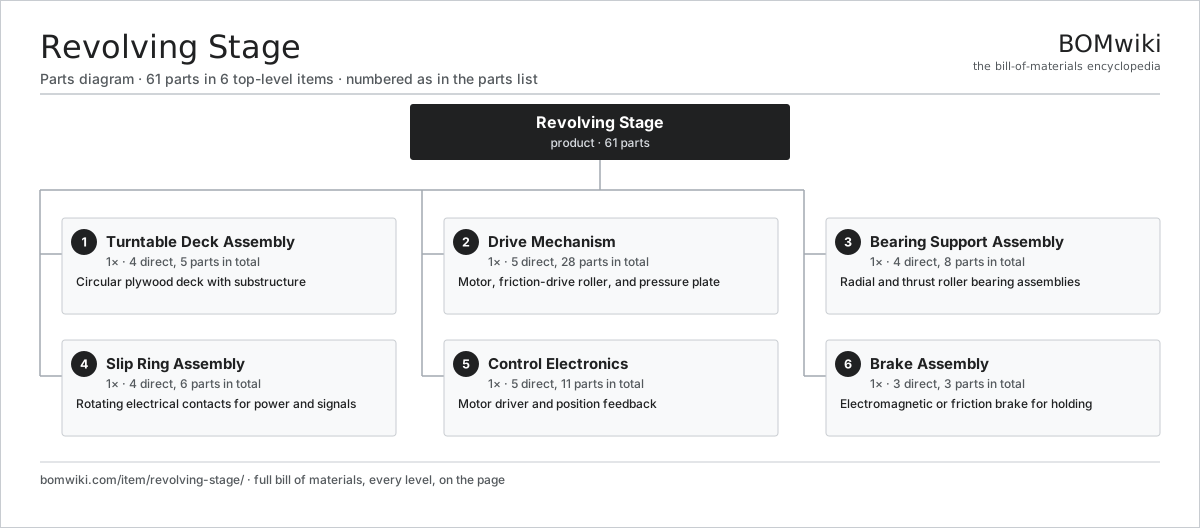
| # | Part | Qty | What it does |
|---|---|---|---|
| 1 | Turntable Deck Assembly 4 parts | 1× | Circular plywood deck with substructure |
| 2 | Drive Mechanism 5 parts | 1× | Motor, friction-drive roller, and pressure plate |
| 3 | Bearing Support Assembly 4 parts | 1× | Radial and thrust roller bearing assemblies |
| 4 | Slip Ring Assembly 4 parts | 1× | Rotating electrical contacts for power and signals |
| 5 | Control Electronics 5 parts | 1× | Motor driver and position feedback |
| 6 | Brake Assembly 3 parts | 1× | Electromagnetic or friction brake for holding |
3D model
No 3D model yet. Have a CAD file of this? Add a 3D model. STL renders right on this page; STEP, FreeCAD, and OpenSCAD sources are welcome too (openly licensed, like all 3D models on BOMwiki).
Build & assembly graph
expand / collapse · shared sub-assemblies converge · links to related products · est. labourTap an assembly to expand/collapse · tap a part to open it · use “Open page” for any node · drag to pan, scroll to zoom.
Bill of materials for Revolving Stage
6 top-level lines · 35 rows shown · 61 parts total · indented to 3 levels| # | Item / sub-assembly | Part no. | Qty/assy | Ext. qty | Parts | Type |
|---|---|---|---|---|---|---|
| 1 | Turntable Deck Assembly 4 parts | revolving-stage-deck | 1× | 1 | 5 | assembly |
| 1.1 | Deck Flooring | revolving-stage-deck-plywood | 1× | 1 | · | part |
| 1.2 | Steel Substructure | revolving-stage-steel-frame | 1× | 1 | · | part |
| 1.3 | Drive Engagement Ring | revolving-stage-rim-ring | 1× | 1 | · | part |
| 1.4 | Fastener Set | fastener-set | 2× | 2 | · | part |
| 2 | Drive Mechanism 5 parts | revolving-stage-ring-drive | 1× | 1 | 28 | assembly |
| 2.1 | Servo Motor 4 parts | servo-motor | 1× | 1 | 24 | assembly |
| 2.1.1 | Stator Assembly 3 parts + deeper › | stator-assembly | 1× | 1 | 3 | assembly |
| 2.1.2 | Rotor Assembly 4 parts + deeper › | rotor-assembly | 1× | 1 | 19 | assembly |
| 2.1.3 | Encoder | encoder | 1× | 1 | · | part |
| 2.1.4 | Motor Housing | motor-housing | 1× | 1 | · | part |
| 2.2 | Drive Gearbox | revolving-stage-gearbox | 1× | 1 | · | part |
| 2.3 | Friction Drive Roller | revolving-stage-drive-roller | 1× | 1 | · | part |
| 2.4 | Pressure Plate Assembly | revolving-stage-pressure-plate | 1× | 1 | · | part |
| 2.5 | Fastener Set | fastener-set | 1× | 1 | · | part |
| 3 | Bearing Support Assembly 4 parts | revolving-stage-bearings | 1× | 1 | 8 | assembly |
| 3.1 | Ball Bearing | ball-bearing | 4× | 4 | · | part |
| 3.2 | Thrust Bearing | revolving-stage-thrust-bearing | 2× | 2 | · | part |
| 3.3 | Bearing Pedestal | revolving-stage-bearing-housing | 1× | 1 | · | part |
| 3.4 | Fastener Set | fastener-set | 1× | 1 | · | part |
| 4 | Slip Ring Assembly 4 parts | revolving-stage-slip-rings | 1× | 1 | 6 | assembly |
| 4.1 | Slip Ring Rotor | revolving-stage-slip-ring-rotor | 1× | 1 | · | part |
| 4.2 | Brush Block Assembly | revolving-stage-brush-block | 1× | 1 | · | part |
| 4.3 | Connector | connector | 3× | 3 | · | part |
| 4.4 | Fastener Set | fastener-set | 1× | 1 | · | part |
| 5 | Control Electronics 5 parts | revolving-stage-control-system | 1× | 1 | 11 | assembly |
| 5.1 | Bare PCB | pcb-bare | 1× | 1 | · | part |
| 5.2 | Power MOSFET | mosfet | 6× | 6 | · | part |
| 5.3 | Microcontroller | mcu | 1× | 1 | · | part |
| 5.4 | Encoder | encoder | 1× | 1 | · | part |
| 5.5 | Connector | connector | 2× | 2 | · | part |
| 6 | Brake Assembly 3 parts | revolving-stage-braking-system | 1× | 1 | 3 | assembly |
| 6.1 | Brake Caliper | revolving-stage-brake-caliper | 1× | 1 | · | part |
| 6.2 | Brake Release Solenoid | revolving-stage-solenoid-release | 1× | 1 | · | part |
| 6.3 | Fastener Set | fastener-set | 1× | 1 | · | part |
Something wrong in this list? Report a problem with this BOM.
Related products
same domain, ranked by shared parts Broadcast Pedestal
83 parts · shares 12 with this page
Broadcast Pedestal
83 parts · shares 12 with this page
 PTZ Camera
499 parts · shares 12 with this page
Studio Jib Arm
106 parts · shares 12 with this page
PTZ Camera
499 parts · shares 12 with this page
Studio Jib Arm
106 parts · shares 12 with this page
 Projector
482 parts · shares 10 with this page
Projector
482 parts · shares 10 with this page
 Record Player
215 parts · shares 9 with this page
Record Player
215 parts · shares 9 with this page
Sourcing: possible vendors
Browse the supplier directory → Prices, MOQ, and lead times are algorithmic estimates, not quotes, and not claims about these companies. Company mappings are curated by keyword; est. price band $50–$3k. How estimates work| Vendor | HQ | Specialty | MOQ | Lead time |
|---|---|---|---|---|
|
🇯🇵Sony
sony.com ↗
|
Tokyo, JP | Consumer electronics | 1,000 units | 8–12 wks |
| samsung.com ↗ | Suwon, KR | Electronics & displays | 1,000 units | 8–12 wks |
|
🇺🇸Harman
harman.com ↗
|
Stamford, US | Audio (JBL, AKG) | 1,000 units | 8–12 wks |
|
🇺🇸Bose
bose.com ↗
|
Framingham, US | Audio | 1,000 units | 8–12 wks |
| yamaha.com ↗ | Hamamatsu, JP | Audio & instruments | 1,000 units | 8–12 wks |
1,259-word article