Fixed RFID Reader
ProductOverview
An RFID reader is the electronic eye of the supply chain. Radio frequency identification uses passive tags, small chips with antennas, powered wirelessly by the reader, to track items at scale and speed. A warehouse receiving dock, a retail distribution centre, a factory work-in-progress (WIP) line, or an automotive assembly plant uses RFID gates to automatically register the passage of pallets, cartons, or vehicles without human scanning.
Fixed RFID readers are bolted into permanent locations: above a conveyor line, at a loading dock, at an assembly-line gating station. Unlike handheld readers, they operate unattended and are networked to the facility WMS (warehouse management system) or MES (manufacturing execution system), automatically logging tags and triggering downstream actions.
Radio Transceiver Architecture
The UHF Radio Module is the electromagnetic powerhouse. Its RFID Transceiver IC is a full Gen 2 protocol engine, a chip implementing the EPC (Electronic Product Code) Gen 2 standard (ISO 18000-6C), which defines how RFID readers and tags communicate at 860–960 MHz. The chip generates the carrier frequency, encodes commands (inventory, read, write), and demodulates tag responses, all in real-time.
The Power Amplifier power amplifier (typically a GaN or LDMOS device) amplifies the transceiver's ~10 dBm signal to 30 dBm (1 W), the maximum legal limit in most regions. This power is delivered to the antenna via the Antenna Multiplexer multiplexer, which can sequence between 1–4 antennas or apply switched diversity (alternating antennas to mitigate multipath fading).
The Low-Noise Amplifier low-noise amplifier on the receiver path achieves <5 dB noise figure, boosting the sensitivity to detect tags at 10+ metres in open field. In warehouse racking, signal attenuation is higher, typically reducing range to 5–8 metres.
Tag Detection and Singulation
The EPC Gen 2 protocol is elegant but complex. When the reader interrogates a volume, dozens or hundreds of tags may respond simultaneously, creating collisions. The protocol uses a binary-tree anti-collision algorithm: the reader sends a command partitioning tags into groups, and only a subset respond. Through multiple rounds, the reader identifies every tag in range.
A typical inventory sequence:
- Reader sends "select" command (e.g. "I want Gen 2 tags").
- Tags matching the filter transition to "selected" state.
- Reader sends "query" starting an inventory round.
- Selected tags backscatter a random 16-bit handle.
- Reader sends "ack" to each handle, forcing that tag to transmit its EPC (product code) and RSSI (signal strength).
- Reader repeats with different random seeds until all tags are read.
The Reader Processor Module CPU runs this algorithm, implemented as a tight state machine in firmware. At a 100-tag/second density (typical for high-speed conveyor), the reader cycles through 10 tags per cycle at 1 kHz cycle rate, with each tag interrogation taking ~10 microseconds of air-time (compliance with FCC regulations limiting transmission duty cycle).
Antenna System
The External RFID Antenna is a critical design choice. Linearly-polarised antennas (patch or dipole, 6–9 dBi gain) are most common and cheapest. Circularly-polarised antennas are more robust, because tags randomly orientate themselves on cartons and pallets; circular polarisation receives equally well regardless of tag orientation, though with a ~3 dB gain penalty.
The Antenna Port Interface support four independent antenna channels. A typical dock gate has:
- Port 1: Overhead antenna pointing downward, scanning top of arriving pallets.
- Port 2: Vertical antenna on the left side, scanning left flanks.
- Port 3: Vertical antenna on the right side.
- Port 4: Lateral antenna on the far side, catching tags on the far pallet edge.
The reader polls ports sequentially (100 ms per port in a 400 ms cycle), logging tags detected on each port. Software can correlate multiple-port detections to infer the pallet centroid and velocity. Some advanced systems use time-difference-of-arrival (TDOA) to triangulate tags in 3D space.
Processor and Event Logging
The Reader Processor Module is a modest CPU, dual-core ARM running Linux with a custom RFID daemon. Its job is:
- Protocol execution: Run the Gen 2 stack, driving the transceiver IC through its command sequences.
- Tag filtering: Apply regex rules, e.g., "only log tags matching EPC prefix 337000", reducing data volume.
- Event logging: Every tag read is timestamped and logged to the Event Log Flash SSD, typically 30–90 days of history at 10–100 tags/second.
- Networking: Publish tag detections in real-time via MQTT or HTTP POST to the WMS, and expose a REST API for configuration and log download.
The Real-Time Clock battery-backed real-time clock ensures accurate timestamps even during power loss. Many deployments use GPS PPS (pulse-per-second) discipline to synchronise multiple readers' clocks across a facility, allowing cross-reader time-correlation.
Network Integration
The Ethernet Interface Gigabit Ethernet port supports PoE (power over Ethernet, 802.3at+), allowing a single Ethernet cable to power and network the reader, eliminating the need for local AC power or dedicated 24 V wiring. This is game-changing for retrofits in existing warehouses.
The reader implements LLRP (Low-Level Reader Protocol), an industry-standard protocol developed by EPCglobal allowing third-party WMS systems to control the reader and receive tag events. Most warehouse software vendors (Blue Yonder, Oracle, SAP) support LLRP readers natively. The reader also supports MQTT for edge computing scenarios: a single reader forwards tag events to a local edge gateway running node-red or a custom application, which filters and makes local decisions without sending all traffic to the cloud.
Event Triggering and PLC Integration
The Event / GPIO Interface relay and GPIO outputs allow the reader to autonomously trigger external equipment. A typical conveyor gate scenario:
- A pallet moves toward the dock.
- An External RFID Antenna reads the pallet's shipping label RFID tag.
- The reader matches the tag to an expected inbound shipment (via WMS query).
- Reader energises a Relay Output Channel relay, solenoid opens the gate, pallet passes.
- If the tag is unexpected, relay stays de-energised, gate blocked, alert sent to dock supervisor.
The four GPIO Input Sensing GPIO inputs allow the reader to react to external signals: a motion detector triggers a read, a gate-position sensor confirms closure, etc.
Deployment Scenarios
Warehouse receiving dock: One fixed reader mounted above the unloading bay, scanning inbound pallets. Tag detections are logged to WMS; exceptions (missing shipments, wrong SKU) trigger alarms.
Conveyor line: Readers spaced 1–2 metres apart on a high-speed line, each scanning items. Software correlates detections across readers to infer flow direction and velocity, enabling line-stop logic if a defect is detected downstream.
Manufacturing WIP: RFID tags on work-in-progress (WIP) cartons are read at each station (assembly, test, pack). Readers provide real-time traceability, detecting out-of-sequence operations and scrap.
Vehicle gate: RFID transponders on company vehicles trigger gate opening and logging of ingress/egress, enabling security and asset tracking.
Regulatory Considerations
RFID operates in licence-free ISM bands (Industrial, Scientific, Medical), but power limits and duty-cycle restrictions vary by region:
- US (FCC): 902–928 MHz, 36 dBm EIRP (equivalent isotropic radiated power), no duty-cycle limit.
- EU (ETSI): 865–867 MHz, 33 dBm EIRP, max 10% duty cycle.
- China: 920–925 MHz, 33 dBm EIRP.
Readers are typically configurable to regional parameters; shipping a US reader into Europe requires firmware adjustment and antenna recalibration.
Evolution: Item-Level RFID
Historically, RFID was expensive (~$0.30–1.00 per tag), limiting use to pallets and cases. As tag costs dropped to ~$0.05–0.10 and unit volumes increased (billions of tags/year for apparel, pharmaceuticals), item-level RFID (tagging every individual SKU) became economically feasible. Retailers like Decathlon and Sephora now tag every garment and product, enabling real-time inventory visibility, theft detection, and supply-chain transparency. This shift is driving demand for higher-throughput readers and multi-port antenna arrays to simultaneously process 500+ items per minute in high-speed sorting systems.
Fixed RFID Reader parts and their functions
9 top-level parts · 150 parts in total · full bill of materials below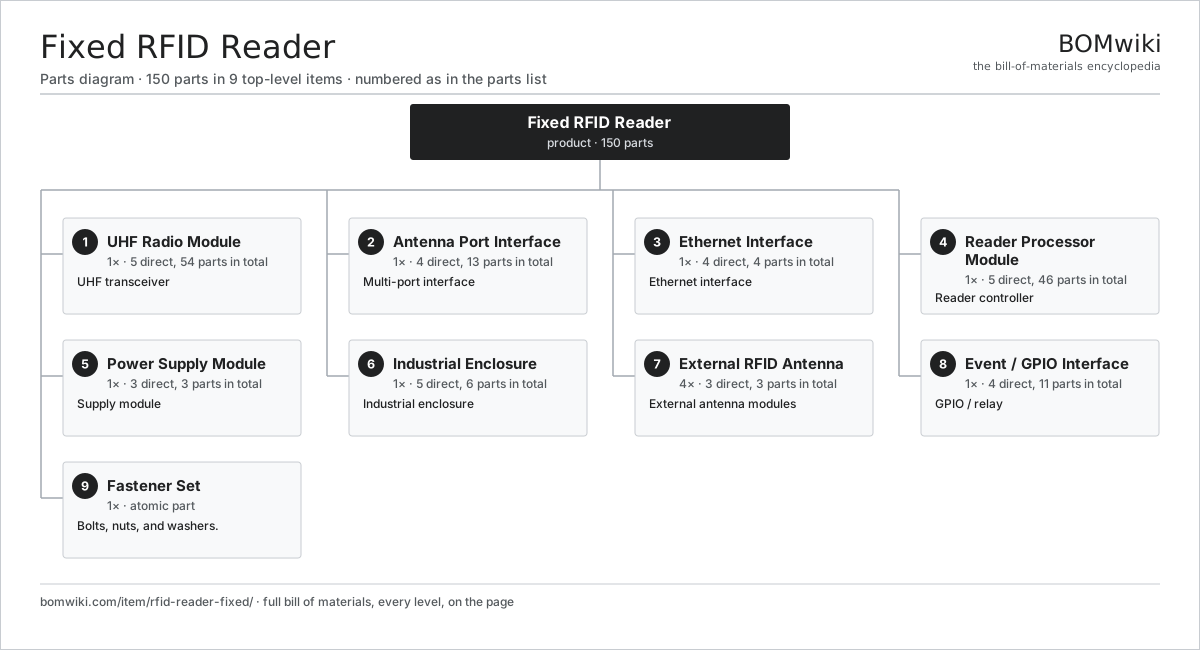
| # | Part | Qty | What it does |
|---|---|---|---|
| 1 | UHF Radio Module 5 parts | 1× | UHF transceiver |
| 2 | Antenna Port Interface 4 parts | 1× | Multi-port interface |
| 3 | Ethernet Interface 4 parts | 1× | Ethernet interface |
| 4 | Reader Processor Module 5 parts | 1× | Reader controller |
| 5 | Power Supply Module 3 parts | 1× | Supply module |
| 6 | Industrial Enclosure 5 parts | 1× | Industrial enclosure |
| 7 | External RFID Antenna 3 parts | 4× | External antenna modules |
| 8 | Event / GPIO Interface 4 parts | 1× | GPIO / relay |
| 9 | Fastener Set | 1× | Bolts, nuts, and washers. |
3D model
No 3D model yet. Have a CAD file of this? Add a 3D model. STL renders right on this page; STEP, FreeCAD, and OpenSCAD sources are welcome too (openly licensed, like all 3D models on BOMwiki).
Build & assembly graph
expand / collapse · shared sub-assemblies converge · links to related products · est. labourTap an assembly to expand/collapse · tap a part to open it · use “Open page” for any node · drag to pan, scroll to zoom.
Bill of materials for Fixed RFID Reader
9 top-level lines · 45 rows shown · 150 parts total · indented to 3 levels| # | Item / sub-assembly | Part no. | Qty/assy | Ext. qty | Parts | Type |
|---|---|---|---|---|---|---|
| 1 | UHF Radio Module 5 parts | rfid-reader-fixed-radio | 1× | 1 | 54 | assembly |
| 1.1 | RFID Transceiver IC | rfid-reader-fixed-radio-ic | 1× | 1 | · | part |
| 1.2 | Power Amplifier | rfid-reader-fixed-pa | 1× | 1 | · | part |
| 1.3 | Low-Noise Amplifier | rfid-reader-fixed-lna | 1× | 1 | · | part |
| 1.4 | Antenna Multiplexer | rfid-reader-fixed-antenna-switch | 1× | 1 | · | part |
| 1.5 | SMD Passive (R/C/L) | smd-passives | 50× | 50 | · | part |
| 2 | Antenna Port Interface 4 parts | rfid-reader-fixed-antenna-ports | 1× | 1 | 13 | assembly |
| 2.1 | Antenna Connector | rfid-reader-fixed-port-connector | 4× | 4 | · | part |
| 2.2 | Impedance Coupler | rfid-reader-fixed-port-impedance | 4× | 4 | · | part |
| 2.3 | Surge Protector | rfid-reader-fixed-port-protection | 4× | 4 | · | part |
| 2.4 | RF Port Cable | rfid-reader-fixed-port-cable | 1× | 1 | · | part |
| 3 | Ethernet Interface 4 parts | rfid-reader-fixed-network | 1× | 1 | 4 | assembly |
| 3.1 | Ethernet PHY | rfid-reader-fixed-eth-phy | 1× | 1 | · | part |
| 3.2 | PoE RJ-45 Jack | rfid-reader-fixed-eth-connector | 1× | 1 | · | part |
| 3.3 | Network Surge Protection | rfid-reader-fixed-eth-surge | 1× | 1 | · | part |
| 3.4 | Optional WiFi Module | rfid-reader-fixed-wifi-module | 1× | 1 | · | part |
| 4 | Reader Processor Module 5 parts | rfid-reader-fixed-processor | 1× | 1 | 46 | assembly |
| 4.1 | CPU PCB 3 parts | rfid-reader-fixed-processor-board | 1× | 1 | 3 | assembly |
| 4.1.1 | Bare PCB | pcb-bare | 1× | 1 | · | part |
| 4.1.2 | Compute SoC Module | soc-module | 1× | 1 | · | part |
| 4.1.3 | Reference Oscillator | rfid-reader-fixed-oscillator | 1× | 1 | · | part |
| 4.2 | Event Log Flash | rfid-reader-fixed-flash | 1× | 1 | · | part |
| 4.3 | Working Memory | rfid-reader-fixed-ram | 1× | 1 | · | part |
| 4.4 | Real-Time Clock | rfid-reader-fixed-rtc | 1× | 1 | · | part |
| 4.5 | SMD Passive (R/C/L) | smd-passives | 40× | 40 | · | part |
| 5 | Power Supply Module 3 parts | rfid-reader-fixed-power | 1× | 1 | 3 | assembly |
| 5.1 | Power Supply | power-supply | 1× | 1 | · | part |
| 5.2 | Power Protection | rfid-reader-fixed-power-protection | 1× | 1 | · | part |
| 5.3 | Rail Distribution | rfid-reader-fixed-power-distribution | 1× | 1 | · | part |
| 6 | Industrial Enclosure 5 parts | rfid-reader-fixed-housing | 1× | 1 | 6 | assembly |
| 6.1 | Enclosure Body | rfid-reader-fixed-housing-body | 1× | 1 | · | part |
| 6.2 | Hinged Door | rfid-reader-fixed-housing-door | 1× | 1 | · | part |
| 6.3 | Heatsink | rfid-reader-fixed-cooling-fin | 1× | 1 | · | part |
| 6.4 | Cable Gland | rfid-reader-fixed-cable-gland | 2× | 2 | · | part |
| 6.5 | Fastener Set | fastener-set | 1× | 1 | · | part |
| 7 | External RFID Antenna 3 parts | rfid-reader-fixed-antenna | 4× | 4 | 3 | assembly |
| 7.1 | Antenna Radiator | rfid-reader-fixed-antenna-element | 1× | 4 | · | part |
| 7.2 | Antenna Connector | rfid-reader-fixed-antenna-connector | 1× | 4 | · | part |
| 7.3 | Mounting Bracket | rfid-reader-fixed-antenna-mount | 1× | 4 | · | part |
| 8 | Event / GPIO Interface 4 parts | rfid-reader-fixed-event-output | 1× | 1 | 11 | assembly |
| 8.1 | Relay Output Channel | rfid-reader-fixed-relay-output | 2× | 2 | · | part |
| 8.2 | GPIO Output | rfid-reader-fixed-gpio-line | 4× | 4 | · | part |
| 8.3 | GPIO Input Sensing | rfid-reader-fixed-input-sensor | 4× | 4 | · | part |
| 8.4 | Connector | connector | 1× | 1 | · | part |
| 9 | Fastener Set | fastener-set | 1× | 1 | · | part |
Something wrong in this list? Report a problem with this BOM.
Related products
same domain, ranked by shared parts


Sourcing: possible vendors
Browse the supplier directory → Prices, MOQ, and lead times are algorithmic estimates, not quotes, and not claims about these companies. Company mappings are curated by keyword; est. price band $20–$3k. How estimates work| Vendor | HQ | Specialty | MOQ | Lead time |
|---|---|---|---|---|
| dell.com ↗ | Round Rock, US | Computers & infrastructure | 1,000 units | 8–14 wks |
|
🇺🇸HP
hp.com ↗
|
Palo Alto, US | Computers & printers | 1,000 units | 8–14 wks |
|
🇨🇳Lenovo
lenovo.com ↗
|
Beijing, CN | Computers | 1,000 units | 8–14 wks |
|
🇹🇼ASUS
asus.com ↗
|
Taipei, TW | Computers & components | 1,000 units | 8–14 wks |
|
🇨🇳Foxconn
foxconn.com ↗
|
Shenzhen, CN | Electronics contract mfg | 1,000 units | 8–14 wks |
1,352-word article