Right-Angle Drill
ProductOverview
A right-angle drill is a specialized compact drill with a 90-degree angled gearbox that redirects the motor axis so the chuck emerges perpendicular to the body. This geometry allows boring in confined spaces, between joists, inside cupboards, under sinks, behind instrumentation, where a conventional drill cannot physically fit. The tool is essential in electrical installation, plumbing, HVAC service, and cabinetmaking.
The cordless electric variant offers superior mobility compared to corded models and the reliability of brushless motors. Compact size and variable-speed control make it ideal for both rough-in drilling and precision work in tight quarters.
How it Works
The Brushless Motor Assembly brushless motor runs at 1200 RPM, powered by the Lithium-Ion Battery Pack 18V lithium-ion pack. The motor output shaft couples to the Angled Reduction Gearbox, a precision bevel gear reducer.
Bevel gears are conical-shaped and interlocking; as the motor shaft rotates, the male bevel (pinion) gear engages the female bevel (crown) gear. The gears are cut at a 90-degree angle, so rotation of the input shaft is converted to perpendicular rotation of the output. Additionally, the gear ratio (typically 2:1 to 4:1) reduces motor RPM and multiplies torque.
The output is the Output Spindle Shaft, rotating perpendicular to the motor, at approximately 400–600 RPM depending on gear ratio and battery voltage. The 3/8" Keyed Chuck on the output shaft grips the drill bit.
The Variable-Speed Control Electronics board modulates motor speed via PWM. Half-trigger delivers 50% RPM and proportionally lower torque; full-trigger delivers maximum speed and torque. This proportional control allows the operator to dial speed for different materials and bit sizes: slow speed (200 RPM) for precision work and hard materials, high speed (600 RPM) for rapid drilling in soft materials.
Chuck Design and Bit Retention
The 3/8" Keyed Chuck is a 3/8" keyed chuck with three jaws. Round bits (up to approximately 8 mm diameter) and hex shank bits (1/4" and 3/8" hex) engage and are tightened with the chuck key. The jaws develop significant gripping force; the chuck rarely slips under normal drilling loads.
Some models incorporate impact-rated chucks designed to withstand occasional impact-driver loads; standard drills use precision chucks optimized for smooth torque delivery.
Compact Geometry and Accessibility
The right-angle profile enables access in spaces unreachable by conventional drills. Typical applications include:
- Drilling joist blocking between floor framing, accessed from above or below
- Drilling studs for plumbing rough-in inside confined wall cavities
- Boring electrical outlet boxes inside cabinet sides or panel raceways
- Access behind appliances or machinery where the drill body must fit in a 75–100 mm width
The compact 180 × 75 × 180 mm profile fits where conventional 200+ mm length drills cannot. The low weight (1.2 kg) allows sustained one-handed operation for extended periods.
Gearbox Wear and Maintenance
Bevel gears running continuously at high torque develop wear over years of use. Backlash (play between gears) gradually increases; spin test: the bit will show 2–5 mm of free rotation before load is applied. This wear is normal and does not impair function until it exceeds 10 mm.
The Angled Reduction Gearbox runs in sealed oil and requires no user service. Replacement gearbox assemblies are available and exchange in 15–20 minutes.
Torque Reaction and Control
At full torque (35 Nm or higher with extended bits), reactive torque tries to twist the drill body against the operator's grip. The Secondary Paddle Handle, a removable auxiliary grip that threads into the gearbox body, provides leverage to resist reaction. Using the paddle handle is mandatory when driving large bits or fasteners; omitting it risks wrist injury.
Speed Control and Material Selection
The Variable-Speed Control Electronics proportional trigger allows speed modulation:
- Concrete and masonry require carbide bits at slow speed (200 RPM) for control and to prevent overheating.
- Wood and plastic accept faster speed (400–600 RPM) with standard bits.
- Hardwoods and metals benefit from intermediate speed (250–350 RPM) for balance of speed and control.
Experienced operators adjust speed mid-drilling, slowing if vibration or bit binding is felt.
Battery Runtime and Charging
A 1.5 Ah battery provides approximately 30–60 holes (13 mm diameter in wood) before depletion. Continuous drilling in dense material (concrete) depletes the battery faster due to higher torque load.
Charging time is 30–60 minutes depending on charger type. Most job sites use two batteries, rotating between use and charge.
Thermal Management
Sustained high-torque drilling generates heat in the motor and gearbox, dissipated passively through the Main Housing Body aluminum casting. The tool reaches thermal equilibrium within 15–30 minutes of continuous operation. A thermal overload breaker cuts power if the motor overheats, allowing it to cool before resuming.
Applications in Installation and Service
Electrical Work: Boring for circuit breaker cable, outdoor outlet service lines, and panel-to-subpanel rough-in in tight spaces.
Plumbing: Drilling supply and drain openings in floor joists, wall studs, and behind cabinetry.
HVAC: Access and duct penetration holes in structural bays where conventional drills do not fit.
Cabinetry and Furniture: Boring hinge mounting and shelf pin holes inside cabinet sides and vertical partitions.
Low-voltage Installation: Network cabling, security system wiring, and audio visual cabling rough-in inside walls and between framing.
Comparison to Standard Drills
A standard cordless drill (with body length 200+ mm) is more versatile for general drilling but cannot access tight spaces. Many professionals carry both: a standard drill for general work and a right-angle for confined-space tasks.
Bit Runout and Precision
The bevel gear interface introduces slight runout (bit wobble) compared to precision industrial spindles. Precision work (hole alignment critical to ±1 mm) may suffer; general construction drilling tolerates the runout. For repeated precision work, a bench-mounted electromagnetic drill press is preferred.
Cordless Advantages
Cordless operation eliminates the cord tether and enables access in spaces where cords cannot safely route (e.g., joist cavities under active floors). Battery compatibility with other cordless tools reduces total inventory on mixed-trade job sites.
Brushless motors provide longer lifespan and lower maintenance than universal motors in corded variants, improving tool reliability on extended job sites.
Right-Angle Drill parts and their functions
8 top-level parts · 51 parts in total · full bill of materials below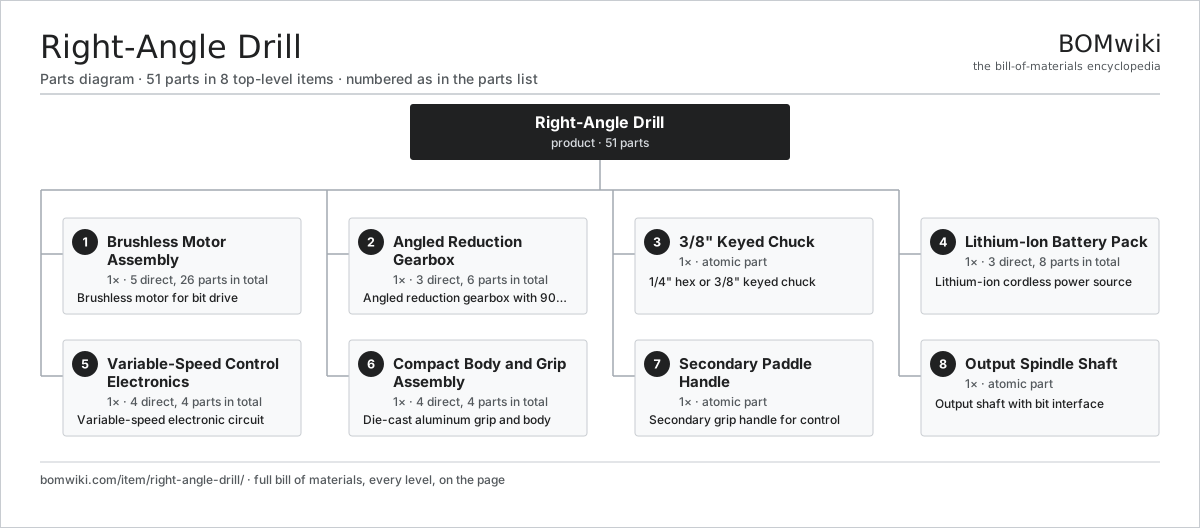
| # | Part | Qty | What it does |
|---|---|---|---|
| 1 | Brushless Motor Assembly 5 parts | 1× | Brushless motor for bit drive |
| 2 | Angled Reduction Gearbox 3 parts | 1× | Angled reduction gearbox with 90-degree output |
| 3 | 3/8" Keyed Chuck | 1× | 1/4" hex or 3/8" keyed chuck |
| 4 | Lithium-Ion Battery Pack 3 parts | 1× | Lithium-ion cordless power source |
| 5 | Variable-Speed Control Electronics 4 parts | 1× | Variable-speed electronic circuit |
| 6 | Compact Body and Grip Assembly 4 parts | 1× | Die-cast aluminum grip and body |
| 7 | Secondary Paddle Handle | 1× | Secondary grip handle for control |
| 8 | Output Spindle Shaft | 1× | Output shaft with bit interface |
3D model
No 3D model yet. Have a CAD file of this? Add a 3D model. STL renders right on this page; STEP, FreeCAD, and OpenSCAD sources are welcome too (openly licensed, like all 3D models on BOMwiki).
Build & assembly graph
expand / collapse · shared sub-assemblies converge · links to related products · est. labourTap an assembly to expand/collapse · tap a part to open it · use “Open page” for any node · drag to pan, scroll to zoom.
Bill of materials for Right-Angle Drill
8 top-level lines · 31 rows shown · 51 parts total · indented to 3 levels| # | Item / sub-assembly | Part no. | Qty/assy | Ext. qty | Parts | Type |
|---|---|---|---|---|---|---|
| 1 | Brushless Motor Assembly 5 parts | right-angle-drill-motor | 1× | 1 | 26 | assembly |
| 1.1 | Motor Housing | motor-housing | 1× | 1 | · | part |
| 1.2 | Rotor Assembly 4 parts | rotor-assembly | 1× | 1 | 19 | assembly |
| 1.2.1 | Rotor Shaft | rotor-shaft | 1× | 1 | · | part |
| 1.2.2 | Rotor Core | rotor-core | 1× | 1 | · | part |
| 1.2.3 | Neodymium Magnet | neodymium-magnet | 16× | 16 | · | part |
| 1.2.4 | Ball Bearing | ball-bearing | 1× | 1 | · | part |
| 1.3 | Copper Winding | copper-winding | 2× | 2 | · | part |
| 1.4 | Hall Sensor | hall-sensor | 2× | 2 | · | part |
| 1.5 | Ball Bearing | ball-bearing | 2× | 2 | · | part |
| 2 | Angled Reduction Gearbox 3 parts | right-angle-drill-gearbox | 1× | 1 | 6 | assembly |
| 2.1 | Helical Gear Pair | gear-pair | 2× | 2 | · | part |
| 2.2 | Gearbox Housing | gearbox-housing | 1× | 1 | · | part |
| 2.3 | Ball Bearing | ball-bearing | 3× | 3 | · | part |
| 3 | 3/8" Keyed Chuck | right-angle-drill-chuck | 1× | 1 | · | part |
| 4 | Lithium-Ion Battery Pack 3 parts | right-angle-drill-battery | 1× | 1 | 8 | assembly |
| 4.1 | Li-ion Cell, 18650 | li-cell-18650 | 6× | 6 | · | part |
| 4.2 | BMS Board | bms-board | 1× | 1 | · | part |
| 4.3 | Battery Connector | right-angle-drill-battery-connector | 1× | 1 | · | part |
| 5 | Variable-Speed Control Electronics 4 parts | right-angle-drill-speed-control | 1× | 1 | 4 | assembly |
| 5.1 | Bare PCB | pcb-bare | 1× | 1 | · | part |
| 5.2 | Power MOSFET | mosfet | 1× | 1 | · | part |
| 5.3 | SMD Passive (R/C/L) | smd-passives | 1× | 1 | · | part |
| 5.4 | Microcontroller | mcu | 1× | 1 | · | part |
| 6 | Compact Body and Grip Assembly 4 parts | right-angle-drill-housing | 1× | 1 | 4 | assembly |
| 6.1 | Main Housing Body | right-angle-drill-main-body | 1× | 1 | · | part |
| 6.2 | Rubberized Grip Sleeve | right-angle-drill-grip-rubber | 1× | 1 | · | part |
| 6.3 | Proportional Trigger Switch | right-angle-drill-trigger-switch | 1× | 1 | · | part |
| 6.4 | Fastener Set | fastener-set | 1× | 1 | · | part |
| 7 | Secondary Paddle Handle | right-angle-drill-paddle-handle | 1× | 1 | · | part |
| 8 | Output Spindle Shaft | right-angle-drill-spindle-shaft | 1× | 1 | · | part |
Something wrong in this list? Report a problem with this BOM.
Related products
same domain, ranked by shared parts Electric Nibbler
60 parts · shares 7 with this page
Electric Nibbler
60 parts · shares 7 with this page
 Reciprocating Saw
85 parts · shares 7 with this page
Reciprocating Saw
85 parts · shares 7 with this page
 Airless Paint Sprayer
97 parts · shares 5 with this page
Airless Paint Sprayer
97 parts · shares 5 with this page
 Impact Wrench
87 parts · shares 6 with this page
Impact Wrench
87 parts · shares 6 with this page
Sourcing: possible vendors
Browse the supplier directory → Prices, MOQ, and lead times are algorithmic estimates, not quotes, and not claims about these companies. Company mappings are curated by keyword; est. price band $30–$800. How estimates work| Vendor | HQ | Specialty | MOQ | Lead time |
|---|---|---|---|---|
| stanleyblackanddecker.com ↗ | New Britain, US | Tools (DeWalt, Craftsman) | 500 units | 6–12 wks |
| bosch-professional.com ↗ | Leinfelden, DE | Power tools | 500 units | 6–12 wks |
| ttigroup.com ↗ | Hong Kong, CN | Tools (Milwaukee, Ryobi) | 500 units | 6–12 wks |
|
🇯🇵Makita
makita.com ↗
|
Anjo, JP | Power tools | 500 units | 6–12 wks |
|
🇨🇭Hilti
hilti.com ↗
|
Schaan, CH | Construction tools | 500 units | 6–12 wks |
1,047-word article