Ring Rolling Machine
ProductAlso known as: Ring Rolling Mill
Overview
Ring rolling is a cold or warm metalworking process that expands seamless tubes or forged blanks into larger-diameter rings by radially compressing them between rotating rolls. The Main Rolling Roll rotates horizontally at 10–100 rpm; the ring is loaded onto a tapered Central Mandrel Arbor at the machine center and positioned against the main roll. As the roll rotates, friction and normal force compress the ring, reducing its wall thickness and expanding its outer diameter in a continuous spiral. This is how large bearing rings, pressure-vessel rings, and aircraft fuselage rings are produced, starting with a small, thick-walled tube and expanding it to final size in a single automated cycle.
The advantage of ring rolling over forging or welding is material efficiency and surface quality: no flash is generated (unlike open-die forging), no seams or fusion defects occur (unlike welded construction), and the final ring is mechanically isotropic. A 1.5 m OD bearing ring can be completed in 2–10 minutes, depending on size and material.
Machine configuration and rolls
The ring-rolling machine has three primary roll elements: the Main Rolling Roll (horizontal, rotating), and upper and lower Axial Control Rolls (vertical, controlling width). The Central Mandrel Arbor is a stationary tapered arbor on which the ring is seated. The main roll diameter ranges from 0.5 m to 3 m depending on machine size; larger rolls provide more contact area and smoother surface finish.
The ring sits at an angle, typically 45 degrees or tangent, between the main roll (rotating at the circumference) and the stationary mandrel (at the center). As the ring rotates around the mandrel (following the main roll), both the main roll and the Central Mandrel Arbor compress it radially, reducing wall thickness and expanding OD.
The Axial Control Rolls are smaller (100–300 mm diameter) vertical cylinders pressing down from above and up from below, controlling the ring width (axial direction) to prevent the ring from bulging or spreading axially during rolling.
Rolling dynamics and strain
As the Main Rolling Roll rotates, the ring follows due to friction. At each point of contact, the roll exerts a normal force (radial compression) and a tangential force (friction). The normal force plastically deforms the ring, reducing its cross-sectional area (thickness × width); by conservation of volume, if thickness decreases and width is held constant by the Axial Control Rolls, the outer diameter must increase.
The radial strain (change in wall thickness) per revolution is small, typically 1–5 %, so the ring requires multiple revolutions (10–50, depending on inlet thickness and desired final dimension) to reach the target size. Modern machines use closed-loop feedback from the Ring Dimension Feedback: the OD Sensor continuously measures OD, and the PLC adjusts the Main Rolling Roll load via the hydraulic Load Cylinder to achieve the setpoint OD with accuracy ±1–2 mm.
Material flow and microstructure
Ring rolling is a controlled deformation process, not a violent shock (like drop forging). Material flows smoothly from the inner diameter (smaller) to the outer diameter (larger), following the roll surface curvature. The strain path is complex (combined radial compression and circumferential shear), resulting in a well-oriented microstructure.
For steel, ring rolling refines the grain structure compared to a cast or forged blank. A 150 mm OD × 100 mm thick forged disk, when rolled to 500 mm OD × 30 mm thick, experiences 3× area reduction and becomes finer-grained, with improved fatigue strength.
For materials sensitive to deformation heating (titanium, some superalloys), induction heating to 700–900 °C precedes the rolling to lower flow stress and reduce roll loading. The ring exits still hot and is allowed to air-cool or quenched, depending on final heat-treat specification.
Ring loading and dimensional control
Loading a ring onto the machine is manual: the operator positions the Central Mandrel Arbor taper, slides the ring onto it, and adjusts the Ring Guide System to center the ring. The Position Sensor (a linear encoder or LVDT) verifies centering. Once centered, the operator initiates the rolling cycle via the HMI Screen.
The rolling cycle is automated:
Feed: The Guide Servo Motor advances the ring radially toward the Main Rolling Roll until light contact is made.
Rolling: The Main Drive Motor rotates the main roll at a setpoint speed (30–60 rpm typical for large rings). The ring rotates around the mandrel following the roll surface. The Load Cylinder is fed pressure to apply radial load, compressing the ring slightly with each revolution.
Measurement: Every 5–10 revolutions, the OD Sensor measures the current OD. The PLC compares it to the target and adjusts Load Cylinder pressure or Main Rolling Roll speed to maintain the target expansion rate.
Finish: When the OD Sensor reaches the setpoint (±1 mm tolerance), the rolling pressure is released, the main roll stops, and the ring is unloaded manually.
Hydraulic system and load control
The Hydraulic Power System is the workhorse. A Hydraulic Pump supplies 20–50 L/min at 150–250 bar. Two Load Cylinder units are driven: one applies radial load to the main roll (via the roll support Roll Bearing Block), and another applies vertical load to the Axial Control Rolls.
Load feedback is provided by Pressure Sensor readings on the cylinders. The PLC reads these and adjusts solenoid valve signals to the Directional Valve units, modulating cylinder pressure. This closed-loop pressure control maintains consistent rolling forces despite variations in ring material hardness and size.
A Load Cylinder failure (leak, piston crack) stops production immediately. Typically, machines have an automatic stop on low hydraulic pressure to prevent ring jam.
Temperature control and material heating
Most ring rolling is done cold (20–40 °C). However, some materials require heating to reduce flow stress:
- Titanium: Hot-rolled at 700–900 °C to prevent cracking and reduce load. Induction heating prior to rolling is standard.
- Stainless steel: Often warm-rolled (200–300 °C) to reduce flow stress and improve surface finish.
- Superalloys (Inconel, Hastelloy): Hot-rolled at 900–1,100 °C. Requires high-temperature Central Mandrel Arbor and roll sleeves (ceramic or cobalt-base inserts).
The heating is done in a separate induction furnace upstream; the operator transfers the hot ring to the machine and immediately begins rolling. Timing is critical: too cool and the ring jams; too hot and the ring distorts from its own weight.
Dimensional accuracy and tolerances
Ring rolling achieves ±2–5 mm OD tolerance on large rings (> 500 mm). The Ring Dimension Feedback allows real-time correction, so final OD is typically ±1–2 mm. Wall thickness tolerance depends on inlet blank uniformity but is usually ±3–5 % of final thickness.
Wall thickness variation around the circumference (ovality) is controlled by the Axial Control Rolls and Ring Guide System geometry. A well-maintained machine keeps ovality < 2 %.
Tooling and wear
The Main Rolling Roll is the primary wear surface. After 10,000–50,000 tonnes of rolling (depending on material and roll diameter), the barrel surface flattens and its roundness tolerance exceeds specification. At that point, the roll is re-ground or replaced, a major maintenance event costing 20,000–100,000 USD depending on roll size.
The Mandrel Taper Surface surface also wears; when wear exceeds 0.5 mm, it is re-machined or the mandrel is replaced. Mandrel replacement is faster than roll replacement, a few hours vs. days, but skill is required to set the taper angle and concentricity correctly.
Applications and production rates
Ring rolling is used for:
Ball and roller bearing rings: 50–500 mm bore diameters in steel, expanded from thick-walled tubes.
Pressure vessels: Large rings for vessels, autocaves, and reactor domes.
Wind turbine components: Large rings for main bearings (> 3 m OD).
Aircraft fuselage frames: Titanium rings for military transport and fighter fuselage circumferential frames.
Industrial gears: Large hub rings for large gears in mills and power plants.
Production time per ring varies: a 1.5 m OD bearing ring in mild steel takes 5–10 minutes; a 3 m OD pressure vessel ring takes 30–60 minutes. Machines often operate in shifts, with an operator managing 1–2 machines, producing 10–30 rings per 8-hour shift.
Ring Rolling Machine parts and their functions
9 top-level parts · 102 parts in total · full bill of materials below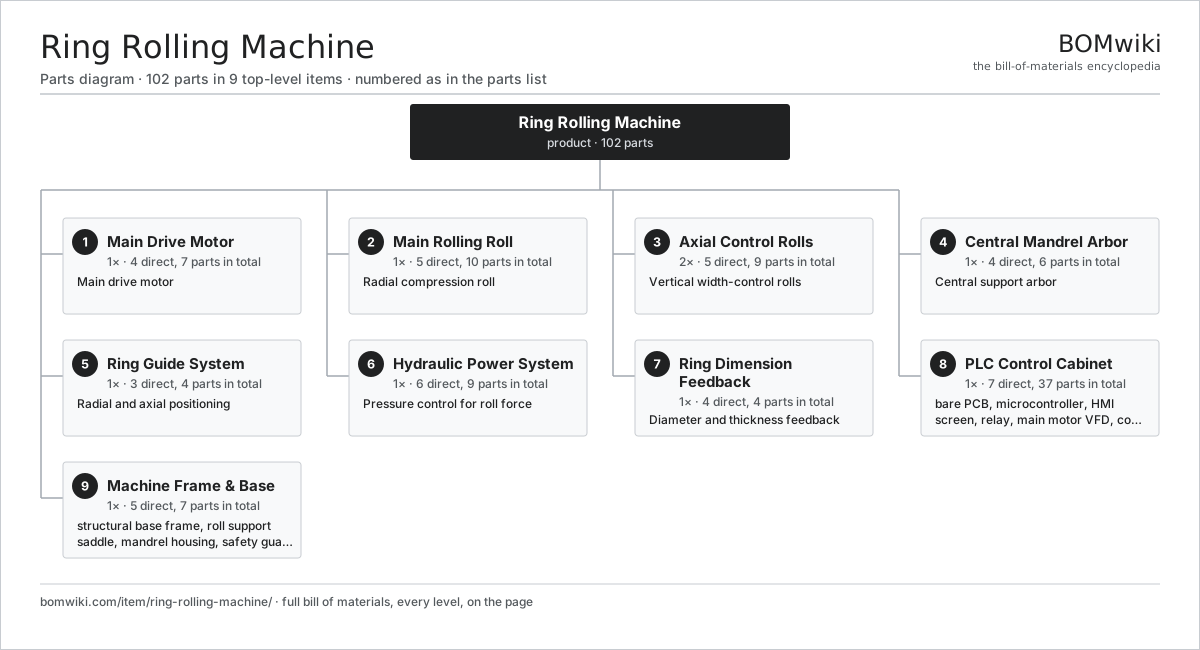
| # | Part | Qty | What it does |
|---|---|---|---|
| 1 | Main Drive Motor 4 parts | 1× | Main drive motor |
| 2 | Main Rolling Roll 5 parts | 1× | Radial compression roll |
| 3 | Axial Control Rolls 5 parts | 2× | Vertical width-control rolls |
| 4 | Central Mandrel Arbor 4 parts | 1× | Central support arbor |
| 5 | Ring Guide System 3 parts | 1× | Radial and axial positioning |
| 6 | Hydraulic Power System 6 parts | 1× | Pressure control for roll force |
| 7 | Ring Dimension Feedback 4 parts | 1× | Diameter and thickness feedback |
| 8 | PLC Control Cabinet 7 parts | 1× | Programmable controller managing roll speed, load, and dimension feedback for closed-loop control. |
| 9 | Machine Frame & Base 5 parts | 1× | Heavy welded steel structural frame supporting all rolling components. |
3D model
No 3D model yet. Have a CAD file of this? Add a 3D model. STL renders right on this page; STEP, FreeCAD, and OpenSCAD sources are welcome too (openly licensed, like all 3D models on BOMwiki).
Build & assembly graph
expand / collapse · shared sub-assemblies converge · links to related products · est. labourTap an assembly to expand/collapse · tap a part to open it · use “Open page” for any node · drag to pan, scroll to zoom.
Bill of materials for Ring Rolling Machine
9 top-level lines · 52 rows shown · 102 parts total · indented to 3 levels| # | Item / sub-assembly | Part no. | Qty/assy | Ext. qty | Parts | Type |
|---|---|---|---|---|---|---|
| 1 | Main Drive Motor 4 parts | ring-rolling-machine-motor | 1× | 1 | 7 | assembly |
| 1.1 | Induction Motor | ring-rolling-machine-motor-induction | 1× | 1 | · | part |
| 1.2 | Speed Reduction Gearbox | ring-rolling-machine-drive-gearbox | 1× | 1 | · | part |
| 1.3 | Flexible Coupling | ring-rolling-machine-motor-coupling | 1× | 1 | · | part |
| 1.4 | Ball Bearing | ball-bearing | 4× | 4 | · | part |
| 2 | Main Rolling Roll 5 parts | ring-rolling-machine-main-roll | 1× | 1 | 10 | assembly |
| 2.1 | Roll Barrel | ring-rolling-machine-roll-barrel | 1× | 1 | · | part |
| 2.2 | Roll Journal | ring-rolling-machine-roll-journals | 2× | 2 | · | part |
| 2.3 | Roll Bearing Block | ring-rolling-machine-roll-bearing-block | 2× | 2 | · | part |
| 2.4 | Ball Bearing | ball-bearing | 4× | 4 | · | part |
| 2.5 | Roll Surface | ring-rolling-machine-roll-surface-hardness | 1× | 1 | · | part |
| 3 | Axial Control Rolls 5 parts | ring-rolling-machine-axial-rolls | 2× | 2 | 9 | assembly |
| 3.1 | Upper Axial Roll | ring-rolling-machine-axial-roll-upper | 1× | 2 | · | part |
| 3.2 | Lower Axial Roll | ring-rolling-machine-axial-roll-lower | 1× | 2 | · | part |
| 3.3 | Axial Roll Bearing Block | ring-rolling-machine-axial-bearing-block | 2× | 4 | · | part |
| 3.4 | Ball Bearing | ball-bearing | 4× | 8 | · | part |
| 3.5 | Axial Roll Load Cylinder | ring-rolling-machine-axial-pressure-cylinder | 1× | 2 | · | part |
| 4 | Central Mandrel Arbor 4 parts | ring-rolling-machine-mandrel | 1× | 1 | 6 | assembly |
| 4.1 | Mandrel Shaft | ring-rolling-machine-mandrel-shaft | 1× | 1 | · | part |
| 4.2 | Mandrel Taper Surface | ring-rolling-machine-mandrel-taper | 1× | 1 | · | part |
| 4.3 | Mandrel Support Bearing | ring-rolling-machine-mandrel-bearing | 2× | 2 | · | part |
| 4.4 | Ball Bearing | ball-bearing | 2× | 2 | · | part |
| 5 | Ring Guide System 3 parts | ring-rolling-machine-guide-system | 1× | 1 | 4 | assembly |
| 5.1 | Guide Shoe | ring-rolling-machine-guide-shoes | 2× | 2 | · | part |
| 5.2 | Guide Servo Motor | ring-rolling-machine-guide-servo | 1× | 1 | · | part |
| 5.3 | Position Sensor | ring-rolling-machine-position-sensor | 1× | 1 | · | part |
| 6 | Hydraulic Power System 6 parts | ring-rolling-machine-hydraulic-system | 1× | 1 | 9 | assembly |
| 6.1 | Hydraulic Pump | ring-rolling-machine-hydraulic-pump | 1× | 1 | · | part |
| 6.2 | Pump Drive Motor | ring-rolling-machine-hydraulic-motor | 1× | 1 | · | part |
| 6.3 | Directional Valve | ring-rolling-machine-directional-valve | 2× | 2 | · | part |
| 6.4 | Load Cylinder | ring-rolling-machine-hydraulic-cylinder | 2× | 2 | · | part |
| 6.5 | Pressure Sensor | pressure-sensor | 2× | 2 | · | part |
| 6.6 | Hydraulic Reservoir | ring-rolling-machine-reservoir | 1× | 1 | · | part |
| 7 | Ring Dimension Feedback 4 parts | ring-rolling-machine-measuring-system | 1× | 1 | 4 | assembly |
| 7.1 | OD Sensor | ring-rolling-machine-od-sensor | 1× | 1 | · | part |
| 7.2 | ID Sensor | ring-rolling-machine-id-sensor | 1× | 1 | · | part |
| 7.3 | Thickness Gauge | ring-rolling-machine-thickness-gauge | 1× | 1 | · | part |
| 7.4 | Sensor Interface Module | ring-rolling-machine-sensor-interface | 1× | 1 | · | part |
| 8 | PLC Control Cabinet 7 parts | ring-rolling-machine-control-cabinet | 1× | 1 | 37 | assembly |
| 8.1 | Bare PCB | pcb-bare | 2× | 2 | · | part |
| 8.2 | Microcontroller | mcu | 1× | 1 | · | part |
| 8.3 | HMI Screen | ring-rolling-machine-hmi-screen | 1× | 1 | · | part |
| 8.4 | Relay | relay | 10× | 10 | · | part |
| 8.5 | Main Motor VFD | ring-rolling-machine-vfd-drive | 1× | 1 | · | part |
| 8.6 | Connector | connector | 20× | 20 | · | part |
| 8.7 | Power Supply | power-supply | 2× | 2 | · | part |
| 9 | Machine Frame & Base 5 parts | ring-rolling-machine-frame | 1× | 1 | 7 | assembly |
| 9.1 | Structural Base Frame | ring-rolling-machine-base-frame | 1× | 1 | · | part |
| 9.2 | Roll Support Saddle | ring-rolling-machine-roll-support-saddle | 1× | 1 | · | part |
| 9.3 | Mandrel Housing | ring-rolling-machine-mandrel-housing | 1× | 1 | · | part |
| 9.4 | Safety Guard Enclosure | ring-rolling-machine-guard-enclosure | 1× | 1 | · | part |
| 9.5 | Fastener Set | fastener-set | 3× | 3 | · | part |
Something wrong in this list? Report a problem with this BOM.
Sourcing: possible vendors
Browse the supplier directory → Prices, MOQ, and lead times are algorithmic estimates, not quotes, and not claims about these companies. Company mappings are curated by keyword; est. price band $10k–$1M. How estimates work| Vendor | HQ | Specialty | MOQ | Lead time |
|---|---|---|---|---|
|
🇩🇪DMG MORI
dmgmori.com ↗
|
Bielefeld, DE | Machine tools | 5 units | 12–20 wks |
|
🇯🇵Mazak
mazak.com ↗
|
Oguchi, JP | Machine tools | 5 units | 12–20 wks |
| haascnc.com ↗ | Oxnard, US | CNC machine tools | 5 units | 12–20 wks |
|
🇯🇵Okuma
okuma.com ↗
|
Niwa, JP | Machine tools | 5 units | 12–20 wks |
|
🇩🇪Trumpf
trumpf.com ↗
|
Ditzingen, DE | Laser & sheet-metal machines | 5 units | 12–20 wks |
1,459-word article