Wearable Ring Scanner
ProductOverview
A wearable ring scanner is a compact, hands-free barcode reader worn on the index finger like a ring. The scanner is positioned naturally so that the wearer's pointing gesture toward a barcode simultaneously aims the scan beam. A pressure-sensitive trigger worn beneath the index finger initiates the scan. This design is optimized for warehouse picking, retail inventory, and healthcare applications where workers need both hands free to handle items while scanning barcodes continuously.
The ergonomic advantage over handheld scanners is substantial: workers pick items, scan them, and place them without setting the scanner down between scans. Over an 8-hour shift, this eliminates thousands of hand movements and arm extensions to a handheld device, reducing fatigue and repetitive stress injuries. Bluetooth connectivity allows workers to move throughout a facility without tethered cables, and the device pairs with a mobile terminal (tablet or industrial handheld computer) that displays inventory confirmations and provides audio/vibration feedback.
Hardware Architecture
The barcode scanning engine consists of a red laser diode (650 nm) and a CMOS linear or 2D array sensor. The laser projects a line or grid of light onto the barcode surface, and the sensor captures the reflection pattern. A molded plastic lens focuses the reflected light onto the sensor array.
The main MCU reads the sensor data continuously, executing barcode decode algorithms. Modern decoders are software-only on the MCU, no dedicated hardware decoder is needed for 1D codes. For 2D codes (QR, Data Matrix), some designs include an optional hardware decoder ASIC accelerating the 2D image-to-bits conversion.
The Bluetooth LE SoC (typically nRF52810) handles wireless transmission of decoded barcode data to the host terminal. The lithium polymer cell (150–200 mAh) provides 8–12 hours of runtime, sufficient for a full warehouse shift. Power is managed by a dedicated IC sequencing the laser, sensor, and wireless subsystems.
Ergonomic Design and Mounting
The finger ring assembly is adjustable webbing (velcro-fastened) sized to fit fingers 8–12 (US ring sizing). The PCB carrier mounting the laser, lens, and trigger sits above the finger at the knuckle, positioning the optical axis perpendicular to the finger's pointing direction. A worker aims the scanner at a barcode by pointing naturally; the beam hits the barcode without conscious aiming adjustment.
The trigger mechanism is a small tactile switch positioned on the index finger directly below the main electronics. Pressing with the index fingertip against the palm activates the scan. The 2 N actuation force is minimal, reducing finger fatigue over thousands of scans per day.
Barcode Capture and Decoding
When the trigger is pressed, the Microcontroller activates the Red Laser Diode and Aiming LED simultaneously. The laser projects a line of light across the barcode; the Image Sensor captures the reflected intensity pattern. The sensor array typically has 320 or 640 pixels; pixels where the barcode has bars (low reflectance) report low intensity, and pixels in spaces (high reflectance) report high intensity.
The MCU reads the pixel data, applies threshold and normalization, and runs a barcode decoder algorithm. For Code128 and other linear codes, the algorithm searches for the start pattern, decodes each bar-space pair, verifies the checksum, and reports the string. Typical decode latency is 100–300 milliseconds, acceptable for warehouse workflows.
The Wireless Module forwards the decoded barcode string to the host terminal via Bluetooth. The terminal's application software verifies the barcode against an inventory database, logs the transaction, and provides audio (beep for success, three beeps for error) or haptic feedback (vibration) to the worker.
Wireless Communication
Bluetooth LE allows the ring scanner to pair with multiple host devices simultaneously, enabling rapid task reassignment. A warehouse worker can start a picking task on one tablet, disconnect and walk to a different zone, and rescan with a second tablet without re-pairing. The scanner's firmware maintains connections across 50 meters (open space) with typical warehouse obstructions (metal racks, concrete walls) reducing range to 15–30 meters.
Bluetooth 5.0 (vs. earlier BLE 4.2) offers improved range and higher data throughput, critical for high-scan-rate applications. The 2.4 GHz antenna is miniaturized, often a PCB trace or small chip antenna, to fit within the finger ring form factor.
Battery Management and Charging
The 150–200 mAh lithium polymer cell provides 8–12 hours at typical usage (100–200 scans per hour, 20 mA average current draw). The inductive charging cradle allows workers to deposit the scanner overnight without physical connector mating. Inductive charging eliminates wear on charging contacts, critical for high-volume scanning environments where the device might be docked hundreds of times per year.
The battery management system protects against overcharge and over-discharge, extending cell life to 2–3 years (500–1000 charge cycles typical for industrial LiPo).
Barcode Types Supported
Most ring scanners decode linear barcodes natively (EAN-13, Code128, UPC-A) in firmware. These codes are 1D, the information is encoded only in bar width and spacing, not in position. Scanning speed for linear codes is fast (millisecond decode time).
2D barcodes (QR, DataMatrix, Aztec) require more complex decoding, finding the target position finder patterns, reading rotation and error correction level, and decoding the data region. Modern ARM Cortex-M4 MCUs can handle 2D decoding in software, though some high-speed designs include a dedicated hardware decoder ASIC (like a Zebra or Symbol barcode engine chip) accelerating the process.
Industrial Variants and Ruggedness
Rugged industrial models include:
- Drop rating: Survives 1.5 meter drops onto concrete, essential for busy warehouse floors.
- IP rating: IP65 (dust and water resistance) to withstand spills and high-pressure washdown in food processing.
- Temperature range: Extended operating range (−10 to +50 °C) for cold storage applications.
- Vibration alert: Haptic feedback motor provides confirmation without audio beep (useful in loud environments).
Integration with Warehouse Management Systems
Ring scanners pair with mobile terminals (typically Android or Windows rugged tablets) running warehouse management software (WMS). The barcode string captured by the ring scanner is transmitted via Bluetooth to the tablet, which queries the backend inventory database. The WMS confirms correctness (item matched to picking task), logs the scan, and displays the next item location.
Multi-item picking workflows benefit from ring scanner speed: a worker carrying a bag and clipboard uses the scanner to rapidly confirm items without returning to a stationary terminal between picks. Some facilities achieve 20–30% faster picking velocity with ring scanners compared to handheld barcode guns.
Limitations and Alternatives
Ring scanners are optimized for high-speed, high-volume scanning. They are less suitable for applications requiring detailed image capture (vehicle license plates, document barcodes with poor contrast) or high-precision distance measurements. For those use cases, dedicated industrial barcode scanners or imaging devices are preferred.
The finger-mounted position is ergonomic for pointing-based scanning but can be uncomfortable for workers with arthritis or fine motor limitations. Handheld scanners remain the standard for jobs requiring dexterity with held items.
Wearable Ring Scanner parts and their functions
7 top-level parts · 26 parts in total · full bill of materials below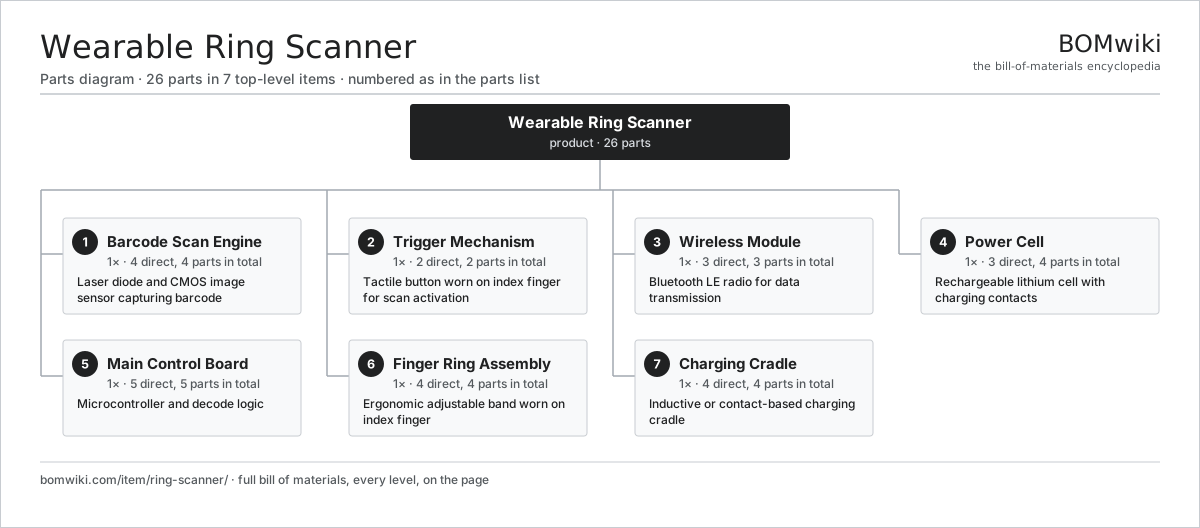
| # | Part | Qty | What it does |
|---|---|---|---|
| 1 | Barcode Scan Engine 4 parts | 1× | Laser diode and CMOS image sensor capturing barcode |
| 2 | Trigger Mechanism 2 parts | 1× | Tactile button worn on index finger for scan activation |
| 3 | Wireless Module 3 parts | 1× | Bluetooth LE radio for data transmission |
| 4 | Power Cell 3 parts | 1× | Rechargeable lithium cell with charging contacts |
| 5 | Main Control Board 5 parts | 1× | Microcontroller and decode logic |
| 6 | Finger Ring Assembly 4 parts | 1× | Ergonomic adjustable band worn on index finger |
| 7 | Charging Cradle 4 parts | 1× | Inductive or contact-based charging cradle |
3D model
No 3D model yet. Have a CAD file of this? Add a 3D model. STL renders right on this page; STEP, FreeCAD, and OpenSCAD sources are welcome too (openly licensed, like all 3D models on BOMwiki).
Build & assembly graph
expand / collapse · shared sub-assemblies converge · links to related products · est. labourTap an assembly to expand/collapse · tap a part to open it · use “Open page” for any node · drag to pan, scroll to zoom.
Bill of materials for Wearable Ring Scanner
7 top-level lines · 32 rows shown · 26 parts total · indented to 3 levels| # | Item / sub-assembly | Part no. | Qty/assy | Ext. qty | Parts | Type |
|---|---|---|---|---|---|---|
| 1 | Barcode Scan Engine 4 parts | ring-scanner-scan-engine | 1× | 1 | 4 | assembly |
| 1.1 | Red Laser Diode | ring-scanner-laser-diode | 1× | 1 | · | part |
| 1.2 | Objective Lens | ring-scanner-lens-assembly | 1× | 1 | · | part |
| 1.3 | Image Sensor | ring-scanner-image-sensor | 1× | 1 | · | part |
| 1.4 | Aiming LED | ring-scanner-led-illuminator | 1× | 1 | · | part |
| 2 | Trigger Mechanism 2 parts | ring-scanner-trigger-button | 1× | 1 | 2 | assembly |
| 2.1 | Tactile Switch | ring-scanner-tact-switch | 1× | 1 | · | part |
| 2.2 | Button Cap | ring-scanner-button-stem | 1× | 1 | · | part |
| 3 | Wireless Module 3 parts | ring-scanner-wireless-module | 1× | 1 | 3 | assembly |
| 3.1 | Bluetooth LE SoC | ring-scanner-ble-soc | 1× | 1 | · | part |
| 3.2 | Wireless Antenna | ring-scanner-antenna | 1× | 1 | · | part |
| 3.3 | RF Matching Network | ring-scanner-matching-network | 1× | 1 | · | part |
| 4 | Power Cell 3 parts | ring-scanner-battery | 1× | 1 | 4 | assembly |
| 4.1 | LiPo Battery Cell | ring-scanner-lipo-cell | 1× | 1 | · | part |
| 4.2 | Battery Management System | ring-scanner-bms-simple | 1× | 1 | · | part |
| 4.3 | Charging Contact Pin | ring-scanner-charging-contacts | 2× | 2 | · | part |
| 5 | Main Control Board 5 parts | ring-scanner-electronics | 1× | 1 | 5 | assembly |
| 5.1 | Microcontroller | ring-scanner-mcu | 1× | 1 | · | part |
| 5.2 | Barcode Decoder | ring-scanner-decoder-asic | 1× | 1 | · | part |
| 5.3 | Power Management IC | ring-scanner-power-management | 1× | 1 | · | part |
| 5.4 | Bare PCB | pcb-bare | 1× | 1 | · | part |
| 5.5 | SMD Passive (R/C/L) | smd-passives | 1× | 1 | · | part |
| 6 | Finger Ring Assembly 4 parts | ring-scanner-finger-mount | 1× | 1 | 4 | assembly |
| 6.1 | Nylon Webbing Band | ring-scanner-nylon-band | 1× | 1 | · | part |
| 6.2 | Electronics Carrier PCB | ring-scanner-pcb-carrier | 1× | 1 | · | part |
| 6.3 | Cable Strain Relief | ring-scanner-strain-relief | 1× | 1 | · | part |
| 6.4 | Fastener Set | fastener-set | 1× | 1 | · | part |
| 7 | Charging Cradle 4 parts | ring-scanner-charging-dock | 1× | 1 | 4 | assembly |
| 7.1 | Inductive Charging Coil | ring-scanner-dock-coil | 1× | 1 | · | part |
| 7.2 | Dock USB Connector | ring-scanner-dock-usb | 1× | 1 | · | part |
| 7.3 | Status Indicator LED | ring-scanner-dock-led | 1× | 1 | · | part |
| 7.4 | Dock Base Enclosure | ring-scanner-dock-enclosure | 1× | 1 | · | part |
Something wrong in this list? Report a problem with this BOM.
Sourcing: possible vendors
Browse the supplier directory → Prices, MOQ, and lead times are algorithmic estimates, not quotes, and not claims about these companies. Company mappings are curated by keyword; est. price band $20–$3k. How estimates work| Vendor | HQ | Specialty | MOQ | Lead time |
|---|---|---|---|---|
| dell.com ↗ | Round Rock, US | Computers & infrastructure | 1,000 units | 8–14 wks |
|
🇺🇸HP
hp.com ↗
|
Palo Alto, US | Computers & printers | 1,000 units | 8–14 wks |
|
🇨🇳Lenovo
lenovo.com ↗
|
Beijing, CN | Computers | 1,000 units | 8–14 wks |
|
🇹🇼ASUS
asus.com ↗
|
Taipei, TW | Computers & components | 1,000 units | 8–14 wks |
|
🇨🇳Foxconn
foxconn.com ↗
|
Shenzhen, CN | Electronics contract mfg | 1,000 units | 8–14 wks |
1,227-word article