Rocket Upper Stage
ProductOverview
An upper stage does the precision work of a launch. The booster below it is a brute-force machine that climbs out of the atmosphere; the upper stage then adds most of the orbital velocity, coasts, restarts, and places the spacecraft on its target orbit to within fractions of a degree and a few kilometres. The design brief is therefore different from a booster's: vacuum-optimized performance, multiple in-space restarts, hours of battery-powered autonomy, and the cleanliness demanded by the payload riding centimetres above the Payload Adapter & Separation.
This stage burns liquid hydrogen and liquid oxygen. Hydrogen gives the highest specific impulse of any practical chemical propellant, 465 s here, at the cost of a 20 K storage temperature and a density of only 71 kg/m³, which is why the LH2 Tank dwarfs the LOX Tank despite holding a sixth of the propellant mass.
The expander cycle
The Vacuum Engine is an expander-cycle engine, the gentlest of the pump-fed cycles. There is no gas generator and no preburner: liquid hydrogen pumped through the milled cooling channels of the Thrust Chamber both keeps the copper liner from melting and absorbs enough heat to emerge as warm gas, which then spins the Turbine Wheel before being injected and burned. Every joule of turbine drive energy ends up in the chamber, and turbine inlet temperature is a few hundred kelvin rather than a thousand, so the engine starts softly and restarts reliably, up to a dozen times, lit each time by the Spark-Torch Igniter torches. The cycle's physics cap its thrust (chamber surface area grows slower than volume), which is exactly why expander engines live on upper stages and not boosters.
The LH2 Turbopump spins near 50,000 rpm; the LOX Turbopump is geared down from it because dense oxygen needs far less pump speed. The purged Turbopump Shaft Seal stacks between them are among the most safety-critical parts on the stage, hydrogen and oxygen meeting along a shaft is a loss-of-mission event. Thrust is steered ±4° by the TVC Actuator pair and trimmed by the Turbine Bypass Valve, which bleeds hydrogen around the turbine to modulate pump speed.
Cryogenic tankage
The Propellant Tank Assembly are welded aluminium-lithium, separated by a Common Bulkhead: a double-wall dome with an evacuated honeycomb core that holds a 70 K gradient across a few centimetres while saving the mass and length of a separate intertank section. Spray-On Foam Insulation limits boil-off and stops air from liquefying against the hydrogen wall on the pad. Anti-Slosh Baffle rings damp the propellant modes that would otherwise feed back into guidance.
In zero-g coast, propellant floats. Before each restart the Settling Thruster pair fires to settle liquid over the sumps, and the Pressurization Regulator holds ullage near 3 bar from the Helium COPV set, stored inside the LOX tank, where cold multiplies helium storage density. During burns the Autogenous Pressurization Line taps warmed vapour from the engine so each tank pressurizes itself. Between burns the Vent & Relief Valve relieves boil-off, often through aft-facing ducts so even venting produces useful settling thrust.
Brains of the vehicle
The Avionics Equipment Ring at the forward end is the launch vehicle's only brain, the booster takes commands from here. Redundant Flight Computer units vote on guidance solutions from the Inertial Navigation Unit cluster, with the GNSS Receiver bounding inertial drift across long coasts. The independent Flight Termination System answers only to range safety. The Cold-Gas Thruster set holds attitude with clean nitrogen pulses, cold gas is chosen deliberately, since combustion products would condense on the payload.
Flight sequence
After booster burnout, retro motors back the spent stage away as the Linear Separation Charge severs the Interstage Shell that had enclosed the fragile Nozzle Extension. The engine chills down, ignites, and burns to a parking orbit; a coast and second burn shape the transfer; then the Separation Clamp Band releases and the Separation Spring set pushes the spacecraft off at half a metre per second with negligible tip-off. A final brief burn deorbits the stage or lifts it to a graveyard orbit, ending a working life measured in hours on the Avionics Battery supply.
Rocket Upper Stage parts and their functions
8 top-level parts · 1,459 parts in total · full bill of materials below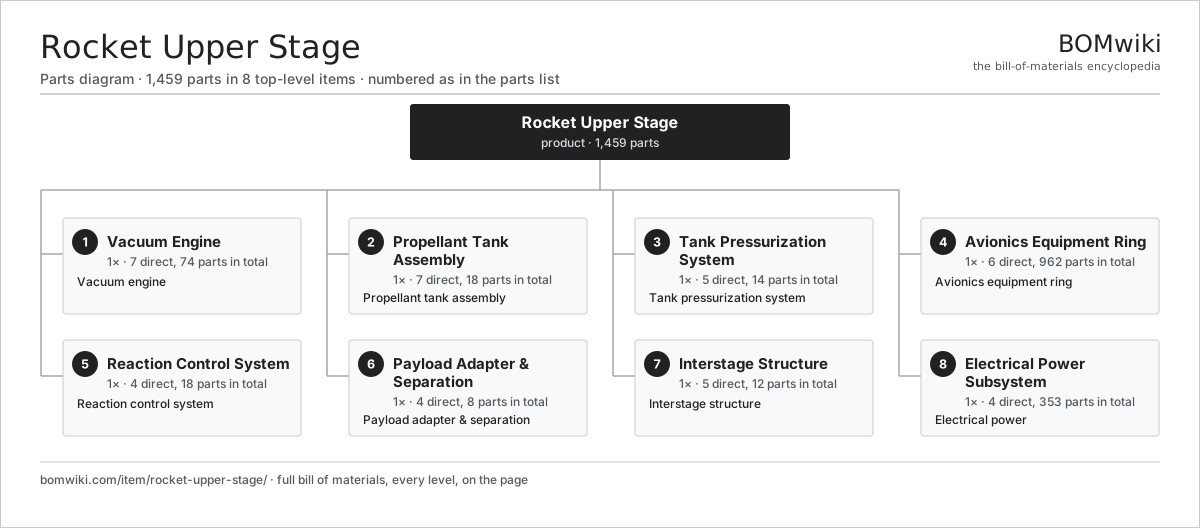
| # | Part | Qty | What it does |
|---|---|---|---|
| 1 | Vacuum Engine 7 parts | 1× | Vacuum engine |
| 2 | Propellant Tank Assembly 7 parts | 1× | Propellant tank assembly |
| 3 | Tank Pressurization System 5 parts | 1× | Tank pressurization system |
| 4 | Avionics Equipment Ring 6 parts | 1× | Avionics equipment ring |
| 5 | Reaction Control System 4 parts | 1× | Reaction control system |
| 6 | Payload Adapter & Separation 4 parts | 1× | Payload adapter & separation |
| 7 | Interstage Structure 5 parts | 1× | Interstage structure |
| 8 | Electrical Power Subsystem 4 parts | 1× | Electrical power |
Diagrams & photos
.jpg)


3D model
No 3D model yet. Have a CAD file of this? Add a 3D model. STL renders right on this page; STEP, FreeCAD, and OpenSCAD sources are welcome too (openly licensed, like all 3D models on BOMwiki).
Build & assembly graph
expand / collapse · shared sub-assemblies converge · links to related products · est. labourTap an assembly to expand/collapse · tap a part to open it · use “Open page” for any node · drag to pan, scroll to zoom.
Bill of materials for Rocket Upper Stage
8 top-level lines · 74 rows shown · 1,459 parts total · indented to 3 levels| # | Item / sub-assembly | Part no. | Qty/assy | Ext. qty | Parts | Type |
|---|---|---|---|---|---|---|
| 1 | Vacuum Engine 7 parts | rocket-upper-stage-engine | 1× | 1 | 74 | assembly |
| 1.1 | Thrust Chamber | rocket-upper-stage-thrust-chamber | 1× | 1 | · | part |
| 1.2 | Nozzle Extension | rocket-upper-stage-nozzle-ext | 1× | 1 | · | part |
| 1.3 | LH2 Turbopump 4 parts | rocket-upper-stage-lh2-turbopump | 1× | 1 | 7 | assembly |
| 1.3.1 | Pump Impeller | rocket-upper-stage-impeller | 2× | 2 | · | part |
| 1.3.2 | Turbine Wheel | rocket-upper-stage-turbine-wheel | 1× | 1 | · | part |
| 1.3.3 | Ball Bearing | ball-bearing | 2× | 2 | · | part |
| 1.3.4 | Turbopump Shaft Seal | rocket-upper-stage-shaft-seal | 2× | 2 | · | part |
| 1.4 | LOX Turbopump 4 parts | rocket-upper-stage-lox-turbopump | 1× | 1 | 6 | assembly |
| 1.4.1 | Pump Impeller | rocket-upper-stage-impeller | 1× | 1 | · | part |
| 1.4.2 | Helical Gear Pair | gear-pair | 1× | 1 | · | part |
| 1.4.3 | Ball Bearing | ball-bearing | 2× | 2 | · | part |
| 1.4.4 | Turbopump Shaft Seal | rocket-upper-stage-shaft-seal | 2× | 2 | · | part |
| 1.5 | Turbine Bypass Valve | rocket-upper-stage-bypass-valve | 1× | 1 | · | part |
| 1.6 | Spark-Torch Igniter | rocket-upper-stage-igniter | 2× | 2 | · | part |
| 1.7 | TVC Actuator 4 parts | rocket-upper-stage-tvc-actuator | 2× | 2 | 28 | assembly |
| 1.7.1 | Servo Motor 4 parts + deeper › | servo-motor | 1× | 2 | 24 | assembly |
| 1.7.2 | Ball Screw | ball-screw | 1× | 2 | · | part |
| 1.7.3 | Encoder | encoder | 1× | 2 | · | part |
| 1.7.4 | Connector | connector | 2× | 4 | · | part |
| 2 | Propellant Tank Assembly 7 parts | rocket-upper-stage-tanks | 1× | 1 | 18 | assembly |
| 2.1 | LH2 Tank | rocket-upper-stage-lh2-tank | 1× | 1 | · | part |
| 2.2 | LOX Tank | rocket-upper-stage-lox-tank | 1× | 1 | · | part |
| 2.3 | Common Bulkhead | rocket-upper-stage-common-bulkhead | 1× | 1 | · | part |
| 2.4 | Anti-Slosh Baffle | rocket-upper-stage-slosh-baffle | 6× | 6 | · | part |
| 2.5 | Spray-On Foam Insulation | rocket-upper-stage-foam-insulation | 1× | 1 | · | part |
| 2.6 | Engine Feedline | rocket-upper-stage-feedline | 2× | 2 | · | part |
| 2.7 | Pressure Sensor | pressure-sensor | 6× | 6 | · | part |
| 3 | Tank Pressurization System 5 parts | rocket-upper-stage-pressurization | 1× | 1 | 14 | assembly |
| 3.1 | Helium COPV | rocket-upper-stage-helium-bottle | 4× | 4 | · | part |
| 3.2 | Pressurization Regulator | rocket-upper-stage-press-regulator | 2× | 2 | · | part |
| 3.3 | Vent & Relief Valve | rocket-upper-stage-vent-valve | 2× | 2 | · | part |
| 3.4 | Autogenous Pressurization Line | rocket-upper-stage-autogenous-line | 2× | 2 | · | part |
| 3.5 | O-Ring Set | oring-set | 4× | 4 | · | part |
| 4 | Avionics Equipment Ring 6 parts | rocket-upper-stage-avionics-ring | 1× | 1 | 962 | assembly |
| 4.1 | Flight Computer 5 parts | rocket-upper-stage-flight-computer | 2× | 2 | 467 | assembly |
| 4.1.1 | Bare PCB | pcb-bare | 3× | 6 | · | part |
| 4.1.2 | Compute SoC Module | soc-module | 1× | 2 | · | part |
| 4.1.3 | Microcontroller | mcu | 3× | 6 | · | part |
| 4.1.4 | SMD Passive (R/C/L) | smd-passives | 450× | 900 | · | part |
| 4.1.5 | Connector | connector | 10× | 20 | · | part |
| 4.2 | Inertial Navigation Unit | rocket-upper-stage-ins | 2× | 2 | · | part |
| 4.3 | Flight Termination System | rocket-upper-stage-fts | 1× | 1 | · | part |
| 4.4 | GNSS Receiver | rocket-upper-stage-gps-receiver | 2× | 2 | · | part |
| 4.5 | Wire Bundle | wire-bundle | 3× | 3 | · | part |
| 4.6 | Connector | connector | 20× | 20 | · | part |
| 5 | Reaction Control System 4 parts | rocket-upper-stage-rcs | 1× | 1 | 18 | assembly |
| 5.1 | Cold-Gas Thruster | rocket-upper-stage-rcs-thruster | 12× | 12 | · | part |
| 5.2 | Settling Thruster | rocket-upper-stage-settling-thruster | 2× | 2 | · | part |
| 5.3 | GN2 Bottle | rocket-upper-stage-rcs-tank | 2× | 2 | · | part |
| 5.4 | Pressure Sensor | pressure-sensor | 2× | 2 | · | part |
| 6 | Payload Adapter & Separation 4 parts | rocket-upper-stage-payload-adapter | 1× | 1 | 8 | assembly |
| 6.1 | Adapter Cone | rocket-upper-stage-adapter-cone | 1× | 1 | · | part |
| 6.2 | Separation Clamp Band | rocket-upper-stage-clamp-band | 1× | 1 | · | part |
| 6.3 | Separation Spring | rocket-upper-stage-sep-spring | 4× | 4 | · | part |
| 6.4 | Fastener Set | fastener-set | 2× | 2 | · | part |
| 7 | Interstage Structure 5 parts | rocket-upper-stage-interstage | 1× | 1 | 12 | assembly |
| 7.1 | Interstage Shell | rocket-upper-stage-interstage-shell | 1× | 1 | · | part |
| 7.2 | Linear Separation Charge | rocket-upper-stage-sep-charge | 1× | 1 | · | part |
| 7.3 | Retro Motor | rocket-upper-stage-retro-motor | 4× | 4 | · | part |
| 7.4 | Sheet Metal Panel | sheet-panel | 2× | 2 | · | part |
| 7.5 | Fastener Set | fastener-set | 4× | 4 | · | part |
| 8 | Electrical Power Subsystem 4 parts | rocket-upper-stage-eps | 1× | 1 | 353 | assembly |
| 8.1 | Avionics Battery 2 parts | rocket-upper-stage-main-battery | 2× | 2 | 57 | assembly |
| 8.1.1 | Li-ion Cell, 18650 | li-cell-18650 | 56× | 112 | · | part |
| 8.1.2 | BMS Board | bms-board | 1× | 2 | · | part |
| 8.2 | TVC Battery | rocket-upper-stage-tvc-battery | 1× | 1 | · | part |
| 8.3 | Power Distribution Unit 5 parts | rocket-upper-stage-power-dist | 1× | 1 | 236 | assembly |
| 8.3.1 | Bare PCB | pcb-bare | 2× | 2 | · | part |
| 8.3.2 | Relay | relay | 8× | 8 | · | part |
| 8.3.3 | Power MOSFET | mosfet | 16× | 16 | · | part |
| 8.3.4 | SMD Passive (R/C/L) | smd-passives | 200× | 200 | · | part |
| 8.3.5 | Connector | connector | 10× | 10 | · | part |
| 8.4 | Wire Bundle | wire-bundle | 2× | 2 | · | part |
Something wrong in this list? Report a problem with this BOM.
Related products
same domain, ranked by shared parts Lunar Lander
1,803 parts · shares 19 with this page
Lunar Lander
1,803 parts · shares 19 with this page
 GPS Navigation Satellite
2,640 parts · shares 19 with this page
GPS Navigation Satellite
2,640 parts · shares 19 with this page
 Weather Satellite
1,765 parts · shares 19 with this page
Weather Satellite
1,765 parts · shares 19 with this page
 Crewed Space Capsule
7,222 parts · shares 17 with this page
Crewed Space Capsule
7,222 parts · shares 17 with this page
 Satellite Ground Station Antenna
274 parts · shares 13 with this page
Satellite Ground Station Antenna
274 parts · shares 13 with this page
 Cargo Resupply Spacecraft
574 parts · shares 15 with this page
Cargo Resupply Spacecraft
574 parts · shares 15 with this page
Sourcing: possible vendors
Browse the supplier directory → Prices, MOQ, and lead times are algorithmic estimates, not quotes, and not claims about these companies. Company mappings are curated by keyword; est. price band $50k–$500M. How estimates work| Vendor | HQ | Specialty | MOQ | Lead time |
|---|---|---|---|---|
|
🇺🇸SpaceX
spacex.com ↗
|
Hawthorne, US | Launch & spacecraft | made to order | 52–104 wks |
| northropgrumman.com ↗ | Falls Church, US | Space & defense | made to order | 52–104 wks |
|
🇫🇷Airbus
airbus.com ↗
|
Toulouse, FR | Aerospace OEM | made to order | 52–104 wks |
| rocketlabusa.com ↗ | Long Beach, US | Launch & spacecraft | made to order | 52–104 wks |
| thalesaleniaspace.com ↗ | Cannes, FR | Satellites | made to order | 52–104 wks |
789-word article