Roll Forming Machine
ProductOverview
A roll-forming machine transforms flat or slit coil stock into shaped sections, channels, angles, C- and U-profiles, sigma shapes, in a continuous pass. Unlike press-brake or extrusion work, which reshape the full cross-section in one blow, roll forming applies incremental bends across a series of paired rolls (forming stands) moving progressively closer to the final profile. At the exit, a synchronized cutoff punch or shear severs the continuous piece into individual lengths. The process is fast (10–80 m/min), tooling is simple (rolls and a die), and the economics favour short-run custom profiles and long production runs at the same die setup.
Stock arrives on a motorized Motorized Uncoiler and feeds through the Entry Guide & Alignment where fixed rails and centering rolls align it. The strip then passes through 8–20 Progressive Roll Forming Stations, each stand bending it fractionally closer to the target shape. The forming loads are light because incremental bends are shallow; the upper roll floats under spring pressure, so no hydraulic clamps are needed. Finally the Cutoff Press Assembly triggers on a position signal from the Length Encoder, severing the piece, and the part slides onto a Discharge & Stacking conveyor or collection table.
How it works
Each forming stand consists of two hardened rolls, upper and lower, each shaped to advance the profile one small step. The lower roll is driven continuously by the Main Drive Train at constant speed; the upper roll floats on Coil Spring cartridges that maintain even contact pressure across the width. As the strip passes between them, friction and normal force bend it. The upper roll follows the incoming contour because its springs yield to match the lower roll shape.
The Main Drive Motor runs the Helical Reduction Gearbox, a helical reducer that outputs to a Drive Chain & Sprockets driving the Bottom Roll Drive Shaft. All lower rolls are geared or chained together so they turn in synchronization; the Input Shaft and Flexible Overload Coupling protect the system by slipping if a jam or tramp metal stalls the output. Intermediate Bottom Roll Drive Shaft stages may include spur or spiral gears to transmit power along the 10–15 m length of the line.
Forming strain is distributed and gentle because each stand removes only a fraction of the total bending. The first stand makes a light graze; by stand five, the part has rotated roughly 90 degrees; by the final stand, the web is in its target orientation and edge flanges are nearly closed. This is the key advantage over press-brake forming: the material is never shocked, so corner cracking and spring-back are minimal, and the rolls wear slowly.
Cutoff timing and length control
Cutoff happens at a fixed position down the machine. The Cutoff Timing Sensor is a photosensor or limit switch on a swing arm triggered by the part passing a preset marker, or, on newer machines, an Length Encoder tracks the strip position directly and the Control Panel electronics count pulses to trigger the cut after a programmable distance. The Cutoff Actuator is a pneumatic or hydraulic double-acting cylinder with a 50–200 mm stroke. When triggered, it drives the Upper Cutoff Die down onto the Lower Cutoff Die in 150–250 milliseconds. For thick steel (> 1.5 mm), a hydraulic cylinder is used; for thin gauge, pneumatic is adequate.
Two die types are common: a shear die (flat punch and anvil with minimal clearance) for very thin sections where scrap trimming is negligible, and a punch die (formed punch and anvil matched to the profile) for sections where edge squeezing or trim waste is acceptable. The dies are bolted into quick-change Die Holder Fixture blocks so setup time for a different length is seconds.
Speed, tension and alignment
The Motorized Uncoiler motor is variable-speed and load-sensing so that the tension on the incoming coil stays constant even as the coil diameter shrinks from 1.5 m down to 100 mm. A mechanical Tension Brake Band backs up the motor if power fails. The Entry Guide & Alignment side rolls are hand-adjustable or, on CNC machines, motor-driven to center the strip in the forming line; misalignment causes edge wave and profile distortion. The Alignment Adjuster is typically an eccentric cam or differential screw moving the roll blocks left and right.
Production speed is set on the Control Panel via a Speed Potentiometer knob (manual machines) or digital input (CNC). Higher speed means higher forming loads because the material has less time to flow plastically; the upper Top Roll Assembly spring cartridges must be tuned for the material hardness and thickness.
Material-specific considerations
Mild steel (< 0.5 % carbon) forms easily at all speeds. High-strength grades (HSLA, 440–550 MPa) demand slower speeds (≤ 30 m/min) and stiffer springs to avoid chatter and spring-back. Aluminium (1100 H14, 3105 H14) forms at higher speeds (≥ 60 m/min) but is prone to edge cracking at tight bend radii; the roll profiles must have generous radii (R ≥ 1 t, where t is thickness). Stainless steel (304, 430) is work-hardening and temperamental; forming is done slowly and the rolls are harder (tungsten-carbide overlay) to resist galling.
Maintenance and die changes
The Bottom Roll Drive Shaft and Top Roll Assembly run on Ball Bearing pillow blocks and are packed with grease; they are inspected for radial play (< 0.1 mm) monthly. The Single Forming Stand upper rolls are changed as a matched set when wear exceeds 0.2 mm (a few thousand tons of output). The Cutoff Press Assembly dies are sharpened after 500–2,000 cuts depending on material hardness, and the Upper Cutoff Die clearance is checked to avoid pinching scrap or leaving burrs.
Setup time for a new profile is typically 4–8 hours: delivering the correct set of forming rolls, installing them in sequence, adjusting the upper-roll Top Roll Assembly springs, installing the Cutoff Press Assembly dies, and running a trial piece. Once dialed in, changeover between different lengths is minutes: reprogram the Control Panel length and swap the Die Holder Fixture inserts.
Roll Forming Machine parts and their functions
8 top-level parts · 137 parts in total · full bill of materials below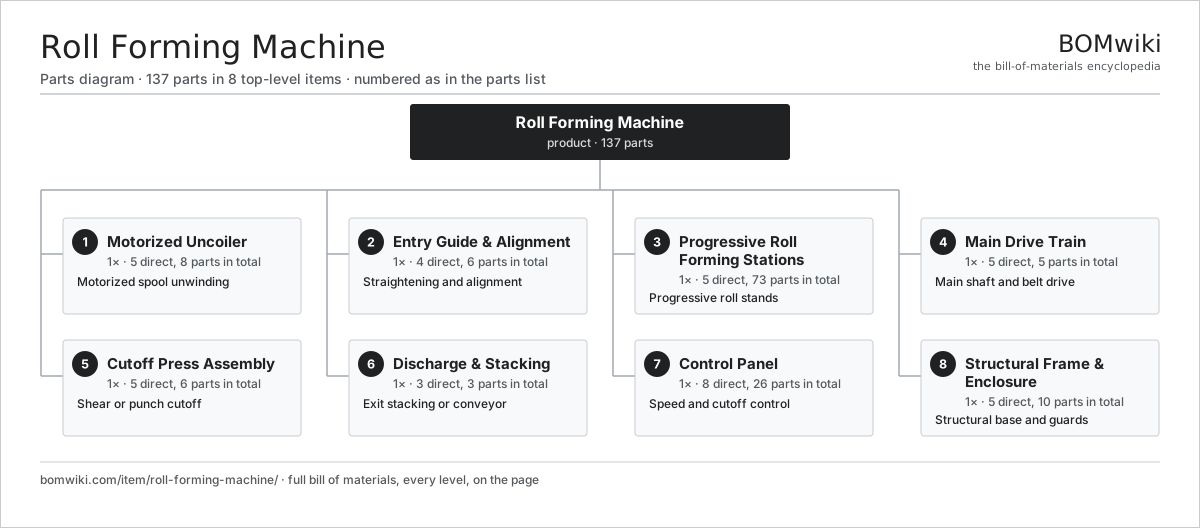
| # | Part | Qty | What it does |
|---|---|---|---|
| 1 | Motorized Uncoiler 5 parts | 1× | Motorized spool unwinding |
| 2 | Entry Guide & Alignment 4 parts | 1× | Straightening and alignment |
| 3 | Progressive Roll Forming Stations 5 parts | 1× | Progressive roll stands |
| 4 | Main Drive Train 5 parts | 1× | Main shaft and belt drive |
| 5 | Cutoff Press Assembly 5 parts | 1× | Shear or punch cutoff |
| 6 | Discharge & Stacking 3 parts | 1× | Exit stacking or conveyor |
| 7 | Control Panel 8 parts | 1× | Speed and cutoff control |
| 8 | Structural Frame & Enclosure 5 parts | 1× | Structural base and guards |
3D model
No 3D model yet. Have a CAD file of this? Add a 3D model. STL renders right on this page; STEP, FreeCAD, and OpenSCAD sources are welcome too (openly licensed, like all 3D models on BOMwiki).
Build & assembly graph
expand / collapse · shared sub-assemblies converge · links to related products · est. labourTap an assembly to expand/collapse · tap a part to open it · use “Open page” for any node · drag to pan, scroll to zoom.
Bill of materials for Roll Forming Machine
8 top-level lines · 52 rows shown · 137 parts total · indented to 3 levels| # | Item / sub-assembly | Part no. | Qty/assy | Ext. qty | Parts | Type |
|---|---|---|---|---|---|---|
| 1 | Motorized Uncoiler 5 parts | roll-forming-machine-uncoiler | 1× | 1 | 8 | assembly |
| 1.1 | Uncoiler Motor | roll-forming-machine-uncoiler-motor | 1× | 1 | · | part |
| 1.2 | Uncoiler Mandrel | roll-forming-machine-mandrel | 1× | 1 | · | part |
| 1.3 | Tension Brake Band | roll-forming-machine-brake-band | 1× | 1 | · | part |
| 1.4 | Ball Bearing | ball-bearing | 4× | 4 | · | part |
| 1.5 | Coil Guard | roll-forming-machine-coil-guard | 1× | 1 | · | part |
| 2 | Entry Guide & Alignment 4 parts | roll-forming-machine-entry-guide | 1× | 1 | 6 | assembly |
| 2.1 | Entry Guide Rail | roll-forming-machine-guide-rails | 2× | 2 | · | part |
| 2.2 | Centering Roller | roll-forming-machine-side-rolls | 2× | 2 | · | part |
| 2.3 | Alignment Adjuster | roll-forming-machine-alignment-adjuster | 1× | 1 | · | part |
| 2.4 | Fastener Set | fastener-set | 1× | 1 | · | part |
| 3 | Progressive Roll Forming Stations 5 parts | roll-forming-machine-forming-stations | 1× | 1 | 73 | assembly |
| 3.1 | Single Forming Stand 4 parts | roll-forming-machine-forming-stand | 8× | 8 | 6 | assembly |
| 3.1.1 | Upper Forming Roll | roll-forming-machine-upper-roll | 1× | 8 | · | part |
| 3.1.2 | Lower Forming Roll | roll-forming-machine-lower-roll | 1× | 8 | · | part |
| 3.1.3 | Roll Bearing Block | roll-forming-machine-roll-bearing-block | 2× | 16 | · | part |
| 3.1.4 | Coil Spring | coil-spring | 2× | 16 | · | part |
| 3.2 | Bottom Roll Drive Shaft | roll-forming-machine-bottom-roll-shaft | 1× | 1 | · | part |
| 3.3 | Top Roll Assembly | roll-forming-machine-top-roll-shaft | 1× | 1 | · | part |
| 3.4 | Ball Bearing | ball-bearing | 20× | 20 | · | part |
| 3.5 | O-Ring Set | oring-set | 3× | 3 | · | part |
| 4 | Main Drive Train 5 parts | roll-forming-machine-drive-train | 1× | 1 | 5 | assembly |
| 4.1 | Main Drive Motor | roll-forming-machine-motor | 1× | 1 | · | part |
| 4.2 | Helical Reduction Gearbox | roll-forming-machine-gearbox | 1× | 1 | · | part |
| 4.3 | Input Shaft | roll-forming-machine-input-shaft | 1× | 1 | · | part |
| 4.4 | Flexible Overload Coupling | roll-forming-machine-flex-coupling | 1× | 1 | · | part |
| 4.5 | Drive Chain & Sprockets | roll-forming-machine-sprocket-chain | 1× | 1 | · | part |
| 5 | Cutoff Press Assembly 5 parts | roll-forming-machine-cutoff-press | 1× | 1 | 6 | assembly |
| 5.1 | Cutoff Actuator | roll-forming-machine-cutoff-cylinder | 1× | 1 | · | part |
| 5.2 | Upper Cutoff Die | roll-forming-machine-upper-die | 1× | 1 | · | part |
| 5.3 | Lower Cutoff Die | roll-forming-machine-lower-die | 1× | 1 | · | part |
| 5.4 | Cutoff Timing Sensor | roll-forming-machine-cutoff-timing | 1× | 1 | · | part |
| 5.5 | Die Holder Fixture | roll-forming-machine-die-holder | 2× | 2 | · | part |
| 6 | Discharge & Stacking 3 parts | roll-forming-machine-discharge | 1× | 1 | 3 | assembly |
| 6.1 | Exit Guide Rails | roll-forming-machine-exit-guide | 1× | 1 | · | part |
| 6.2 | Discharge Conveyor | roll-forming-machine-discharge-conveyor | 1× | 1 | · | part |
| 6.3 | Stacking Table | roll-forming-machine-stacking-table | 1× | 1 | · | part |
| 7 | Control Panel 8 parts | roll-forming-machine-control-panel | 1× | 1 | 26 | assembly |
| 7.1 | Bare PCB | pcb-bare | 1× | 1 | · | part |
| 7.2 | Microcontroller | mcu | 1× | 1 | · | part |
| 7.3 | Speed Potentiometer | roll-forming-machine-speed-potentiometer | 1× | 1 | · | part |
| 7.4 | Length Encoder | roll-forming-machine-length-encoder | 1× | 1 | · | part |
| 7.5 | Relay | relay | 8× | 8 | · | part |
| 7.6 | Pressure Sensor | pressure-sensor | 1× | 1 | · | part |
| 7.7 | Connector | connector | 12× | 12 | · | part |
| 7.8 | Wire Bundle | wire-bundle | 1× | 1 | · | part |
| 8 | Structural Frame & Enclosure 5 parts | roll-forming-machine-frame | 1× | 1 | 10 | assembly |
| 8.1 | Base Frame Weldment | roll-forming-machine-base-frame | 1× | 1 | · | part |
| 8.2 | Side Safety Guard | roll-forming-machine-side-guards | 2× | 2 | · | part |
| 8.3 | Top Interlock Cover | roll-forming-machine-top-cover | 1× | 1 | · | part |
| 8.4 | Fastener Set | fastener-set | 2× | 2 | · | part |
| 8.5 | Sheet Metal Panel | sheet-panel | 4× | 4 | · | part |
Something wrong in this list? Report a problem with this BOM.
Related products
same domain, ranked by shared parts Centrifugal Disc Finishing Machine
326 parts · shares 3 with this page
Centrifugal Disc Finishing Machine
326 parts · shares 3 with this page
 Continuous Belt Furnace
130 parts · shares 3 with this page
Continuous Belt Furnace
130 parts · shares 3 with this page
 Crankshaft Grinder
511 parts · shares 3 with this page
Crankshaft Grinder
511 parts · shares 3 with this page
 Creep-Feed Grinder
571 parts · shares 3 with this page
Creep-Feed Grinder
571 parts · shares 3 with this page
Sourcing: possible vendors
Browse the supplier directory → Prices, MOQ, and lead times are algorithmic estimates, not quotes, and not claims about these companies. Company mappings are curated by keyword; est. price band $10k–$1M. How estimates work| Vendor | HQ | Specialty | MOQ | Lead time |
|---|---|---|---|---|
|
🇩🇪DMG MORI
dmgmori.com ↗
|
Bielefeld, DE | Machine tools | 5 units | 12–20 wks |
|
🇯🇵Mazak
mazak.com ↗
|
Oguchi, JP | Machine tools | 5 units | 12–20 wks |
| haascnc.com ↗ | Oxnard, US | CNC machine tools | 5 units | 12–20 wks |
|
🇯🇵Okuma
okuma.com ↗
|
Niwa, JP | Machine tools | 5 units | 12–20 wks |
|
🇩🇪Trumpf
trumpf.com ↗
|
Ditzingen, DE | Laser & sheet-metal machines | 5 units | 12–20 wks |
1,105-word article