Rubber Extruder
ProductOverview
A rubber extruder is a heated screw-in-barrel machine that transforms compounded rubber into continuous profiles: tire tread beads, sidewall strips, hose inner tubes, or custom extrusions. The Cold-Feed Screw rotates inside a Barrel, conveying solid rubber forward while internal friction and external heating raise temperature above the polymer glass transition (100–130 °C for natural rubber). The softened rubber is forced through a precision Die Head shaped to the final profile (e.g., a 40 mm × 200 mm tread extrusion).
Unlike injection molding, extrusion is a continuous process: material flows into the hopper infinitely, and product emerges in an endless strand. The extruded strand travels onto a Cooling & Takeoff Table where water spray rapidly cools it to room temperature (from 150 °C to <50 °C in 30 seconds). The finished extrusion is then wound, pelletized, or cut to length.
Rubber extrusion is faster and more economical than injection molding for high-volume commodity profiles. A single 30 kW extruder can produce 200–300 kg/hour of tire tread, feeding multiple tire-building machines.
How it works
Raw rubber compound (already vulcanized or partially vulcanized, from a Banbury Internal Mixer) is gravity-fed into the Barrel hopper. As the Cold-Feed Screw rotates at 60–100 rpm (driven by the Drive System), the screw flight (helical ridge) conveys rubber forward along the barrel.
The Temperature Control Zones divide the barrel into stages:
- Feed Zone (50 °C): Low heat, compacting the rubber mass without premature plasticization.
- Melt Zone (100–130 °C): Moderate heat, raising polymer temperature and reducing viscosity.
- Metering Zone (120–150 °C): High heat, bringing rubber to true melt state and forcing it toward the die.
Each zone is independently controlled: the Proportional Control Valve regulates steam flow to Feed Zone Heater, Melt Zone Heater, and Die Zone Heater. The Temperature Sensors (thermocouples) report zone temperatures to the Control System PLC every 2 seconds. If melt zone temperature drifts below 110 °C, PLC opens the proportional valve to increase steam. If it climbs above 135 °C, PLC throttles steam or activates a water cooling spray.
Simultaneously, the rotating screw creates shear: the rubber is stretched and compressed between the screw flight and barrel bore. This mechanical working further plasticizes the polymer and mixes residual compounds evenly. The forward displacement of the screw flight also builds back-pressure: as rubber approaches the Die Head, pressure accumulates to 100–200 bar. This high pressure is necessary to:
- Force rubber through the Screen Pack (wire cloth filters removing contaminants)
- Overcome die flow resistance
- Ensure a constant, compact extrusion with no voids
At the die head entrance, the Breaker Plate creates a shear break: a sudden pressure drop across the screen pack thoroughly mixes any remaining unmixed lumps of carbon black or curatives. The melt then enters the Die Insert, a precision cavity imprinting the desired profile cross-section, and exits at a linear speed (typically 0.5–2 m/minute).
Immediately after exiting the die, the Cooling Spray Header sprays 10–20 °C water onto the hot extrusion. In 30 seconds, the surface temperature drops from 150 °C to 50 °C. The Conveyor Belt, running at matched speed via the Conveyor Motor, carries the cooling extrusion through the spray zone for 5–10 meters. By the time it reaches the Takeoff Roller, the rubber is solid and handleable.
The finished extrusion is then:
- Wound onto a spool for storage or feed to another machine (e.g., tire-building-machine tread feeder)
- Cut to length by downstream automated shears
- Pelletized for later re-extrusion or injection molding
- Cooled further in a water tank before packaging
Profile Design & Die Selection
The Die Insert is a precision component (±0.1 mm) and is profile-specific. A tire plant might stock 30–100 different die inserts for different tire sizes and tread patterns. Changing dies takes 15–45 minutes: drain old rubber from the barrel, heat the die body to prevent sticking, push out the old insert, clean the cavity, insert the new die, and prime with fresh rubber.
Extrusion geometry can be complex:
- Tread bead: 40 mm wide × 20 mm tall, with internal reinforcement rib
- Sidewall: 60 mm wide × 3 mm thick, with white stripe graphics embedded
- Hose tube: 30 mm inner diameter × 5 mm wall thickness, with embedded spiral wire reinforcement
Complex profiles may require a multi-cavity die head, feeding 2–4 parallel extrusions per cycle, doubling throughput.
Melt Pressure & Viscosity
The Control System monitors rubber-extruder-pressure-sensor at the die inlet. For a given screw speed, melt pressure reflects compound viscosity:
- High pressure (180–220 bar): Stiff compound, high viscosity, poor flow, reduce screw speed or heat die zone.
- Low pressure (50–80 bar): Thin compound, low viscosity, possible extrusion defects (surface texture, voids), increase screw speed or check temperature.
Target pressure is typically 120–160 bar. The PLC can automatically adjust screw speed via the Drive System VFD to maintain constant pressure despite batch-to-batch viscosity variation, ensuring consistent extrusion dimension and surface quality.
Troubleshooting & Wear
The Screw Flight wears over time (every 500–2000 hours depending on compound abrasiveness). Worn screw flights reduce conveying efficiency, causing:
- Increased back-pressure
- Uneven extrusion (diameter fluctuates)
- Reduced output
Worn screw shafts are either re-flighted (a new flight welded to the core) or replaced wholesale (cost: $2,000–5,000 per core). Many operations keep spare shafts on hand to minimize downtime.
The Die Insert also wears, especially the flow channels. Over 1,000–5,000 hours, dies may be re-machined (tighter tolerances) or replaced.
Energy Efficiency
Total power draw:
- Drive motor: 15–45 kW (screw shear)
- Zone heaters: 40–50 kW electric resistance (initial warm-up) or 5–10 kW (steady-state steam input)
- Cooling spray pump: 5 kW
- Conveyor: 2–5 kW
Steady-state: ~60 kW. A 500-ton/day tire plant with 2–4 extruders feeding tire builders continuously consumes ~200–300 kW from extrusion equipment alone.
Output throughput: 200–300 kg/hour per machine. An 8-hour shift on one extruder yields ~1600–2400 kg finished extrusion (tread, sidewall, or trim). Larger plants run two or three extruders per shift to feed downstream demand.
Rubber Extruder parts and their functions
8 top-level parts · 57 parts in total · full bill of materials below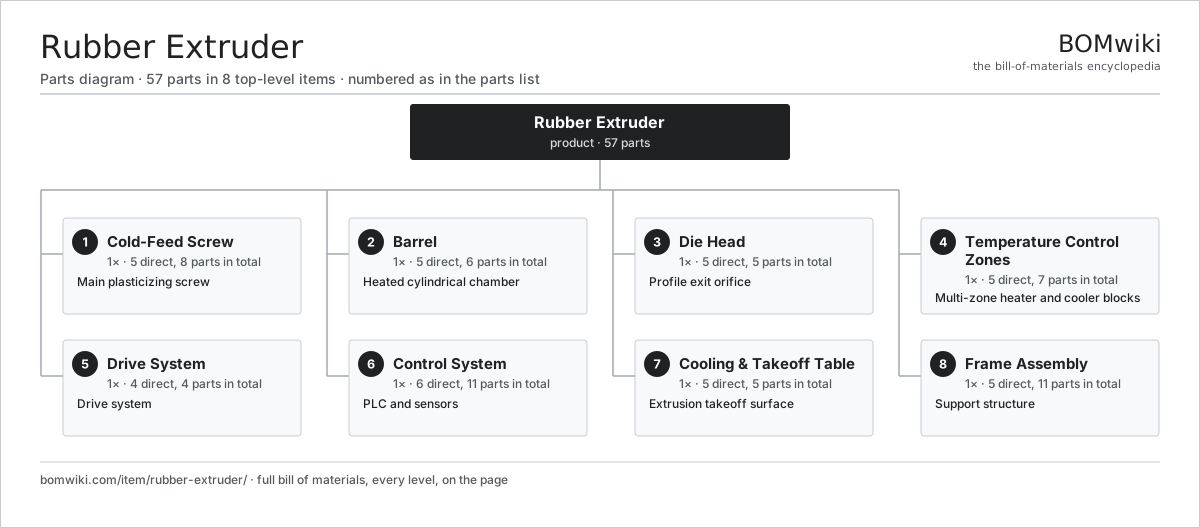
| # | Part | Qty | What it does |
|---|---|---|---|
| 1 | Cold-Feed Screw 5 parts | 1× | Main plasticizing screw |
| 2 | Barrel 5 parts | 1× | Heated cylindrical chamber |
| 3 | Die Head 5 parts | 1× | Profile exit orifice |
| 4 | Temperature Control Zones 5 parts | 1× | Multi-zone heater and cooler blocks |
| 5 | Drive System 4 parts | 1× | Drive system |
| 6 | Control System 6 parts | 1× | PLC and sensors |
| 7 | Cooling & Takeoff Table 5 parts | 1× | Extrusion takeoff surface |
| 8 | Frame Assembly 5 parts | 1× | Support structure |
3D model
No 3D model yet. Have a CAD file of this? Add a 3D model. STL renders right on this page; STEP, FreeCAD, and OpenSCAD sources are welcome too (openly licensed, like all 3D models on BOMwiki).
Build & assembly graph
expand / collapse · shared sub-assemblies converge · links to related products · est. labourTap an assembly to expand/collapse · tap a part to open it · use “Open page” for any node · drag to pan, scroll to zoom.
Bill of materials for Rubber Extruder
8 top-level lines · 50 rows shown · 57 parts total · indented to 3 levels| # | Item / sub-assembly | Part no. | Qty/assy | Ext. qty | Parts | Type |
|---|---|---|---|---|---|---|
| 1 | Cold-Feed Screw 5 parts | rubber-extruder-cold-feed-screw | 1× | 1 | 8 | assembly |
| 1.1 | Screw Shaft | rubber-extruder-screw-shaft | 1× | 1 | · | part |
| 1.2 | Screw Flight | rubber-extruder-screw-flight | 1× | 1 | · | part |
| 1.3 | Screw Nib | rubber-extruder-screw-nib | 1× | 1 | · | part |
| 1.4 | Screw Bearing 2 parts | rubber-extruder-screw-bearing | 2× | 2 | 2 | assembly |
| 1.4.1 | Ball Bearing | ball-bearing | 1× | 2 | · | part |
| 1.4.2 | Bearing Housing | rubber-extruder-bearing-housing | 1× | 2 | · | part |
| 1.5 | Screw Seal | rubber-extruder-screw-seal | 1× | 1 | · | part |
| 2 | Barrel 5 parts | rubber-extruder-barrel | 1× | 1 | 6 | assembly |
| 2.1 | Barrel Bore | rubber-extruder-barrel-bore | 1× | 1 | · | part |
| 2.2 | Barrel Jacket | rubber-extruder-barrel-jacket | 1× | 1 | · | part |
| 2.3 | Cooling Tube | rubber-extruder-barrel-cooling-tube | 1× | 1 | · | part |
| 2.4 | Barrel Liner | rubber-extruder-barrel-liner | 1× | 1 | · | part |
| 2.5 | Barrel End Ring | rubber-extruder-barrel-end-ring | 2× | 2 | · | part |
| 3 | Die Head 5 parts | rubber-extruder-die-head | 1× | 1 | 5 | assembly |
| 3.1 | Die Body | rubber-extruder-die-body | 1× | 1 | · | part |
| 3.2 | Die Insert | rubber-extruder-die-insert | 1× | 1 | · | part |
| 3.3 | Breaker Plate | rubber-extruder-breaker-plate | 1× | 1 | · | part |
| 3.4 | Screen Pack | rubber-extruder-screen-pack | 1× | 1 | · | part |
| 3.5 | Adaptor Ring | rubber-extruder-adaptor-ring | 1× | 1 | · | part |
| 4 | Temperature Control Zones 5 parts | rubber-extruder-temperature-zones | 1× | 1 | 7 | assembly |
| 4.1 | Feed Zone Heater | rubber-extruder-feed-zone-heater | 1× | 1 | · | part |
| 4.2 | Melt Zone Heater | rubber-extruder-melt-zone-heater | 1× | 1 | · | part |
| 4.3 | Die Zone Heater | rubber-extruder-die-zone-heater | 1× | 1 | · | part |
| 4.4 | Proportional Control Valve | rubber-extruder-proportional-valve | 1× | 1 | · | part |
| 4.5 | Temperature Sensor | rubber-extruder-temperature-sensor | 3× | 3 | · | part |
| 5 | Drive System 4 parts | rubber-extruder-gear-motor | 1× | 1 | 4 | assembly |
| 5.1 | Drive Motor | rubber-extruder-motor | 1× | 1 | · | part |
| 5.2 | Reduction Gearbox | rubber-extruder-gearbox | 1× | 1 | · | part |
| 5.3 | Drive Coupling | rubber-extruder-coupling | 1× | 1 | · | part |
| 5.4 | Torque Meter | rubber-extruder-torque-meter | 1× | 1 | · | part |
| 6 | Control System 6 parts | rubber-extruder-control-system | 1× | 1 | 11 | assembly |
| 6.1 | Microcontroller | mcu | 1× | 1 | · | part |
| 6.2 | LCD Panel | lcd-panel | 1× | 1 | · | part |
| 6.3 | Pressure Sensor | pressure-sensor | 1× | 1 | · | part |
| 6.4 | Encoder | encoder | 1× | 1 | · | part |
| 6.5 | Relay | relay | 6× | 6 | · | part |
| 6.6 | Bare PCB | pcb-bare | 1× | 1 | · | part |
| 7 | Cooling & Takeoff Table 5 parts | rubber-extruder-cooling-table | 1× | 1 | 5 | assembly |
| 7.1 | Conveyor Belt | rubber-extruder-conveyor-belt | 1× | 1 | · | part |
| 7.2 | Conveyor Motor | rubber-extruder-conveyor-motor | 1× | 1 | · | part |
| 7.3 | Cooling Spray Header | rubber-extruder-cooling-spray-header | 1× | 1 | · | part |
| 7.4 | Support Frame | rubber-extruder-support-table | 1× | 1 | · | part |
| 7.5 | Takeoff Roller | rubber-extruder-deflection-guide | 1× | 1 | · | part |
| 8 | Frame Assembly 5 parts | rubber-extruder-frame | 1× | 1 | 11 | assembly |
| 8.1 | Base Plate | rubber-extruder-base-plate | 1× | 1 | · | part |
| 8.2 | Barrel Support Block | rubber-extruder-barrel-support-block | 2× | 2 | · | part |
| 8.3 | Motor Pedestal | rubber-extruder-motor-pedestal | 1× | 1 | · | part |
| 8.4 | Hopper Bracket | rubber-extruder-hopper-bracket | 1× | 1 | · | part |
| 8.5 | Vibration Isolator | rubber-extruder-vibration-isolator | 6× | 6 | · | part |
Something wrong in this list? Report a problem with this BOM.
Related products
same domain, ranked by shared parts Cable Coiling Machine
36 parts · shares 5 with this page
Cable Coiling Machine
36 parts · shares 5 with this page
Sourcing: possible vendors
Browse the supplier directory → Prices, MOQ, and lead times are algorithmic estimates, not quotes, and not claims about these companies. Company mappings are curated by keyword; est. price band $5k–$2M. How estimates work| Vendor | HQ | Specialty | MOQ | Lead time |
|---|---|---|---|---|
| atlascopco.com ↗ | Stockholm, SE | Compressors & industrial | 10 units | 12–20 wks |
|
🇦🇹Andritz
andritz.com ↗
|
Graz, AT | Process plants & machinery | 10 units | 12–20 wks |
| buhlergroup.com ↗ | Uzwil, CH | Food & materials processing | 10 units | 12–20 wks |
| gea.com ↗ | Düsseldorf, DE | Process technology | 10 units | 12–20 wks |
| mhi.com ↗ | Tokyo, JP | Heavy machinery | 10 units | 12–20 wks |
1,085-word article