Sawmill Headrig
ProductOverview
A sawmill headrig is the primary cutting station in a lumber mill, responsible for transforming a raw log into primary breakdown products. It consists of a powerful saw blade (band or circular), a mobile Carriage Assembly that holds and advances the log, and a Drive System that powers the saw and infeed mechanism. The headrig is fed logs from a debarker or log deck and produces the first breakdown cuts, typically a cant and/or main slab or two-by products, that are passed to secondary mills (edger, resaw, or planer) for further sizing.
The Structural Frame is a rigid steel structure anchoring the Saw Assembly, which revolves at high speed. The Carriage Assembly rides on Guide Rail Track and is drawn through the saw blade by a Powered Infeed of motorized rollers. Horizontal and vertical positioning is set by the operator or by a programmable Control Assembly, which commands the Log Turner to rotate the log between passes to present the next cutting face to the blade.
How it works
The Main Motor, typically 25–60 horsepower, drives the Main Gearbox, which steps down its speed to the 5,000–12,000 rpm range required by the saw blade. A Saw Assembly with a Saw Blade (band or circular) cuts material as it revolves. A band saw blade runs over two crowned Saw Wheels under tension and is guided by Saw Guide Block blocks to maintain a straight, vertical cut. A circular saw is mounted on a spindle and rotates at fixed high speed.
The log lies on the Carriage Platform, immobilized by Log Dogs (pneumatic log grippers) and Knee Clamps (pivoting pressure arms). The carriage is propelled by the Powered Infeed, typically a pair of powered Infeed Rollers driven through a Speed Reducer gearbox. As the carriage advances under a preset feed rate (40–180 ft/min), the log is cut by the blade. After a pass, the carriage retracts to the starting position, and the log is rotated by the Log Turner: its Turner Spindle extends and grips the log with Turner Grippers, rotates it 90 or 45 degrees, then retracts. The Control Assembly orchestrates this sequence, commanding the Hydraulic Valves that actuate the dogs, knees, and turner, and the electrical signals that set feed speed and saw speed.
Typical lumber flow on a headrig: a debarked, oriented log is fed into the carriage and clamped. The first pass, the "slab cut", removes bark and irregular surface. The log is rotated 90 degrees. The second pass breaks off the cant, leaving a rectangular cross-section. That cant is rotated again and split top-and-bottom to yield dimensional lumber (e.g., 2×4s or 2×6s) or is passed to a resaw for further division. The slabs are conveyed away for chipping or firewood. A well-tuned headrig is the bottleneck of a sawmill: blade dullness, setup drift, or hydraulic lag directly throttle mill throughput.
Band vs. Circular
Band saws use a thin, continuous steel band blade running over pulleys. Blade width is 1.25 to 1.875 inches, and cuts are narrow (1/8 inch kerf), minimizing log waste. Band saws excel at large logs and accept varying log shapes because the blade flexes around obstacles. Blade life is 40–80 hours of cutting.
Circular saws mount a single large disc blade (48–54 inches diameter) on a spindle and rotate at 10,000–12,000 rpm. Blade kerf is larger (1/4 inch), but circular saws run faster on small logs and are more rigid. Blade life is 8–16 hours; the blade is sharpened frequently or replaced. Circular saws are common in small mills and rough breakdown; band saws dominate high-throughput mills.
Infeed and log positioning
The Powered Infeed typically uses two powered Infeed Rollers, 4–6 inches in diameter, covered in hard rubber. They grip the top and bottom of the log and push it through the blade at a constant speed set by the operator (or automatic setworks). Variable-speed hydraulic motors or electric VSDs (variable-speed drives) allow rapid adjustment from 40 to 180 feet per minute to optimize blade speed and prevent stalling or scoring.
The Log Turner is positioned at the far end of the Carriage Assembly. After the carriage retracts, the turner slides forward, grips the log with spring-loaded or hydraulic Turner Grippers, rotates the log 45 or 90 degrees around its long axis, then retracts. This allows sequential cuts to be made on four or eight different faces without manual log repositioning.
Hydraulics and control
The Control Assembly is the nervous system. A hydraulic pump (10–15 gpm at 2,500 psi) supplies oil to Hydraulic Valves that meter flow to the Log Dogs, Knee Clamps, and Log Turner. A Relief Valve prevents overpressure. Pressure Sensors feed back actual pressures and log position to the Microcontroller or PLC, which closes control loops and alarms if a dog fails to engage or a knee slip occurs.
Modern setups integrate a remote control pendant for manual operation or interface with a mill-wide data network that coordinates saw blade speed, infeed rate, and log positioning across multiple stations based on incoming log dimensions.
Maintenance and performance
Headrig throughput depends on several factors. Blade dullness increases cutting forces and reduces speed; dull blades are either re-sharpened (band) or replaced (circular). Worn Ball Bearings on the carriage or saw Saw Wheels increase friction and slow travel. Hydraulic leaks reduce clamping and actuation force. Misalignment of the Guide Rail Track causes tapered cuts. A typical headrig runs 18–20 hours per day in a production mill and requires daily blade inspection, weekly greasing of sawmill-headrig-carriage-wheels and rail Ball Bearings, and monthly gearbox oil analysis.
Sawmill Headrig parts and their functions
8 top-level parts · 76 parts in total · full bill of materials below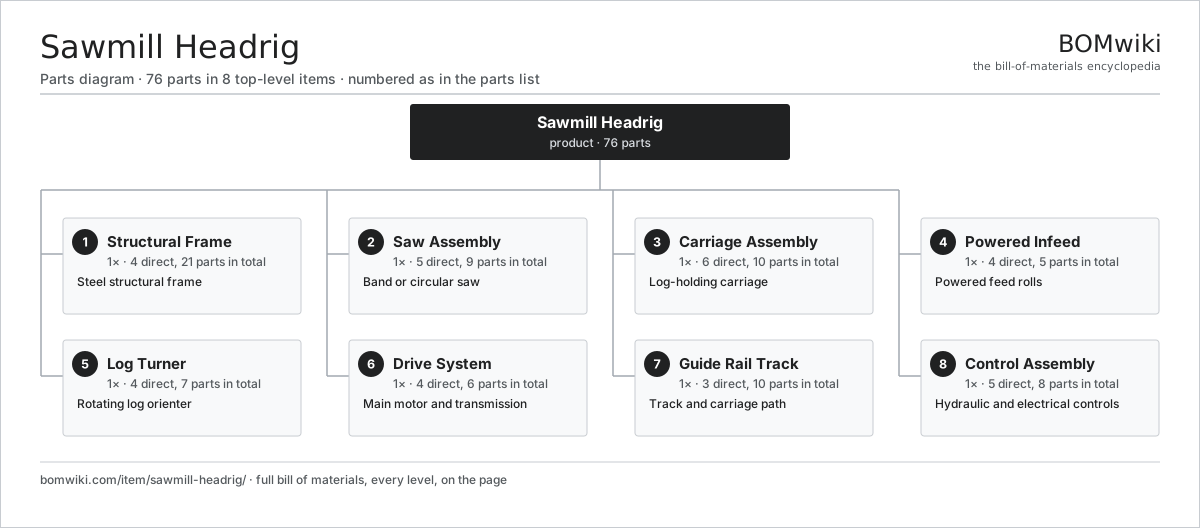
| # | Part | Qty | What it does |
|---|---|---|---|
| 1 | Structural Frame 4 parts | 1× | Steel structural frame |
| 2 | Saw Assembly 5 parts | 1× | Band or circular saw |
| 3 | Carriage Assembly 6 parts | 1× | Log-holding carriage |
| 4 | Powered Infeed 4 parts | 1× | Powered feed rolls |
| 5 | Log Turner 4 parts | 1× | Rotating log orienter |
| 6 | Drive System 4 parts | 1× | Main motor and transmission |
| 7 | Guide Rail Track 3 parts | 1× | Track and carriage path |
| 8 | Control Assembly 5 parts | 1× | Hydraulic and electrical controls |
3D model
No 3D model yet. Have a CAD file of this? Add a 3D model. STL renders right on this page; STEP, FreeCAD, and OpenSCAD sources are welcome too (openly licensed, like all 3D models on BOMwiki).
Build & assembly graph
expand / collapse · shared sub-assemblies converge · links to related products · est. labourTap an assembly to expand/collapse · tap a part to open it · use “Open page” for any node · drag to pan, scroll to zoom.
Bill of materials for Sawmill Headrig
8 top-level lines · 43 rows shown · 76 parts total · indented to 3 levels| # | Item / sub-assembly | Part no. | Qty/assy | Ext. qty | Parts | Type |
|---|---|---|---|---|---|---|
| 1 | Structural Frame 4 parts | sawmill-headrig-frame | 1× | 1 | 21 | assembly |
| 1.1 | Main Beam | sawmill-headrig-frame-beam | 4× | 4 | · | part |
| 1.2 | Cross Member | sawmill-headrig-frame-cross-member | 6× | 6 | · | part |
| 1.3 | Gusset Plate | sawmill-headrig-frame-gusset | 8× | 8 | · | part |
| 1.4 | Fastener Set | fastener-set | 3× | 3 | · | part |
| 2 | Saw Assembly 5 parts | sawmill-headrig-saw-assembly | 1× | 1 | 9 | assembly |
| 2.1 | Saw Blade | sawmill-headrig-saw-type | 1× | 1 | · | part |
| 2.2 | Saw Wheel | sawmill-headrig-saw-wheel | 2× | 2 | · | part |
| 2.3 | Saw Guide Block | sawmill-headrig-saw-guide | 1× | 1 | · | part |
| 2.4 | Saw Enclosure | sawmill-headrig-saw-housing | 1× | 1 | · | part |
| 2.5 | Ball Bearing | ball-bearing | 4× | 4 | · | part |
| 3 | Carriage Assembly 6 parts | sawmill-headrig-carriage | 1× | 1 | 10 | assembly |
| 3.1 | Carriage Platform | sawmill-headrig-carriage-base | 1× | 1 | · | part |
| 3.2 | Log Dog | sawmill-headrig-dog | 2× | 2 | · | part |
| 3.3 | Knee Clamp | sawmill-headrig-knee-clamp | 2× | 2 | · | part |
| 3.4 | Carriage Wheel | sawmill-headrig-wheel | 2× | 2 | · | part |
| 3.5 | Ball Bearing | ball-bearing | 2× | 2 | · | part |
| 3.6 | Hydraulic Pack | sawmill-headrig-hydraulic-pack | 1× | 1 | · | part |
| 4 | Powered Infeed 4 parts | sawmill-headrig-infeed-system | 1× | 1 | 5 | assembly |
| 4.1 | Infeed Roller | sawmill-headrig-infeed-roller | 2× | 2 | · | part |
| 4.2 | Speed Reducer | sawmill-headrig-speed-reducer | 1× | 1 | · | part |
| 4.3 | Motor Housing | motor-housing | 1× | 1 | · | part |
| 4.4 | Drive Belt | drive-belt | 1× | 1 | · | part |
| 5 | Log Turner 4 parts | sawmill-headrig-log-turner | 1× | 1 | 7 | assembly |
| 5.1 | Turner Spindle | sawmill-headrig-turner-spindle | 1× | 1 | · | part |
| 5.2 | Turner Gripper | sawmill-headrig-turner-gripper | 3× | 3 | · | part |
| 5.3 | Spindle Bearing | sawmill-headrig-turner-bearing | 2× | 2 | · | part |
| 5.4 | Turner Motor | sawmill-headrig-turner-motor | 1× | 1 | · | part |
| 6 | Drive System 4 parts | sawmill-headrig-drive-system | 1× | 1 | 6 | assembly |
| 6.1 | Main Motor | sawmill-headrig-main-motor | 1× | 1 | · | part |
| 6.2 | Main Gearbox | sawmill-headrig-gearbox | 1× | 1 | · | part |
| 6.3 | Shaft Coupling | sawmill-headrig-coupling | 2× | 2 | · | part |
| 6.4 | Drive Pulley | sawmill-headrig-pulley | 2× | 2 | · | part |
| 7 | Guide Rail Track 3 parts | sawmill-headrig-guide-rails | 1× | 1 | 10 | assembly |
| 7.1 | Guide Rail | sawmill-headrig-rail | 2× | 2 | · | part |
| 7.2 | Rail Support | sawmill-headrig-rail-support | 4× | 4 | · | part |
| 7.3 | Ball Bearing | ball-bearing | 4× | 4 | · | part |
| 8 | Control Assembly 5 parts | sawmill-headrig-control-panel | 1× | 1 | 8 | assembly |
| 8.1 | Hydraulic Valve | sawmill-headrig-hydraulic-valve | 3× | 3 | · | part |
| 8.2 | Relief Valve | sawmill-headrig-relief-valve | 1× | 1 | · | part |
| 8.3 | Pressure Sensor | pressure-sensor | 2× | 2 | · | part |
| 8.4 | Microcontroller | mcu | 1× | 1 | · | part |
| 8.5 | Bare PCB | pcb-bare | 1× | 1 | · | part |
Something wrong in this list? Report a problem with this BOM.
Related products
same domain, ranked by shared parts Cable Extrusion Line
46 parts · shares 5 with this page
Cable Extrusion Line
46 parts · shares 5 with this page
 Continuous Galvanizing Line
1,296 parts · shares 5 with this page
Continuous Galvanizing Line
1,296 parts · shares 5 with this page
 Decanter Centrifuge
172 parts · shares 5 with this page
Decanter Centrifuge
172 parts · shares 5 with this page
 Dynamic Balancing Machine
573 parts · shares 5 with this page
Dynamic Balancing Machine
573 parts · shares 5 with this page
Sourcing: possible vendors
Browse the supplier directory → Prices, MOQ, and lead times are algorithmic estimates, not quotes, and not claims about these companies. Company mappings are curated by keyword; est. price band $5k–$2M. How estimates work| Vendor | HQ | Specialty | MOQ | Lead time |
|---|---|---|---|---|
| atlascopco.com ↗ | Stockholm, SE | Compressors & industrial | 10 units | 12–20 wks |
|
🇦🇹Andritz
andritz.com ↗
|
Graz, AT | Process plants & machinery | 10 units | 12–20 wks |
| buhlergroup.com ↗ | Uzwil, CH | Food & materials processing | 10 units | 12–20 wks |
| gea.com ↗ | Düsseldorf, DE | Process technology | 10 units | 12–20 wks |
| mhi.com ↗ | Tokyo, JP | Heavy machinery | 10 units | 12–20 wks |
1,049-word article