Self-Balancing Personal Transporter
ProductOverview
The self-balancing personal transporter, the Segway PT, launched in 2001, is a standing vehicle with two wheels side by side and no static stability at all. Left to itself it falls over in under a second; powered up, it is an inverted pendulum actively balanced by its own wheels, the same control problem as balancing a broomstick on a palm. The rider commands speed simply by leaning: lean forward and the machine accelerates to keep the wheels under the combined center of mass, lean back and it slows or reverses. Steering is a second lean axis, through the handlebar column. The product never reached its forecast volumes, but its sensing and redundancy architecture became the template for hoverboards, electric unicycles and balancing robots.
The balance loop
About 100 times per second, the IMU Sensor Array measures the pitch angle and pitch rate of the chassis, and the Redundant Controller Set computes wheel torques that drive the wheels toward the falling direction. If the platform pitches forward 1 degree, the wheels accelerate forward until the wheelbase is back under the center of mass; the rider experiences this as the machine obediently following a lean. The control law is a stabilizing feedback on pitch and pitch rate plus terms on wheel speed, identical in structure to the textbook inverted-pendulum regulator, with gain scheduling for speed and rider mass.
The sensing is where the design earns its safety case. Five MEMS Rate Gyroscope MEMS rate gyroscopes are mounted at skewed angles on the IMU Carrier Board so that any pitch, roll or yaw rate is seen by several sensors at once; the redundancy lets the system detect a disagreeing gyro and outvote it. Two Accelerometer sensors provide the gravity reference that corrects long-term gyro drift, fused with the gyros through complementary filtering. The array lives in a vibration-isolated IMU Housing because MEMS gyros rectify vibration into false rate signals.
Fail-operational redundancy
A balancing vehicle cannot fail safe by shutting down, power loss at speed throws the rider. So every element in the torque path is duplicated. There are two identical Balance Controller Board units, each with two Microcontroller processors and its own Power MOSFET bridges, comparing computations every cycle over the Controller Crosslink. Each Dual-Winding Servo Motor is wound with two electrically independent Copper Winding phase sets, controller A drives one set in each motor, controller B the other, and either winding alone can produce full balancing torque. Two Battery Pack saddle packs of 73 V flank the platform, either sufficient to power a controlled stop. After any single fault the machine enters a "safety glide": it remains balanced, alerts the rider through the Speaker and Status Light Ring indicators, and enforces a slowdown to a stop within about ten seconds.
Drive
Each Wheel Drive Unit pairs the dual-winding servo motor with a two-stage helical Helical Gearbox of roughly 24:1, turning a 48 cm Wheel Assembly. The gearbox is a small acoustic curiosity: its two meshes were deliberately designed with tooth counts producing whine frequencies two octaves apart, so the unit hums a musical interval rather than a beat. An Encoder on each motor closes the velocity loop; with two motors controlled independently, turning is differential, the machine can rotate in place about its own axis, which is why it threads sidewalks and warehouse aisles better than anything with a steered wheel.
Steering and rider interface
The Lean-Steer Column pivots laterally about ±14 degrees at its Lean Pivot; redundant Lean Angle Sensor Halls read the angle as a yaw-rate command, scaled down with speed so a full lean at 20 km/h gives a gentle arc rather than a spin. The Handlebar carries no throttle or brake, there is nothing to actuate, since speed is the rider's posture. Four Foot Presence Sensor pads under the Deck Mat tell both controllers a rider is aboard; stepping off returns the machine to a parked attitude. Speed limiting is enforced by the only mechanism available to a lean-commanded vehicle: at the limit, the controller pitches the platform back against the rider's lean ("speed limiter tilt-back"), making further acceleration physically awkward.
Legacy
Production of the PT ended in 2020 after about 140,000 units in 19 years. The architecture outlived the product: the five-gyro voting array, dual-winding motors and fail-operational philosophy reappear in Segway-Ninebot's later self-balancing products, in electric unicycles, and in the balance stages of legged and two-wheeled robots. The machine remains the cleanest commercial demonstration that a statically unstable vehicle can be made safe through redundancy rather than mechanical stability.
Self-Balancing Personal Transporter parts and their functions
8 top-level parts · 402 parts in total · full bill of materials below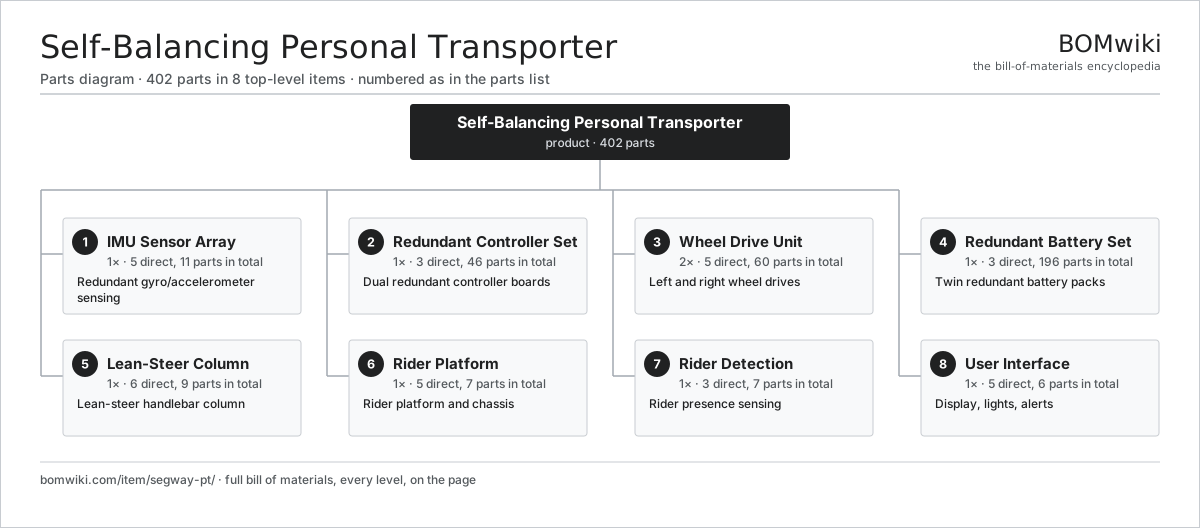
| # | Part | Qty | What it does |
|---|---|---|---|
| 1 | IMU Sensor Array 5 parts | 1× | Redundant gyro/accelerometer sensing |
| 2 | Redundant Controller Set 3 parts | 1× | Dual redundant controller boards |
| 3 | Wheel Drive Unit 5 parts | 2× | Left and right wheel drives |
| 4 | Redundant Battery Set 3 parts | 1× | Twin redundant battery packs |
| 5 | Lean-Steer Column 6 parts | 1× | Lean-steer handlebar column |
| 6 | Rider Platform 5 parts | 1× | Rider platform and chassis |
| 7 | Rider Detection 3 parts | 1× | Rider presence sensing |
| 8 | User Interface 5 parts | 1× | Display, lights, alerts |
3D model
No 3D model yet. Have a CAD file of this? Add a 3D model. STL renders right on this page; STEP, FreeCAD, and OpenSCAD sources are welcome too (openly licensed, like all 3D models on BOMwiki).
Build & assembly graph
expand / collapse · shared sub-assemblies converge · links to related products · est. labourTap an assembly to expand/collapse · tap a part to open it · use “Open page” for any node · drag to pan, scroll to zoom.
Bill of materials for Self-Balancing Personal Transporter
8 top-level lines · 69 rows shown · 402 parts total · indented to 3 levels| # | Item / sub-assembly | Part no. | Qty/assy | Ext. qty | Parts | Type |
|---|---|---|---|---|---|---|
| 1 | IMU Sensor Array 5 parts | segway-pt-imu-array | 1× | 1 | 11 | assembly |
| 1.1 | MEMS Rate Gyroscope | segway-pt-gyro | 5× | 5 | · | part |
| 1.2 | Accelerometer | segway-pt-accelerometer | 2× | 2 | · | part |
| 1.3 | IMU Carrier Board | segway-pt-imu-board | 1× | 1 | · | part |
| 1.4 | IMU Housing | segway-pt-imu-housing | 1× | 1 | · | part |
| 1.5 | Connector | connector | 2× | 2 | · | part |
| 2 | Redundant Controller Set 3 parts | segway-pt-controller-set | 1× | 1 | 46 | assembly |
| 2.1 | Balance Controller Board 5 parts | segway-pt-controller-board | 2× | 2 | 22 | assembly |
| 2.1.1 | Bare PCB | pcb-bare | 1× | 2 | · | part |
| 2.1.2 | Microcontroller | mcu | 2× | 4 | · | part |
| 2.1.3 | Power MOSFET | mosfet | 12× | 24 | · | part |
| 2.1.4 | SMD Passive (R/C/L) | smd-passives | 1× | 2 | · | part |
| 2.1.5 | Connector | connector | 6× | 12 | · | part |
| 2.2 | Controller Crosslink | segway-pt-crosslink | 1× | 1 | · | part |
| 2.3 | Electronics Tray | segway-pt-controller-tray | 1× | 1 | · | part |
| 3 | Wheel Drive Unit 5 parts | segway-pt-drive-unit | 2× | 2 | 60 | assembly |
| 3.1 | Dual-Winding Servo Motor 7 parts | segway-pt-drive-motor | 1× | 2 | 42 | assembly |
| 3.1.1 | Motor Housing | motor-housing | 1× | 2 | · | part |
| 3.1.2 | Stator Assembly 3 parts + deeper › | stator-assembly | 1× | 2 | 3 | assembly |
| 3.1.3 | Copper Winding | copper-winding | 2× | 4 | · | part |
| 3.1.4 | Rotor Assembly 4 parts + deeper › | rotor-assembly | 1× | 2 | 19 | assembly |
| 3.1.5 | Neodymium Magnet | neodymium-magnet | 12× | 24 | · | part |
| 3.1.6 | Hall Sensor | hall-sensor | 3× | 6 | · | part |
| 3.1.7 | Ball Bearing | ball-bearing | 2× | 4 | · | part |
| 3.2 | Helical Gearbox 4 parts | segway-pt-gearbox | 1× | 2 | 7 | assembly |
| 3.2.1 | Gearbox Housing | gearbox-housing | 1× | 2 | · | part |
| 3.2.2 | Helical Gear Pair | gear-pair | 2× | 4 | · | part |
| 3.2.3 | Ball Bearing | ball-bearing | 3× | 6 | · | part |
| 3.2.4 | Oil Seal | oil-seal | 1× | 2 | · | part |
| 3.3 | Wheel Assembly 5 parts | wheel-assembly | 1× | 2 | 9 | assembly |
| 3.3.1 | Alloy Wheel | alloy-wheel | 1× | 2 | · | part |
| 3.3.2 | Tire | tire | 1× | 2 | · | part |
| 3.3.3 | TPMS Sensor | tpms-sensor | 1× | 2 | · | part |
| 3.3.4 | Lug Nut | lug-nut | 5× | 10 | · | part |
| 3.3.5 | Valve Stem | valve-stem | 1× | 2 | · | part |
| 3.4 | Encoder | encoder | 1× | 2 | · | part |
| 3.5 | Oil Seal | oil-seal | 1× | 2 | · | part |
| 4 | Redundant Battery Set 3 parts | segway-pt-battery-set | 1× | 1 | 196 | assembly |
| 4.1 | Battery Pack 5 parts | segway-pt-battery-pack | 2× | 2 | 96 | assembly |
| 4.1.1 | Li-ion Cell, 18650 | li-cell-18650 | 92× | 184 | · | part |
| 4.1.2 | BMS Board | bms-board | 1× | 2 | · | part |
| 4.1.3 | Pack Case | segway-pt-pack-case | 1× | 2 | · | part |
| 4.1.4 | Thermal Fuse | thermal-fuse | 1× | 2 | · | part |
| 4.1.5 | Wire Bundle | wire-bundle | 1× | 2 | · | part |
| 4.2 | Battery Mounting Rail | segway-pt-battery-rail | 2× | 2 | · | part |
| 4.3 | Connector | connector | 2× | 2 | · | part |
| 5 | Lean-Steer Column 6 parts | segway-pt-lean-column | 1× | 1 | 9 | assembly |
| 5.1 | Column Tube | segway-pt-column-tube | 1× | 1 | · | part |
| 5.2 | Handlebar | segway-pt-handlebar | 1× | 1 | · | part |
| 5.3 | Lean Pivot | segway-pt-lean-pivot | 1× | 1 | · | part |
| 5.4 | Lean Angle Sensor | segway-pt-lean-sensor | 2× | 2 | · | part |
| 5.5 | Column Centering Spring | segway-pt-centering-spring | 2× | 2 | · | part |
| 5.6 | Ball Bearing | ball-bearing | 2× | 2 | · | part |
| 6 | Rider Platform 5 parts | segway-pt-platform | 1× | 1 | 7 | assembly |
| 6.1 | Chassis Casting | segway-pt-chassis-casting | 1× | 1 | · | part |
| 6.2 | Deck Mat | segway-pt-deck-mat | 2× | 2 | · | part |
| 6.3 | Wheel Fender | segway-pt-fender | 2× | 2 | · | part |
| 6.4 | Skid Plate | segway-pt-skid-plate | 1× | 1 | · | part |
| 6.5 | Fastener Set | fastener-set | 1× | 1 | · | part |
| 7 | Rider Detection 3 parts | segway-pt-rider-detect | 1× | 1 | 7 | assembly |
| 7.1 | Foot Presence Sensor | segway-pt-foot-sensor | 4× | 4 | · | part |
| 7.2 | Rider Detect Board | segway-pt-detect-board | 1× | 1 | · | part |
| 7.3 | Connector | connector | 2× | 2 | · | part |
| 8 | User Interface 5 parts | segway-pt-ui | 1× | 1 | 6 | assembly |
| 8.1 | LCD Panel | lcd-panel | 1× | 1 | · | part |
| 8.2 | Wireless InfoKey | segway-pt-infokey | 1× | 1 | · | part |
| 8.3 | Speaker | speaker | 1× | 1 | · | part |
| 8.4 | Status Light Ring | segway-pt-light-ring | 2× | 2 | · | part |
| 8.5 | Wire Bundle | wire-bundle | 1× | 1 | · | part |
Something wrong in this list? Report a problem with this BOM.
Related products
same domain, ranked by shared parts Electric Motorcycle
1,278 parts · shares 21 with this page
Battery-Swap Electric Moped
426 parts · shares 18 with this page
Electric Unicycle
176 parts · shares 14 with this page
Electric Motorcycle
1,278 parts · shares 21 with this page
Battery-Swap Electric Moped
426 parts · shares 18 with this page
Electric Unicycle
176 parts · shares 14 with this page
 Hoverboard
399 parts · shares 14 with this page
Hoverboard
399 parts · shares 14 with this page
 Electric Skateboard
215 parts · shares 14 with this page
Electric Skateboard
215 parts · shares 14 with this page
Sourcing: possible vendors
Browse the supplier directory → Prices, MOQ, and lead times are algorithmic estimates, not quotes, and not claims about these companies. Company mappings are curated by keyword; est. price band $300–$15k. How estimates work| Vendor | HQ | Specialty | MOQ | Lead time |
|---|---|---|---|---|
| global.honda ↗ | Tokyo, JP | Motorcycles & power products | made to order | 10–16 wks |
| yamaha-motor.com ↗ | Iwata, JP | Motorcycles & marine | made to order | 10–16 wks |
| heromotocorp.com ↗ | New Delhi, IN | Motorcycle & scooter maker | made to order | 10–16 wks |
| bajajauto.com ↗ | Pune, IN | Two- & three-wheeler maker | made to order | 10–16 wks |
| harley-davidson.com ↗ | Milwaukee, US | Motorcycles | made to order | 10–16 wks |
800-word article