Thermoforming Machine
ProductOverview
Thermoforming is the simplest and lowest-cost method for producing plastic parts from rigid sheet stock. A flat plastic sheet is heated to softening (130–180 °C depending on material), draped over a mold cavity using vacuum suction and optional mechanical plug assistance, then cooled and trimmed. The result is a formed part with little or no waste, making thermoforming ideal for custom packaging (food trays, clamshell cases), signage, and decorative panels.
Process
Heating
The plastic sheet is clamped in a frame and positioned beneath an array of electric infrared heaters. Lamps (typically nichrome wire or quartz elements, 1500–3000 W each) radiate heat downward, softening the sheet uniformly in 5–15 seconds depending on thickness and material.
Temperature control is critical: too cool, and the sheet will not stretch evenly (undrawn regions remain stiff); too hot, and the sheet becomes rubbery, loses dimensional control, and may sag under its own weight.
Vacuum Forming
Once the sheet reaches optimal softness (typically 10–20 °C above the material's glass-transition temperature), the heated sheet is rapidly transferred over the mold cavity. A vacuum pump (0.3–0.8 bar below atmospheric pressure) is activated, sucking the sheet downward against the cavity walls. The sheet conforms to the mold shape in 0.5–2 seconds.
The low-pressure suction (≈0.7 bar × 0.1 m² = ~7 ton pulling force for a 10 cm² part) is sufficient for most shallow-draw parts but becomes inadequate for deep cavities with undercuts.
Plug Assist (Optional)
For deeper draw depths (>50 mm or 3–4× part width), a mechanical plug, a male form matching the part cavity shape, is driven downward into the preheated sheet just before vacuum activation. This pre-stretches the sheet and distributes material more evenly across the cavity, preventing excessive thinning near the cavity entrance.
Plug materials include hardened steel (most common), aluminum (lighter, faster cooling), or composite (low friction, reduced sheet marking).
Cooling & Ejection
Cooling water (typically 15–30 °C) is sprayed onto the mold or circulated through cooling galleries. Cooling time is 10–30 seconds depending on part thickness and material thermal conductivity. Once cooled and solidified, the sheet (now with the formed part) is ejected from the mold.
Flash (excess material at the parting line) is trimmed manually or via a CNC routing station. The trimmed part is then inspected, stacked, or packaged.
Materials
HIPS (High-Impact Polystyrene)
Most common thermoforming material. Excellent rigidity, good clarity, easily colored. Thermoforming temperature ≈115–125 °C. Low cost (~$1–2/kg). Used for food trays, hinged clamshells, display cases.
PP (Polypropylene)
Higher melting point (160 °C) and stiffness than HIPS. Better chemical resistance and lower density (lighter parts). Slightly higher cost ($1.5–3/kg). Used for durable food containers, automotive trim.
PET (Polyethylene Terephthalate)
Premium thermoforming material. High transparency, stiffness, and barrier properties. Thermoforming temperature ~85–95 °C (must be carefully controlled to avoid crystallization). Cost ~$3–5/kg. Used for premium food packaging and beverage trays.
ABS (Acrylonitrile Butadiene Styrene)
High-gloss appearance, excellent dimensional stability. Thermoforming temperature ≈115–120 °C. Cost ~$2–4/kg. Used for decorative trim, automotive panels, appliance covers.
Advantages
- Low capital cost: Thermoforming machines are simpler and cheaper than injection molding or blow molding equipment ($50k–$200k).
- Fast mold turnaround: Molds can be carved from aluminum or composite (epoxy resin + fiberglass) in days vs. weeks for steel injection molds.
- Minimal waste: Unlike injection molding (10–20% sprue/runner waste), thermoforming generates only edge trim and flash.
- Complex shapes achievable: Thermoforming excels at large, shallow-draw parts (e.g., food trays 300 × 200 × 50 mm) with complex contours.
- Custom/low-volume production: Short lead time makes thermoforming ideal for prototypes and short runs (100–10,000 parts).
Limitations
- Slow for large volumes: Cycle times 10–60 seconds are slow compared to injection molding (~30 seconds for large parts) or blow molding (~5 seconds). Output typically 20–120 parts/minute.
- Limited wall thickness control: Vacuum forming stretches material unevenly, resulting in thinner walls near cavity entrance and thicker walls at depth.
- Shallow-draw limitation: Deep cavities (>100 mm depth on small molds) are difficult without skilled plug design.
- Secondary trimming: Flash removal adds labor cost if not automated.
Machine Types
Shuttle Machines
Single mold cavity with a shuttle mechanism: sheet heats on one side while parts cool and eject on the other. Simple, common for small shops.
Carousel Machines
Multi-station rotating carousel (4–8 stations) with separate heating, forming, and cooling zones. Higher throughput but more complex control.
Inline Machines
Continuous sheet feed (from roll or stack) through heating zone, then formed, cooled, and trimmed automatically. Used for high-volume commodity products (food trays, hinged clamshells). Output 50–120 parts/minute with minimal manual labor.
Design Considerations
Draft Angle
Molds must include a slight draft angle (2–5°) to allow parts to release cleanly without sticking.
Wall Thickness Uniformity
Because of uneven stretching, thermoformed parts exhibit varying wall thickness. Good design minimizes this by optimizing plug geometry and draw depth.
Gate/Vent Locations
Vacuum ports (small holes in mold) must be positioned to pull air uniformly; vents prevent trapped air pockets that result in under-formed regions.
Sustainability
Thermoforming generates post-consumer waste (trims, failed parts) that is difficult to recycle because mixed geometry and thickness. However, off-spec or post-consumer thermoformed parts can be re-pelletized and fed back into the extruder as regrind material, reducing waste cost by ~30–50%.
Typical Cost Structure
Material cost: 40–50% (sheet cost ~$2–4/kg) Labor (including trim): 30–40% Energy + depreciation: 10–20% Retail price: 2–4× manufacturing cost
For a clamshell food container weighing 5 g:
- Material: ~$0.01 (5 g × $2/kg)
- Labor + overhead: ~$0.02
- Total: ~$0.03 (wholesale); retail $0.08–$0.15
Thermoforming Machine parts and their functions
8 top-level parts · 82 parts in total · full bill of materials below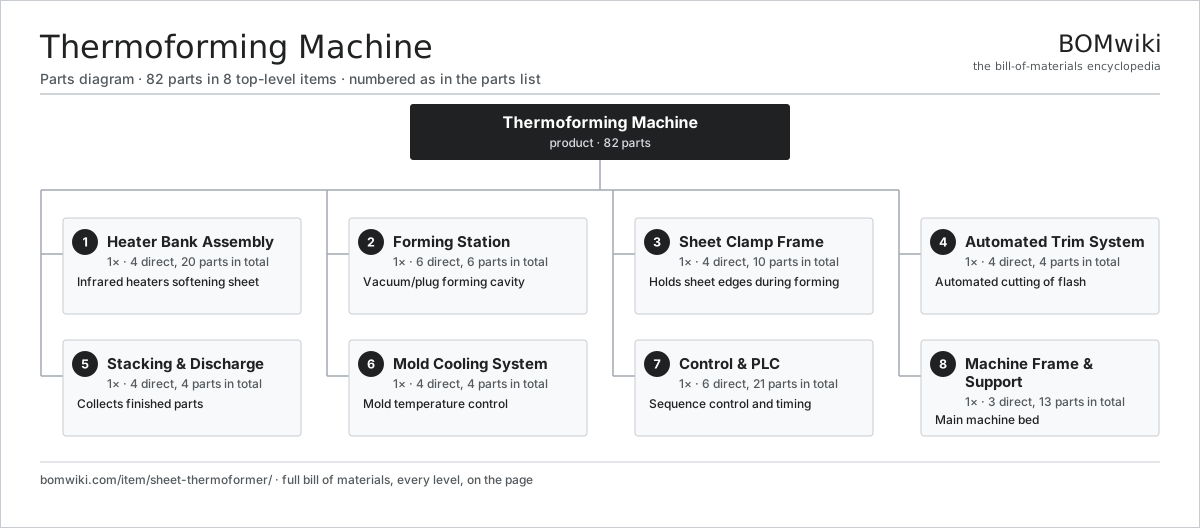
| # | Part | Qty | What it does |
|---|---|---|---|
| 1 | Heater Bank Assembly 4 parts | 1× | Infrared heaters softening sheet |
| 2 | Forming Station 6 parts | 1× | Vacuum/plug forming cavity |
| 3 | Sheet Clamp Frame 4 parts | 1× | Holds sheet edges during forming |
| 4 | Automated Trim System 4 parts | 1× | Automated cutting of flash |
| 5 | Stacking & Discharge 4 parts | 1× | Collects finished parts |
| 6 | Mold Cooling System 4 parts | 1× | Mold temperature control |
| 7 | Control & PLC 6 parts | 1× | Sequence control and timing |
| 8 | Machine Frame & Support 3 parts | 1× | Main machine bed |
3D model
No 3D model yet. Have a CAD file of this? Add a 3D model. STL renders right on this page; STEP, FreeCAD, and OpenSCAD sources are welcome too (openly licensed, like all 3D models on BOMwiki).
Build & assembly graph
expand / collapse · shared sub-assemblies converge · links to related products · est. labourTap an assembly to expand/collapse · tap a part to open it · use “Open page” for any node · drag to pan, scroll to zoom.
Bill of materials for Thermoforming Machine
8 top-level lines · 43 rows shown · 82 parts total · indented to 3 levels| # | Item / sub-assembly | Part no. | Qty/assy | Ext. qty | Parts | Type |
|---|---|---|---|---|---|---|
| 1 | Heater Bank Assembly 4 parts | sheet-thermoformer-heater-bank | 1× | 1 | 20 | assembly |
| 1.1 | Heating Element | heating-element | 16× | 16 | · | part |
| 1.2 | Reflector Panel | sheet-thermoformer-reflector-panel | 1× | 1 | · | part |
| 1.3 | Heater Controller | sheet-thermoformer-heater-controller | 1× | 1 | · | part |
| 1.4 | Temperature Sensor | temperature-sensor | 2× | 2 | · | part |
| 2 | Forming Station 6 parts | sheet-thermoformer-forming-station | 1× | 1 | 6 | assembly |
| 2.1 | Forming Mold | sheet-thermoformer-forming-mold | 1× | 1 | · | part |
| 2.2 | Vacuum Pump | sheet-thermoformer-vacuum-pump | 1× | 1 | · | part |
| 2.3 | Vacuum Manifold | sheet-thermoformer-vacuum-manifold | 1× | 1 | · | part |
| 2.4 | Forming Plug | sheet-thermoformer-plug-core | 1× | 1 | · | part |
| 2.5 | Plug Actuator | sheet-thermoformer-plug-actuator | 1× | 1 | · | part |
| 2.6 | Pressure Sensor | pressure-sensor | 1× | 1 | · | part |
| 3 | Sheet Clamp Frame 4 parts | sheet-thermoformer-clamp-frame | 1× | 1 | 10 | assembly |
| 3.1 | Clamp Platen | sheet-thermoformer-clamp-platen | 1× | 1 | · | part |
| 3.2 | Clamp Cylinder | sheet-thermoformer-clamp-cylinder | 1× | 1 | · | part |
| 3.3 | Linear Guide Bushing | sheet-thermoformer-clamp-bushings | 4× | 4 | · | part |
| 3.4 | Ball Bearing | ball-bearing | 4× | 4 | · | part |
| 4 | Automated Trim System 4 parts | sheet-thermoformer-trim-unit | 1× | 1 | 4 | assembly |
| 4.1 | Trim Blade | sheet-thermoformer-trim-blade | 1× | 1 | · | part |
| 4.2 | Trim Drive Motor | sheet-thermoformer-trim-motor | 1× | 1 | · | part |
| 4.3 | Trim Gearbox | sheet-thermoformer-trim-gearbox | 1× | 1 | · | part |
| 4.4 | Cam Follower Guide | sheet-thermoformer-trim-guide | 1× | 1 | · | part |
| 5 | Stacking & Discharge 4 parts | sheet-thermoformer-stacking-system | 1× | 1 | 4 | assembly |
| 5.1 | Vacuum Gripper | sheet-thermoformer-pneumatic-gripper | 1× | 1 | · | part |
| 5.2 | Gripper Solenoid | sheet-thermoformer-gripper-actuator | 1× | 1 | · | part |
| 5.3 | Transfer Conveyor | sheet-thermoformer-conveyor-belt | 1× | 1 | · | part |
| 5.4 | Stacking Magazine | sheet-thermoformer-stacking-magazine | 1× | 1 | · | part |
| 6 | Mold Cooling System 4 parts | sheet-thermoformer-cooling-circuit | 1× | 1 | 4 | assembly |
| 6.1 | Chiller Unit | extrusion-blow-molder-chiller-unit | 1× | 1 | · | part |
| 6.2 | Coolant Pump | extrusion-blow-molder-pump | 1× | 1 | · | part |
| 6.3 | Cooling Gallery Passages | extrusion-blow-molder-mold-cooling-lines | 1× | 1 | · | part |
| 6.4 | Flow Meter | extrusion-blow-molder-flow-meter | 1× | 1 | · | part |
| 7 | Control & PLC 6 parts | sheet-thermoformer-control-system | 1× | 1 | 21 | assembly |
| 7.1 | Microcontroller | mcu | 1× | 1 | · | part |
| 7.2 | Bare PCB | pcb-bare | 2× | 2 | · | part |
| 7.3 | LCD Panel | lcd-panel | 1× | 1 | · | part |
| 7.4 | Relay | relay | 12× | 12 | · | part |
| 7.5 | Power Supply | power-supply | 1× | 1 | · | part |
| 7.6 | Temperature Sensor | temperature-sensor | 4× | 4 | · | part |
| 8 | Machine Frame & Support 3 parts | sheet-thermoformer-frame-structure | 1× | 1 | 13 | assembly |
| 8.1 | Machine Bed | sheet-thermoformer-machine-bed | 1× | 1 | · | part |
| 8.2 | Support Column | sheet-thermoformer-column-support | 2× | 2 | · | part |
| 8.3 | Fastener Set | fastener-set | 10× | 10 | · | part |
Something wrong in this list? Report a problem with this BOM.
Related products
same domain, ranked by shared parts Profile Extrusion Line
78 parts · shares 9 with this page
Extrusion Blow Molding Machine
71 parts · shares 9 with this page
Profile Extrusion Line
78 parts · shares 9 with this page
Extrusion Blow Molding Machine
71 parts · shares 9 with this page
 Injection Blow Molding Machine
54 parts · shares 9 with this page
Stretch Blow Molder
62 parts · shares 8 with this page
Injection Blow Molding Machine
54 parts · shares 9 with this page
Stretch Blow Molder
62 parts · shares 8 with this page
 Pipe Extrusion Line
85 parts · shares 8 with this page
Pipe Extrusion Line
85 parts · shares 8 with this page
Sourcing: possible vendors
Browse the supplier directory → Prices, MOQ, and lead times are algorithmic estimates, not quotes, and not claims about these companies. Company mappings are curated by keyword; est. price band $5k–$2M. How estimates work| Vendor | HQ | Specialty | MOQ | Lead time |
|---|---|---|---|---|
| atlascopco.com ↗ | Stockholm, SE | Compressors & industrial | 10 units | 12–20 wks |
|
🇦🇹Andritz
andritz.com ↗
|
Graz, AT | Process plants & machinery | 10 units | 12–20 wks |
| buhlergroup.com ↗ | Uzwil, CH | Food & materials processing | 10 units | 12–20 wks |
| gea.com ↗ | Düsseldorf, DE | Process technology | 10 units | 12–20 wks |
| mhi.com ↗ | Tokyo, JP | Heavy machinery | 10 units | 12–20 wks |
964-word article