Shotgun Microphone
ProductOverview
The shotgun microphone is a highly directional condenser pickup used in broadcast, film, and video production to capture sound from a single source while rejecting room reflections and ambient noise. Its distinctive supercardioid-to-hypercardioid polar pattern results from an Interference Tube, a slotted acoustic resonator that makes rear and side sounds interfere destructively while on-axis sound reaches the Cardioid Condenser Capsule constructively. The result is a pickup that narrows as frequency rises, delivering clean dialogue recording and focused environmental sound in noisy settings.
How it Works
Interference Tube Design
The Interference Tube contains a series of precision-drilled Slotted Baffle Plate arranged axially along a 25 cm tube. Sound entering the Front Endcap mesh travels straight to the capsule; simultaneously, off-axis sound waves enter the slots and travel through internal passages at different path lengths. The slot spacing is tuned so that off-axis sound arriving at the rear of the capsule is 180° out of phase with the direct sound, causing cancellation. This geometric phase-shifting is frequency-dependent: lower frequencies are less efficiently rejected (cancellation requires slots spaced at wavelength intervals), while higher frequencies above 2 kHz exhibit near-total off-axis suppression.
Cardioid Capsule
The Cardioid Condenser Capsule is a back-electret design, a Diaphragm coated with a permanently charged polymer layer that maintains a constant electrical field between itself and the Backplate. When sound vibrates the diaphragm, the capacitance between diaphragm and backplate changes, modulating a DC bias voltage supplied by the Phantom Power Circuit phantom power network. The resulting signal is a low-level AC voltage (microvolts) mirroring the original pressure wave.
Directionality
The Acoustic Vent Port at the capsule rear allows sound to reach the back of the diaphragm, creating a passive cardioid response. The interference tube extends this directionality: its slots create a lobing pattern that narrows with frequency. At 1 kHz, the microphone exhibits supercardioid rejection (>25 dB attenuation at 180°); at 4 kHz, it approaches hypercardioid (near-zero pickup directly behind the microphone).
Preamplifier
The Preamplifier Module houses a low-noise Input Transformer matching the capsule's high impedance (>1 MΩ) to a buffer amplifier, and a Line Driver IC IC delivering a balanced, low-impedance XLR output at line level (−35 dBV nominal becomes +4 dBu at the connector). The preamp also extracts phantom power from the XLR cable's pins 2 and 3 via a Bias Resistor Array, applying that 48 V to the capsule backplate and internal biasing networks.
Shock Isolation
The Shock Mount and Bracket surrounds the microphone with elastomer rings that absorb vibration from camera rigs, tripods, and handling. The mount includes a Ball Joint Swivel permitting rapid angle adjustment without detaching the microphone from the camera or boompole.
Wind Rejection
The Windscreen Sleeve is a 2 cm layer of open-cell polyurethane foam. Wind flowing across the microphone creates pressure fluctuations; the foam's cell structure disrupts coherent airflow, converting kinetic energy into heat. The Foam Mesh Cover breathable nylon mesh retains the foam while allowing normal sound passage. Windscreens reduce wind rumble by 10–15 dB, critical for outdoor recording.
Polar Pattern and Frequency
Shotgun microphones exhibit frequency-dependent directionality. At low frequencies (250 Hz), the pattern approximates cardioid; at mid frequencies (1 kHz), it tightens to supercardioid; at high frequencies (4 kHz and above), it approaches hypercardioid with a sharp null at 180°. This means off-axis dialogue is progressively attenuated at higher frequencies, reducing room reflections while maintaining bass reverb presence.
Mounting and Operator Techniques
In film and broadcast, shotgun microphones are mounted on boompoles held by recordists positioned just outside the frame, angling the Shock Mount and Bracket to point at the talent. The interference tube must be aimed within approximately 30° of the sound source's axial direction for optimal rejection. Rotating the microphone by 90° degrades directional performance. The cable is typically routed through a microphone cable with low-impedance, oxygen-free copper twisted pair to minimize RF ingress and maintain signal fidelity.
Comparison with Omnidirectional Microphones
Omnidirectional microphones pick up equally from all directions and rely on close placement (within 30 cm) to preserve the direct-to-ambient ratio. Shotgun microphones permit placement further away (0.5–2 meters) while maintaining high direct-sound pickup and off-axis rejection. This distance permits boompoles to remain outside camera framing during cinema production and offers safe stand-off distance from wildlife in nature recording.
Maintenance
The Windscreen Sleeve should be washed in lukewarm soapy water and air-dried regularly; compressed air can temporarily restore foam compliance. The Aluminum Tube interior should be inspected for dust; if necessary, a soft brush or compressed air removes debris without disturbing the slotted baffles. XLR connectors should be stored with protective caps and exercised periodically (mated and unmated) to prevent corrosion.
Shotgun Microphone parts and their functions
8 top-level parts · 41 parts in total · full bill of materials below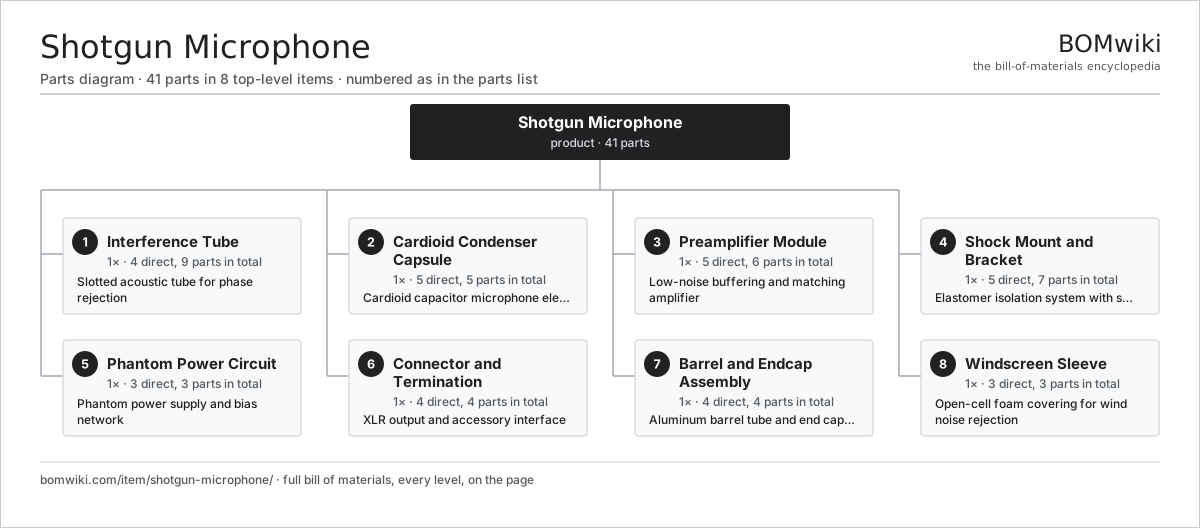
| # | Part | Qty | What it does |
|---|---|---|---|
| 1 | Interference Tube 4 parts | 1× | Slotted acoustic tube for phase rejection |
| 2 | Cardioid Condenser Capsule 5 parts | 1× | Cardioid capacitor microphone element |
| 3 | Preamplifier Module 5 parts | 1× | Low-noise buffering and matching amplifier |
| 4 | Shock Mount and Bracket 5 parts | 1× | Elastomer isolation system with swivel bracket |
| 5 | Phantom Power Circuit 3 parts | 1× | Phantom power supply and bias network |
| 6 | Connector and Termination 4 parts | 1× | XLR output and accessory interface |
| 7 | Barrel and Endcap Assembly 4 parts | 1× | Aluminum barrel tube and end cap assembly |
| 8 | Windscreen Sleeve 3 parts | 1× | Open-cell foam covering for wind noise rejection |
3D model
No 3D model yet. Have a CAD file of this? Add a 3D model. STL renders right on this page; STEP, FreeCAD, and OpenSCAD sources are welcome too (openly licensed, like all 3D models on BOMwiki).
Build & assembly graph
expand / collapse · shared sub-assemblies converge · links to related products · est. labourTap an assembly to expand/collapse · tap a part to open it · use “Open page” for any node · drag to pan, scroll to zoom.
Bill of materials for Shotgun Microphone
8 top-level lines · 41 rows shown · 41 parts total · indented to 3 levels| # | Item / sub-assembly | Part no. | Qty/assy | Ext. qty | Parts | Type |
|---|---|---|---|---|---|---|
| 1 | Interference Tube 4 parts | shotgun-microphone-interference-tube | 1× | 1 | 9 | assembly |
| 1.1 | Aluminum Tube | shotgun-microphone-tube-barrel | 1× | 1 | · | part |
| 1.2 | Slotted Baffle Plate | shotgun-microphone-slot-baffle | 6× | 6 | · | part |
| 1.3 | Fastener Set | fastener-set | 1× | 1 | · | part |
| 1.4 | Front Endcap | shotgun-microphone-endcap-front | 1× | 1 | · | part |
| 2 | Cardioid Condenser Capsule 5 parts | shotgun-microphone-condenser-capsule | 1× | 1 | 5 | assembly |
| 2.1 | Diaphragm | shotgun-microphone-diaphragm | 1× | 1 | · | part |
| 2.2 | Backplate | shotgun-microphone-backplate | 1× | 1 | · | part |
| 2.3 | Capsule Housing | shotgun-microphone-capsule-body | 1× | 1 | · | part |
| 2.4 | Fastener Set | fastener-set | 1× | 1 | · | part |
| 2.5 | Acoustic Vent Port | shotgun-microphone-acoustic-port | 1× | 1 | · | part |
| 3 | Preamplifier Module 5 parts | shotgun-microphone-preamp-stage | 1× | 1 | 6 | assembly |
| 3.1 | Bare PCB | pcb-bare | 1× | 1 | · | part |
| 3.2 | Input Transformer | shotgun-microphone-input-transformer | 1× | 1 | · | part |
| 3.3 | Line Driver IC | shotgun-microphone-output-driver | 1× | 1 | · | part |
| 3.4 | SMD Passive (R/C/L) | smd-passives | 2× | 2 | · | part |
| 3.5 | Connector | connector | 1× | 1 | · | part |
| 4 | Shock Mount and Bracket 5 parts | shotgun-microphone-shock-mount | 1× | 1 | 7 | assembly |
| 4.1 | Elastomer Mount | shotgun-microphone-elastomer-insert | 1× | 1 | · | part |
| 4.2 | Aluminum Bracket | shotgun-microphone-bracket-arm | 1× | 1 | · | part |
| 4.3 | Ball Joint Swivel | shotgun-microphone-ball-joint | 1× | 1 | · | part |
| 4.4 | Fastener Set | fastener-set | 2× | 2 | · | part |
| 4.5 | Coil Spring | coil-spring | 2× | 2 | · | part |
| 5 | Phantom Power Circuit 3 parts | shotgun-microphone-power-supply | 1× | 1 | 3 | assembly |
| 5.1 | Bias Resistor Array | shotgun-microphone-bias-resistor-array | 1× | 1 | · | part |
| 5.2 | Blocking Capacitor | shotgun-microphone-blocking-capacitor | 1× | 1 | · | part |
| 5.3 | Supply Filter Network | shotgun-microphone-supply-filter | 1× | 1 | · | part |
| 6 | Connector and Termination 4 parts | shotgun-microphone-connector-block | 1× | 1 | 4 | assembly |
| 6.1 | Connector | connector | 1× | 1 | · | part |
| 6.2 | Pad Switch | shotgun-microphone-pad-switch | 1× | 1 | · | part |
| 6.3 | XLR Boot | shotgun-microphone-connector-housing | 1× | 1 | · | part |
| 6.4 | Fastener Set | fastener-set | 1× | 1 | · | part |
| 7 | Barrel and Endcap Assembly 4 parts | shotgun-microphone-housing | 1× | 1 | 4 | assembly |
| 7.1 | Aluminum Tube | shotgun-microphone-tube-barrel | 1× | 1 | · | part |
| 7.2 | Front Endcap | shotgun-microphone-endcap-front | 1× | 1 | · | part |
| 7.3 | Rear Endcap | shotgun-microphone-endcap-rear | 1× | 1 | · | part |
| 7.4 | Fastener Set | fastener-set | 1× | 1 | · | part |
| 8 | Windscreen Sleeve 3 parts | shotgun-microphone-foam-windscreen | 1× | 1 | 3 | assembly |
| 8.1 | Foam Core | shotgun-microphone-foam-core | 1× | 1 | · | part |
| 8.2 | Foam Mesh Cover | shotgun-microphone-foam-cover | 1× | 1 | · | part |
| 8.3 | Fastener Set | fastener-set | 1× | 1 | · | part |
Something wrong in this list? Report a problem with this BOM.
Related products
same domain, ranked by shared parts


Sourcing: possible vendors
Browse the supplier directory → Prices, MOQ, and lead times are algorithmic estimates, not quotes, and not claims about these companies. Company mappings are curated by keyword; est. price band $50–$3k. How estimates work| Vendor | HQ | Specialty | MOQ | Lead time |
|---|---|---|---|---|
|
🇯🇵Sony
sony.com ↗
|
Tokyo, JP | Consumer electronics | 1,000 units | 8–12 wks |
| samsung.com ↗ | Suwon, KR | Electronics & displays | 1,000 units | 8–12 wks |
|
🇺🇸Harman
harman.com ↗
|
Stamford, US | Audio (JBL, AKG) | 1,000 units | 8–12 wks |
|
🇺🇸Bose
bose.com ↗
|
Framingham, US | Audio | 1,000 units | 8–12 wks |
| yamaha.com ↗ | Hamamatsu, JP | Audio & instruments | 1,000 units | 8–12 wks |
831-word article