SMT Stencil Printer
ProductOverview
The stencil printer is the first process step in surface-mount assembly, applying solder paste, a mixture of tiny solder powder particles suspended in tacky flux, precisely onto PCB pads. A stainless steel stencil (cut to the exact pad pattern) is positioned over the PCB, and a squeegee blade draws solder paste across the stencil opening, forcing paste through apertures and onto pads. Squeegee pressure, angle, and speed are carefully controlled to deposit the correct volume (typically 10–100 microliters per pad) for reliable solder joint formation after reflow.
Stencil printing quality directly determines solder joint quality. Insufficient paste volume leads to weak, high-resistance joints; excess paste creates bridges between pads (shorts) and tall solder balls that risk component lift-off. Modern printers integrate vision systems to verify fiducials (alignment marks) and confirm paste deposition on sample pads, enabling in-line quality feedback. Stencil printing is typically the first bottleneck in SMT assembly lines; printer throughput (200–600 boards/hour) often limits overall line capacity.
Stencil Design and Materials
The Stencil Mount holds a laser-cut stainless steel or nickel stencil, typically 0.1–0.15 mm thick (paste thickness is approximately stencil thickness minus squeegee wiping). Stencil apertures are cut to match pad dimensions and positions; aperture walls are typically straight (laser-cut) or electropolished smooth to prevent paste sticking.
Stencil life is typically 50,000–500,000 prints depending on aperture size, paste chemistry, and squeegee hardness. Small apertures (<0.2 mm) clog faster due to solder powder bridging the opening; large apertures (>2 mm) wear the stencil edges faster from squeegee abrasion. Many fabs maintain multiple stencil sets and rotate them through offline cleaning cycles to extend life.
Frameless stencils (thin stainless steel tape) and framed stencils (steel frame with welded or glued mesh) are both common. Framed stencils are more rigid and repeatable but cost $2000–$5000+ per set. Frameless tape stencils cost $500–$1500 but require more precise support structures on the printer.
Squeegee System and Print Mechanics
The Squeegee Assembly blade is the key tool. Stainless steel blades are hard and long-life (~500k prints) but leave finer paste deposits and require higher pressure. Polyurethane blades are softer, deposit higher-aspect-ratio paste (useful for fine-pitch BGA), but wear faster (~50k–100k prints). Blade thickness is typically 0.5–1.5 mm; thinner blades conform better to stencil openings but flex more.
The Blade Holder allows tuning blade pressure (100–1000 grams force) and angle (45–60° from horizontal). Pressure must be enough to force paste through apertures but not so high as to squeeze too much paste out sideways (bleeding). Angle affects paste wiping (steeper angle clears more paste from stencil surface) and deposit profile (shallower angle leaves more paste on pad).
Squeegee speed is typically 50–300 mm/sec, with slower speeds (50–100 mm/sec) for fine-pitch (0.3 mm) pads and faster speeds for coarse pads. Fast squeegee speed reduces dwell time and can minimize bleeding, but risks incomplete fill of high-aspect-ratio apertures.
Registration and Vision Control
Fiducials are alignment marks on the PCB (typically printed solder resist or etched via markers). The Vision Registration system detects PCB fiducials and adjusts the stencil position (via PCB Clamp) to align stencil apertures to PCB pads. Registration accuracy is typically ±50 μm (3σ), sufficient for 0.4 mm BGA pitch and finer.
The Main Controller system moves the Vacuum Chuck (X and Y stages) to achieve alignment. Some machines also adjust stencil position via a second Stencil Mount positioning stage; this dual registration (PCB and stencil adjustment) allows compensation for both board and stencil repeatability errors.
After positioning, the stencil is lowered onto the PCB with Frame Vacuum assist, creating a thin air gap (typically 0.5–2 mm, called the "snap-off distance"). The squeegee travels across, forcing paste through stencil apertures. After squeegee withdrawal, the stencil is lifted, and the PCB advances to the pick-and-place machine.
Paste Deposit Quality and Defects
The Paste System maintains solder paste at 23–27 °C to ensure consistent viscosity. Viscosity is temperature-sensitive; a 5 °C change shifts paste flow by ~10%, affecting deposit volume. The reservoir circulates paste via a pump, preventing settling of solder powder and maintaining homogeneous mixture.
Paste deposit volume is primarily determined by stencil thickness (T) and aperture area (A): Volume = T × A × fill-factor. Fill-factor is 0.7–0.95 (accounting for paste squeegee-off and compression). Squeegee pressure and angle also affect volume; higher pressure increases squeeze-off and reduces deposit; steeper angle increases wiping and reduces residue.
Common printing defects include:
- Solder balls: Molten solder separating into spheres during reflow, caused by excess paste or low-boiling-point solvents.
- Bridging: Solder paste connecting adjacent pads, caused by excess volume or stencil misalignment.
- Voids: Internal cavities in solder joints, caused by trapped air or incomplete paste wetting.
- Bleeding: Paste seeping under stencil edges and smearing onto non-pad areas.
- Skips: Missing paste deposits caused by stencil clogging or severe misalignment.
Modern printers include vision-based paste verification: after print, a camera inspects selected pads (e.g., every 100th board) to measure paste height and area. Measurements are compared against specification; deviations trigger alerts or process corrections.
Stencil Cleaning and Maintenance
Solder paste residue accumulates on stencil undersides, eventually clogging apertures. The Squeegee Wiper removes paste from the squeegee blade during print. Some printers integrate in-line wet or ultrasonic stencil cleaners, cycling the stencil through a solvent bath every 100–500 prints.
Off-line stencil cleaning uses specialized stations with ultrasonic agitation and solvent spray, removing all paste residue in 5–10 minutes. Stencils are cleaned every 5000–10,000 prints or when paste volume drifts beyond spec. Proper cleaning extends stencil life significantly.
Integration with SMT Line and Inline Vision
Modern SMT lines integrate stencil printing with automated board handling. Pallets carry PCBs from printer through pick-and-place, reflow, and inspection in a continuous flow. Some advanced lines add inline paste measurement via automated optical or laser sensors; deviations trigger real-time process corrections.
Automated paste height measurement (via 3D laser or optical triangulation) scans entire PCBs post-print, detecting volume errors at the pad level. This data drives closed-loop control: if paste volume is low, the machine adjusts squeegee pressure or speed for subsequent boards. This feedback significantly improves first-pass reflow yield.
Squeegee Blade Degradation and Replacement
Squeegee blades wear from abrasion against stencil edges. Worn blades produce inconsistent paste volumes, causing electrical opens (insufficient paste) or bridges (excessive paste). Blade edge wear (roundness loss) is the primary degradation mode. Some operators re-sharpen blades on-site using honing stones; others simply replace blades every 50,000–200,000 prints.
Premium blade materials (tungsten-carbide-coated polyurethane) resist wear and can achieve 500,000+ prints, but cost 3–5× more than standard stainless steel blades. Cost vs. downtime trade-offs drive the choice.
Process Optimization and Tuning
Stencil printing recipe optimization involves tuning: squeegee speed, pressure, angle, snap-off distance, stencil vacuum level, and board carrier positioning. A well-tuned process achieves ±10–15% paste volume variation; poorly tuned processes can have ±50% variation or higher.
Process window mapping (testing combinations of speed, pressure, angle) identifies the optimal operating point. For production, a "sweet spot" is chosen that's robust to small variations (±10% speed/pressure changes) while staying within paste volume limits. Regular auditing (every shift or daily) with paste measurement confirms process stability.
Specialized Applications and Advanced Techniques
High-mix production (different product types) requires quick stencil changeover. Quick-change frames and automatic stencil positioning reduce changeover time to 5–10 minutes. Some lines use multiple printers running in parallel or inline printers with automatic feeder switching.
For ultra-fine-pitch (0.3 mm or finer BGA), enhanced printing techniques include:
- Stencil wetting (pre-wet stencil with solder liquid to ease paste transfer)
- Micro-printing (second pass with thinner stencil, higher speeds)
- Fritted glass or diamond-coated stencils (longer life, smoother walls)
Selectively masked or stepped stencils (varying thickness across the stencil) allow different pad heights to deposit consistent volumes; critical for mixed-height packages (tall connectors next to flat ICs).
Yield Impact and Reliability
Poor stencil printing is a leading cause of assembly defects and failures. Studies show that 20–30% of assembly yield loss traces to printing inadequacy. Consistent, controlled paste deposition is foundational; everything downstream (reflow, joint inspection) assumes adequate paste volume.
In high-reliability applications (military, medical, aerospace), stencil printing is highly controlled: process validation (extensive tuning and characterization), statistical process control (SPC) charts tracking paste volume, and 100% inspection (automated or manual) of critical pads. This rigor adds cost but ensures field-failure-free product.
SMT Stencil Printer parts and their functions
8 top-level parts · 43 parts in total · full bill of materials below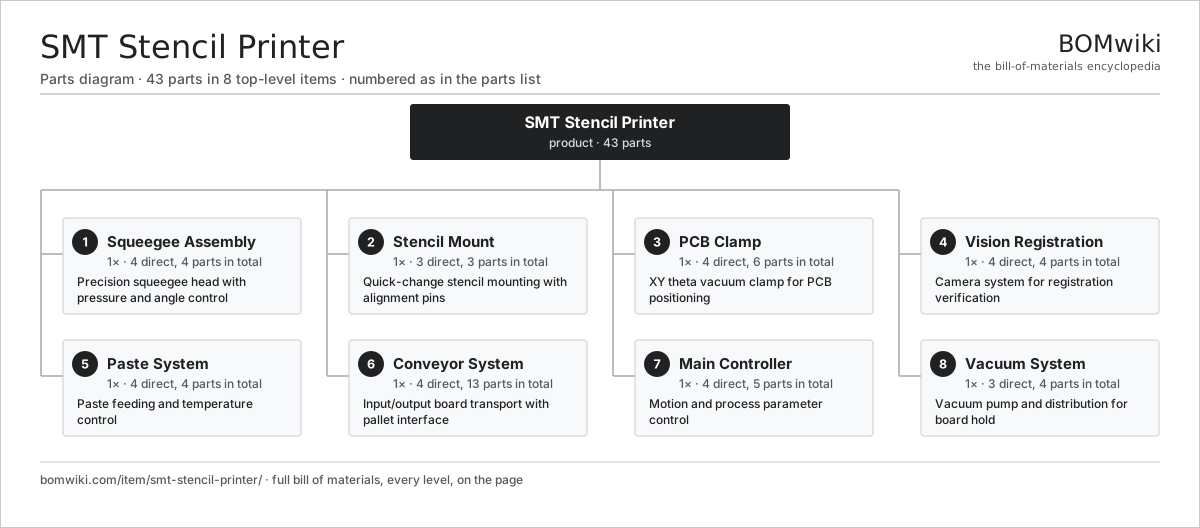
| # | Part | Qty | What it does |
|---|---|---|---|
| 1 | Squeegee Assembly 4 parts | 1× | Precision squeegee head with pressure and angle control |
| 2 | Stencil Mount 3 parts | 1× | Quick-change stencil mounting with alignment pins |
| 3 | PCB Clamp 4 parts | 1× | XY theta vacuum clamp for PCB positioning |
| 4 | Vision Registration 4 parts | 1× | Camera system for registration verification |
| 5 | Paste System 4 parts | 1× | Paste feeding and temperature control |
| 6 | Conveyor System 4 parts | 1× | Input/output board transport with pallet interface |
| 7 | Main Controller 4 parts | 1× | Motion and process parameter control |
| 8 | Vacuum System 3 parts | 1× | Vacuum pump and distribution for board hold |
3D model
No 3D model yet. Have a CAD file of this? Add a 3D model. STL renders right on this page; STEP, FreeCAD, and OpenSCAD sources are welcome too (openly licensed, like all 3D models on BOMwiki).
Build & assembly graph
expand / collapse · shared sub-assemblies converge · links to related products · est. labourTap an assembly to expand/collapse · tap a part to open it · use “Open page” for any node · drag to pan, scroll to zoom.
Bill of materials for SMT Stencil Printer
8 top-level lines · 38 rows shown · 43 parts total · indented to 3 levels| # | Item / sub-assembly | Part no. | Qty/assy | Ext. qty | Parts | Type |
|---|---|---|---|---|---|---|
| 1 | Squeegee Assembly 4 parts | smt-stencil-printer-squeegee | 1× | 1 | 4 | assembly |
| 1.1 | Squeegee Blade | smt-stencil-printer-squeegee-blade | 1× | 1 | · | part |
| 1.2 | Blade Holder | smt-stencil-printer-blade-holder | 1× | 1 | · | part |
| 1.3 | Squeegee Drive Motor | smt-stencil-printer-speed-motor | 1× | 1 | · | part |
| 1.4 | Pressure Actuator | smt-stencil-printer-pressure-actuator | 1× | 1 | · | part |
| 2 | Stencil Mount 3 parts | smt-stencil-printer-stencil-frame | 1× | 1 | 3 | assembly |
| 2.1 | Frame Holder | smt-stencil-printer-frame-holder | 1× | 1 | · | part |
| 2.2 | Alignment Pins | smt-stencil-printer-alignment-pins | 1× | 1 | · | part |
| 2.3 | Frame Vacuum | smt-stencil-printer-frame-vacuum | 1× | 1 | · | part |
| 3 | PCB Clamp 4 parts | smt-stencil-printer-pcb-board-clamp | 1× | 1 | 6 | assembly |
| 3.1 | Vacuum Chuck | smt-stencil-printer-vacuum-chuck | 1× | 1 | · | part |
| 3.2 | Ball Screw | ball-screw | 2× | 2 | · | part |
| 3.3 | Encoder | encoder | 2× | 2 | · | part |
| 3.4 | Theta Motor | smt-stencil-printer-theta-motor | 1× | 1 | · | part |
| 4 | Vision Registration 4 parts | smt-stencil-printer-vision | 1× | 1 | 4 | assembly |
| 4.1 | CMOS Image Sensor | image-sensor | 1× | 1 | · | part |
| 4.2 | Lens Assembly | camera-lens | 1× | 1 | · | part |
| 4.3 | LED Ring Light | smt-stencil-printer-light | 1× | 1 | · | part |
| 4.4 | Vision Processor | smt-stencil-printer-vision-processor | 1× | 1 | · | part |
| 5 | Paste System 4 parts | smt-stencil-printer-paste-system | 1× | 1 | 4 | assembly |
| 5.1 | Paste Reservoir | smt-stencil-printer-paste-reservoir | 1× | 1 | · | part |
| 5.2 | Heating Element | heating-element | 1× | 1 | · | part |
| 5.3 | Paste Pump | smt-stencil-printer-paste-pump | 1× | 1 | · | part |
| 5.4 | Squeegee Wiper | smt-stencil-printer-paste-squeegee-wipe | 1× | 1 | · | part |
| 6 | Conveyor System 4 parts | smt-stencil-printer-conveyor | 1× | 1 | 13 | assembly |
| 6.1 | Blower Motor | blower-motor | 2× | 2 | · | part |
| 6.2 | Conveyor Belt | smt-stencil-printer-conveyor-belt | 2× | 2 | · | part |
| 6.3 | Ball Bearing | ball-bearing | 8× | 8 | · | part |
| 6.4 | Pallet Interface | smt-stencil-printer-pallet-interface | 1× | 1 | · | part |
| 7 | Main Controller 4 parts | smt-stencil-printer-control | 1× | 1 | 5 | assembly |
| 7.1 | Main CPU | smt-stencil-printer-cpu | 1× | 1 | · | part |
| 7.2 | Power Supply | power-supply | 2× | 2 | · | part |
| 7.3 | Motion Drivers | smt-stencil-printer-motion-drivers | 1× | 1 | · | part |
| 7.4 | Bare PCB | pcb-bare | 1× | 1 | · | part |
| 8 | Vacuum System 3 parts | smt-stencil-printer-vacuum-system | 1× | 1 | 4 | assembly |
| 8.1 | Vacuum Pump | smt-stencil-printer-vac-pump | 1× | 1 | · | part |
| 8.2 | Vacuum Regulator | smt-stencil-printer-regulator | 1× | 1 | · | part |
| 8.3 | Relay | relay | 2× | 2 | · | part |
Something wrong in this list? Report a problem with this BOM.
Related products
same domain, ranked by shared parts Wire Bonder
44 parts · shares 7 with this page
Wire Bonder
44 parts · shares 7 with this page
 Mask Aligner
38 parts · shares 6 with this page
Mask Aligner
38 parts · shares 6 with this page
 SMT Pick-and-Place Machine
60 parts · shares 6 with this page
SMT Pick-and-Place Machine
60 parts · shares 6 with this page
 Wafer Dicing Saw
44 parts · shares 6 with this page
Wafer Dicing Saw
44 parts · shares 6 with this page
Sourcing: possible vendors
Browse the supplier directory → Prices, MOQ, and lead times are algorithmic estimates, not quotes, and not claims about these companies. Company mappings are curated by keyword; est. price band $5k–$2M. How estimates work| Vendor | HQ | Specialty | MOQ | Lead time |
|---|---|---|---|---|
| atlascopco.com ↗ | Stockholm, SE | Compressors & industrial | 10 units | 12–20 wks |
|
🇦🇹Andritz
andritz.com ↗
|
Graz, AT | Process plants & machinery | 10 units | 12–20 wks |
| buhlergroup.com ↗ | Uzwil, CH | Food & materials processing | 10 units | 12–20 wks |
| gea.com ↗ | Düsseldorf, DE | Process technology | 10 units | 12–20 wks |
| mhi.com ↗ | Tokyo, JP | Heavy machinery | 10 units | 12–20 wks |
1,491-word article