Soap Plodder
ProductOverview
A soap plodder (also called a soap extruder) is a specialized machine that takes handmade cold-process or melt-and-pour soap batches and converts them into uniform logs and bars through a combination of vacuum degassing, thermal conditioning, and extrusion. The machine is essential for artisanal and small-batch cosmetic producers who want to eliminate trapped air, homogenize color and fragrance, and achieve consistent bar dimensions without the labor of hand-cutting.
The core process involves three sequential stages: (1) vacuum refining, breaking up soap lumps and removing air bubbles via low pressure and rotating screws, (2) thermal conditioning in a heated die manifold, and (3) extrusion and cutting into finished bars.
How It Works
Raw cold-process soap (typically in irregular chunks from curing) is fed through the Incoming Hopper into the Vacuum Chamber. The chamber is maintained at 0.5–0.8 bar absolute pressure (partial vacuum) by the Vacuum Pump, a 1.5 kW rotary vane pump. This low pressure causes air and volatile solvents to escape from the soap matrix, preventing bubbles and surface cracks in the final bar.
Inside the chamber, a rotating twin-screw auger (the Auger Assembly) turns at 5–15 rpm, driven through a 100:1 helical gearbox by an 11 kW electric motor. The two intermeshing screws, one with left-hand threads, one with right-hand, compress and knead the soap as they push it toward the extrusion die. Four hardened steel Refining Plates are positioned stationary around the screw flights, with 2 mm clearance; as the soap rotates, it is repeatedly sheared against these plates, breaking down large crystals and air pockets into a homogeneous paste.
The conditioned soap exits the vacuum chamber and enters the Die Head, a heated manifold block containing an interchangeable Rectangular Die Insert. For standard bars, the die is a 100 × 70 mm rectangular slot. The die is heated to 40–60 °C via band heaters, which softens the soap slightly for smoother extrusion without compromising set (cold-process soap remains solid; the die does not melt it). A Pressure Relief Valve valve mounted directly on the die head protects against overpressure spikes; if extrusion pressure exceeds 80 bar (due to a die blockage), the relief valve bypasses excess flow back to the Hydraulic Pack.
As the soap log exits the die, it travels past the Cutter Interface. A pneumatic cylinder drives a reciprocating wire or blade across the log face at a cadence set by proximity sensors. Typically, the cutter fires every 3–5 seconds, creating bars approximately 80–100 mm long from a 100 × 70 mm log profile. The cut bars are separated on a small Conveyor Table and stacked for curing or packaging.
The Hydraulic Pack is a self-contained unit supplying the die-head pressure and managing thermal control. A 5 cc/rev gear pump pressurizes hydraulic fluid to 80 bar, feeding the die manifold. The hydraulic circuit also drives coolant circulation through a Cooler Element (a plate-frame heat exchanger), which maintains the die jacket at a target temperature, warm enough to ease extrusion but cool enough to prevent soap degradation. The pump operates at 1500 rpm, derived from the motor shaft via a flexible coupling; the motor itself turns the screws through the gearbox.
The Control Cabinet houses a PLC, relay logic, and optional servo drive. Operators set parameters such as screw speed, die temperature, and cutter frequency via a touchscreen interface. The machine autonomously monitors vacuum level, hydraulic pressure, and die temperature, shutting down if any parameter drifts beyond safe limits.
Vacuum Degassing Advantage
Vacuum is critical. At atmospheric pressure, air trapped in the soap can cause blooming (crystalline bloom forming on the surface) and soft spots in the interior. Vacuum reduces the boiling point of both water and volatile fragrance oils, drawing them out of the soap without external heating. This keeps cold-process soap truly cold, preserving sensitive actives (shea butter, aloe, etc.) that heat-processing would degrade.
Die and Custom Profiles
The standard die is 100 × 70 mm, yielding bars approximately 100 g each (at 1.0 g/cm³ soap density). Alternative dies, circular, hexagonal, or embossed, can be swapped in seconds. Some operators run multiple dies in series, producing mixed bars in a single plodding run.
Roller and Refining Mechanics
The Refining Plates function like a continuous kneading action. As each screw flight rotates, it carries soap toward the stationary plate, then peels away; the next flight does the same. This cycling shear-mixes the soap and breaks air bubbles more effectively than single-screw extrusion. The 2 mm gap is critical: too wide and soaps bridge past the plates; too narrow and friction causes jamming or screw damage.
Hydraulic Heating and Cooling Loop
The die manifold is jacketed; hot or cold hydraulic fluid circulates through ports to modulate die temperature precisely. A Cooler Element plate-frame heat exchanger dissipates 5 kW of heat (generated by screw friction and die shear) using circulating glycol-water coolant. This keeps the soap from degrading while maintaining its plasticity for clean extrusion.
Maintenance and Throughput
At maximum speed, the plodder achieves 20–40 kg/hour of finished bars, depending on soap hardness, fragrance volatility, and die complexity. Harder soaps (high stearic or palm content) extrude slower; softer mixes (high oleic or coconut oils) move faster.
Maintenance includes weekly checks of screw flights for adhesive buildup, monthly seal inspection, and periodic hydraulic fluid sampling (the gear pump and friction heat degrade oil slowly). Mica-loaded or glitter-embedded soaps can increase wear and reduce inter-service intervals.
Related Subsystems
- Vacuum Chamber degasses and conditions soap.
- Auger Assembly shears and conveys soap toward extrusion.
- Die Head shapes and heats soap just before final extrusion.
- Cutter Interface cuts logs into individual bars.
- Motor Drive supplies screw rotation torque.
- Hydraulic Pack provides die pressure and thermal control.
Soap Plodder parts and their functions
8 top-level parts · 61 parts in total · full bill of materials below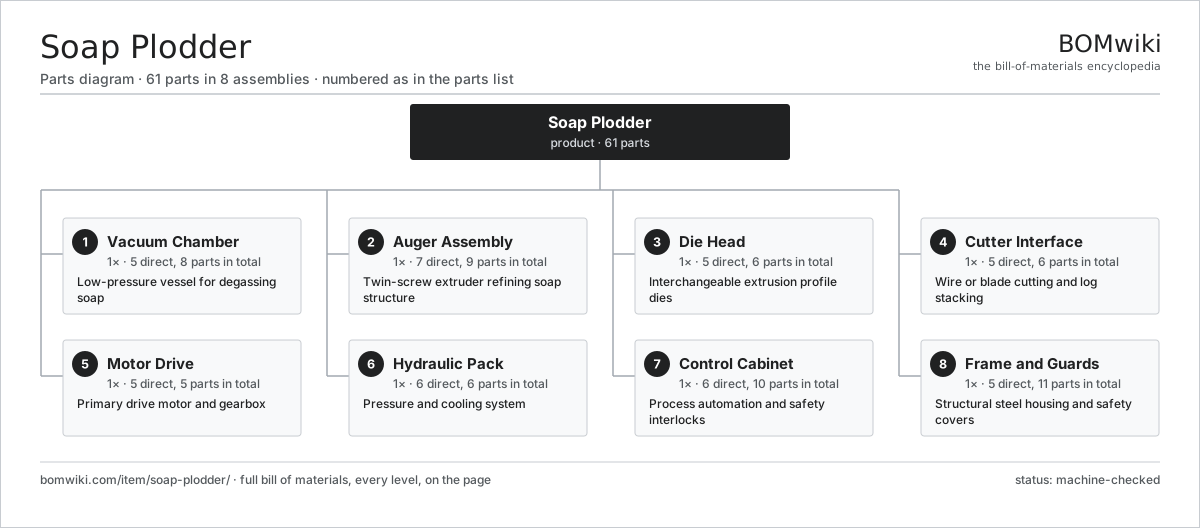
| # | Part | Qty | What it does |
|---|---|---|---|
| 1 | Vacuum Chamber 5 parts | 1× | Low-pressure vessel for degassing soap |
| 2 | Auger Assembly 7 parts | 1× | Twin-screw extruder refining soap structure |
| 3 | Die Head 5 parts | 1× | Interchangeable extrusion profile dies |
| 4 | Cutter Interface 5 parts | 1× | Wire or blade cutting and log stacking |
| 5 | Motor Drive 5 parts | 1× | Primary drive motor and gearbox |
| 6 | Hydraulic Pack 6 parts | 1× | Pressure and cooling system |
| 7 | Control Cabinet 6 parts | 1× | Process automation and safety interlocks |
| 8 | Frame and Guards 5 parts | 1× | Structural steel housing and safety covers |
3D model
No 3D model yet. Have a CAD file of this? Add a 3D model — STL renders right on this page; STEP, FreeCAD, and OpenSCAD sources are welcome too (openly licensed, like all 3D models on BOMwiki).
Build & assembly graph
expand / collapse · shared sub-assemblies converge · links to related products · est. labourTap an assembly to expand/collapse · tap a part to open it · use “Open page” for any node · drag to pan, scroll to zoom.
Bill of materials for Soap Plodder
8 top-level lines · 52 rows shown · 61 parts total · indented to 3 levels| # | Item / sub-assembly | Part no. | Qty/assy | Ext. qty | Parts | Type |
|---|---|---|---|---|---|---|
| 1 | Vacuum Chamber 5 parts | soap-plodder-vacuum-chamber | 1× | 1 | 8 | assembly |
| 1.1 | Chamber Shell | soap-plodder-chamber-shell | 1× | 1 | · | part |
| 1.2 | Refining Plate | soap-plodder-refining-plate | 4× | 4 | · | part |
| 1.3 | Incoming Hopper | soap-plodder-incoming-hopper | 1× | 1 | · | part |
| 1.4 | Rotary Seal | soap-plodder-rotary-seal | 1× | 1 | · | part |
| 1.5 | Vacuum Pump | soap-plodder-vacuum-pump | 1× | 1 | · | part |
| 2 | Auger Assembly 7 parts | soap-plodder-auger-assembly | 1× | 1 | 9 | assembly |
| 2.1 | Left Screw Shaft | soap-plodder-screw-shaft-left | 1× | 1 | · | part |
| 2.2 | Right Screw Shaft | soap-plodder-screw-shaft-right | 1× | 1 | · | part |
| 2.3 | Barrel Liner | soap-plodder-barrel-liner | 1× | 1 | · | part |
| 2.4 | Left Bearing Block | soap-plodder-bearing-block-left | 1× | 1 | · | part |
| 2.5 | Right Bearing Block | soap-plodder-bearing-block-right | 1× | 1 | · | part |
| 2.6 | Ball Bearing | ball-bearing | 2× | 2 | · | part |
| 2.7 | Oil Seal | oil-seal | 2× | 2 | · | part |
| 3 | Die Head 5 parts | soap-plodder-die-head | 1× | 1 | 6 | assembly |
| 3.1 | Die Body | soap-plodder-die-body | 1× | 1 | · | part |
| 3.2 | Rectangular Die Insert | soap-plodder-die-insert-rectangular | 1× | 1 | · | part |
| 3.3 | Heating Element | heating-element | 2× | 2 | · | part |
| 3.4 | Pressure Relief Valve | soap-plodder-pressure-relief | 1× | 1 | · | part |
| 3.5 | Connector | connector | 1× | 1 | · | part |
| 4 | Cutter Interface 5 parts | soap-plodder-cutter-interface | 1× | 1 | 6 | assembly |
| 4.1 | Cutter Frame | soap-plodder-cutter-frame | 1× | 1 | · | part |
| 4.2 | Cutter Blade | soap-plodder-cutter-blade | 1× | 1 | · | part |
| 4.3 | Pneumatic Cylinder | soap-plodder-pneumatic-cylinder | 1× | 1 | · | part |
| 4.4 | Proximity Sensor | soap-plodder-proximity-sensor | 2× | 2 | · | part |
| 4.5 | Conveyor Table | soap-plodder-conveyor-table | 1× | 1 | · | part |
| 5 | Motor Drive 5 parts | soap-plodder-motor-drive | 1× | 1 | 5 | assembly |
| 5.1 | Electric Motor | soap-plodder-electric-motor | 1× | 1 | · | part |
| 5.2 | Gearbox | soap-plodder-gearbox | 1× | 1 | · | part |
| 5.3 | Motor Coupling | soap-plodder-motor-coupling | 1× | 1 | · | part |
| 5.4 | Motor Base | soap-plodder-motor-base | 1× | 1 | · | part |
| 5.5 | Wire Bundle | wire-bundle | 1× | 1 | · | part |
| 6 | Hydraulic Pack 6 parts | soap-plodder-hydraulic-pack | 1× | 1 | 6 | assembly |
| 6.1 | Hydraulic Reservoir | soap-plodder-hydraulic-reservoir | 1× | 1 | · | part |
| 6.2 | Gear Pump | soap-plodder-gear-pump | 1× | 1 | · | part |
| 6.3 | Pressure Gauge | soap-plodder-pressure-gauge | 1× | 1 | · | part |
| 6.4 | Relief Valve | soap-plodder-relief-valve | 1× | 1 | · | part |
| 6.5 | Cooler Element | soap-plodder-cooler-element | 1× | 1 | · | part |
| 6.6 | Power Supply | power-supply | 1× | 1 | · | part |
| 7 | Control Cabinet 6 parts | soap-plodder-control-cabinet | 1× | 1 | 10 | assembly |
| 7.1 | Microcontroller | mcu | 1× | 1 | · | part |
| 7.2 | Relay | relay | 4× | 4 | · | part |
| 7.3 | Servo Drive | soap-plodder-servo-drive | 1× | 1 | · | part |
| 7.4 | Bare PCB | pcb-bare | 1× | 1 | · | part |
| 7.5 | HMI Panel | soap-plodder-hmi-panel | 1× | 1 | · | part |
| 7.6 | Thermal Fuse | thermal-fuse | 2× | 2 | · | part |
| 8 | Frame and Guards 5 parts | soap-plodder-frame-and-guards | 1× | 1 | 11 | assembly |
| 8.1 | Frame Tubing | soap-plodder-frame-tubing | 1× | 1 | · | part |
| 8.2 | Sheet Metal Panel | sheet-panel | 3× | 3 | · | part |
| 8.3 | Guard Acrylic | soap-plodder-guard-acrylic | 2× | 2 | · | part |
| 8.4 | Fastener Set | fastener-set | 1× | 1 | · | part |
| 8.5 | Wheels Locking | soap-plodder-wheels-locking | 4× | 4 | · | part |
Related products
same domain, ranked by shared parts Briquetting Press
92 parts · shares 8 with this page
Desiccant Resin Dryer
88 parts · shares 8 with this page
Briquetting Press
92 parts · shares 8 with this page
Desiccant Resin Dryer
88 parts · shares 8 with this page
 Industrial FDM Printer
98 parts · shares 8 with this page
Lipstick Molding Machine
131 parts · shares 7 with this page
Mascara Filling Machine
73 parts · shares 7 with this page
Resin Drying Hopper
54 parts · shares 7 with this page
Industrial FDM Printer
98 parts · shares 8 with this page
Lipstick Molding Machine
131 parts · shares 7 with this page
Mascara Filling Machine
73 parts · shares 7 with this page
Resin Drying Hopper
54 parts · shares 7 with this page
Sourcing: possible vendors
Prices, MOQ, and lead times are algorithmic estimates, not quotes, and not claims about these companies. Company mappings are curated by keyword; est. price band $5k–$2M. How estimates work| Vendor | HQ | Specialty | MOQ | Lead time |
|---|---|---|---|---|
| atlascopco.com ↗ | Stockholm, SE | Compressors & industrial | 10 units | 12–20 wks |
|
🇦🇹Andritz
andritz.com ↗
|
Graz, AT | Process plants & machinery | 10 units | 12–20 wks |
| buhlergroup.com ↗ | Uzwil, CH | Food & materials processing | 10 units | 12–20 wks |
| gea.com ↗ | Düsseldorf, DE | Process technology | 10 units | 12–20 wks |
| mhi.com ↗ | Tokyo, JP | Heavy machinery | 10 units | 12–20 wks |
1,023-word article