Soldering Station
ProductOverview
A soldering station is a benchtop tool assembly that maintains a handheld soldering iron at a precise, user-adjustable temperature using closed-loop feedback control. The core innovation is active temperature regulation via a thermocouple or thermistor mounted inside the iron tip, feeding back to a PID controller in the base station electronics.
Professional soldering stations are essential in electronics manufacturing, aerospace assembly, microelectronics repair, and plumbing installations, where solder joint quality is sensitive to temperature. Too cold (~150°C): solder doesn't wet or flow; too hot (>400°C): solder oxidizes, flux burns, and PCB traces can lift. Stations lock temperature to a setpoint, ensuring repeatable joint quality across multiple operators and shifts.
How It Works
The operator sets a desired temperature (e.g., 350°C) using front-panel buttons on the base station enclosure. The temperature controller reads this setpoint and continuously compares it to the actual tip temperature from the thermocouple or thermistor.
The power supply provides 24–50 V DC to the nichrome heating element inside the iron. The PID control algorithm calculates an error term (setpoint minus actual) and modulates heater power, increasing voltage if temperature is low, reducing it if temperature overshoots.
Key control loop timing:
- Measurement: Temperature sensor sampled 10–100 times per second
- Calculation: PID coefficients applied to error term, generating duty cycle 0–100%
- Actuation: Solid-state relay (SSR) or mechanical contactor switches heater on/off at kHz frequency, achieving effective power modulation
Result: steady-state temperature oscillates ±3–5°C around setpoint, far tighter than manual on/off switching.
Temperature Sensor and Feedback
The temperature sensor is typically a K-type thermocouple (chromel-alumel junction) mounted inside the iron tip chamber. As the tip heats, the thermocouple generates a voltage (~40 μV/°C change):
- 200°C → ~8.1 mV
- 350°C → ~14.2 mV
- 400°C → ~16.4 mV
The base station includes cold-junction compensation circuitry, accounting for ambient temperature variations and ensuring accuracy regardless of room conditions.
Thermistor-based sensors (NTC thermistors, 100 kΩ at 25°C) are cheaper but exhibit nonlinear resistance-temperature curves, requiring polynomial correction in firmware.
Power Supply Design
The AC-to-DC power supply converts mains 120/240 V AC to 60–75 V unregulated DC:
- Step-down transformer or SMPS (switched-mode PSU): Reduces AC voltage
- Full-wave rectifier: Converts AC to pulsating DC
- Filter capacitors (2200–4700 μF): Smooth ripple to <100 mV
- Solid-state relay (SSR): PWM switching heater on/off at 1–10 kHz frequency
PWM frequency is deliberately high (>1 kHz) to prevent audible switching noise in the iron coil and smooth temperature transients.
Current limit protection (typical ~5 A on 100 W models) prevents damage if the iron is shorted or heater element fails.
Thermal Time Constant and Response
The iron's temperature response depends on thermal mass and contact conditions. Typical dynamics:
- Cold-to-setpoint time: 30–90 seconds (350°C)
- Temperature rise time constant: 5–15 seconds
- Overshoot: 10–20°C (if PID tuning is aggressive)
High thermal mass (aluminum block) improves steady-state stability but slows response to operator actions (like touching cold solder joints). Optimal tuning balances settling time against steady-state error.
Soldering Iron Construction
The handheld iron consists of:
- Heating chamber: Aluminum or ceramic block surrounding the nichrome element
- Resistive heating element: Nichrome wire, typically 5–15 Ω
- Tip mount: Tapered or threaded connection accepting replaceable soldering tips
- Insulating grip: Silicone or epoxy-resin rated 200–400°C, providing thermal barrier
The iron cord carries three signals:
- Power: 24–50 V DC to heater (2 conductors, typically twisted pair)
- Sensor signal: Low-voltage thermocouple output (shielded pair)
- Ground/return: Common reference
Quick-disconnect connectors allow the operator to remove and store the iron in the stand without powering down the base station, useful when switching between tasks or changing tips.
Solder Tip Metallurgy
Soldering tips are typically:
- Copper core (excellent thermal conductivity, ~400 W/m·K)
- Iron-plated surface (prevents solder adhesion, allows easy wetting)
- Nickel flash (prevents copper leaching into molten solder over thousands of joints)
Common tip geometries:
- Conical (~1/32" point): Fine pitch electronics, microelectronics
- Chisel (~1/16" blade): General purpose, through-hole PCB soldering
- Bevel (~1/16" angled edge): Surface-mount components, drag soldering
- Screwdriver (~1/8" flat): Large joints, power electronics
Tip life (~1000 solder joints) depends on cleanliness and temperature management. Oxidized tips (dull gray, non-wetting) indicate overheating or inadequate tip cleaning, and should be replaced.
Solder Joint Quality and Temperature
Solder joint quality depends critically on tip temperature:
| Temperature | Result |
|---|---|
| <200°C | Cold solder joint, dull gray, unreliable, high resistance |
| 200–250°C | Marginal; extended dwell time required |
| 250–350°C | Optimal for Sn63/Pb37 or Sn96.5/Ag3/Cu0.5; solder flows smoothly |
| 350–400°C | Lead-free solder (Sn99/Ag0.3/Cu0.7) requires higher temp |
| >400°C | Risk of flux burnout, PCB trace lift, component damage |
Modern lead-free solders (RoHS-compliant) require 10–40°C higher temperatures than traditional Sn/Pb, necessitating stations with extended temperature range (up to 450°C).
Application Examples
Through-Hole PCB Assembly
Temperature: 350°C, iron-on-joint dwell time 2–3 seconds per lead. Operator applies iron to both pad and component lead, allowing solder to flow around joint, then removes iron. Capillary action pulls solder through PTH (plated-through hole).
Surface-Mount Rework
Temperature: 380–400°C (depending on solder alloy). Skilled technician uses fine conical tip to reflow individual SMT pads without disturbing adjacent components.
Plumbing and HVAC
Temperature: 400–450°C. Copper water lines and brass fittings require higher heat capacity and temperature to achieve proper silver-solder flow.
Maintenance and Calibration
Periodic maintenance extends station lifetime:
- Tip cleaning: Wet sponge or brass wire cleaner removes oxidation every few joints; dry tip immediately to prevent thermal shock
- Thermal recalibration: Thermocouple calibration drifts ~0.5% per year; recalibration kits with known-temperature reference blocks allow self-service verification
- Filter inspection: Power supply cooling vents accumulate dust; cleaning every 6–12 months prevents thermal shutdown
- Tip replacement: Replace when non-wetting despite cleaning, typically every 500–1000 joints
Standards and Regulatory
- IEC 61010-1: Safety of electrical equipment for measurement, control, and laboratory use
- IEC 61010-2-30: Particular safety requirements for soldering and hot-air-rework equipment
- ESD compliance: Station chassis and tips must be grounded to prevent static discharge damaging semiconductors
- RoHS 2 compliance: Solder and flux must be lead-free for consumer electronics assembly (Asia, EU, China)
Soldering Station parts and their functions
8 top-level parts · 37 parts in total · full bill of materials below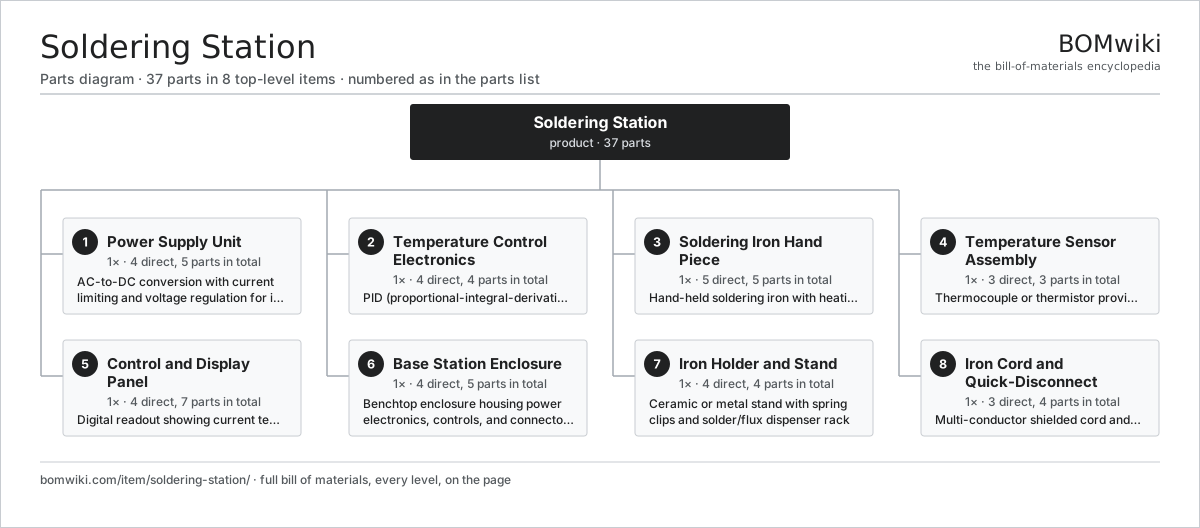
| # | Part | Qty | What it does |
|---|---|---|---|
| 1 | Power Supply Unit 4 parts | 1× | AC-to-DC conversion with current limiting and voltage regulation for iron heating element |
| 2 | Temperature Control Electronics 4 parts | 1× | PID (proportional-integral-derivative) controller maintaining tip temperature setpoint |
| 3 | Soldering Iron Hand Piece 5 parts | 1× | Hand-held soldering iron with heating element, sensor, and replaceable tip |
| 4 | Temperature Sensor Assembly 3 parts | 1× | Thermocouple or thermistor providing real-time temperature feedback |
| 5 | Control and Display Panel 4 parts | 1× | Digital readout showing current temperature, setpoint, and power status |
| 6 | Base Station Enclosure 4 parts | 1× | Benchtop enclosure housing power electronics, controls, and connector ports |
| 7 | Iron Holder and Stand 4 parts | 1× | Ceramic or metal stand with spring clips and solder/flux dispenser rack |
| 8 | Iron Cord and Quick-Disconnect 3 parts | 1× | Multi-conductor shielded cord and quick-disconnect connector between iron and base station |
3D model
No 3D model yet. Have a CAD file of this? Add a 3D model. STL renders right on this page; STEP, FreeCAD, and OpenSCAD sources are welcome too (openly licensed, like all 3D models on BOMwiki).
Build & assembly graph
expand / collapse · shared sub-assemblies converge · links to related products · est. labourTap an assembly to expand/collapse · tap a part to open it · use “Open page” for any node · drag to pan, scroll to zoom.
Bill of materials for Soldering Station
8 top-level lines · 39 rows shown · 37 parts total · indented to 3 levels| # | Item / sub-assembly | Part no. | Qty/assy | Ext. qty | Parts | Type |
|---|---|---|---|---|---|---|
| 1 | Power Supply Unit 4 parts | soldering-station-power-supply | 1× | 1 | 5 | assembly |
| 1.1 | Power Transformer | soldering-station-transformer | 1× | 1 | · | part |
| 1.2 | Rectifier Bridge | soldering-station-rectifier | 1× | 1 | · | part |
| 1.3 | Filter Capacitor | soldering-station-filter-cap | 2× | 2 | · | part |
| 1.4 | Heater Control Relay | soldering-station-heater-relay | 1× | 1 | · | part |
| 2 | Temperature Control Electronics 4 parts | soldering-station-temperature-control | 1× | 1 | 4 | assembly |
| 2.1 | Microcontroller | mcu | 1× | 1 | · | part |
| 2.2 | PID Controller Firmware | soldering-station-pid-controller | 1× | 1 | · | part |
| 2.3 | Temperature Sensor | soldering-station-temperature-sensor | 1× | 1 | · | part |
| 2.4 | Bare PCB | pcb-bare | 1× | 1 | · | part |
| 3 | Soldering Iron Hand Piece 5 parts | soldering-station-iron-assembly | 1× | 1 | 5 | assembly |
| 3.1 | Heating Element | soldering-station-heater-element | 1× | 1 | · | part |
| 3.2 | Heating Chamber | soldering-station-heating-chamber | 1× | 1 | · | part |
| 3.3 | Tip Mounting Seat | soldering-station-tip-seat | 1× | 1 | · | part |
| 3.4 | Handle Grip | soldering-station-handle-grip | 1× | 1 | · | part |
| 3.5 | Connector | connector | 1× | 1 | · | part |
| 4 | Temperature Sensor Assembly 3 parts | soldering-station-sensor | 1× | 1 | 3 | assembly |
| 4.1 | Thermocouple Junction | soldering-station-thermocouple | 1× | 1 | · | part |
| 4.2 | Sensor Sheath | soldering-station-sensor-sheath | 1× | 1 | · | part |
| 4.3 | Cold Junction Compensation | soldering-station-cold-junction-comp | 1× | 1 | · | part |
| 5 | Control and Display Panel 4 parts | soldering-station-display-panel | 1× | 1 | 7 | assembly |
| 5.1 | LCD Panel | lcd-panel | 1× | 1 | · | part |
| 5.2 | Control Buttons | soldering-station-button-array | 3× | 3 | · | part |
| 5.3 | Status Indicator LED | soldering-station-indicator-led | 2× | 2 | · | part |
| 5.4 | Bare PCB | pcb-bare | 1× | 1 | · | part |
| 6 | Base Station Enclosure 4 parts | soldering-station-base-unit | 1× | 1 | 5 | assembly |
| 6.1 | Base Station Chassis | soldering-station-chassis | 1× | 1 | · | part |
| 6.2 | Main Control PCB | soldering-station-pcb-main | 1× | 1 | · | part |
| 6.3 | Connector Panel | soldering-station-connector-panel | 1× | 1 | · | part |
| 6.4 | Fastener Set | fastener-set | 2× | 2 | · | part |
| 7 | Iron Holder and Stand 4 parts | soldering-station-iron-holder | 1× | 1 | 4 | assembly |
| 7.1 | Holder Pedestal | soldering-station-holder-base | 1× | 1 | · | part |
| 7.2 | Iron Rest Cradle | soldering-station-iron-rest | 1× | 1 | · | part |
| 7.3 | Sponge/Cleaner Cup | soldering-station-sponge-holder | 1× | 1 | · | part |
| 7.4 | Solder Spool Holder | soldering-station-solder-spindle | 1× | 1 | · | part |
| 8 | Iron Cord and Quick-Disconnect 3 parts | soldering-station-cord-and-connectors | 1× | 1 | 4 | assembly |
| 8.1 | Wire Bundle | wire-bundle | 2× | 2 | · | part |
| 8.2 | Connector | connector | 1× | 1 | · | part |
| 8.3 | Cable Strain Relief | soldering-station-strain-relief | 1× | 1 | · | part |
Something wrong in this list? Report a problem with this BOM.
Used in 1 assembly
Related products
same domain, ranked by shared parts Airless Paint Sprayer
97 parts · shares 2 with this page
Airless Paint Sprayer
97 parts · shares 2 with this page
 Heat Gun
183 parts · shares 2 with this page
Heat Gun
183 parts · shares 2 with this page
 MIG Welder
77 parts · shares 2 with this page
MIG Welder
77 parts · shares 2 with this page
 Electronic Torque Wrench
42 parts · shares 1 with this page
Electronic Torque Wrench
42 parts · shares 1 with this page
 Angle Grinder
65 parts · shares 1 with this page
Angle Grinder
65 parts · shares 1 with this page
 Belt Sander
68 parts · shares 1 with this page
Belt Sander
68 parts · shares 1 with this page
Sourcing: possible vendors
Browse the supplier directory → Prices, MOQ, and lead times are algorithmic estimates, not quotes, and not claims about these companies. Company mappings are curated by keyword; est. price band $30–$800. How estimates work| Vendor | HQ | Specialty | MOQ | Lead time |
|---|---|---|---|---|
| stanleyblackanddecker.com ↗ | New Britain, US | Tools (DeWalt, Craftsman) | 500 units | 6–12 wks |
| bosch-professional.com ↗ | Leinfelden, DE | Power tools | 500 units | 6–12 wks |
| ttigroup.com ↗ | Hong Kong, CN | Tools (Milwaukee, Ryobi) | 500 units | 6–12 wks |
|
🇯🇵Makita
makita.com ↗
|
Anjo, JP | Power tools | 500 units | 6–12 wks |
|
🇨🇭Hilti
hilti.com ↗
|
Schaan, CH | Construction tools | 500 units | 6–12 wks |
1,153-word article