Cable Spark Tester
ProductOverview
A cable spark tester is a real-time quality-assurance device that detects insulation defects in freshly extruded, armored, or sheathed cables. The tester applies a high voltage (5–15 kV) between the conductor and the sheath; any insulation void, pinhole, or discontinuity causes an arc, which triggers immediate rejection or logging of the defective section.
Spark testing is non-destructive to good cable but definitively identifies faults. A pinhole just 0.1 mm in diameter in a 1 mm thick insulation layer will eventually fail under service voltage (600 V to 33 kV, depending on cable class), causing short circuits and fires. Detecting these microscopic defects in production, before cable ships to customers, is essential for safety, reliability, and brand reputation.
Spark testers are universal in power-cable manufacturing plants. They are installed in-line immediately after extrusion or armoring, operating continuously as cable moves through the production line. A cable plant producing 100 km of cable per shift will run spark testers detecting faults in real-time, with faults logged and defective sections cut out (typically 100–500 m of cable ahead of the fault point, accounting for production line transport delay).
How It Works
The spark-test principle is straightforward: (1) The High-Voltage Power Supply generates a high voltage (5–15 kV DC or AC). (2) The Electrode Assembly, typically a bead chain or brush electrode, makes sliding contact with the cable sheath. (3) The inner conductor (the core of the cable) is grounded, completing a circuit. (4) As the cable moves through the tester, high voltage is continuously applied between the electrode (on the sheath surface) and the conductor. (5) If the insulation is intact, no current flows (capacitive leakage only, ~1–10 µA per meter of cable). (6) If a pinhole or void exists, a spark arcs between the electrode and the conductor through the defect. (7) The Current Sensor detects the arc current (typically 100 µA to 10 mA, depending on void size and applied voltage). (8) The Signal Processing Unit evaluates the arc waveform, distinguishes true faults from false alarms (transient noise), and triggers the Output Trigger System. (9) The output activates a pneumatic solenoid, which actuates a cable cutter or deflector, rejecting the defective section onto a scrap reel.
The test voltage must be high enough to arc through thin insulation but low enough to not cause false positives from normal surface moisture or small leakage paths. A 1 mm thick PVC insulation typically requires 3–5 kV to guarantee breakdown through a 0.2 mm pinhole. Thicker insulation (2–3 mm, common in high-voltage cables) requires 8–15 kV.
The electrode design is critical. A Bead Chain or Brush Electrode is a string of conductive copper beads (typically 3–5 mm diameter) connected by copper wire. As the cable rotates or moves, the bead chain maintains sliding contact across the sheath surface, covering roughly 80–120 degrees of the cable circumference. The contact pressure is typically 10–20 N per meter of electrode length, just enough to ensure good contact without damaging the sheath.
Signal Processing and False-Positive Filtering
High-voltage arc current is not a simple pulse; it is a high-frequency oscillation (typically 1–10 kHz) superimposed on the applied 2–5 kHz test-frequency signal. The Signal Processing Unit must distinguish a genuine insulation arc (which has characteristic spectral content and duration) from electrical noise or harmonic interference from adjacent motors or power equipment.
Modern spark testers use signal-processing algorithms (implemented in a PLC or digital signal processor):
- Frequency filtering: The signal is filtered to the expected arc-frequency band (1–10 kHz); noise outside this band is rejected.
- Threshold detection: The arc-current amplitude must exceed a threshold (typically 200 µA to 1 mA, depending on cable specification).
- Duration confirmation: The arc must persist for a minimum duration (typically 5–50 ms) to be classified as a fault; transient spikes <5 ms are ignored.
- Hysteresis logic: Once a fault is detected, the tester waits for the fault signal to clear (current drops below threshold for >100 ms) before resetting, preventing false multiple triggers on the same defect.
With these algorithms, false-positive rates can be reduced to <1%, while maintaining >99.5% detection of actual insulation defects.
Fault Localization and Cable Rejection
When a fault is detected, the Output Trigger System immediately triggers a Solenoid Valve, which actuates a pneumatic cylinder driving a cable cutter. The cutter blade advances and severs the cable, separating the defective section from the good cable.
However, there is a critical timing issue: the fault is detected when the cable is at the test electrode, but the cut must occur ~100–500 m downstream (typically 10–60 seconds of cable advance, depending on line speed). The cable is continuously marked with the fault location, and the cutter is actuated after a delay equal to the time for the cable to advance from the test point to the cutting point. The delay is calculated based on cable speed feedback from an Encoder on the line.
A typical scenario: (1) Cable moves through spark tester at 50 m/min (0.833 m/s). (2) An insulation void is detected at 14:27:35. (3) The fault is logged with a timestamp. (4) The solenoid is triggered with a delay of 120 seconds (to advance the cable 100 m downline). (5) At 14:29:35, the cutting solenoid fires, severing the cable. (6) The severed section (100 m of cable with the pinhole at one end) is diverted to scrap. (7) The line continues with good cable.
This approach minimizes waste: only the section actually containing the defect (plus some safety margin) is rejected, not the entire coil.
Electrode Contact and Pressure Control
The Bead Chain or Brush Electrode must maintain consistent contact pressure across its length. Uneven contact, too light in one spot, too heavy in another, results in uneven arc sensitivity and possible missed faults. The Electrode Holder Frame is typically spring-loaded or pneumatically actuated to maintain constant pressure (monitored by a Pressure Sensor) across the cable range.
As the cable diameter varies (e.g., extruded cable diameter may vary ±5% due to extrusion process variations), the electrode pressure changes. To accommodate this, some testers use self-adjusting electrode designs (hinged or spring-loaded arms) that maintain constant pressure across a range of cable diameters.
Contact wear is inevitable. The bead chain, constantly sliding across the cable sheath, gradually wears, and the beads may pit or flatten over weeks of continuous operation. A worn electrode loses contact area, reducing sensitivity. Routine inspection includes visual checking of bead-chain condition every 1–2 weeks; replacement is typically required every 3–6 months in high-volume production.
High-Voltage Supply Design
The High-Voltage Power Supply must be both responsive (to detect faults within milliseconds) and safe (to prevent operator shock or equipment damage). The design typically includes:
- Step-up Transformer: A line-frequency transformer (120 V or 240 V input, 5–15 kV output, 50–100 VA) provides the primary high voltage.
- Rectifier (if DC test is required): High-voltage rectifier diodes convert AC to DC.
- Ripple Filter: A High-Voltage Capacitor (0.1–1 µF, 15 kV rated) removes switching ripple and high-frequency noise from the supply.
- Current Limiter: A Current Limiting Resistor or Inductor (resistor or series inductor, typically 100 kΩ to 1 MΩ) limits fault current to safe levels (typically <100 mA during a fault arc).
The combination of current limiter and capacitor allows high voltage to be applied safely: if an insulation arc occurs, the capacitor discharges through the current limiter, limiting transient current to acceptable levels. The arc is self-extinguishing (the current is too small to sustain the arc once the capacitor is discharged), and then the supply recharges the capacitor for the next test.
High voltage must be monitored continuously. A voltage-feedback sensor detects if the supply output falls below the minimum test voltage (which could indicate a equipment failure or excessive load) and triggers a system alarm.
Safety and Interlocking
High-voltage testing equipment poses serious electrical hazard. The Safety Interlocks and Enclosure and safety systems are non-negotiable:
- Physical Enclosure: The electrode assembly and high-voltage components are enclosed in a Safety Guard Cage, preventing accidental contact.
- Interlock Switches: If the guard cage is opened during operation, an interlock relay removes the high voltage immediately.
- Grounding Straps: Before maintenance, technicians must use grounding sticks to discharge the High-Voltage Capacitor, which can retain charge even when the supply is powered off.
- Warning Labels: High-voltage warning signs are prominently displayed.
- Emergency Stop: An emergency-stop button must be within reach of the operator, cutting power to the test circuit immediately.
Modern spark testers are designed to meet IEC 61800-5-2 (safety of variable-frequency drives) and ANSI/OSHA standards for high-voltage equipment.
Integration with Production Lines
Spark testers are installed in-line immediately after the extrusion or armoring stage. On a Cable Extrusion Line, the spark tester is positioned just before or after the Cooling Trough, so defects are detected while the cable is still manageable (not yet coiled). On an armored cable line, the spark tester follows the Cable Armoring Machine, testing the finished armor-sheath assembly.
The spark tester's output (fault detection and cable-cut solenoid trigger) is integrated with the production-line control system (the Control Panel or equivalent). The PLC coordinates:
- Cable speed feedback from the Encoder.
- Spark-tester fault signals.
- Solenoid trigger timing.
- Fault logging to a production database.
This integration allows operators and quality managers to review fault statistics (faults per shift, location distribution, trends over time), identify process issues (e.g., if fault rate suddenly increases, a die may be wearing), and take corrective action.
Fault Rate and Specifications
A well-maintained cable extrusion line should produce <0.01% defective cable (i.e., <1 fault per 10,000 m). If the fault rate climbs above 0.1%, the process is out of control, and the line is typically halted for root-cause analysis. Common causes of increased fault rates include:
- Die wear or blockage: The extrusion die may be clogged or worn, causing uneven coating thickness.
- Conductor surface contamination: Dust or moisture on the bare conductor before extrusion can create weak points in insulation adhesion.
- Temperature excursion: If the oven temperature drops unexpectedly, the enamel or thermoplastic insulation may not cure properly.
- Excessive line speed: If the line accelerates beyond design speed, the cooling system may not remove enough heat, and insulation hardens incompletely.
The spark tester's Fault Counter Display displays running counts (faults per hour, per shift) and triggers statistical alerts if a threshold is exceeded, prompting operator investigation.
Maintenance and Recalibration
Routine maintenance includes:
- Weekly: Visual inspection of electrode contact and condition.
- Monthly: Cleaning of electrode beads and verification of contact pressure.
- Quarterly: Testing of the high-voltage supply output (using a calibrated high-voltage probe) to verify the test voltage is within ±10% of setpoint.
- Semi-annually: Replacement of bead-chain electrode and inspection of all high-voltage connectors.
- Annually: Full recalibration of signal-processing threshold and frequency-response verification.
A defective spark tester is as bad as no tester: if the test voltage is too low, insulation defects are missed; if the signal processor threshold is too high, valid faults are not detected. Testers must be calibrated against known-defect cable samples to verify sensitivity before return to production service.
Cable Spark Tester parts and their functions
5 top-level parts · 23 parts in total · full bill of materials below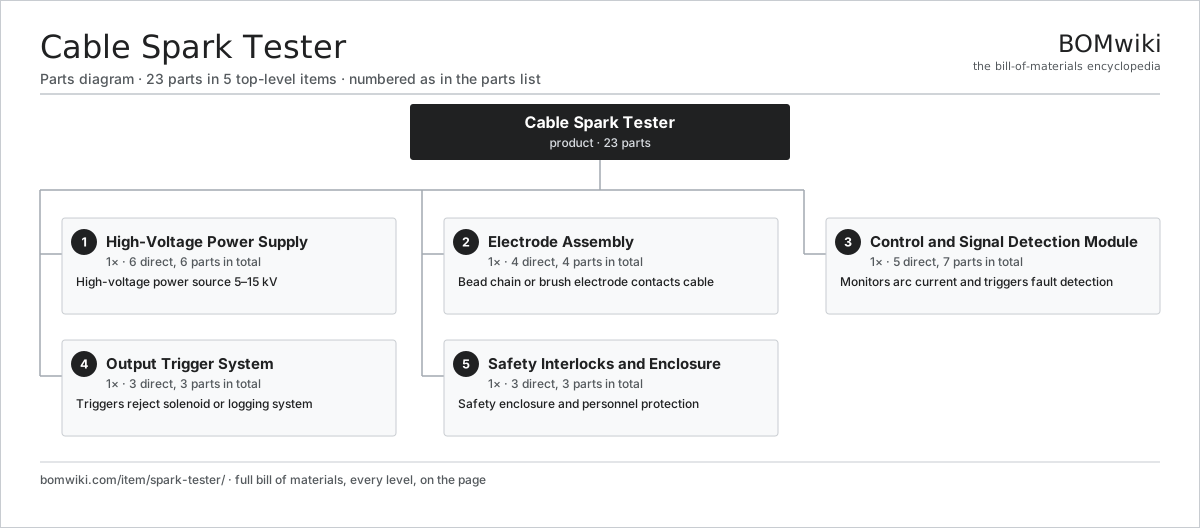
| # | Part | Qty | What it does |
|---|---|---|---|
| 1 | High-Voltage Power Supply 6 parts | 1× | High-voltage power source 5–15 kV |
| 2 | Electrode Assembly 4 parts | 1× | Bead chain or brush electrode contacts cable |
| 3 | Control and Signal Detection Module 5 parts | 1× | Monitors arc current and triggers fault detection |
| 4 | Output Trigger System 3 parts | 1× | Triggers reject solenoid or logging system |
| 5 | Safety Interlocks and Enclosure 3 parts | 1× | Safety enclosure and personnel protection |
3D model
No 3D model yet. Have a CAD file of this? Add a 3D model. STL renders right on this page; STEP, FreeCAD, and OpenSCAD sources are welcome too (openly licensed, like all 3D models on BOMwiki).
Build & assembly graph
expand / collapse · shared sub-assemblies converge · links to related products · est. labourTap an assembly to expand/collapse · tap a part to open it · use “Open page” for any node · drag to pan, scroll to zoom.
Bill of materials for Cable Spark Tester
5 top-level lines · 26 rows shown · 23 parts total · indented to 3 levels| # | Item / sub-assembly | Part no. | Qty/assy | Ext. qty | Parts | Type |
|---|---|---|---|---|---|---|
| 1 | High-Voltage Power Supply 6 parts | spark-tester-hv-supply | 1× | 1 | 6 | assembly |
| 1.1 | Step-Up Transformer | spark-tester-transformer | 1× | 1 | · | part |
| 1.2 | Rectifier Module | spark-tester-rectifier-module | 1× | 1 | · | part |
| 1.3 | High-Voltage Capacitor | spark-tester-hv-capacitor | 1× | 1 | · | part |
| 1.4 | Current Limiting Resistor or Inductor | spark-tester-current-limiter | 1× | 1 | · | part |
| 1.5 | Pressure Sensor | pressure-sensor | 1× | 1 | · | part |
| 1.6 | Fastener Set | fastener-set | 1× | 1 | · | part |
| 2 | Electrode Assembly 4 parts | spark-tester-electrode-assembly | 1× | 1 | 4 | assembly |
| 2.1 | Bead Chain or Brush Electrode | spark-tester-bead-chain | 1× | 1 | · | part |
| 2.2 | Electrode Holder Frame | spark-tester-electrode-holder | 1× | 1 | · | part |
| 2.3 | Pressure Sensor | pressure-sensor | 1× | 1 | · | part |
| 2.4 | Fastener Set | fastener-set | 1× | 1 | · | part |
| 3 | Control and Signal Detection Module 5 parts | spark-tester-control-electronics | 1× | 1 | 7 | assembly |
| 3.1 | Current Sensor | spark-tester-current-sensor | 1× | 1 | · | part |
| 3.2 | Signal Processing Unit | spark-tester-signal-processor | 1× | 1 | · | part |
| 3.3 | Relay | relay | 2× | 2 | · | part |
| 3.4 | Bare PCB | pcb-bare | 1× | 1 | · | part |
| 3.5 | Connector | connector | 2× | 2 | · | part |
| 4 | Output Trigger System 3 parts | spark-tester-signal-output | 1× | 1 | 3 | assembly |
| 4.1 | Relay | relay | 1× | 1 | · | part |
| 4.2 | Solenoid Valve | spark-tester-solenoid-valve | 1× | 1 | · | part |
| 4.3 | Fault Counter Display | spark-tester-fault-counter | 1× | 1 | · | part |
| 5 | Safety Interlocks and Enclosure 3 parts | spark-tester-interlocking-guards | 1× | 1 | 3 | assembly |
| 5.1 | Safety Guard Cage | spark-tester-guard-cage | 1× | 1 | · | part |
| 5.2 | Relay | relay | 1× | 1 | · | part |
| 5.3 | Fastener Set | fastener-set | 1× | 1 | · | part |
Something wrong in this list? Report a problem with this BOM.
Related products
same domain, ranked by shared parts Brush Making Machine
50 parts · shares 2 with this page
Cable Armoring Machine
37 parts · shares 2 with this page
Brush Making Machine
50 parts · shares 2 with this page
Cable Armoring Machine
37 parts · shares 2 with this page
Sourcing: possible vendors
Browse the supplier directory → Prices, MOQ, and lead times are algorithmic estimates, not quotes, and not claims about these companies. Company mappings are curated by keyword; est. price band $5k–$2M. How estimates work| Vendor | HQ | Specialty | MOQ | Lead time |
|---|---|---|---|---|
| atlascopco.com ↗ | Stockholm, SE | Compressors & industrial | 10 units | 12–20 wks |
|
🇦🇹Andritz
andritz.com ↗
|
Graz, AT | Process plants & machinery | 10 units | 12–20 wks |
| buhlergroup.com ↗ | Uzwil, CH | Food & materials processing | 10 units | 12–20 wks |
| gea.com ↗ | Düsseldorf, DE | Process technology | 10 units | 12–20 wks |
| mhi.com ↗ | Tokyo, JP | Heavy machinery | 10 units | 12–20 wks |
1,949-word article