Spin Coater
ProductOverview
Spin coating is the dominant method for applying liquid films, photoresists, dielectrics, planarizing polymers, and other coatings, uniformly onto rotating wafers in semiconductor manufacturing, research, and specialty industries. The spin coater dispenses a small volume of liquid onto the wafer center, then spins the wafer at high speed (500–5000 RPM), centrifugal force spreading the liquid outward and expelling excess to the bowl. As the wafer continues spinning, solvent evaporates and the film thickens, reaching final thickness (0.5–3 μm typical) in 30–60 seconds.
The advantages of spin coating are simplicity, speed, excellent uniformity (±3–5% thickness variation across a 300 mm wafer), and compatibility with low-cost equipment. Photoresist thickness is easily tuned by adjusting spin speed or dispense volume: faster speeds produce thinner films due to reduced dwell time before solvent evaporation. This simplicity and tuning range make spin coaters nearly universal in research labs and foundries.
Coating Mechanics and Film Formation
The physics of spin coating are well-characterized. When liquid is dispensed onto a spinning wafer, three phases occur: (1) viscous spreading (first 5–10 seconds), where the liquid rapidly spreads outward due to centrifugal force, (2) solvent evaporation (next 20–40 seconds), where volatile components evaporate and film thickness decreases monotonically, and (3) final consolidation (last 10 seconds), where evaporation slows and film thickness approaches final value. The final thickness is approximately T = K / √ω, where ω is angular velocity and K is a constant depending on viscosity, dispense volume, and solvent properties. Doubling the spin speed reduces thickness by ~30%.
Photoresists used in contact mask alignment are typically 0.5–2 μm thick, achieved at 2000–5000 RPM with 1–2 mL dispense for 100 mm wafers. Advanced nodes requiring thinner resists (0.1–0.3 μm) spin faster (7000–10,000 RPM) or use lower-viscosity formulations. The solvent (usually propylene glycol monomethyl ether acetate, PGMEA, or other ketones) is highly volatile; most is expelled during spin, with residual solvent (1–3 wt%) driven off during subsequent softbake (heating to 80–120 °C in a hotplate or oven).
Spindle and Vacuum Chuck System
The Spindle Assembly is the mechanical core. The Spindle Motor is typically a brushless DC motor or induction motor driving a spindle at variable speed via a belt or direct coupling. Spindle speed is regulated by Speed Control feedback from the Speed Encoder, maintaining ±1–2% speed accuracy. Modern coaters use stepper or servo motor drives, enabling pre-programmed speed ramps (acceleration/deceleration profiles) that can be optimized for film uniformity.
The Vacuum Chuck is a vacuum-held precision surface, typically ceramic or aluminum with vacuum channels etched or drilled underneath. Vacuum hold pressure is 5–8 inHg, sufficient to secure 50–300 mm wafers without shifting during acceleration to full speed. Escape grooves near the chuck perimeter allow excess liquid to drain outward toward the Catch Bowl. The chuck is balanced to run true at 10,000 RPM; vibration or runout causes thickness nonuniformity and risks wafer slip.
The Vacuum System includes a rotary vane pump delivering 20–50 CFM at low vacuum, and a regulator maintaining constant chuck vacuum. Many coaters vent the vacuum automatically at the end of the spin cycle, releasing the wafer for unloading. Some integrate a wafer centering function: slight underpressure (2–3 inHg) in pneumatic centering rings on the chuck periphery auto-centers the wafer radially.
Liquid Dispensing and Control
The Dispense System is critical for thickness repeatability. The Syringe Pump is stepper-motor-driven, advancing a syringe plunger at a programmed rate (typically 1–10 mL/min). The Dispense Nozzle is a stainless steel or PEEK tip positioned at the wafer center. Dispense volume (0.5–2 mL) is set by counting stepper motor pulses; reproducibility is ±2–3%.
The Liquid Supply maintains resist at optimal temperature (25–35 °C) to control viscosity. Photoresist viscosity is highly temperature-sensitive; a 5 °C change shifts thickness by ~3–5%. The Heater Cartridge in the reservoir or heating jacket maintains setpoint ±1 °C. The Inline Filter in the supply line removes particulates down to 0.2–0.45 μm, critical since any dust on the wafer surface creates thickness variations and defects that propagate through patterning.
Dispense timing relative to spindle speed is programmable. Most recipes dispense at rest (0 RPM) or low speed (100–200 RPM), then accelerate to target speed. Some advanced recipes ramp speed during dispensing, achieving better uniformity by spreading the liquid gradually. Post-dispense, the Dispense Arm retracts the nozzle before accelerating to full speed, preventing nozzle contact with the spinning wafer.
Film Uniformity and Thickness Monitoring
Spin-coated films achieve excellent uniformity across the wafer. Thickness variation is typically ±3–5% (3σ) on a 300 mm wafer when process parameters (speed, dispense volume, viscosity, temperature) are controlled. Edge effects (slightly thinner edges) are unavoidable due to centrifugal expulsion but are minimized by proper escape groove design.
The Vision System includes optional thickness measurement. A laser reflectance probe can measure film thickness on the spinning wafer (from 0 to 5 μm, repeatability ±50 nm). Thickness is sampled at wafer center and one or more edge locations, providing real-time feedback. Some advanced systems use this feedback to adjust subsequent process steps (softbake time, exposure dose) to compensate for thickness variations.
Recipe Development and Control
Modern spin coaters are fully programmable, with recipes specifying: (1) vacuum application, (2) initial acceleration phase, (3) dispense timing and volume, (4) spin speed profile (ramp rate, final speed, hold time), (5) deceleration and final coast, and (6) vacuum vent. A typical recipe takes 30–60 seconds total time.
The Main Controller is a PLC or PC running recipe interpreter. Recipes are stored in non-volatile memory and selected via a Touch Panel Interface user interface. Advanced systems log every cycle: spindle speed, dispense volume, total cycle time, and optional thickness measurements. This data feeds process control charts (SPC) for detecting equipment drift or reagent degradation.
Reagent Management and Environmental Control
Photoresist shelf life is typically 6–12 months when stored cool (15–25 °C) and dark. Once opened, resist bottles degrade due to moisture absorption and solvent evaporation. Many fabs use closed-loop dispensing systems where resist is drawn from a fresh bottle under positive nitrogen pressure, minimizing air exposure. The Liquid Supply regulator supplies 1–5 PSI positive pressure to the bottle, pushing resist through the pump.
Spin coaters generate aerosols and solvent vapor. Equipment must be installed in a fume hood or enclosed space with local exhaust. Waste liquid (expulsed resist and solvent) is collected in the Catch Bowl and disposed via the Drain Pump. Wafers are usually rinsed post-spin in a separate cleanup station to remove traces of resist, especially for processes where pattern features are only 0.5 μm or smaller.
Thermal Effects and Solvent Evaporation
Solvent evaporation is endothermic and cools the resist film; during a 60-second spin at high speed, film temperature can drop 5–10 °C below ambient. This cools the wafer slightly, affecting subsequent thermal steps. Some recipes include a brief low-speed coast (100–200 RPM for 10 seconds) at the end to allow partial solvent re-absorption and stabilization before removal.
Humidity affects coating uniformity. In humid environments (>60% RH), atmospheric water can wick into the resist film during spin, causing thickness increase (5–10%) and nonuniformity. Fabs in humid climates maintain spin coat areas at <40% RH via air conditioning and dehumidifiers.
Variations and Alternatives
Spray coating is an alternative to spin coating for large panels or specialty substrates; it offers better reagent efficiency and compatibility with non-circular shapes but requires more hardware and can produce thicker residual films. Dip coating is used for thick films (>5 μm) in research but offers poor uniformity and is rarely used in manufacturing.
For advanced nodes requiring extremely thin films (50–200 nm), specialized track systems couple spin coating with inline annealing, develop, and patterning, reducing cycle time and improving uniformity. These integrated tools are expensive ($1M+) but valuable in high-volume 0.5–2 μm fabs.
Typical Photoresist Recipes
Positive photoresist (0.8 μm target): 1.5 mL dispense, 4000 RPM for 50 seconds. Positive photoresist (1.2 μm target): 1.5 mL dispense, 2500 RPM for 50 seconds. Negative photoresist (2.0 μm target): 2.0 mL dispense, 1500 RPM for 60 seconds. Nanoparticle coating (0.5 μm target): 0.5 mL dispense, 6000 RPM for 45 seconds.
Recipes are validated once during process qualification and locked unless a deliberate change is needed (resist lot change, equipment maintenance, or process target shift). Spin coater parameters directly impact downstream lithography yield; careful control of this step is essential.
Spin Coater parts and their functions
8 top-level parts · 32 parts in total · full bill of materials below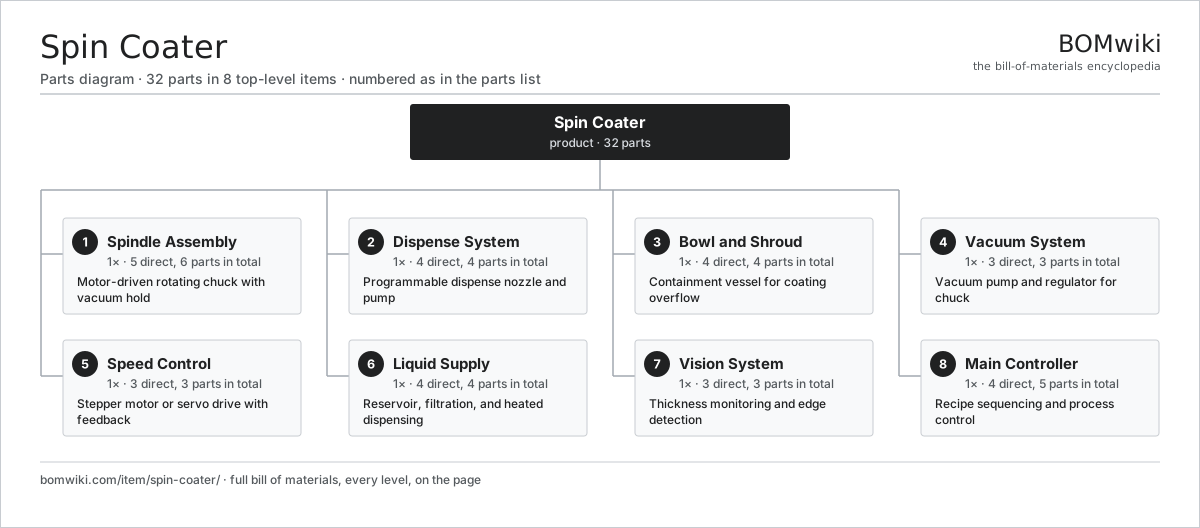
| # | Part | Qty | What it does |
|---|---|---|---|
| 1 | Spindle Assembly 5 parts | 1× | Motor-driven rotating chuck with vacuum hold |
| 2 | Dispense System 4 parts | 1× | Programmable dispense nozzle and pump |
| 3 | Bowl and Shroud 4 parts | 1× | Containment vessel for coating overflow |
| 4 | Vacuum System 3 parts | 1× | Vacuum pump and regulator for chuck |
| 5 | Speed Control 3 parts | 1× | Stepper motor or servo drive with feedback |
| 6 | Liquid Supply 4 parts | 1× | Reservoir, filtration, and heated dispensing |
| 7 | Vision System 3 parts | 1× | Thickness monitoring and edge detection |
| 8 | Main Controller 4 parts | 1× | Recipe sequencing and process control |
3D model
No 3D model yet. Have a CAD file of this? Add a 3D model. STL renders right on this page; STEP, FreeCAD, and OpenSCAD sources are welcome too (openly licensed, like all 3D models on BOMwiki).
Build & assembly graph
expand / collapse · shared sub-assemblies converge · links to related products · est. labourTap an assembly to expand/collapse · tap a part to open it · use “Open page” for any node · drag to pan, scroll to zoom.
Bill of materials for Spin Coater
8 top-level lines · 38 rows shown · 32 parts total · indented to 3 levels| # | Item / sub-assembly | Part no. | Qty/assy | Ext. qty | Parts | Type |
|---|---|---|---|---|---|---|
| 1 | Spindle Assembly 5 parts | spin-coater-spindle | 1× | 1 | 6 | assembly |
| 1.1 | Spindle Motor | spin-coater-motor | 1× | 1 | · | part |
| 1.2 | Vacuum Chuck | spin-coater-chuck | 1× | 1 | · | part |
| 1.3 | High-Speed Bearing | spin-coater-bearing | 2× | 2 | · | part |
| 1.4 | Drive Belt | spin-coater-drive-belt | 1× | 1 | · | part |
| 1.5 | Speed Encoder | spin-coater-encoder | 1× | 1 | · | part |
| 2 | Dispense System 4 parts | spin-coater-dispense-system | 1× | 1 | 4 | assembly |
| 2.1 | Syringe Pump | spin-coater-syringe-pump | 1× | 1 | · | part |
| 2.2 | Dispense Nozzle | spin-coater-nozzle | 1× | 1 | · | part |
| 2.3 | Dispense Arm | spin-coater-dispense-arm | 1× | 1 | · | part |
| 2.4 | Heated Reservoir | spin-coater-reservoir | 1× | 1 | · | part |
| 3 | Bowl and Shroud 4 parts | spin-coater-bowl-enclosure | 1× | 1 | 4 | assembly |
| 3.1 | Catch Bowl | spin-coater-bowl-pan | 1× | 1 | · | part |
| 3.2 | Drain Pump | spin-coater-drain-pump | 1× | 1 | · | part |
| 3.3 | Process Shroud | spin-coater-shroud | 1× | 1 | · | part |
| 3.4 | Drain Filter | spin-coater-filter-cartridge | 1× | 1 | · | part |
| 4 | Vacuum System 3 parts | spin-coater-vacuum-system | 1× | 1 | 3 | assembly |
| 4.1 | Vacuum Pump | spin-coater-vac-pump | 1× | 1 | · | part |
| 4.2 | Vacuum Regulator | spin-coater-regulator | 1× | 1 | · | part |
| 4.3 | Relay | relay | 1× | 1 | · | part |
| 5 | Speed Control 3 parts | spin-coater-speed-controller | 1× | 1 | 3 | assembly |
| 5.1 | Motor Driver | spin-coater-motor-driver | 1× | 1 | · | part |
| 5.2 | Tachometer Circuit | spin-coater-tach-circuit | 1× | 1 | · | part |
| 5.3 | PID Controller | spin-coater-pid-controller | 1× | 1 | · | part |
| 6 | Liquid Supply 4 parts | spin-coater-liquid-system | 1× | 1 | 4 | assembly |
| 6.1 | Supply Bottle | spin-coater-supply-bottle | 1× | 1 | · | part |
| 6.2 | Inline Filter | spin-coater-filter | 1× | 1 | · | part |
| 6.3 | Heater Cartridge | spin-coater-heater | 1× | 1 | · | part |
| 6.4 | Pressure Regulator | spin-coater-pressure-regulator | 1× | 1 | · | part |
| 7 | Vision System 3 parts | spin-coater-vision-module | 1× | 1 | 3 | assembly |
| 7.1 | Thickness Probe | spin-coater-thickness-probe | 1× | 1 | · | part |
| 7.2 | Probe Arm | spin-coater-probe-arm | 1× | 1 | · | part |
| 7.3 | Thickness Display | spin-coater-display-unit | 1× | 1 | · | part |
| 8 | Main Controller 4 parts | spin-coater-main-controller | 1× | 1 | 5 | assembly |
| 8.1 | Main CPU | spin-coater-cpu | 1× | 1 | · | part |
| 8.2 | Power Supply | power-supply | 2× | 2 | · | part |
| 8.3 | Touch Panel Interface | spin-coater-touch-panel | 1× | 1 | · | part |
| 8.4 | Bare PCB | pcb-bare | 1× | 1 | · | part |
Something wrong in this list? Report a problem with this BOM.
Related products
same domain, ranked by shared parts All-Electric Injection Molding Machine
851 parts · shares 1 with this page
AOI Machine
38 parts · shares 1 with this page
Automated Paint Spray Line
2,003 parts · shares 1 with this page
Ballpoint Pen Assembly Machine
51 parts · shares 1 with this page
Battery Formation System
57 parts · shares 1 with this page
All-Electric Injection Molding Machine
851 parts · shares 1 with this page
AOI Machine
38 parts · shares 1 with this page
Automated Paint Spray Line
2,003 parts · shares 1 with this page
Ballpoint Pen Assembly Machine
51 parts · shares 1 with this page
Battery Formation System
57 parts · shares 1 with this page
Sourcing: possible vendors
Browse the supplier directory → Prices, MOQ, and lead times are algorithmic estimates, not quotes, and not claims about these companies. Company mappings are curated by keyword; est. price band $5k–$2M. How estimates work| Vendor | HQ | Specialty | MOQ | Lead time |
|---|---|---|---|---|
| atlascopco.com ↗ | Stockholm, SE | Compressors & industrial | 10 units | 12–20 wks |
|
🇦🇹Andritz
andritz.com ↗
|
Graz, AT | Process plants & machinery | 10 units | 12–20 wks |
| buhlergroup.com ↗ | Uzwil, CH | Food & materials processing | 10 units | 12–20 wks |
| gea.com ↗ | Düsseldorf, DE | Process technology | 10 units | 12–20 wks |
| mhi.com ↗ | Tokyo, JP | Heavy machinery | 10 units | 12–20 wks |
1,479-word article