Diagnostic Spirometer
ProductOverview
A spirometer is a diagnostic device that measures how much air a person can breathe in and out, and how fast that air moves. The Airflow Measurement Sensor quantifies the volume and velocity of breath, and the Signal Processing & Data Acquisition integrates these measurements into clinically meaningful indices: forced vital capacity (FVC), forced expiratory volume in 1 second (FEV1), FEV1/FVC ratio, and forced expiratory flow rates (FEF25–75%). These numbers form the foundation of pulmonary function testing, revealing obstructive lung disease (asthma, COPD), restrictive disease (pulmonary fibrosis, chest wall weakness), or diffusion impairment. A patient breathes through the Patient Mouthpiece & Tubing and is instructed to make a forceful inhalation, then exhale hard and fast, with the Display & Control Console displaying the classic flow-volume loop in real time. Abnormal patterns (reduced FEV1, reversed loops, premature flow termination) point to specific pathology.
The Airflow Measurement Sensor is the core measurement element: it determines how much air and at what rate the patient is breathing. The Signal Processing & Data Acquisition samples the sensor output dozens of times per second and computes cumulative volume (by integrating flow over time) and instantaneous flow. The Display & Control Console plots flow (y-axis) against volume (x-axis), creating a characteristic shape that clinicians recognize at a glance. A normal FVC trace rises steeply to a peak flow, then declines smoothly back to zero; an obstructed patient may show early termination, a rounded peak, or a concave (scooped) decline.
How it works
The Pneumotach Element is the most common airflow sensor in clinical spirometers. It consists of a fine Fine Mesh Screen (sintered bronze or nylon) inside a Pneumotach Housing. When the patient exhales or inhales, air flows through the mesh, creating a tiny pressure drop proportional to the flow velocity. This pressure difference is sensed by a Differential Pressure Transducer (a differential pressure transducer), which converts the pressure into an electrical signal.
The relationship between pressure drop and flow rate follows Poiseuille's law for laminar flow through the mesh pores. A known proportionality constant (calibrated during manufacturing) lets the electronics convert the measured pressure into liters per minute of flow. Unlike a rotating turbine sensor (which measures the spin rate of a tiny fan), a pneumotach is completely non-mechanical in the measurement sense: there is no moving part in the measurement path, so nothing wears out, and measurement is not affected by vibration or orientation.
The Signal Processing & Data Acquisition samples the Differential Pressure Transducer output at 10–100 Hz (depending on the spirometer). At each sample, it receives a flow value in L/s. By integrating (summing) these instantaneous flow values over time, the processor calculates cumulative volume: volume = integral of flow over time. This is the principle: if you know how much air moved per second, you can add up all those tiny increments to get total volume exhaled.
The Display & Control Console plots the flow-volume loop by displaying, in real time, each (flow, volume) point as the patient breathes. Typically, a line is drawn: at time 0, the patient is at (0,0). As they exhale, volume increases and flow rises to a peak (the peak expiratory flow or PEF), then falls as air runs out. The line traces a path that is characteristic of the patient's lung mechanics. A restrictive pattern (low total volume) shows a shrunken loop. An obstructive pattern (reduced flow despite adequate volume) shows a concave, sagging trace in the expiratory phase.
Calibration is critical: if the Fine Mesh Screen becomes clogged with moisture or secretions, the pressure drop will change, throwing off all measurements. Daily quality checks use the Calibration Syringe Set: the technician attaches a 3 L syringe to the mouthpiece and slowly pumps a known volume back and forth, checking that the spirometer reports exactly 3 L. If the error exceeds 3%, the instrument is taken out of service for cleaning or repair.
Temperature and barometric pressure also affect air density and thus the relationship between pressure drop and flow. The Pressure Sensor Array and Pressure Compensation Board continuously monitor ambient pressure and temperature, allowing the Signal Processing & Data Acquisition to adjust calculations in real time, critical for comparing a patient's result to population-based predicted values.
After testing, the Analysis & Report Software application on a connected computer reads the stored spirometry file and computes indices: FEV1 and FVC from the forced expiratory curve, the FEV1/FVC ratio (a key marker of obstruction), and FEF25–75% (a more sensitive indicator of small-airway disease). The software also compares the patient's values to population-based predictions and generates an interpretive report. Serial testing over months or years reveals disease progression or improvement.
Modern spirometers often include Bluetooth or USB connectivity to electronic health records, allowing seamless integration into the clinic workflow and automatic population of pulmonary function values into the patient chart.
Diagnostic Spirometer parts and their functions
8 top-level parts · 46 parts in total · full bill of materials below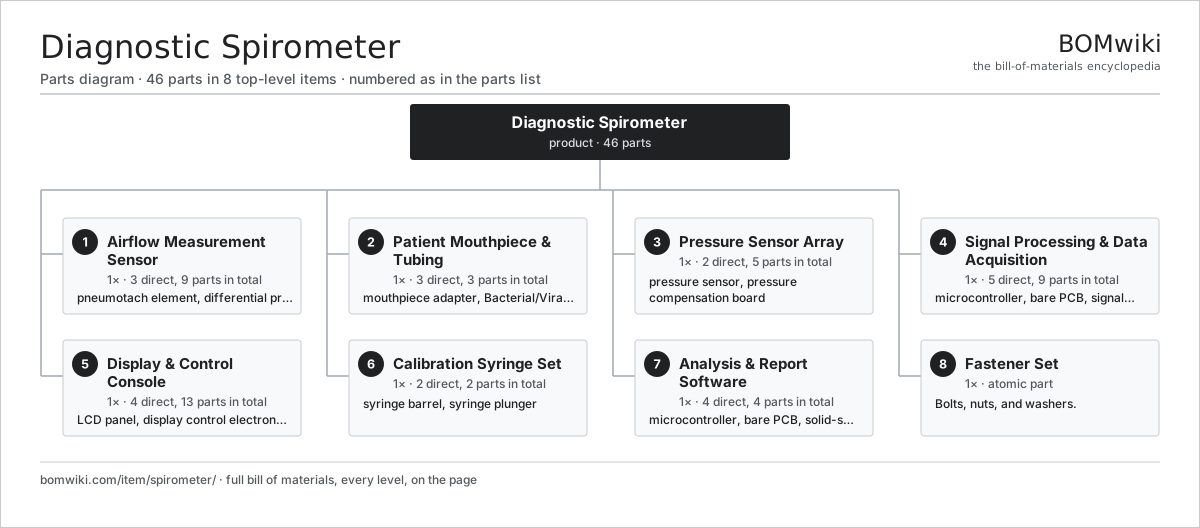
| # | Part | Qty | What it does |
|---|---|---|---|
| 1 | Airflow Measurement Sensor 3 parts | 1× | Pneumotach or turbine sensor quantifying inspiratory and expiratory volume and flow rate. |
| 2 | Patient Mouthpiece & Tubing 3 parts | 1× | Disposable or sterilizable plastic mouthpiece with bacterial filter. |
| 3 | Pressure Sensor Array 2 parts | 1× | Multiple transducers measuring static and dynamic pressures for calibration and compensation. |
| 4 | Signal Processing & Data Acquisition 5 parts | 1× | Microcontroller that samples sensors and integrates flow to calculate volumes. |
| 5 | Display & Control Console 4 parts | 1× | Screen showing real-time spirometry curves, FEV1, FVC, and FEF measurements. |
| 6 | Calibration Syringe Set 2 parts | 1× | Known-volume syringes (typically 3 L) for daily calibration verification. |
| 7 | Analysis & Report Software 4 parts | 1× | Desktop or cloud-based application computing pulmonary function indices and generating interpretive reports. |
| 8 | Fastener Set | 1× | Bolts, nuts, and washers. |
3D model
No 3D model yet. Have a CAD file of this? Add a 3D model. STL renders right on this page; STEP, FreeCAD, and OpenSCAD sources are welcome too (openly licensed, like all 3D models on BOMwiki).
Build & assembly graph
expand / collapse · shared sub-assemblies converge · links to related products · est. labourTap an assembly to expand/collapse · tap a part to open it · use “Open page” for any node · drag to pan, scroll to zoom.
Bill of materials for Diagnostic Spirometer
8 top-level lines · 50 rows shown · 46 parts total · indented to 3 levels| # | Item / sub-assembly | Part no. | Qty/assy | Ext. qty | Parts | Type |
|---|---|---|---|---|---|---|
| 1 | Airflow Measurement Sensor 3 parts | spirometer-flow-sensor | 1× | 1 | 9 | assembly |
| 1.1 | Pneumotach Element 4 parts | spirometer-pneumotach | 1× | 1 | 4 | assembly |
| 1.1.1 | Fine Mesh Screen | spirometer-mesh-element | 1× | 1 | · | part |
| 1.1.2 | Pneumotach Housing | spirometer-housing-body | 1× | 1 | · | part |
| 1.1.3 | Inlet Connection Port | spirometer-inlet-port | 1× | 1 | · | part |
| 1.1.4 | Outlet Connection Port | spirometer-outlet-port | 1× | 1 | · | part |
| 1.2 | Differential Pressure Transducer 4 parts | spirometer-differential-transducer | 1× | 1 | 4 | assembly |
| 1.2.1 | Pressure Sensor | pressure-sensor | 1× | 1 | · | part |
| 1.2.2 | Bare PCB | pcb-bare | 1× | 1 | · | part |
| 1.2.3 | SMD Passive (R/C/L) | smd-passives | 1× | 1 | · | part |
| 1.2.4 | Connector | connector | 1× | 1 | · | part |
| 1.3 | Disposable Screen Cartridge | spirometer-screen-cartridge | 1× | 1 | · | part |
| 2 | Patient Mouthpiece & Tubing 3 parts | spirometer-mouthpiece | 1× | 1 | 3 | assembly |
| 2.1 | Mouthpiece Adapter | spirometer-mouth-adapter | 1× | 1 | · | part |
| 2.2 | Bacterial/Viral Filter | spirometer-filter-cartridge | 1× | 1 | · | part |
| 2.3 | Flexible Connection Tubing | spirometer-connection-tubing | 1× | 1 | · | part |
| 3 | Pressure Sensor Array 2 parts | spirometer-pressure-transducers | 1× | 1 | 5 | assembly |
| 3.1 | Pressure Sensor | pressure-sensor | 2× | 2 | · | part |
| 3.2 | Pressure Compensation Board 3 parts | spirometer-compensation-board | 1× | 1 | 3 | assembly |
| 3.2.1 | Microcontroller | mcu | 1× | 1 | · | part |
| 3.2.2 | Bare PCB | pcb-bare | 1× | 1 | · | part |
| 3.2.3 | SMD Passive (R/C/L) | smd-passives | 1× | 1 | · | part |
| 4 | Signal Processing & Data Acquisition 5 parts | spirometer-processor-unit | 1× | 1 | 9 | assembly |
| 4.1 | Microcontroller | mcu | 1× | 1 | · | part |
| 4.2 | Bare PCB | pcb-bare | 1× | 1 | · | part |
| 4.3 | Signal Amplifier Board 2 parts | spirometer-amplifier-board | 1× | 1 | 2 | assembly |
| 4.3.1 | Bare PCB | pcb-bare | 1× | 1 | · | part |
| 4.3.2 | SMD Passive (R/C/L) | smd-passives | 1× | 1 | · | part |
| 4.4 | SMD Passive (R/C/L) | smd-passives | 1× | 1 | · | part |
| 4.5 | Connector | connector | 4× | 4 | · | part |
| 5 | Display & Control Console 4 parts | spirometer-display-console | 1× | 1 | 13 | assembly |
| 5.1 | LCD Panel | lcd-panel | 1× | 1 | · | part |
| 5.2 | Display Control Electronics 3 parts | spirometer-display-board | 1× | 1 | 3 | assembly |
| 5.2.1 | Microcontroller | mcu | 1× | 1 | · | part |
| 5.2.2 | Bare PCB | pcb-bare | 1× | 1 | · | part |
| 5.2.3 | SMD Passive (R/C/L) | smd-passives | 1× | 1 | · | part |
| 5.3 | Control Buttons 3 parts | spirometer-keypad | 1× | 1 | 6 | assembly |
| 5.3.1 | Bare PCB | pcb-bare | 1× | 1 | · | part |
| 5.3.2 | Pushbutton Switch | spirometer-button-switch | 4× | 4 | · | part |
| 5.3.3 | Connector | connector | 1× | 1 | · | part |
| 5.4 | Connector | connector | 3× | 3 | · | part |
| 6 | Calibration Syringe Set 2 parts | spirometer-calibration-syringes | 1× | 1 | 2 | assembly |
| 6.1 | Syringe Barrel | spirometer-syringe-barrel | 1× | 1 | · | part |
| 6.2 | Syringe Plunger | spirometer-syringe-plunger | 1× | 1 | · | part |
| 7 | Analysis & Report Software 4 parts | spirometer-software-analysis | 1× | 1 | 4 | assembly |
| 7.1 | Microcontroller | mcu | 1× | 1 | · | part |
| 7.2 | Bare PCB | pcb-bare | 1× | 1 | · | part |
| 7.3 | Solid-State Storage Drive | ssd-storage | 1× | 1 | · | part |
| 7.4 | Connector | connector | 1× | 1 | · | part |
| 8 | Fastener Set | fastener-set | 1× | 1 | · | part |
Something wrong in this list? Report a problem with this BOM.
Related products
same domain, ranked by shared parts Holter ECG Monitor
55 parts · shares 1 with this page
Holter ECG Monitor
55 parts · shares 1 with this page
 Blood Pressure Monitor
173 parts · shares 2 with this page
Blood Pressure Monitor
173 parts · shares 2 with this page
 CPAP Machine
259 parts · shares 2 with this page
CPAP Machine
259 parts · shares 2 with this page
 Dermatology Laser
58 parts · shares 2 with this page
Dermatology Laser
58 parts · shares 2 with this page
 ECMO Machine
142 parts · shares 2 with this page
Endoscope Washer-Disinfector
87 parts · shares 2 with this page
ECMO Machine
142 parts · shares 2 with this page
Endoscope Washer-Disinfector
87 parts · shares 2 with this page
Sourcing: possible vendors
Browse the supplier directory → Prices, MOQ, and lead times are algorithmic estimates, not quotes, and not claims about these companies. Company mappings are curated by keyword; est. price band $500–$3M. How estimates work| Vendor | HQ | Specialty | MOQ | Lead time |
|---|---|---|---|---|
| gehealthcare.com ↗ | Chicago, US | Medical imaging & devices | 100 units | 12–20 wks |
| siemens-healthineers.com ↗ | Erlangen, DE | Medical systems | 100 units | 12–20 wks |
|
🇳🇱Philips
philips.com ↗
|
Amsterdam, NL | Health technology | 100 units | 12–20 wks |
| medtronic.com ↗ | Minneapolis, US | Medical devices | 100 units | 12–20 wks |
|
🇨🇳Mindray
mindray.com ↗
|
Shenzhen, CN | Medical devices | 100 units | 12–20 wks |
809-word article