Staple Forming Machine
ProductOverview
Staple forming machines automate the production of metal staples from coiled wire by combining wire straightening, forming (bending wire into U-shaped geometry), cutting (trimming legs to length), adhesive bonding, optional clinching (curling legs for improved grip), and collation (assembling staples into strips). These machines achieve 3000–8000 staples per minute using rotary or reciprocating forming dies, synchronized cutting, and automated strip assembly. The machines transform bulk wire coils into finished staple packs ready for office stapler use, creating one of the most essential commodity fasteners worldwide.
How It Works
Wire Unwinding and Tension Control
The Wire Reel Feed system holds large coils of pre-drawn wire (0.8–1.2 mm diameter, 25–50 kg capacity) on a Wire Reel Spindle heavy-duty spindle. A Wire Feed Brake (magnetic or mechanical friction brake) controls unwinding speed, allowing steady feed without slack or over-tension. A Wire Tension Dancer weighted dancer lever monitors wire tension and adjusts dynamically, maintaining ±5% tension variance. An Encoder senses wire feed rate and signals the master PLC if speed drifts out of synchronization.
Wire Straightening
Fresh wire from coils retains residual curvature (coil memory). The Wire Straightening Unit unit removes this deformation using a multi-stage roller assembly. Four Straightening Roller (alternating above and below the wire path) press the wire with progressive force, flattening waves and coil curves. A Wire Guide Bushing precision bushing (±0.01 mm) centers the straightened wire for entry into the forming head.
Staple Forming
At the Staple Forming Dies station, straightened wire is bent into staple geometry. A Forming Head Arbor rotates at 200–600 rpm (for rotary dies) or reciprocates at 100–300 strokes per minute (for reciprocating dies). Two Forming Die Set (male and female, hardened tool steel) compress the wire simultaneously, bending it into the characteristic U-shape with controlled crown width (2–4 mm). The dies are designed with precision to produce legs at a slight angle (typically 5–10°), allowing staples to penetrate paper and then diverge for clinching.
Forming pressure is typically 5–20 bar, monitored by Pressure Sensor feedback. Over-pressure deforms the wire or breaks dies; under-pressure produces incomplete bends.
Synchronized Cutting
As each formed staple exits the dies, a Wire Cutter blade must fire at the precise moment to cut the legs to finished length (typically 10–15 mm per leg, yielding 20–28 mm overall length). A Cutter Drive Cylinder (pneumatic, 5–20 bar) drives the Cutting Shear Blade downward with 50–100 mm stroke at 1–5 Hz frequency. The blade meets a Cutting Anvil Block backing block, shearing the wire cleanly without burr.
Synchronization is critical: if the cutter fires too early (staple not fully formed), the wire is crimped; if too late, the leg is over-cut. An Encoder senses former position and triggers cutter solenoid with <10 millisecond latency.
Adhesive Bonding into Strips
After cutting, individual staples are positioned sequentially into a Strip Assembly Conveyor or work table that arranges them in linear order. A Adhesive Bonding Unit unit applies a controlled bead of hot-melt adhesive to the staple crown (0.1–0.5 mL per staple) via a solenoid-triggered Adhesive Nozzle Head. The adhesive bonds staples together into a strip, typically 100–210 staples per pack (105 is the standard office size).
The Hot-Melt Adhesive Tank maintains hot-melt adhesive at 50–100 °C for optimal viscosity. A Adhesive Pump (gear pump) meters adhesive through the nozzle. Temperature Sensor feedback controls heater output to prevent polymerization or degradation.
Optional Clinching
For premium staples or heavy-duty applications, an optional Optional Clinching Station station curls and crimps staple legs inward, creating a barbed edge that prevents staples from backing out under repeated use. A Clinching Head Arbor (rotating or reciprocating at 100–300 spm) houses Clinching Die Set with inward-curl profiles. As each staple passes through, the dies compress the legs, creating a permanent interlock.
Clinching is an optional feature; many commercial staples skip this step due to time cost and slightly reduced leg flexibility.
Strip Assembly and Collation
Adhesive-bonded staples (and optionally clinched) are conveyed to the Strip Assembly and Stacking station, where they are collected into completed strips. A Strip Table or conveyor assembles staples into the correct linear arrangement. Once a strip is complete (typically 100–210 staples), a Strip Ejector Pusher (pneumatic arm) ejects the strip from the template into a collection bin or directly into secondary packaging equipment.
Master Synchronization and Control
The Control and Synchronization PLC orchestrates all operations:
- Wire brake: Modulates unwinding speed based on Encoder feedback
- Straightening rollers: Continuous rolling action (no pulsing needed)
- Former head: Rotates or reciprocates at constant speed (200–600 rpm rotary, 100–300 spm reciprocating)
- Cutter solenoid: Triggered via Encoder sense of former position (within <10 ms accuracy)
- Adhesive pump: Activated at each staple position per strip convey
- Clinch motor (if present): Synchronized to accept finished staples at correct timing
- Strip conveyor and pusher: Cycled at strip-completion count
A Microcontroller high-speed PLC manages step/direction pulses to former and clinch motor drives; Relay outputs switch solenoids and pump motor contactor.
Engineering Considerations
Wire Coil Quality: Inconsistent wire diameter (>±0.05 mm) causes forming-die jamming or incomplete bends. Coil suppliers must maintain tight tolerance. Lubricant residue on coiled wire can interfere with straightening; wire may need degreasing before processing.
Forming Die Wear: Repeated impact and cyclic stress gradually dull dies, increasing forming pressure and causing incomplete bends. Dies typically last 500,000–2,000,000 staples; regular inspection and replacement are critical to avoid quality drift.
Cutting Blade Timing: Cutter and former must be synchronized to <10 milliseconds or staple length variance exceeds ±1 mm. Cam timing, mechanical backlash, and solenoid response time must be tightly controlled. Aging solenoids with slow response are a common cause of production issues.
Adhesive Temperature: Hot-melt adhesive viscosity doubles over a 30 °C range. If adhesive is too cool, it fails to wet the staple crown and doesn't bond; if too hot, it polymerizes in the pump and nozzle. Precise temperature control (±5 °C) is required.
Strip Collation Accuracy: Staple spacing in strips must be uniform (typically 2–3 mm spacing) to fit stapler feed slots. Conveyor speed and feeder timing must be precisely matched. Off-pitch staples jam in staplers and cause customer complaints.
Production Metrics
A machine producing 5000 staples/minute yields 3,000,000 staples per 10-hour shift. At 105 staples per strip, this equals approximately 28,500 strips/shift. Power consumption is 10–18 kW, with the adhesive heating system consuming 30% of total load. Wire material cost typically dominates; a 50 kg coil might produce 100,000–150,000 staples, making per-staple wire cost <0.1 cent. Changeover between wire gauges or staple lengths requires new coils and forming/cutting die adjustment (15–30 minutes).
Staple Forming Machine parts and their functions
8 top-level parts · 50 parts in total · full bill of materials below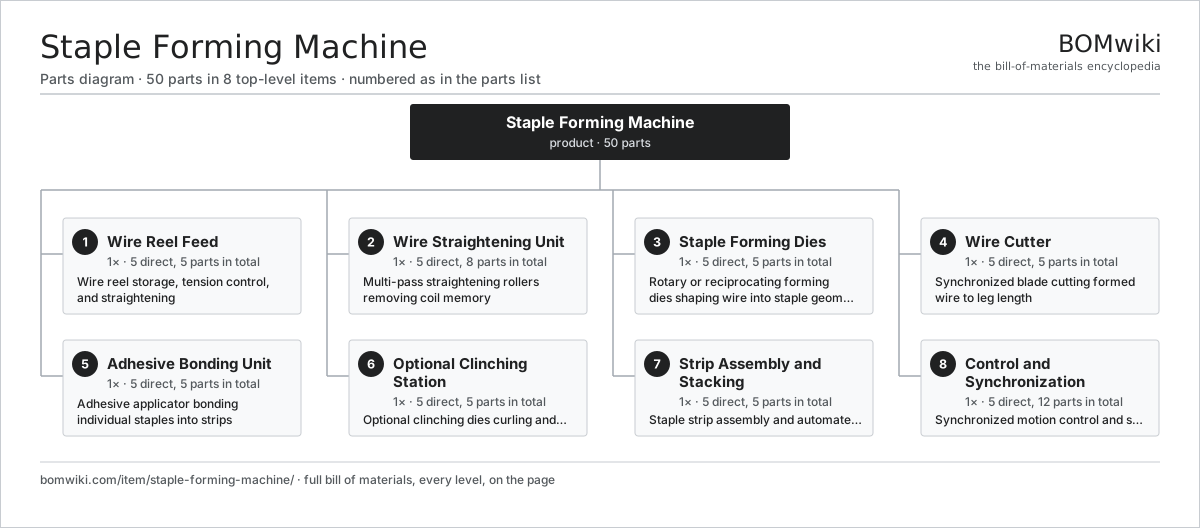
| # | Part | Qty | What it does |
|---|---|---|---|
| 1 | Wire Reel Feed 5 parts | 1× | Wire reel storage, tension control, and straightening |
| 2 | Wire Straightening Unit 5 parts | 1× | Multi-pass straightening rollers removing coil memory |
| 3 | Staple Forming Dies 5 parts | 1× | Rotary or reciprocating forming dies shaping wire into staple geometry |
| 4 | Wire Cutter 5 parts | 1× | Synchronized blade cutting formed wire to leg length |
| 5 | Adhesive Bonding Unit 5 parts | 1× | Adhesive applicator bonding individual staples into strips |
| 6 | Optional Clinching Station 5 parts | 1× | Optional clinching dies curling and crimping staple legs |
| 7 | Strip Assembly and Stacking 5 parts | 1× | Staple strip assembly and automated stacking |
| 8 | Control and Synchronization 5 parts | 1× | Synchronized motion control and speed regulation |
3D model
No 3D model yet. Have a CAD file of this? Add a 3D model. STL renders right on this page; STEP, FreeCAD, and OpenSCAD sources are welcome too (openly licensed, like all 3D models on BOMwiki).
Build & assembly graph
expand / collapse · shared sub-assemblies converge · links to related products · est. labourTap an assembly to expand/collapse · tap a part to open it · use “Open page” for any node · drag to pan, scroll to zoom.
Bill of materials for Staple Forming Machine
8 top-level lines · 48 rows shown · 50 parts total · indented to 3 levels| # | Item / sub-assembly | Part no. | Qty/assy | Ext. qty | Parts | Type |
|---|---|---|---|---|---|---|
| 1 | Wire Reel Feed 5 parts | staple-forming-machine-wire | 1× | 1 | 5 | assembly |
| 1.1 | Wire Reel Spindle | staple-forming-machine-reel-arbor | 1× | 1 | · | part |
| 1.2 | Wire Feed Brake | staple-forming-machine-brake | 1× | 1 | · | part |
| 1.3 | Wire Tension Dancer | staple-forming-machine-tension-arm | 1× | 1 | · | part |
| 1.4 | Encoder | encoder | 1× | 1 | · | part |
| 1.5 | Fastener Set | fastener-set | 1× | 1 | · | part |
| 2 | Wire Straightening Unit 5 parts | staple-forming-machine-straightener | 1× | 1 | 8 | assembly |
| 2.1 | Straightening Roller | staple-forming-machine-straighten-roller | 4× | 4 | · | part |
| 2.2 | Wire Guide Bushing | staple-forming-machine-guide-block | 1× | 1 | · | part |
| 2.3 | Encoder | encoder | 1× | 1 | · | part |
| 2.4 | Fastener Set | fastener-set | 1× | 1 | · | part |
| 2.5 | Pressure Sensor | pressure-sensor | 1× | 1 | · | part |
| 3 | Staple Forming Dies 5 parts | staple-forming-machine-former | 1× | 1 | 5 | assembly |
| 3.1 | Forming Head Arbor | staple-forming-machine-form-head | 1× | 1 | · | part |
| 3.2 | Forming Die Set | staple-forming-machine-form-dies | 1× | 1 | · | part |
| 3.3 | Forming Drive Motor | staple-forming-machine-form-motor | 1× | 1 | · | part |
| 3.4 | Encoder | encoder | 1× | 1 | · | part |
| 3.5 | Pressure Sensor | pressure-sensor | 1× | 1 | · | part |
| 4 | Wire Cutter 5 parts | staple-forming-machine-cutter | 1× | 1 | 5 | assembly |
| 4.1 | Cutting Shear Blade | staple-forming-machine-cut-blade | 1× | 1 | · | part |
| 4.2 | Cutter Drive Cylinder | staple-forming-machine-cut-cylinder | 1× | 1 | · | part |
| 4.3 | Cutting Anvil Block | staple-forming-machine-cut-anvil | 1× | 1 | · | part |
| 4.4 | Encoder | encoder | 1× | 1 | · | part |
| 4.5 | Pressure Sensor | pressure-sensor | 1× | 1 | · | part |
| 5 | Adhesive Bonding Unit 5 parts | staple-forming-machine-glue | 1× | 1 | 5 | assembly |
| 5.1 | Hot-Melt Adhesive Tank | staple-forming-machine-glue-tank | 1× | 1 | · | part |
| 5.2 | Adhesive Pump | staple-forming-machine-glue-pump | 1× | 1 | · | part |
| 5.3 | Adhesive Nozzle Head | staple-forming-machine-glue-nozzle | 1× | 1 | · | part |
| 5.4 | Temperature Sensor | temperature-sensor | 1× | 1 | · | part |
| 5.5 | Connector | connector | 1× | 1 | · | part |
| 6 | Optional Clinching Station 5 parts | staple-forming-machine-clinch | 1× | 1 | 5 | assembly |
| 6.1 | Clinching Head Arbor | staple-forming-machine-clinch-head | 1× | 1 | · | part |
| 6.2 | Clinching Die Set | staple-forming-machine-clinch-dies | 1× | 1 | · | part |
| 6.3 | Clinch Motor | staple-forming-machine-clinch-motor | 1× | 1 | · | part |
| 6.4 | Encoder | encoder | 1× | 1 | · | part |
| 6.5 | Pressure Sensor | pressure-sensor | 1× | 1 | · | part |
| 7 | Strip Assembly and Stacking 5 parts | staple-forming-machine-collate | 1× | 1 | 5 | assembly |
| 7.1 | Strip Assembly Conveyor | staple-forming-machine-strip-conveyor | 1× | 1 | · | part |
| 7.2 | Strip Table | staple-forming-machine-strip-table | 1× | 1 | · | part |
| 7.3 | Strip Ejector Pusher | staple-forming-machine-stack-pusher | 1× | 1 | · | part |
| 7.4 | Encoder | encoder | 1× | 1 | · | part |
| 7.5 | Blower Motor | blower-motor | 1× | 1 | · | part |
| 8 | Control and Synchronization 5 parts | staple-forming-machine-control | 1× | 1 | 12 | assembly |
| 8.1 | Microcontroller | mcu | 1× | 1 | · | part |
| 8.2 | Bare PCB | pcb-bare | 1× | 1 | · | part |
| 8.3 | Relay | relay | 6× | 6 | · | part |
| 8.4 | Power Supply | power-supply | 1× | 1 | · | part |
| 8.5 | Encoder | encoder | 3× | 3 | · | part |
Something wrong in this list? Report a problem with this BOM.
Sourcing: possible vendors
Browse the supplier directory → Prices, MOQ, and lead times are algorithmic estimates, not quotes, and not claims about these companies. Company mappings are curated by keyword; est. price band $10k–$1M. How estimates work| Vendor | HQ | Specialty | MOQ | Lead time |
|---|---|---|---|---|
|
🇩🇪DMG MORI
dmgmori.com ↗
|
Bielefeld, DE | Machine tools | 5 units | 12–20 wks |
|
🇯🇵Mazak
mazak.com ↗
|
Oguchi, JP | Machine tools | 5 units | 12–20 wks |
| haascnc.com ↗ | Oxnard, US | CNC machine tools | 5 units | 12–20 wks |
|
🇯🇵Okuma
okuma.com ↗
|
Niwa, JP | Machine tools | 5 units | 12–20 wks |
|
🇩🇪Trumpf
trumpf.com ↗
|
Ditzingen, DE | Laser & sheet-metal machines | 5 units | 12–20 wks |
1,193-word article